Rank tracking vs AI visibility: do you need both?
A rank tracker shows where your page sits; an AI visibility tool shows how often AI answers name or cite you. Here's which one you need, and when.

Short on time?
Short on time? Here's my take.
- You live on Google clicks
- Keep your rank tracker + Search Console
- Turn on AI Overview tracking inside the tracker. No second tool yet.
- You want to know if AI Overviews cite you
- A tracker that records AI Overview citations
- Pair it with Search Console's free generative AI report for impressions.
- Buyers ask ChatGPT about your category
- Add a prompt-based AI visibility tool
- Start with 25 to 50 prompts, not 500, and watch the share over weeks.
- One budget for both
- A tracker that bundles AI prompts
- SE Ranking Core and Nightwatch both include prompts on their plans.
- Reporting results to your boss
- Search Console + analytics
- Visibility numbers are context. Clicks and conversions are the results.
Prices verified . Tool capabilities from vendors' own pages, verified 13 Nov 2026. No vendor paid to be included, and sponsors can't buy a verdict.
Rank tracking tells you where your page sits in Google’s results for a keyword, place and device. AI visibility tells you how often AI answers (ChatGPT, Perplexity, Gemini, Google’s AI Overviews and AI Mode) mention or cite your brand across a set of questions, and because those answers change every time, it’s a share, not a position.
The two overlap in one place, Google’s own AI features, and Google now gives you a free report on that overlap. Below I separate the two numbers, show what each can and can’t prove, and name a pick for your situation.
What does each one measure? #
A rank tracker records your position on a list of search results. An AI visibility tool counts how often you appear in answers that are generated fresh each time someone asks.
That difference shapes everything else: what triggers a check, where the data comes from and what the number can’t tell you. Here’s the full picture, including the two free Google sources most guides skip.
| Source | What it counts | What triggers it | Where the data comes from | How often | What it can't prove |
|---|---|---|---|---|---|
| Rank tracker | Your URL's position per keyword, engine, device and place | A keyword search | The tracker's own result checks | Daily | Clicks, traffic or revenue |
| AI Overview / AI Mode data in a tracker | Whether an AI Overview shows, whether your URL is cited, and where | A keyword search | The tracker's captured results page | Daily | That a person saw or clicked it |
| Prompt-based AI visibility tool | Share of answers that name or cite you, plus sentiment | A prompt (a question) | Repeated runs on ChatGPT, Perplexity, Gemini, AI Overviews, AI Mode | Daily or weekly | Your share of the whole market, or traffic |
| Search Console generative AI report | Impressions of your links in AI Overviews and AI Mode, combined | Real Google searches | Google's own logs | Daily | Clicks, positions, queries, or which AI feature |
| Search Console Performance report | Clicks, impressions, CTR, average position (AI features included under Web) | Real Google searches | Google's own logs | Daily | Revenue, or brand mentions without a link |
| Your analytics | Visits and conversions, incl. visits referred by AI assistants | A visit to your site | Your site | Real time | That an answer named you |
Source: Google Search Console help, AccuRanker, Nightwatch, SE Ranking and Peec docs, all verified 13 Nov 2026. Scroll sideways for more columns.
Trackers check on a fixed schedule. AccuRanker updates keywords automatically every 24 hours, and Nightwatch’s plans say “Tracked daily” (Nightwatch pricing, verified 13 Nov 2026).
The AI side has its own vocabulary. These four terms cover most dashboards:
- Mention: the answer names your brand, with or without a link. Peec’s version is a plain ratio: “The Visibility Score measures the percentage of AI responses that mention your brand” (Peec docs).
- Citation: the answer links to one of your pages as a source. It’s the only kind of AI appearance Google’s own report counts, because that report counts links.
- Share of voice: your mentions compared with competitors’ mentions across the same prompts. Tools count it differently; see where AI share of voice misleads.
- Sentiment: whether the answer describes you favorably or not, scored by the tool. The scales differ from tool to tool.
Why can’t you rank in ChatGPT? #
Because the same prompt rarely returns the same list twice, there’s no stable position to record. What holds steadier is how often a brand shows up across many runs.
SparkToro and Gumshoe.ai collected 2,961 runs in November and December 2025: 12 prompts, 60 to 100 runs each, on ChatGPT, Claude and Google’s AI Overviews (falling back to AI Mode). As Search Engine Journal reported on 30 January 2026, the tools returned the same list of brands less than once in 100 runs, and the same list in the same order less than once in 1,000.
The same report says a brand’s visibility percentage across many runs was more consistent than its ranking position. Rand Fishkin’s conclusion, as SEJ quotes it: “any tool that gives a ‘ranking position in AI’ is full of baloney.”
Two caveats. Gumshoe sells AI tracking, which the study disclosed, and the research isn’t peer-reviewed. SparkToro’s own page blocked my research tools, so every figure here comes via SEJ.
Ahrefs, which sells its own AI tracker, makes the same point: “Think of AI tracking less like rank tracking and more like polling” (Ahrefs, Sep 2025). I agree, and it’s why I’d read any “AI rank” as an average across runs at best. OpenAI’s free Business Hub now counts ChatGPT mentions and clicks for businesses that claim a listing, but gives no individual prompts (what ChatGPT Business Hub shows).
Does ranking well still get you cited? #
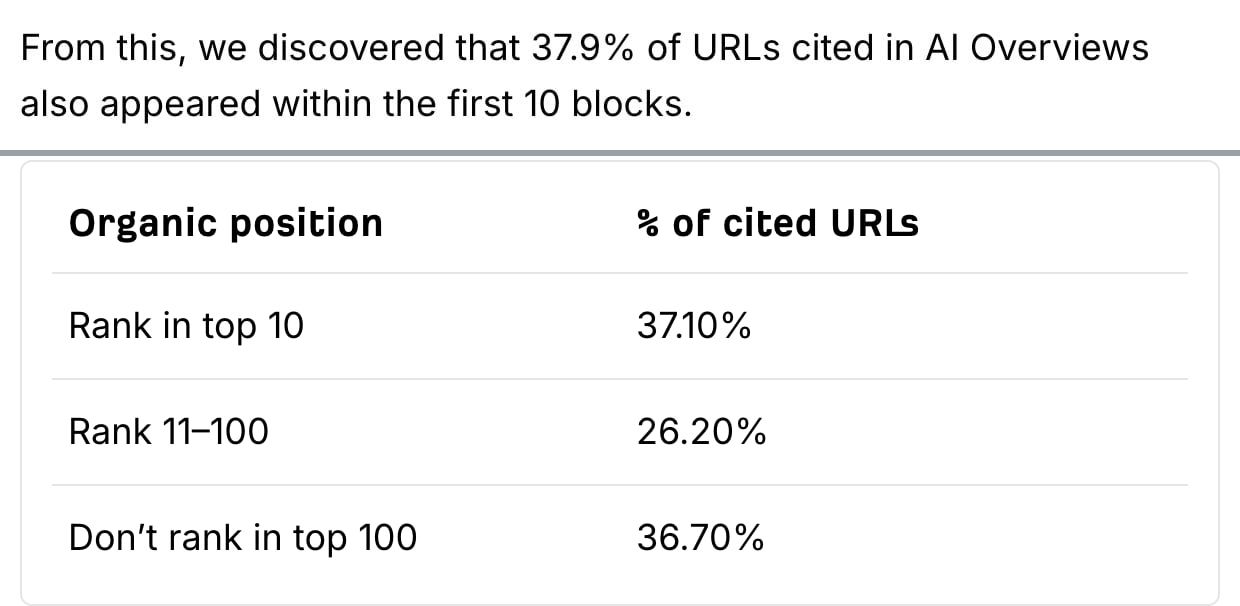
Not reliably. In Ahrefs’ March 2026 study, 37.9% of URLs cited in AI Overviews also appeared in the first 10 blocks of the results page for the same search; the rest sat further down or outside the top 100.
Ahrefs matched about 4 million AI Overview URLs against 863,000 keyword results pages (Ahrefs, 2 Mar 2026). Its “first 10 blocks” include ads, featured snippets and People Also Ask, not just blue links. Counting blue links only, the split was 37.10% in the top 10, 26.20% in positions 11 to 100 and 36.70% beyond.
You’ll see that compared with 76%. That figure is from Ahrefs’ July 2025 study, which looked at the top three citations per answer with an older parser; Ahrefs says it has since improved its parsing, so the two aren’t directly comparable. So I wouldn’t read it as citations from the top 10 halving in a year.
BrightEdge, which also sells search software, measured overlap another way. Its 18 September 2025 analysis of nine industries (May 2024 to September 2025, its own parser, sample size not given) found AI Overview citations overlapping with organic rankings rose from 32.3% to 54.5%, yet “Only 16.7% of citations come from top 10 results” (BrightEdge).
Clicks have shifted too. Ahrefs’ February 2026 study of 300,000 keywords, using aggregated Search Console desktop data, found position-1 click-through on keywords with an AI Overview fell from 0.073 in December 2023 to 0.016 in December 2025, against 0.076 to 0.039 for keywords without one (Ahrefs, 4 Feb 2026). Against its forecast of 0.037 without AI Overviews, Ahrefs calls that “58% lower”; it’s a correlation, not proof of cause. For how ChatGPT’s referral traffic compares with Google’s, see whether ChatGPT is really a fifth of Google.
Being cited seems to help. Seer Interactive’s April 2026 study (53 brands, 2.43 billion organic impressions, January 2025 to February 2026) found brands cited in an AI Overview averaged 2.07% organic click-through in 2025, against 0.94% when not cited: roughly 120% more clicks per impression (Seer, Apr 2026).
Seer’s earlier update is candid about the limit: “We cannot definitively prove that citation causes higher CTRs” (Seer, Nov 2025). My read is that ranking and being cited are related but separate outcomes, so if AI Overviews show up for your keywords, you want to see both.
Where do the two overlap? #
In AI Overviews and AI Mode. Both appear in response to a Google search, so rank trackers can capture them per keyword; answers in ChatGPT, Perplexity and Gemini start from a prompt and need a prompt-based tool. They mostly cite different pages; AI Mode vs AI Overviews covers which to track first.
The trackers I read all record this now. SE Ranking says you can “Track AI Overview presence and see where your website ranks within it”, see which URLs are used as sources, and “Review cached copies of search results with AI-generated answers” (SE Ranking).
AccuRanker “tracks how many of your keywords trigger an AIO, how many URLs contribute, and whether yours is one of them” (AccuRanker). That last part is the question most bosses are really asking. For the market-wide figure, how often AI Overviews actually appear lines up the panel and vendor numbers.
Some trackers now cross into prompts. Nightwatch lists ChatGPT, Gemini, Perplexity, AI Mode and AI Overview on every plan, with 50, 150 or 500 prompts (Nightwatch pricing), and SE Ranking’s Core plan includes 25 prompts tracked daily on 5 AI engines (SE Ranking plans), both verified 13 Nov 2026.
The unit is the real difference. Trackers sell keywords; prompt tools sell prompts × engines × runs. Peec counts answers as “tracked prompts × active models × tracking frequency” (Peec pricing), and on Otterly one credit is one prompt checked once on one engine (Otterly pricing), both verified 13 Nov 2026.
| Kind of tool | The question it answers | Examples I read | What you pay for |
|---|---|---|---|
| Classic rank tracker | Where do my pages rank, by keyword, place and device? | AccuRanker, Nightwatch | Keywords |
| Rank tracker with AI Overview data | Does this keyword trigger an AI Overview, and am I cited? | SE Ranking, AccuRanker | Keywords |
| Rank tracker that bundles prompts | All of the above, plus a small prompt set in chat engines | Nightwatch, SE Ranking Core | Keywords plus prompts |
| Prompt-based AI visibility tool | How often do AI answers mention or cite me, against competitors? | Peec, Otterly | Prompts × engines × runs |
| Google Search Console | How often were my links shown in AI Overviews and AI Mode, and what got clicked? | Nothing (free) |
Source: Vendor product and pricing pages and Search Console help, verified 13 Nov 2026. Examples are evidence of each category, not a ranking. Scroll sideways for more columns.
I rank the trackers that record AI Overviews in rank trackers for AI Overviews, and compare two of them in Nightwatch vs AccuRanker. Prompt tools live in the AI visibility hub.
What does Google show you for free? #
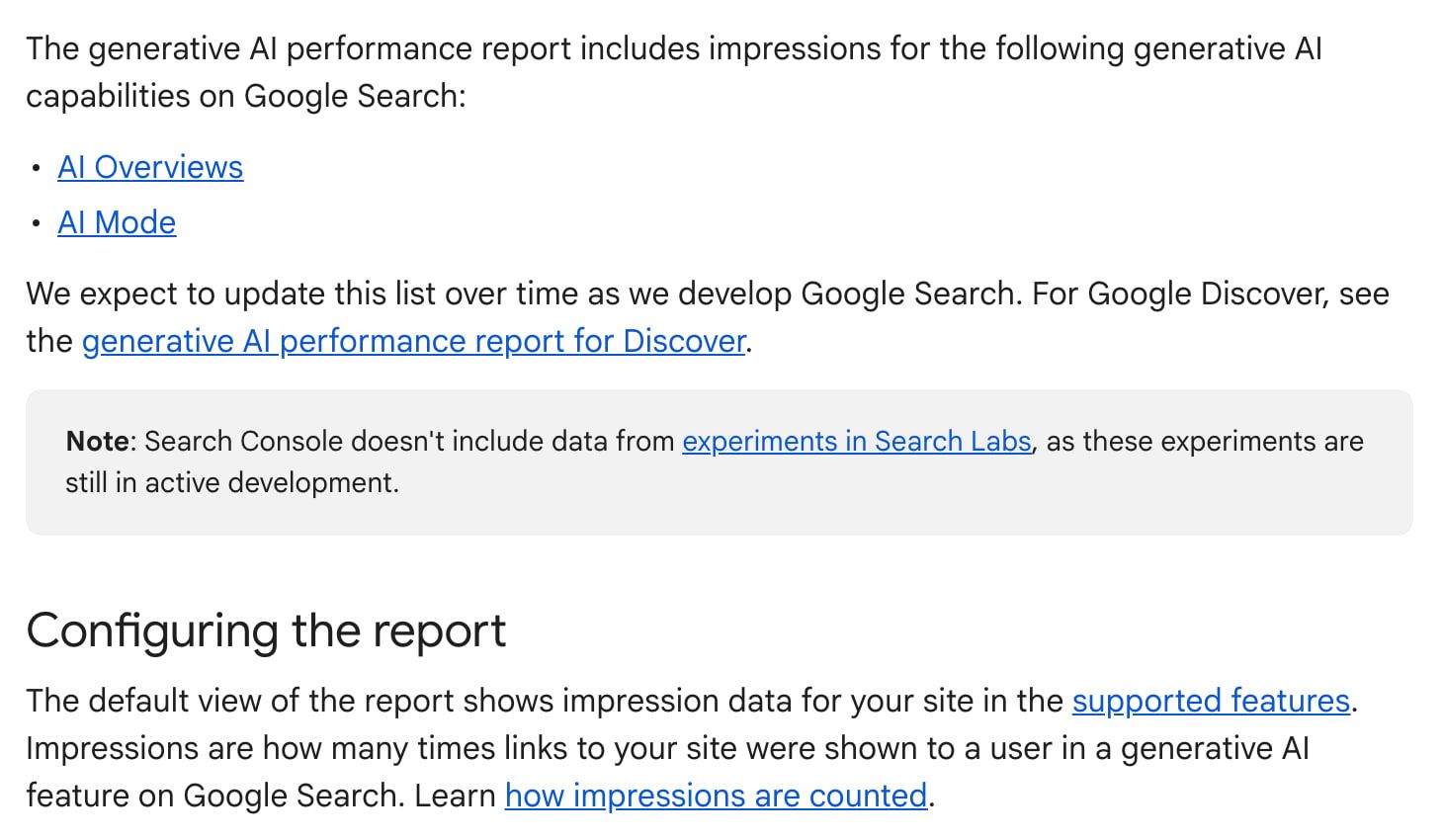
Search Console’s generative AI performance report shows how often links to your site appeared in AI Overviews and AI Mode, by page, country, device and date. It counts impressions only: no clicks, positions or queries. For how it counts and which dates to skip, see what Search Console’s AI report shows, and what it misses.
Google announced it on 3 June 2026 for a subset of sites, and its help page now says: “As of August 31, 2026, we’ve rolled out these insights to all websites worldwide.” Impressions are “how many times links to your site were shown to a user in a generative AI feature on Google Search.”
The two features are combined, so you can’t split AI Overviews from AI Mode. If the report is missing, Google says “This usually happens when your site hasn’t received enough impressions in generative AI features”, without naming a threshold. (The June post also covers Discover, which gets a separate report.)
Read early November with care. Google logged an error that lowered impressions in this report from 9 to 11 November 2026, adding that “This issue affects data logging only” (Search Console data anomalies).
Clicks haven’t disappeared. They sit in the main Performance report under the Web search type (AI features guide), where “Clicking a link to an external page in the AI Overview counts as a click” and every link in an AI Overview shares one position (metric definitions). From 3 December, the UK’s CMA wants Google to show AI clicks separately; I explain what that covers in will Search Console finally show AI Overview clicks? How that shared position plays out when Google moves the overview is in Google’s AI Overview citation tests.
There’s also an off switch. The Search generative AI control in Settings excludes your site from AI Overviews, AI Mode and Discover’s AI features, and Google says it “isn’t used as a ranking or inclusion signal affecting other parts of Search.” One site published what that switch cost it: should you opt out of AI Overviews?
You don’t need to buy anything to qualify, either. Google’s AI features guide says: “You don’t need to create new machine readable files, AI text files, or markup to appear in these features.” A page only has to be indexed and eligible to show in Search with a snippet.
What can neither number prove? #
Traffic, revenue, or that a real person saw you. Clicks and conversions come from Search Console and your analytics; tracker positions and AI visibility shares only describe the checks you set up.
Here’s a hypothetical to show the trap. If a tool finds your brand in 10 of 50 monitored answers, your rate is 20% of that prompt set, not 20% of the market. Change the prompts next month and the two numbers stop being comparable.
Search Console misses mentions that don’t link to you, because its AI report counts links. Asked whether analytics fills the gap, Searchable’s FAQ answers “Only partly: Analytics shows visits that arrive from AI assistants”. A visit tells you someone came, not what the answer said.
A crawler requesting your page isn’t a citation, and a citation isn’t a visit. I’d keep those three records apart in any report, and I wouldn’t credit a revenue change to AI visibility without a click path to back it. If you’d rather keep your pages out of AI training, see the new AI training opt-out.
Is rank tracking still worth paying for? #
Yes, if Google clicks pay your bills. A tracker is the daily read on positions for the keywords, places and devices you choose, and the three I read (SE Ranking, AccuRanker, Nightwatch) now log AI Overviews too.
Search Console gives you real clicks, but its position is an average across searchers, and it shows nothing for keywords where you don’t appear yet. Koozai calls rank tracking “a general guide rather than a definitive metric” (Koozai, Feb 2025), and I agree: act on it daily, check it against clicks weekly.
Drop it only if you follow a handful of keywords that Search Console already covers. For the trackers themselves, start at the rank trackers hub; for what a bundled plan costs, see SE Ranking pricing.
What do other guides get wrong? #
Mostly they’ve aged. These are claims I found on ranking pages that no longer match the primary sources.
Stale claims you'll still find
- An “AI rank position” you can track. The same brand list came back less than once in 100 runs in SparkToro and Gumshoe’s study (via SEJ).
- “SGE monitoring.” Google launched AI Overviews (formerly a Search Labs experiment) on 14 May 2024.
- “AI Overviews cut clicks by about a third.” That’s Ahrefs’ 2025 figure. Its February 2026 study, a different study over two years, puts it at 58% at position 1.
- “AI trackers cap you at 50 to 100 queries.” Nightwatch sells 50, 150 or 500 prompts and Peec 50 to 350 (Peec pricing, verified 13 Nov 2026).
- “76% of AI Overview citations rank in the top 10.” Ahrefs’ newer study, with improved parsing, puts it near 38%, so the two aren’t directly comparable.
- “Search Console can’t show AI separately.” The generative AI report has covered every site since 31 August 2026, though mentions without a link still don’t show.
- “You need llms.txt or AI schema.” Google says no AI text files or markup are needed (what the llms.txt evidence shows).
So do you need both? #
Most teams don’t need two subscriptions yet. Keep your rank tracker and Search Console, turn on the tracker’s AI Overview data, and add a prompt-based tool once buyers research your category in AI chat.
| Your situation | My pick | Why |
|---|---|---|
| Local service business | Rank tracker + Search Console, AI Overview tracking on | Your money comes from local Google clicks, and a tracker checks positions by place |
| Ecommerce store | Rank tracker + Search Console | Sales follow clicks, which both measure; AI Overview data shows which product keywords trigger one |
| B2B SaaS | Rank tracker + a prompt-based tool with 25–50 prompts | If buyers ask ChatGPT or Perplexity for a shortlist, only a prompt tool sees those answers |
| Agency reporting to clients | Tracker with AI Overview data + a prompt set per client | Ranking and citation are separate outcomes (37.9% top-10 overlap in Ahrefs' data), so clients need both views |
| One budget for both | A tracker that bundles prompts | Nightwatch includes 50–500 prompts and SE Ranking Core 25 a day, before a second bill |
| Reporting to executives | Search Console + analytics, visibility as context | Neither visibility number shows clicks or revenue |
| A handful of keywords, no budget | Search Console alone | It's free and now includes AI Overview and AI Mode impressions |
Source: My picks, based on Google's Search Console help, Ahrefs' Mar 2026 study and vendor pages, verified 13 Nov 2026. Scroll sideways for more columns.
For trackers that record AI Overviews, see rank trackers for AI Overviews. If you’re adding prompts, how many prompts to track helps you size the set, the AI visibility hub compares the tools, and Peec AI pricing and Otterly AI pricing show what a prompt set costs.
My one rule: measure what pays you. Positions and clicks if Google sends your customers, a share of AI answers if buyers build shortlists in chat, and Search Console’s free report either way.
FAQ
Is rank tracking dead?
No. If Google clicks pay your bills, a rank tracker is still the daily read on positions for the keywords, places and devices you choose, and SE Ranking, AccuRanker and Nightwatch now record AI Overviews too. You can skip it only if Search Console already covers your handful of keywords.
Can Search Console show AI Overview traffic?
Partly. Since 31 August 2026 every site has a generative AI performance report that shows impressions of your links in AI Overviews and AI Mode combined, by page, country, device and date. It has no clicks, positions or queries. Clicks from those features are counted in the main Performance report under the Web search type, alongside your other clicks.
Does ranking number one mean AI Overviews will cite me?
No. Ahrefs' March 2026 study found 37.9% of URLs cited in AI Overviews also appeared in the first 10 blocks of the results page, and BrightEdge reported in September 2025 that only 16.7% of citations came from top-10 results. Both are vendor research, but they agree that ranking and being cited are separate outcomes.
Can a rank tracker track ChatGPT?
Some now bundle it. Nightwatch lists ChatGPT, Gemini, Perplexity, AI Mode and AI Overview on every plan with 50, 150 or 500 prompts, and SE Ranking's Core plan includes 25 prompts tracked daily on 5 AI engines (both verified 13 Nov 2026). What you get for ChatGPT is a share of answers that mention you, not a ranking.
Is a ranking position in ChatGPT a real metric?
Not a stable one. In SparkToro and Gumshoe's study of 2,961 runs, reported by Search Engine Journal, AI tools returned the same brand list less than once in 100 runs and the same order less than once in 1,000. How often a brand appeared was steadier, so a share across many runs is the number to watch.
Do I need special schema or an llms.txt file for AI Overviews?
No. Google's guide says 'You don't need to create new machine readable files, AI text files, or markup to appear in these features.' A page has to be indexed and eligible to show in Google Search with a snippet.
Sources
25 sources, accessed .
Official pricing, docs, changelogs and status pages 15
- Google Search Central: AI features and your website
- Google Search Central blog: generative AI performance reports (3 Jun 2026)
- Search Console help: Generative AI performance report (Search)
- Search Console help: data anomalies, incl. the 9–11 Nov 2026 logging error
- Search Console help: how clicks, impressions and position are counted
- Search Console help: Search generative AI control
- Google: AI Overviews launch post (14 May 2024)
- SE Ranking: AI Overview tracker
- SE Ranking: plans, incl. AI prompts on Core
- Nightwatch: pricing, daily tracking and AI platforms
- AccuRanker: SERP analysis and AI Overview tracking
- AccuRanker help: automatic keyword updates
- Peec AI docs: visibility score
- Peec AI: pricing and answer formula
- Otterly AI: pricing and credit rule
Other blogs 9
- Ahrefs (vendor research): AI Overview citations vs the top 10, Mar 2026
- Ahrefs (vendor research): rankings and AI citations, Jul 2025
- Ahrefs (vendor research): AI Overviews and click-through, Feb 2026
- BrightEdge (vendor research): rank overlap after 16 months of AI Overviews, Sep 2025
- Seer Interactive (agency research): AI Overviews and CTR, Apr 2026
- Seer Interactive (agency research): AI Overviews and CTR, Nov 2025
- Ahrefs (sells an AI tracker): you can't track AI like traditional search
- Searchable (sells an AI tracker): AI visibility tracking
- Koozai (agency): why rank tracking is losing its place, Feb 2025
Last updated: 13 November 2026. Facts verified 13 Nov 2026. Researched and drafted with AI tools; owner review is pending.


