Google keeps testing AI Overview citations. Does it matter?
SEOs spotted six AI Overview tests in two weeks. Do they change your citations? What Search Console counts, and which trackers record it.

Short on time?
Short on time? Here's what I would do.
- You report AI Overview citations to clients
- SE Ranking
- My roundup's overall pick (Core, $129 a month, verified 13 Nov 2026). It records where you sit in the overview and keeps cached copies, so you can see which layout a client saw.
- You need citation order at scale
- Advanced Web Ranking
- It numbers side sources first, so a layout test can reorder you without any real change.
- Already on Semrush
- Keep it for cited yes or no
- It records any citation as #1, so ignore 'position' inside the overview.
- No tracker budget
- Search Console plus a monthly hand check
- The Generative AI report is free but counts impressions only. Screenshot your brand searches once a month.
Prices verified . Google pages and tracker docs read 16 Nov 2026; tracker plans from my 13 Nov 2026 roundup. No vendor paid to be included, and sponsors can't buy a verdict.
In two weeks, SEOs reported six tests that move, hide or reshape the sources in Google’s AI Overviews. None of the reports includes a Google comment.
Here’s what was seen, whether it changes who gets cited, and what Search Console and your tracker can and can’t show. For the wider category, see my AI visibility hub.
What has Google been testing? #
Six changes were reported between 29 October and 11 November 2026, all by Search Engine Roundtable and most from a single spotter. None includes a Google comment, and SER says it reproduced only one.
| Date | What was seen | Spotted by | Reproduced by SER? |
|---|---|---|---|
| 29 Oct | Citation cards possibly dropped (desktop) | Brodie Clark | No: 'I cannot replicate this' |
| 29 Oct | Query refinement bubbles at the top that open AI Mode | Gagan Ghotra | Not stated |
| 2 Nov | Brand searches show an AI Overview in the right column instead of a Knowledge Panel | Chris Long and others | Not stated (screenshots only) |
| 10 Nov | Local pack AI Overview loses action buttons, reviews and photos | Joy Hawkins | Yes: 'I can replicate it' |
| 11 Nov | Definition AI Overviews fully expanded by default | Glenn Gabe | Not stated |
| 11 Nov | Source icons moved to the bottom; hovering shows the full list | Brodie Clark | Not stated |
Source: Search Engine Roundtable reports by Barry Schwartz, 29 Oct to 11 Nov 2026, and its 30 Oct and 13 Nov recaps. Google comment: none on any. Read 16 Nov 2026. Scroll sideways for more columns.
The one that touches citations most directly is the citation-card test. Clark saw cards drop “consistently across a lot of test queries”, but Schwartz couldn’t reproduce it, thought it might be a bug, and got no reply when he asked Google’s Rajan Patel whether it was a bug or a test.
The right-column change got the most attention. Chris Long’s words, via SER: “Instead of a Knowledge Panel, they’re showing AI Overviews for brand terms in the right column.” SER wrote that Google “has moved” them and posted screenshots for Apple, Zillow, Coke and Google, but didn’t say whether it reproduced the change.
The newest moves the sources. SER reported Google testing “moving the citations or sources icons to the very bottom of the AI Overviews” (SER). In his public notes, Clark logged the count of referenced sites sitting “at the bottom of the response”, where an earlier version of the test put it “at the top of the AI overview (directly above the citations)”.
The only reproduced test is the local pack one, and Hawkins hopes it “reverts soon”. Google’s Robby Stein said back in August, as SER quotes him: “We’re always testing and tuning these experiences.”
Do these tests change who gets cited? #
Not that I could find. The tests move where links sit; which sites are cited already changes often, with 45.5% of cited URLs new between consecutive checks in Ahrefs’ 2025 data.
That figure comes from Ahrefs’ study of 43,000+ keywords over one month, published 11 November 2025. It put the average AI Overview’s persistence at 2.15 days, and only 54.5% of URLs carried over between consecutive responses. Ahrefs says the real rate of change is likely higher, because its checks weren’t daily.
Ranking well doesn’t settle it either. In Ahrefs’ March 2026 study of 863,000 results pages, “37.9% of URLs cited in AI Overviews also appeared within the first 10 blocks”. SEJ notes that BrightEdge measured about 17% with a different method. Treat both Ahrefs figures as vendor studies: both run on data from Brand Radar, which Ahrefs sells.
Google’s own explanation is query fan-out: AI Overviews may search across subtopics, which can surface “a wider and more diverse set of helpful links”. Google says there are “no additional requirements” to appear. With that much normal churn, I wouldn’t blame a layout test for this week’s citation numbers. If a citation really did vanish, what to check before you edit anything sets the order. What Google has documented about source selection, and what six studies add, is in how AI Overviews pick the pages they cite.
What does Search Console count? #
An AI Overview is one position, and every link in it shares that position. The Generative AI report shows impressions only, for AI Overviews and AI Mode together.
Google’s words: “An AI Overview occupies a single position in search results, and all links in the AI Overview are assigned that same position” (Search Console help). Positions are counted “from top to bottom on the primary side of the page, then top to bottom on the secondary side”.
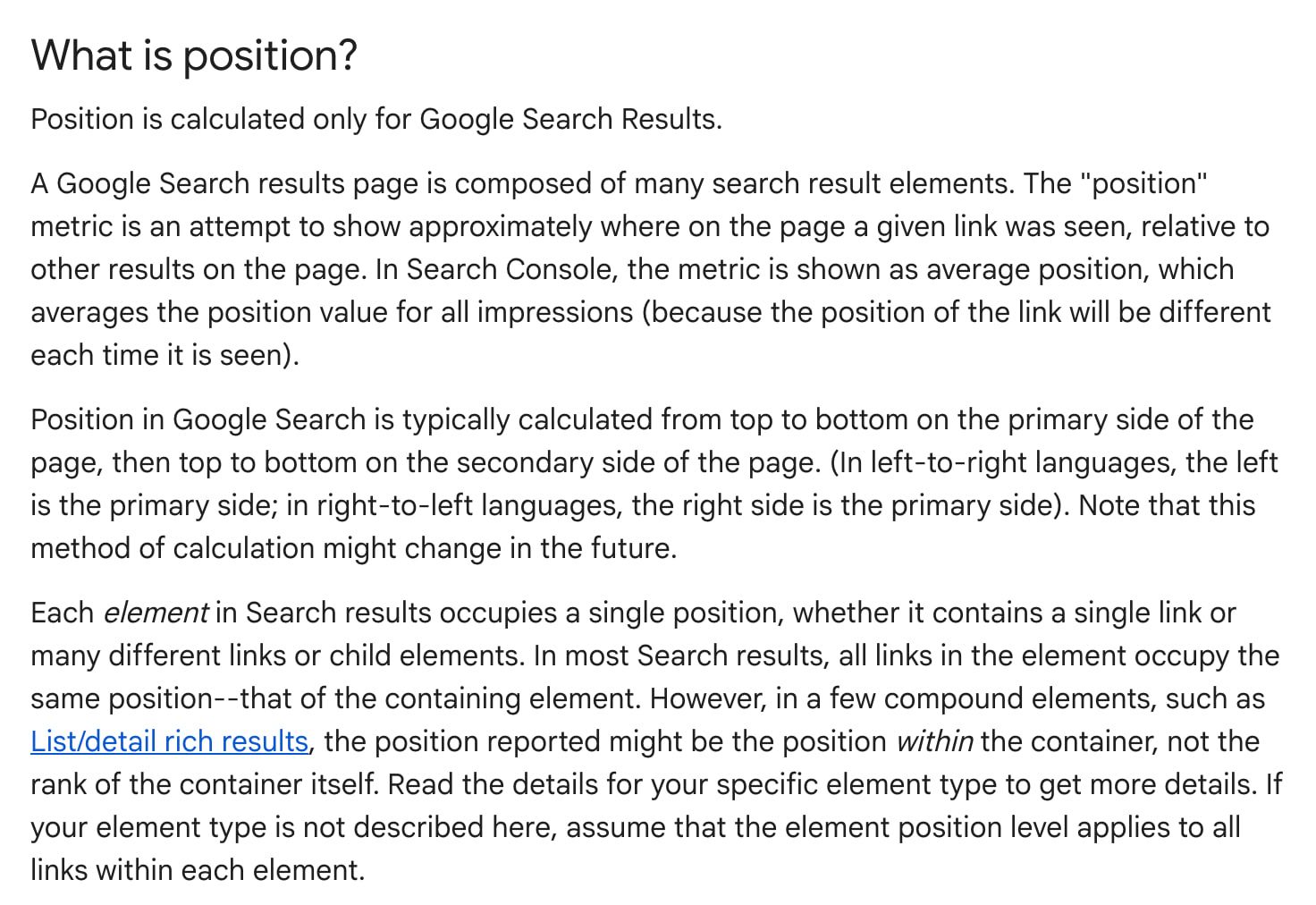
Here’s my inference, not something any source shows: if a brand AI Overview moves into the right column, Google’s rules would count it after the main column. The same citation could then report a lower position than it did at the top of the page. If a client’s brand query suddenly reports a worse position with steady clicks, check the layout before anything else.
The Generative AI report adds little here. It has rolled out to all sites “As of August 31, 2026”, breaks impressions down by pages, countries, dates and devices, and charts them per property. It doesn’t show where in the overview you appeared. Whether it will ever add clicks is a separate question, covered in my post on Search Console and AI Overview clicks. For how it counts impressions and when its data dipped, see how to read Search Console’s AI Overviews report.
What does your tracker actually record? #
Some only say you’re cited. A few record where you sit inside the overview, and a layout test can shuffle that order without any real change in who’s cited.
| Tool | Flags the AI Overview? | Records your citation? | Where inside the overview? | Keeps a copy? |
|---|---|---|---|---|
| Search Console Generative AI report | Impressions only | Per page | No: one shared position | No |
| Semrush Position Tracking | Yes | Yes, as a #1 ranking | Not stated | Not stated |
| Advanced Web Ranking | Not stated in the help doc | Yes | Yes: order of appearance, side sources first | Not stated |
| Nightwatch | Yes, daily | Yes: cited URL and status | Not mentioned | Not mentioned |
| SE Ranking | Yes | Yes | Yes: where you rank within it | Yes: cached copies |
Source: Google Search Console help, Semrush knowledge base, Advanced Web Ranking help (dated 16 Nov 2026), Nightwatch and SE Ranking product pages, read 16 Nov 2026. Scroll sideways for more columns.
Semrush shows keywords that “triggered an AI Overview” and where your domain “appears as a source”, and records a citation as “a #1 ranking”. Nightwatch promises “Cited URL, ranking URL, and citation status”, daily, split by desktop and mobile. Neither documents a position inside the overview.
Advanced Web Ranking “assigns each URL a position based on this order of appearance”: sources in the sidebar on the right of the AI Overview box first, then those in the text. So a test that moves source icons could renumber you overnight (my inference from that rule).
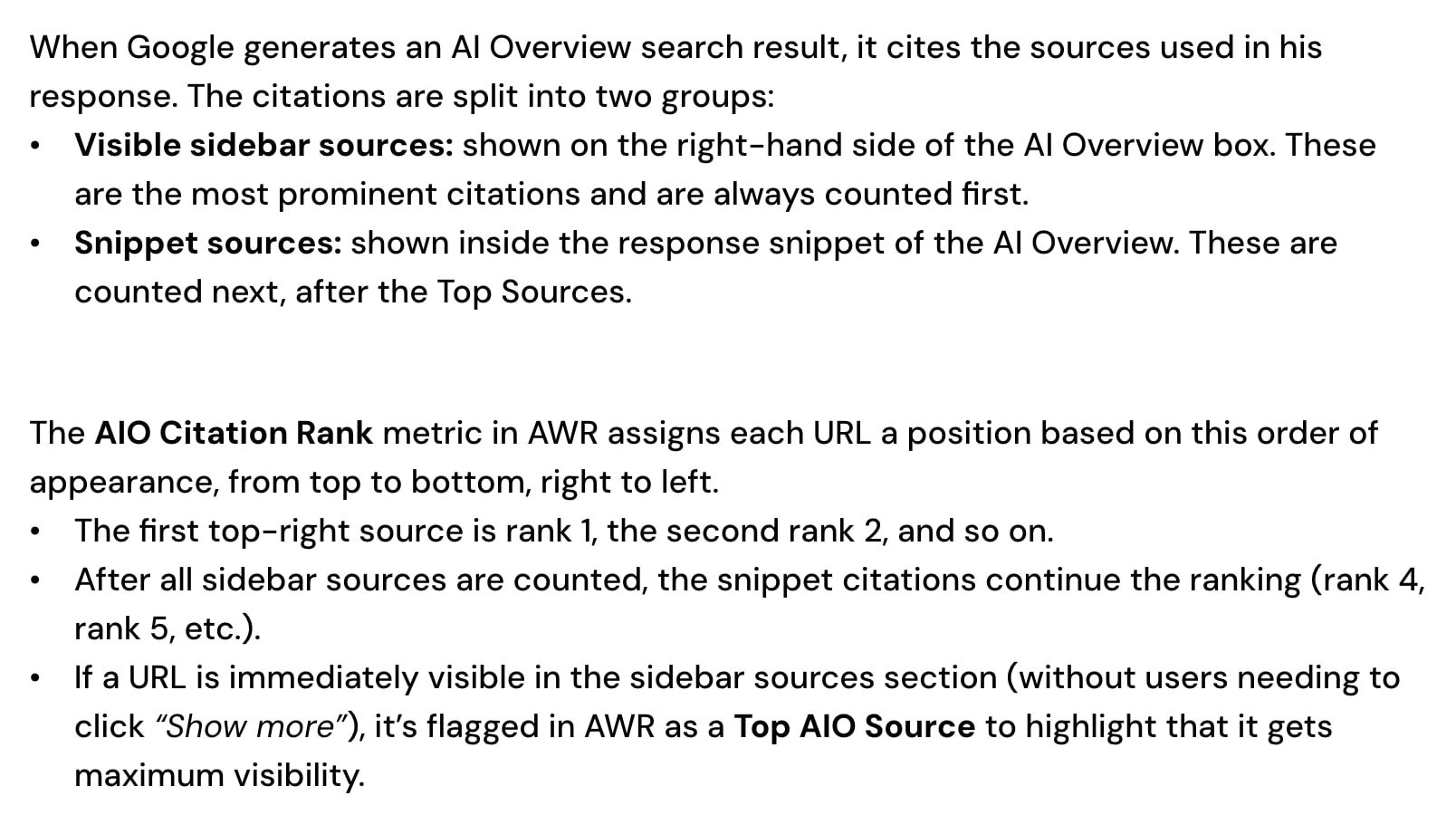
SE Ranking says you can “see where your website ranks within it” and “Review cached copies of search results with AI-generated answers”. The cached copy is what makes it my pick for reporting: you can show a client the layout behind a number. None of the four tracker pages mentions right-column AI Overviews.
Plans and prices for all of these are in my rank trackers for AI Overviews roundup. If you’re weighing a tracker against a dedicated AI visibility tool, read rank tracking vs AI visibility and Semrush AI Toolkit vs Ahrefs Brand Radar.
So what would I do? #
Treat all six as tests. Don’t rewrite pages for them, and change how you report only if a layout change actually ships.
- Client reporting: SE Ranking, my roundup’s overall pick (Core at $129 a month, verified 13 Nov 2026). Report cited or not per keyword over two weeks, and keep the cached copy for brand queries.
- Citation order at scale: Advanced Web Ranking, but report order as a range over weeks, not a daily number, because side sources count first.
- On Semrush: keep it for cited yes or no and ignore its “#1”.
- No budget: Search Console’s Generative AI report for impressions, plus a screenshot of your top brand searches once a month.
I’ll update this post if Google confirms any of these tests or a tracker documents right-column AI Overviews. A model change is a different story: see Gemini 4 Hydrogen in AI Mode.
FAQ
Is Google moving AI Overviews to the right column?
For some brand searches, according to one report. On 2 November Search Engine Roundtable showed brand searches with an AI Overview in the right-hand column instead of a Knowledge Panel, spotted by Chris Long and others. The report includes no Google comment.
Did Google remove citation cards from AI Overviews?
Brodie Clark reported it on 29 October, but Search Engine Roundtable's Barry Schwartz couldn't replicate it and wondered whether it was a bug. Google's Rajan Patel hadn't replied when Schwartz asked him.
Do these tests change which sites are cited?
I found no data showing that. The tests move where sources sit. Which sites are cited already changes often: in Ahrefs' November 2025 study, 45.5% of cited URLs were new between consecutive observations.
How does Search Console count a link in an AI Overview?
Google says an AI Overview occupies a single position and every link in it gets that same position. Its Generative AI report shows impressions for AI Overviews and AI Mode, not clicks.
Which tracker shows where I'm cited inside an AI Overview?
SE Ranking says it shows where your site ranks within the overview and keeps cached copies. Advanced Web Ranking numbers each cited URL by order of appearance, side sources first. Semrush records any citation as a #1 ranking.
Should I change my content because of these tests?
No. None is confirmed, and only one was reproduced. Wait for a launch, then compare two weeks of cited-or-not data before and after.
Sources
19 sources, accessed .
Official pricing, docs, changelogs and status pages 7
- Google Search Central: AI features and your website
- Search Console help: what are impressions, position and clicks
- Search Console help: Generative AI performance report
- Semrush knowledge base: AI Overviews in Position Tracking
- Advanced Web Ranking help: AIO Citation Rank (dated 16 Nov 2026)
- Nightwatch: AI Overview tracking
- SE Ranking: AI Overviews tracker
News and press 9
- Search Engine Roundtable: citation cards possibly removed from AI Overviews, 29 Oct 2026
- Search Engine Roundtable: query refinement bubbles atop AI Overviews, 29 Oct 2026
- Search Engine Roundtable: brand AI Overviews in the right column, 2 Nov 2026
- Search Engine Roundtable: local pack AI Overview loses action buttons, 10 Nov 2026
- Search Engine Roundtable: definition AI Overviews expanded by default, 11 Nov 2026
- Search Engine Roundtable: source icons moved to the bottom, 11 Nov 2026
- Search Engine Roundtable: weekly recap, 30 Oct 2026
- Search Engine Roundtable: weekly recap, 13 Nov 2026
- Search Engine Journal: AI Overview citations from top-ranking pages drop, 2 Mar 2026
Last updated: 16 November 2026. Google pages and tracker docs verified 16 Nov 2026; tracker plans from my 13 Nov 2026 roundup. Researched and drafted with AI tools; owner review is pending.


