How do you show AI visibility ROI to your boss?
You can't prove AI visibility ROI to the dollar. Here are the free numbers to pull, what to label an estimate, tool costs I priced and a 90-day pilot.

Short on time?
Short on time? Here's what I would do.
- No budget yet
- Don't ask for money; report three numbers for 90 days
- Pull GA4's AI Assistant channel, Search Console's branded split if your property is eligible, and a how-did-you-hear field with AI options. Keep them as three separate numbers.
- Budget approved, one brand
- Peec Starter, $95 a month, for a 90-day pilot
- GA4 can't show whether AI answers name you, which is the gap a tracker fills. My judgment: buy it for the pilot, with a stop rule written down first.
- Agency or several projects
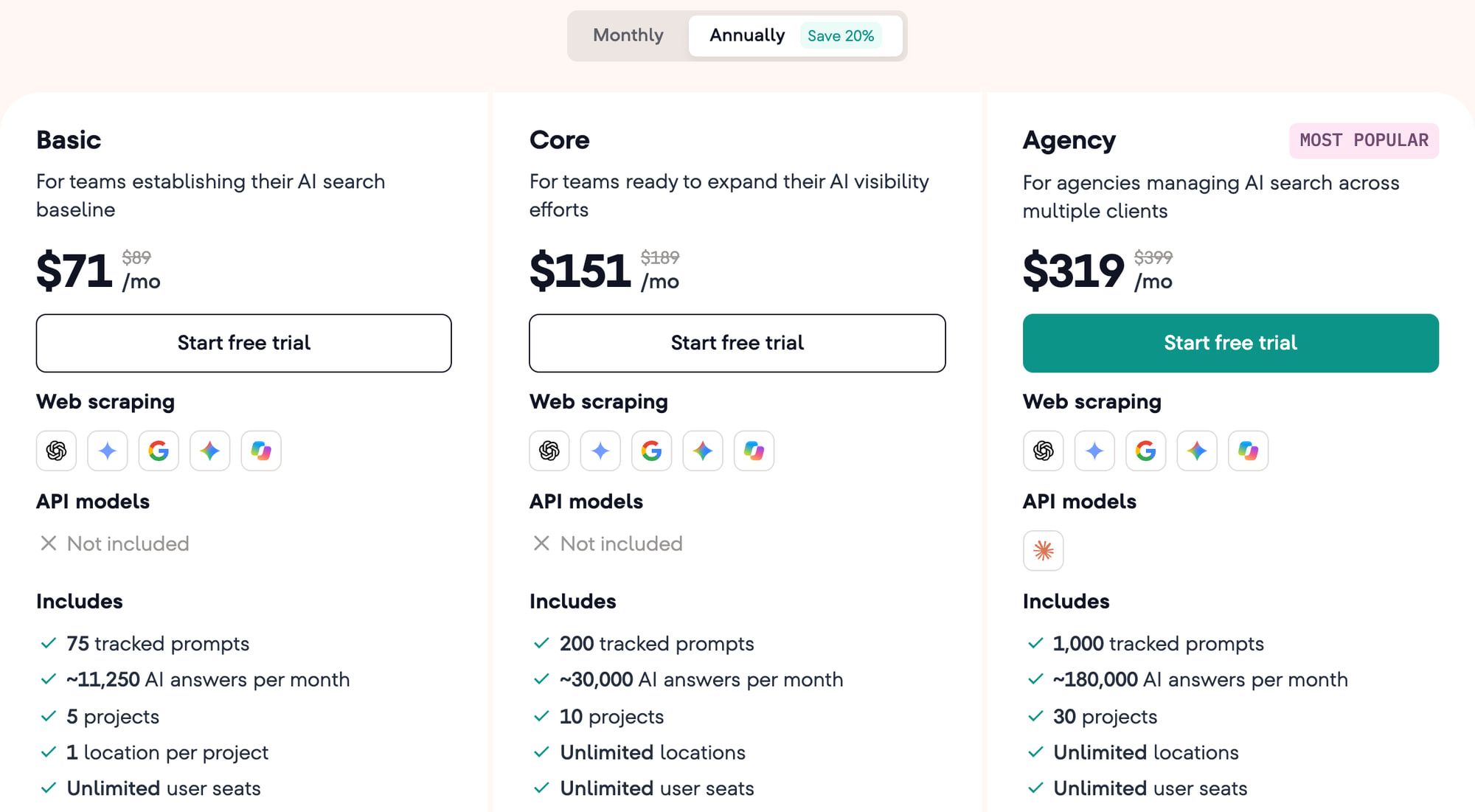
- SE Visible Basic, $89 a month
- Its page lists 5 projects and 75 prompts at that price. For more options, see my agency roundup.
- Already on Semrush
- Its AI Visibility Toolkit, $99 a month per domain
- The pricing page shows it with annual billing, so you add no new vendor. Check the billing term at checkout.
Prices verified . Verified 24 Nov 2026 from each vendor's own pages. The break-even table is my own arithmetic, and the pilot and stop rule are my judgment, not findings. No vendor paid to be included, and sponsors can't buy a verdict.
The three guides a search tool returned first for this question are written by HubSpot, Ahrefs and Semrush, and each sells what the ROI is meant to justify. I read them on 24 November 2026, redid the sums in their examples, and priced the trackers none of them prices.
If you want to know whether AI visitors convert better, that’s in my post on the conversion studies. This one is about what to put in front of the person who signs off the budget, and the wider topic sits in my AI visibility hub.
Can you actually prove AI visibility ROI? #
Not to the dollar. Every guide I read concedes that perfect attribution isn’t possible, so bring three labelled numbers: what you measured, what customers told you, and what a model estimated.
Ahrefs lists its own limits: zero-click answers leave no trace, referrers get stripped, and shared-cost splits are rough guesses (Ahrefs). A second Ahrefs post says there is no Search Console for ChatGPT (Ahrefs).
The spread is the useful part. Ahrefs’ worked example costs the AI work at $27,000 a quarter. Forty tracked conversions at $900 give $36,000 and an ROI of 33%, while customer-reported revenue of $54,000 gives 100% (Ahrefs).
I redid both sums and they hold: ($36,000 − $27,000) ÷ $27,000 is 33.3%, and ($54,000 − $27,000) ÷ $27,000 is 100%. The inputs are an illustration, not a measurement. Same costs, a threefold gap, so bring a range and not a point.
My three buckets, which are my labels and not any vendor’s:
- Measured: GA4 sessions and conversions from the AI Assistant channel, CRM records, Search Console.
- Self-reported: what customers say when you ask how they found you.
- Modelled: anything computed from assumed rates, such as a credit percentage or a funnel chain.
Never add them together. Show them side by side, and flag the modelled one as an estimate.
I also found no study from anyone who doesn’t sell tools or services that links AI visibility to revenue. So nothing here supports promising a revenue figure.
What can you pull this week for free? #
Three things: GA4’s AI Assistant channel, Search Console’s branded split if your property qualifies, and a how-did-you-hear field with AI options. Each has a limit Google or the vendors state.
GA4. Google describes AI Assistant as the channel for visitors arriving from sources such as ChatGPT, Gemini, Deepseek, Copilot or Grok, and says it excludes Google’s AI Overviews and AI Mode (Google Analytics help). The page gives no start date, so check how far back your own channel data goes. The setup is in my GA4 post.
Search Console. The branded filter splits queries into branded and non-branded. Google says an internal, AI-assisted system decides this and that some queries may occasionally be misidentified; it applies to top-level properties and needs enough query volume (Google). Google’s API post of 16 November 2026 says other properties get no rows back (Google); the mechanics are in my branded queries post.

A form field. Add a how-did-you-hear question to signup or checkout, with AI options. My wording, not a vendor’s: “How did you first hear about us?” with ChatGPT, Google AI Overviews or AI Mode, Perplexity, Gemini, Copilot and an other-AI line next to the usual choices.
Ahrefs reports that 21.7% of its own signups name Claude or ChatGPT, from its own survey, so it’s one seller’s data about itself and not a benchmark (Ahrefs). Siege warns that a prominently placed self-attribution field can over-report (Siege Media).
To size the prize, in Ahrefs’ October 2026 figures for 118,671 sites on its web analytics, Google brought 24.74% of visits, ChatGPT 0.36% and all AI assistants together 0.46% (Ahrefs). The categories overlap and it’s one vendor’s customers. The free setup is in my measurement post.
What do the ROI formulas actually count? #
They all share one formula, value minus cost, divided by cost, times 100. They differ on what counts as value, and every example I checked assumes something.
| Guide (and what its publisher sells) | What counts as value | Bucket the example sits in (my label) | Example result | Weak spot |
|---|---|---|---|---|
| HubSpot (HubSpot AEO, Marketing Hub) | CRM pipeline with a confirmed AI touchpoint, times a 25% assisted credit | Measured pipeline, modelled credit | 25% ROI on $6,000 of cost | The formula says revenue and the example credits pipeline; the 25% is explained only as AI being one influence among several |
| Ahrefs (Brand Radar, Web Analytics) | Tracked conversions times customer value, or a survey share scaled to new revenue | Measured, and self-reported | 33% tracked, 100% self-reported | One cost base gives a threefold gap; the inputs are illustrative |
| Semrush (AI Visibility Toolkit) | Visits × lead rate × qualified-lead rate × close rate × deal value, then profit after margin | Modelled | 188% for B2B; 60% for ecommerce | Every rate and margin is assumed, and the examples are introduced only with “For example” |
| Meltwater (GenAI Lens) | Value minus cost, plus a Share of Model count of brand appearances | Mostly a visibility measure | No worked result I could find | Nothing to check; it reads as conceptual to me |
| Siege Media (GEO services) | Customers times lifetime value, assuming about one customer per visibility point | Modelled | Not printed here | The one-customer baseline is an admitted assumption, and by my arithmetic one of its mid-market results doesn't follow from its own inputs |
Source: The five guides' own pages, read 24 Nov 2026. Semrush's 188% is (profit $11,520 − cost $4,000) ÷ $4,000. Bucket labels are mine. Scroll sideways for more columns.
HubSpot’s page gives ROI as (AI-assisted revenue − AI costs) ÷ AI costs × 100. Its example flags $30,000 of pipeline, applies a 25% credit to get $7,500, and sets that against $6,000 of cost (HubSpot). The page is dated 08/12/26, which I read as 12 August 2026.
Ahrefs adds one test I’d keep for the cost side: count a cost as pure AI only if you would stop paying for it the day you stopped the AI work.
Semrush’s B2B chain is 1,000 visits × 4% × 30% × 20% × $6,000, which gives roughly $14,400. With an 80% margin and $4,000 of monthly cost, it reaches 188% (Semrush). I redid that sum, and it holds. Its ecommerce example, 1,000 × 2% × $80, gives $1,600, then 60% ROI after a 60% margin and $600 of cost.
Meltwater defines Share of Model as brand appearances divided by total tracked, times 100 (Meltwater). Siege’s three-part approach is self-attribution, share of voice and branded search lift, and it admits that branded lift is confounded by PR, paid and podcasts (Siege Media).
Semrush’s own modelled traffic numbers are in my post on AI-influenced traffic. My point here: every guide’s example is mostly the modelled bucket, so it can’t be your evidence.
What does it cost, really? #
Entry plans I read run $89 to $99 a month, and in Ahrefs’ own example the tool is about 6% of the cost; agency fees and people time are most of the rest.
That example’s quarterly costs are a $1,500 tool, a $3,500 agency, $18,000 for a third of a three-person content team, $3,000 for half a freelancer and $1,000 for a third of the SEO suite (Ahrefs). They sum to $27,000, and $1,500 is 5.6% of that (my arithmetic). The illustration is Ahrefs’, and it sells a tracker.
| Plan | Price read 24 Nov 2026 | What the page lists | Conversions a month to break even at $200 each (my arithmetic) |
|---|---|---|---|
| Peec Starter | $95 a month; annual billing is 15% off, per its FAQ | 50 prompts, 3 models, 1 country, unlimited seats | 0.475, about one every two months |
| SE Visible Basic | $89 a month; $71 a month with the Annually toggle selected, where $89 shows struck through | 75 prompts, 5 projects, 5 engines | 0.445 |
| Semrush AI Visibility Toolkit | $99 a month per domain, shown with annual billing | 25 custom prompts, tracked daily | 0.495 |
| Your own hours | Your hours × your hourly cost | Not on any pricing page | Add this before you trust the line above |
Source: Peec, SE Visible and Semrush pricing pages, “$” views that loaded on 24 Nov 2026. Break-even is monthly price ÷ value of one conversion, my arithmetic. Scroll sideways for more columns.
The break-even logic is simple. Monthly price divided by what one conversion is worth gives the conversions you need each month. At $95, a $50 conversion needs 1.9 a month, and a $1,000 conversion needs about one a year ($1,140 ÷ $1,000).
Two cautions. A tracker doesn’t create revenue, so this compares a plan price with revenue the AI channel brings, whoever caused it. And it leaves out your time, which I priced at nothing because I can’t know your rate.
Here’s an illustration with my own assumed numbers, not data. At Ahrefs’ 0.46% average, 10,000 monthly visits is about 46 AI visits. At an assumed 2% conversion rate that is under one conversion a month, or about $184 at $200 each. That covers a $95 plan with about $89 to spare, before any of your time.
Plan details are in my Peec pricing post and SE Visible vs Peec comparison, and the cost-per-answer view is on my AI visibility cost page.
How long before it shows up? #
Vendors suggest 90 to 180 days for pipeline or revenue, but none cites data. HubSpot and Semrush give different shapes, so treat both as opinions.
| Stage | HubSpot | Semrush |
|---|---|---|
| Visibility and citations move | Weeks 1 to 4 | Days 0 to 30 |
| Referrals and branded search tick up | Branded and direct, weeks 4 to 8 | Days 30 to 60 |
| Leads and pipeline respond | Months 3 to 6 (pipeline) | Days 60 to 90 |
| Closed revenue and ROI show | Not separated from pipeline | Days 90 to 180 |
Source: HubSpot and Semrush ROI guides, read 24 Nov 2026 and paraphrased. Siege separately suggests a 90-day branded-search window, also unsourced. Scroll sideways for more columns.
This is a reading of two pages, and I found no data behind either (HubSpot, Semrush). My suggestion is a 90-day pilot. It’s no longer than the 90 to 180 days both give for pipeline or revenue, so say up front that it reports leading signs and may not report closed deals.
What if GA4 shows almost no AI traffic? #
Say so plainly. In Ahrefs’ October 2026 data AI assistants were 0.46% of visits, so a small number is normal; bring a visibility baseline, the branded split and the form field.
GA4 only sees clicks. Ahrefs says zero-click answers leave no trace (Ahrefs), so a quiet GA4 doesn’t prove you’re absent from answers. A tracker or a manual check shows that, and my measurement post covers the manual one.
Semrush’s framework starts with a baseline of 10 to 15 buyer prompts. Stacker, writing with WebFX, warns against a pilot that tracks only five prompts or updates a single page. My prompt-count post covers sizing.
What should you not promise? #
A revenue number from visibility alone. Everything else on this list follows from the same reasoning: you don’t have a measured link between a mention and a sale.
- A conversion multiplier. HubSpot gives a 3x lead-conversion figure attributed only to “HubSpot data”, with no study linked. The figures I compared in my conversion post run from about 1x to 23x, and the loudest come from tool sellers. Use your own GA4.
- Branded lift as proof. Siege says it’s confounded by other channels, and Google says its classifier is AI-assisted.
- A mention count as a sale. A citation is visibility. It sits in a different bucket from revenue.
- A credit percentage you can’t explain. HubSpot’s 25% is the example; if finance asks where yours came from, you need an answer.
- A good visibility rate. WebFX says 15 to 25% is good and doesn’t say where that range comes from (WebFX).
- A forecast from vendor prompt volume. Vendors call those figures directional, and I found no AI platform that publishes per-prompt counts. My prompt volume post has the detail.
What goes on the one page? #
Eight lines, in this order. The structure is mine, built from the guides’ common parts.
- Ask: a 90-day pilot, with the named cost.
- Measured: GA4 AI Assistant sessions and conversions, plus the Search Console branded and non-branded split where eligible.
- Self-reported: the how-did-you-hear answers that name AI, with the count of responses.
- Modelled: anything a vendor estimates, flagged as an estimate.
- Cost: tool, your hours, and any content or PR spend.
- Break-even: the conversions a month the cost needs, at your own conversion value.
- What this can’t show: zero-click answers, AI Overviews and AI Mode traffic in GA4, and causation.
- Stop rule: the numbers that end the pilot.
On the stop rule, write the thresholds before you start. For example: stop if, after 90 days, AI sessions are still near zero, nobody names AI on the form and the tracker shows no movement. That example is my judgment, not a finding.
Which setup should you pick? #
Pick by where you are, and make the free numbers the opening act in every case.
- No budget yet: report the three free numbers for 90 days and don’t ask for money. If the Ahrefs average holds for you, they’ll be small, and that’s a finding worth reporting.
- Budget approved, one brand: Peec Starter at $95 a month. It’s a close call with SE Visible Basic, $6 cheaper with more prompts, so this one is my judgment: Starter lists unlimited seats, which suits showing results to a boss and finance. Buy it for the pilot only.
- Agency or several projects: SE Visible Basic at $89 a month, since its page lists 5 projects. See my agency tools roundup for more.
- Already on Semrush: its toolkit at $99 a month per domain, so you add no vendor. Check the billing term at checkout.
Whichever you pick, a tracker answers one question GA4 can’t: do AI answers name you? It doesn’t answer whether that’s making money, and no pricing page claims it does. My free tools post lists what to try before paying.
That’s my reading of the vendors’ pages and Google’s help, not a pilot of my own. I’ll update this post if a source publishes data on lag times, or a study from outside the sellers links visibility to revenue.
FAQ
What is the ROI formula for AI visibility?
The guides I read all use value minus cost, divided by cost, times 100. They differ on what counts as value: HubSpot's example credits CRM pipeline, Ahrefs' uses tracked or customer-reported revenue, and Semrush chains assumed rates into modelled profit.
Can you track revenue from ChatGPT in GA4?
Partly. GA4's AI Assistant channel counts visits from sources such as ChatGPT, Gemini, Deepseek, Copilot and Grok, but Google says it excludes AI Overviews and AI Mode. Visits that arrive without a referrer land elsewhere, and GA4 can't show whether an answer named you without a click.
How long does AI visibility take to pay off?
HubSpot and Semrush each suggest roughly 90 to 180 days before pipeline or revenue shows, and neither cites data. My suggestion is a 90-day pilot that reports leading signs, with the expectation set up front that closed revenue may come later.
Does Search Console show brand lift from AI?
It splits branded and non-branded queries for eligible top-level properties. Google says an internal, AI-assisted system does the classifying and some queries may be misidentified, and nothing in it says AI caused a lift.
Is an AI visibility tracker worth $89 to $99 a month?
By my arithmetic, a plan at that price breaks even at under one conversion a month if a conversion is worth $200 or more. A tracker creates no revenue, though, and the arithmetic ignores your time, which was the larger cost in Ahrefs' own example.
What if GA4 shows almost no AI traffic?
That is normal in the data I read: AI assistants were 0.46% of visits across 118,671 sites in Ahrefs' October 2026 figures. Report a visibility baseline, the Search Console branded split and a how-did-you-hear field, and say plainly that the channel is small.
Should I use the conversion multipliers I see online?
No. HubSpot gives a 3x lead-conversion figure attributed only to "HubSpot data", and the figures I compared in another post range from about 1x to 23x, with one large ecommerce paper finding ChatGPT visitors converting below most channels. Use your own GA4 numbers.
Sources
15 sources, accessed .
Official pricing, docs, changelogs and status pages 6
- Google Analytics help: default channel group definitions, including AI Assistant
- Google Search Central blog: branded queries filter in Search Console, 20 Nov 2025, updated 11 Mar 2026
- Google Search Central blog: Search Analytics API update, 16 Nov 2026
- Peec AI: pricing page
- SE Visible: pricing page
- Semrush: AI Visibility Toolkit pricing
Other blogs 8
- HubSpot (vendor blog): AI search visibility ROI, dated 08/12/26
- Ahrefs (vendor blog): AI search ROI is messy, 6 Oct 2026
- Semrush (vendor blog): AI visibility ROI, 27 Jul 2026
- Meltwater (vendor blog): AI visibility ROI, 20 Aug 2026
- Siege Media (GEO services): GEO ROI measurement, updated 9 Jul 2026
- WebFX (AI SEO services): proxy KPIs for AI visibility ROI, 23 Apr 2026
- Stacker with WebFX: how to convince your boss to invest in GEO, 21 May 2026
- Ahrefs (vendor blog): how to measure AI search visibility when attribution falls short, 6 Oct 2026
Last updated: 24 November 2026. Facts verified 24 Nov 2026. Researched and drafted with AI tools; owner review is pending.


