Which competitors does AI name instead of you?
Find which rivals ChatGPT and AI Overviews name instead of you with a free prompt log, then see where 7 tools show the gap and what they cost.

Short on time?
Short on time? Here's what I would do.
- Start here, whatever you own
- A free rival tally first
- Ten to twenty buyer questions, three runs each. It shows who actually co-appears, and Peec only suggests a rival after it appears at least twice. My method, not run on a site.
- Already on Semrush
- AI Visibility Toolkit, Competitor Research
- $99 a domain, 25 prompts, up to four rivals on the report page. Its Sources view has a Missing filter, per Semrush's help page.
- Already on Ahrefs
- Brand Radar's cited-domains tabs
- Price the AI index first: Ahrefs' help lists $199 a month per index. Lite's table on the Brand Radar page shows 150 checks, which is 5 prompts on one platform.
- Buying new for the gap view
- SE Visible Basic, or Peec Starter
- SE Visible Basic is $89 monthly for 75 prompts and 5 engines, for the most prompts per dollar. Peec Starter is $95 for 50 prompts and has the best-documented gap workflow. Both list unlimited rivals; vendor claims.
- Tiny budget
- Otterly Lite
- €29 a month in the euro view I saw (23 Nov), 16 prompts. The cheapest entry plan I read, and the smallest.
- Eyeing Profound
- Skip it unless you're buying Enterprise
- One quote-only plan, and the public pages I read describe no gap report.
Prices verified . Verified 24 Nov 2026. These picks are my reading of vendor pages. I opened no accounts, so no gap view here is confirmed by me. No vendor paid to be included, and sponsors can't buy a verdict.
A rival keeps turning up when someone asks ChatGPT or Google’s AI Mode about your category, and you don’t. On 24 November 2026 I read 44 vendor, Google, OpenAI and trade pages to find a free way to list the rivals AI names, where seven tools put the “cited instead of you” view, and what they cost.
I opened no accounts and put no prompts through any engine, so what I say about a tool is what its own pages say. For the audit itself, see how to measure AI visibility; for the metric, AI share of voice; for everything else, my AI visibility hub with every guide and tool comparison.
Can I check this for free? #
Yes. Ask 10 to 20 buyer questions that don’t name you, repeat each three times on a few engines, and tally every brand and cited site. It costs time, not money.
This is my method, not run on a site. I built it from the vendor docs and studies below. The audit in my measuring post has the full log and its logged-out advice, so I won’t copy it. Here the tally is about rivals.
- Write 10 to 20 questions a buyer would ask that name neither you nor a rival, such as “best X for Y” or “X for a small team”.
- Pick your engines and fix their settings (next sections), and write the settings down once.
- Ask each question three times, each in a fresh chat.
- For every answer, copy each brand exactly as written, mark the one named first, and copy the domains it cites.
- Count, per brand, answers naming it divided by total answers.
- Take the three to five most-named rivals and build a gap sheet: list the domains cited next to each rival, and mark the ones that also cite or mention you. The rest are your gap.
- Repeat monthly with the same questions and settings.
By my arithmetic, 10 questions on 5 engines three times each is 150 answers, and 20 on 3 engines three times is 180, the same size as the audit in my measuring post.
Eclincher, a marketing platform that sells an AI visibility plan, suggests a fresh temporary chat per run, web search on and at least three runs. It says to set aside an hour for 10 prompts in ChatGPT only, which is 30 runs. That is its own estimate; I found no neutral timing.
The idea is old: Practical Ecommerce described comparison prompts in January 2024, with no run count or location advice.
How many prompts and runs is enough? #
About 20 questions and at least three runs each is my floor, because the same question returns different lists. Three is a floor, not a proof.
Search Engine Journal reported a SparkToro and Gumshoe study with 2,961 prompts, including 12 brand-recommendation prompts run 60 to 100 times per platform. The same brand list came back less than 1% of the time, and the same list in the same order less than 0.1%.
Whose study that is matters. Gumshoe sells tracking, which SEJ discloses, and it was not peer-reviewed. Its useful finding for this job is that appearance share was steadier than rank, so count how often a rival appears, not where.
Ahrefs measured something narrower: AI Overviews had a 70% chance of changing between consecutive observations, and 45.5% of cited URLs were new between responses. Ahrefs sells a tracker, and says the real change rate is higher because it didn’t check daily.
For how many questions to start with, see how many prompts to track.
Does where and how I ask matter? #
Yes. Location, sign-in and memory can change an answer, so fix them and write them down.
| Engine | Works signed out? | Location | What I would fix and record |
|---|---|---|---|
| ChatGPT search | Yes: “People who are not signed in can also use web search.” | Approximate location may come from your IP address; device location is optional and off by default | Where you ask from, and whether memory is on (it may be used to rewrite the search query) |
| Google AI Mode | The page doesn't say sign-in is required for basic access | Availability is set by country and language | Signed in or out, and age and history settings: personalization needs 18+ with history and personalized recommendations on |
| Gemini web app | Some features, yes; history and more need a Google Account | Errors can relate to location, age or account type | Signed in or out, and the account type |
| Perplexity | I could not verify | I could not verify | Write down whatever you do |
| Microsoft Copilot | I could not verify | I could not verify | Write down whatever you do |
Source: OpenAI's ChatGPT search help, Google's AI Mode help and Gemini help, read 24 Nov 2026. I opened no official page for Perplexity or Copilot. Scroll sideways for more columns.
Sources: OpenAI, Google AI Mode, Gemini. OpenAI also says citations “may” be included and results can be incomplete, outdated or incorrect, which is one more reason to run each question more than once.
For checking by country and choosing engines, see AI visibility by country and which AI engines to track.
What should the log show about each rival? #
For each rival: how many answers name it, how often it comes first, and which sites are cited beside it. Then check whether those sites cite you too.
| Column | What to write | Why |
|---|---|---|
| Rival, as the answer wrote it | The name exactly as printed, one row per name | Spellings and product names split a rival across rows if you tidy them early |
| Appearance rate | Answers naming it divided by total answers | SparkToro and Gumshoe found share steadier than order |
| Named first | How many answers put it first | A secondary signal; don't rank on it alone |
| Domains cited beside it | The domain, not the page | The domain is what you can pitch, join or fix |
| Also cites you? | Yes or no per domain | No is a row in your gap sheet |
Source: My method, built from the SparkToro and Gumshoe study as reported by Search Engine Journal. Not run on a site. Scroll sideways for more columns.
Seed the rival list by hand. Peec’s docs say a brand is suggested only once it appears “at least twice” in your prompts, and Sistrix’s handbook lists brands mentioned together with yours. My reading: a rival that never co-appears with you won’t be suggested, so copy names from real answers.
Rivals also change the score. Peec’s share of voice is your mentions divided by mentions of you and your tracked competitors, times 100, so 4 and 12 mentions is 25%. Ahrefs’ help says its AI Share of Voice depends heavily on how you set up brand and competitor entities. My share of voice post covers the formula.
Which tool shows who is cited instead of me? #
Semrush, Peec, Ahrefs, Otterly, Scrunch and SE Visible each describe a rival comparison and a cited-source view. Profound’s public pages I read describe none.
| Tool | The “instead of you” view, per its own pages | Rivals allowed | Entry plan and list price |
|---|---|---|---|
| Ahrefs Brand Radar | Cited-domains view with tabs named Yours, Competitors, Other and All domains, per the May 2026 changelog, which doesn't define each tab. Overview compares share of voice. I did not see the live menu | No cap, per Ahrefs help | A paid Ahrefs plan (Lite $129) plus an AI index, $199 a month per index, or prompt packs from $50; I could not work out the cheapest combination |
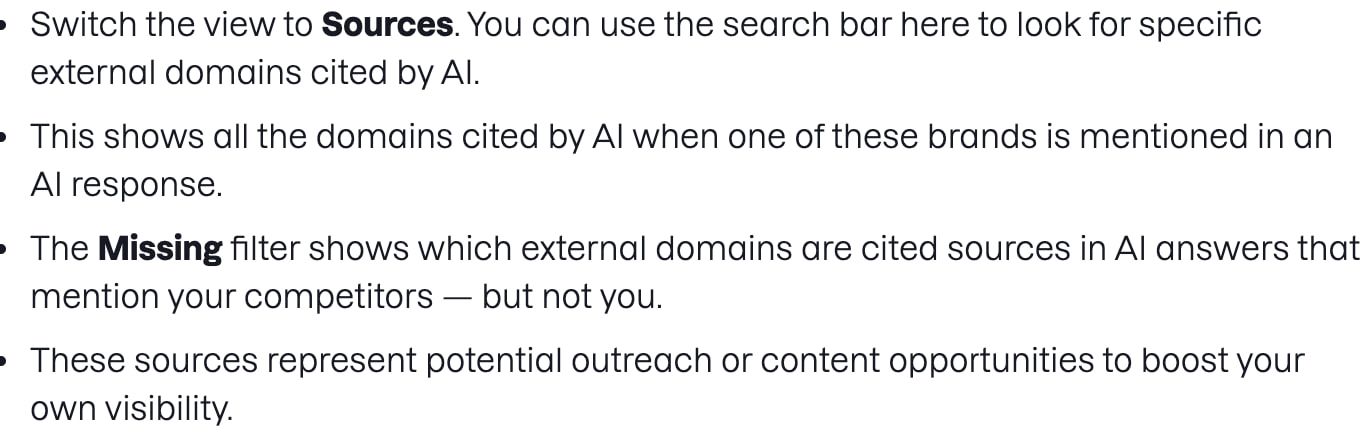
| Semrush AI Visibility Toolkit | Competitor Research: Topics & Prompts with Strong, Weak and Missing filters, and a Sources view with a Missing filter for domains cited when competitors appear and you don't | Up to four (report page); the toolkit article names no maximum | $99 per domain, 25 prompts; billed annually per the pricing page, “per month” per the help article |
| Peec | A Gap Analysis toggle on the Sources tab (Domains or URLs view) with a gap score and a model filter; another Peec page puts it in the sidebar | Unlimited, per pricing page | Starter $95 a month, 50 prompts, 3 of 8 models |
| Otterly | Brand report comparing coverage, average position, sentiment and share of voice per rival; a citation analysis of sources cited in place of your brand | Unlimited, per pricing page | Lite €29 a month in the euro view I saw (23 Nov); $29 in the USD view on 13 Nov |
| SE Visible | Its pricing page lists competitor benchmarking, competitor gaps and citation gaps (cited domains and pages) on all plans. I could not open a help page on the gap view, so this is the vendor's claim | Unlimited, per pricing page | Basic $89 monthly or $71 annual (label inferred), 75 prompts |
| Scrunch | Competitive presence by period, rival, topic and persona, with per-prompt rival citations and alerts when answers cite rivals over you | 5 on Core; unlimited on Enterprise | Core $250 a month |
| Profound | No gap report described on the public pages I read | Not stated | Enterprise only, custom |
| Sistrix, Surfer, AWR, Similarweb | Sistrix: “Source Gaps vs. Competition”. Surfer: a competitors dashboard with a sources table. AWR: a “Cited Competitors” column. Similarweb's blog: prompts where rivals appear and you don't | Not stated | Plans not stated on the pages I read |
| Ahrefs free checker | A snapshot, top 5 per section; accepts a rival's name but offers no comparison | n/a | $0, no signup |
Source: Each vendor's pricing page, help article or docs, read 24 Nov 2026 (Otterly euro view 23 Nov). Gap views described here are the vendors' own claims; I did not see any of them running. Scroll sideways for more columns.
Sources by row: Ahrefs help, Ahrefs pricing, Semrush report page, Semrush toolkit article, Semrush pricing, Peec pricing, Otterly’s competitor help and insights help, Scrunch’s FAQ, SE Visible pricing, Profound pricing, Surfer docs, AWR help, Similarweb’s blog and Ahrefs’ free checker.
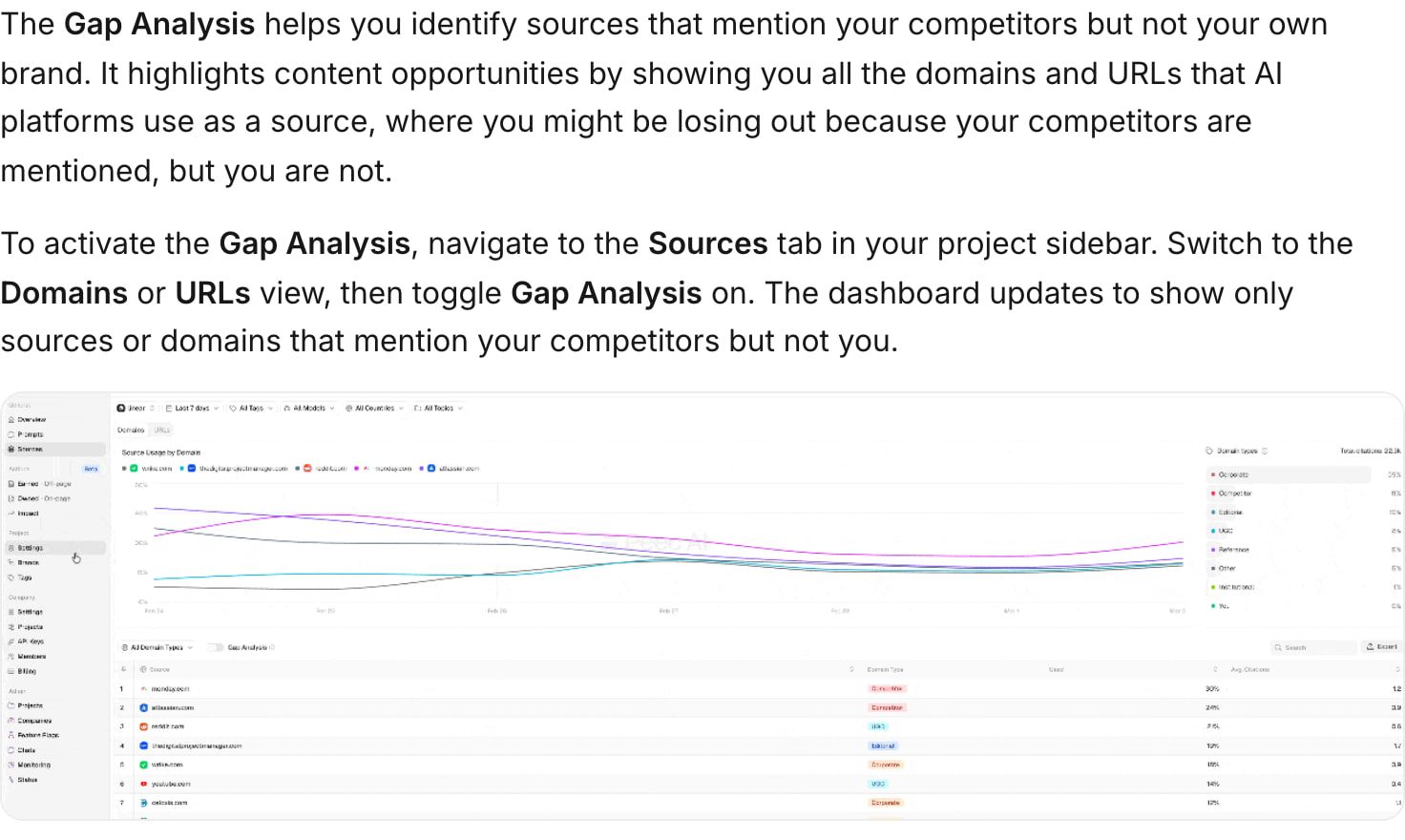
Peec has the clearest write-up of a gap view in what I read. Its help article, updated 29 October 2026, says to open the Sources tab, pick the Domains or URLs view and toggle Gap Analysis on, which shows sources that mention competitors but not you. It needs at least one competitor set up and “a few days” of data for a new project.
Peec’s sources docs place Gap Analysis in the sidebar instead, so I can’t say which is current.
Scrunch has an inconsistency to know about. Its pricing page says Core is $250 a month with 15,000 AI responses, 8 engines, 5 competitors and a 7-day trial, but an older FAQ still says 125 prompts and 4 platforms. I quote the pricing page’s figures and treat the FAQ as stale, which is my reading.
For tool-by-tool pricing, see my breakdowns of Peec, Otterly and Profound, and the comparisons SE Visible vs Peec and Semrush’s toolkit vs Ahrefs Brand Radar.
Why do some guides name reports that are gone? #
Because vendors rename views faster than they update old guides. Ahrefs’ own changelog says “Cited domains is no longer a separate report”.
Ahrefs’ November 2025 guide came first in the web-search results I read for this topic (not a captured Google page), and its first step sends you to the Cited domains report. The changelog, a post dated 25 May 2026 whose title ends “(April 2026)”, says it is now an All domains tab beside Yours, Competitors and Other. An undated Ahrefs Academy page still uses the old name.
I read the guide’s AI Responses filters (Only brand, With others, Others only) only in the 2025 text, so I can’t say they exist today. The guide also names no plan or price, which is a gap, not a flaw: it is written for people already in Brand Radar.
Check the date on any guide’s screenshots, including mine.
What does it cost to get in? #
The cheapest entry plans I read run from €29 to $99 a month. Scrunch Core is $250, Ahrefs needs a paid plan plus an AI index from $199, and Profound is a quote.
| Entry plan | List price I read | Prompts | Engines | Trial | Per prompt, my arithmetic |
|---|---|---|---|---|---|
| Otterly Lite | €29 a month in the euro view I saw (23 Nov 2026); the USD view listed $29 on 13 Nov | 16 | 4 | Free trial, length not stated | €1.81 (euro view) |
| SE Visible Basic | $89 monthly or $71 annual (label inferred) | 75 | 5 | 14 days | $1.19 monthly, $0.95 annual |
| Peec Starter | $95 a month (the page also mentions 15% off annual billing) | 50 | 3 models of 8 | Free trial, length not stated | $1.90 |
| Semrush AI Visibility Toolkit | $99 per domain; annual per pricing page, monthly per help | 25 | ChatGPT, Google AI, Gemini, Perplexity | None per help; 7-day free trial per pricing page | $3.96 |
| Scrunch Core | $250 a month | Sold as 15,000 AI responses | 8, no Claude | 7 days | Not computable |
| Ahrefs Lite plus Brand Radar | Lite $129; AI index $199 a month per index; prompt packs from $50 | 5 on one platform (150 checks, from the Brand Radar page) | AI Overviews and AI Mode, ChatGPT, Perplexity, Gemini, Copilot | Not stated | Not computable |
| Profound | Enterprise, custom | Not stated | Up to 10 | None; demo only | Not computable |
Source: Pricing pages read 24 Nov 2026. Per-prompt figures are my arithmetic: list price divided by prompts, which ignores annual discounts except where shown. Otterly's USD view was recorded 13 Nov 2026; its euro view (23 Nov) listed the same numbers. Scroll sideways for more columns.
Otterly shows prices by region. I saw Lite €29, Standard €189 and Premium €489 a month in the euro view (23 Nov 2026), and the USD view listed $29, $189 and $489 on 13 Nov; see my Otterly pricing breakdown. Otterly’s help says its prompt counts differ by engine count, with 21 prompts on Lite at three engines.
Peec, Otterly, Semrush and SE Visible sell prompts, so the per-prompt column compares them. Ahrefs sells checks and Scrunch sells responses, so I left their per-prompt cells empty; mixing units would mislead.
Semrush’s two pages disagree on billing, so $99 may be the monthly price or the annual rate. They also disagree on a trial: the pricing page says “Try Semrush free for seven days”, the help article says the toolkit has no free trial. That changes the comparison, and I could not settle it.
What do I do once I see the gap? #
Look at which kind of site names your rival but not you: press, community or directories. Peec’s help article lists those three patterns: editorial coverage, community presence such as Reddit, and directory listings.
Peec’s docs add that AI models only see HTML, so paywalled and JavaScript-only pages are missed. That is a vendor’s statement, not something I could confirm. My reading: look at whether a rival’s cited page is plain text before copying its format.
A gap sheet tells you who is named and which sources carry them. None of the pages I read says why, and I found no evidence from anyone who doesn’t sell a tracker that closing a gap raises your citations. For ways to get named, see getting mentioned in ChatGPT, and for a lost citation, my lost AI citation checklist.
If you want a free snapshot first, my free AI visibility tools roundup covers the checkers.
So which one should you pick? #
Run the free rival tally first, then buy by what you already own. These are my reading of vendor pages, and I did not see any gap view running.
- On Semrush: use Competitor Research and its Sources view. Accept the four-rival limit unless Semrush confirms otherwise.
- On Ahrefs: use the cited-domains tabs, but price the AI index first and don’t copy the 2025 guide’s step names.
- Buying new: SE Visible Basic for coverage, because it lists 75 prompts and 5 engines for $89 monthly, though I could not open its gap-view help. Peec Starter if you want the best-documented workflow and a model filter.
- Tight budget: Otterly Lite, with only 16 prompts.
- Large team: a Profound or Scrunch Enterprise quote, with neither gap view verified.
Whatever you buy, four habits matter more than the logo:
- Seed rivals from real answers, not suggestions.
- Use the same prompts for you and for them.
- Keep settings identical month to month.
- Report appearance share with the number of answers behind it.
FAQ
Can I see which competitors ChatGPT recommends without a tool?
Yes. Ask buyer questions that don't name you, repeat each at least three times, and tally every brand named and every domain cited. OpenAI says people who are not signed in can use ChatGPT search, and that approximate location may come from your IP address, so write down where you ask from. This is my method, built from vendor docs and studies, and I have not run it on a site.
How many times should I ask the same question?
At least three, as a floor in my method. Search Engine Journal reports a SparkToro and Gumshoe study (Gumshoe sells tracking, and it was not peer-reviewed) in which the same brand list came back less than 1% of the time across 60 to 100 runs per platform. Count how often a brand appears, not where it ranks.
Does being logged out change the answer?
It can. OpenAI says ChatGPT search works signed out, may use an IP-based approximate location, and may use saved memories if memory is on. Google says AI Mode personalization needs you to be 18 or older with history and personalized recommendations on, and its page doesn't say sign-in is required for basic access. Gemini's web app has some signed-out features. I could not verify Perplexity or Copilot.
Which tool shows the sites AI cites for my rivals but not me?
By the vendors' own pages: Semrush's Sources view has a Missing filter, Peec has a Gap Analysis toggle on its Sources tab, Ahrefs' changelog names tabs for Yours, Competitors, Other and All domains in its cited-domains view (it doesn't define each), SE Visible's pricing page lists citation gaps, and Otterly's help lists a citation analysis. I could not check any of them live, and SE Visible's help page on the gap view did not open.
Is there a free competitor report?
Not a comparison. Ahrefs' free AI Visibility Checker needs no signup and shows a limited preview, the top 5 results per section. It accepts competitor names, but competitor comparison is a Brand Radar feature. The free route that compares rivals is the manual log.
How many competitors can I track?
Semrush's report page says up to four competitor domains, though its toolkit article names no maximum. Scrunch Core tracks five and its Enterprise plan lists unlimited. Peec, Otterly and SE Visible list unlimited on their pricing pages, and Ahrefs' help says there is no cap. Profound doesn't say.
Why is my share of voice lower after I added a rival?
Because every tracked rival sits in the denominator. Peec's formula is your brand mentions divided by all mentions of you and your tracked competitors, times 100, so 4 of 16 is 25%. Ahrefs' help also says its AI Share of Voice can change a lot depending on how you set up the entities for your brand and competitors.
Does Profound show competitor gaps?
I couldn't establish it. Profound's pricing page lists one Enterprise plan with custom pricing and no trial, and the public pages I read describe no gap report. That is not the same as saying it has none.
Sources
37 sources, accessed to .
Official pricing, docs, changelogs and status pages 34
- Ahrefs blog (vendor): AI search competitor analysis, 13 Nov 2025
- Ahrefs changelog (vendor): April 2026 features, dated 25 May 2026
- Ahrefs Academy: Brand Radar cited domains (undated)
- Ahrefs help: what Brand Radar is and how to use it
- Ahrefs help: AI visibility metrics
- Ahrefs pricing
- Ahrefs Brand Radar product page (printed yen to my tool)
- Ahrefs free AI Visibility Checker
- Ahrefs blog (vendor study): how often AI Overviews change, 11 Nov 2025
- Semrush help: Competitor Research report
- Semrush help: AI Visibility Toolkit
- Semrush AI Visibility Toolkit pricing
- Peec pricing
- Peec help: how to use Gap Analysis, updated 29 Oct 2026
- Peec docs: identifying your competitors
- Peec docs: share of voice
- Peec docs: understanding sources
- Otterly pricing (euro view; USD view recorded 13 Nov 2026)
- Otterly help: pricing, 10 Nov 2026
- Otterly help: compare competitors, 5 Oct 2026
- Otterly help: insights on brand reports, 5 Oct 2026
- Profound pricing
- Scrunch pricing
- Scrunch FAQ: pricing (undated, older figures)
- Scrunch FAQ: where competitors are gaining visibility
- SE Visible pricing
- SE Visible: competitor analysis page (undated)
- Surfer docs: AI Tracker competitors dashboard, 13 Nov 2026
- Sistrix handbook: AI search competition, 13 Mar 2026
- AWR help: analyze competitors in AI search, 23 Nov 2026
- Similarweb blog (vendor): competitors' AI brand visibility, 25 Dec 2025
- OpenAI help: ChatGPT search
- Google Search help: AI Mode
- Gemini help: using the web app
News and press 1
Last updated: 24 November 2026. Vendor, Google and OpenAI pages read 24 Nov 2026 (Otterly’s euro view 23 Nov). Researched and drafted with AI tools; owner review is pending.


