How many prompts should you track in AI search?
How many prompts to track? For one brand, about 50, checked daily. I compared 12 tools' plans and read 4 studies on how much AI answers change.

Short on time?
Short on time? Here's my take.
- One brand, small team
- 50 prompts on Peec AI Starter
- 40 non-branded and 10 branded, daily on 3 engines: 4,500 answers a month for $95.
- A pilot on a small budget
- 16 to 21 prompts on Otterly Lite
- €29 a month as the page showed me. Enough for 3 or 4 topics, not a full picture.
- You track keyword rankings too
- Nightwatch Starter
- €79 as shown to me for 500 keywords plus 50 prompts, though only 30 answers per prompt a month.
- B2B with several product lines
- About 150 prompts on SE Visible Core
- $189 a month holds 200 prompts on 5 engines, daily: 30 to 50 per product line.
- Agency
- 25 to 50 per client on SE Visible Agency
- $399 a month for 1,000 prompts across 30 projects, about 33 a project if all are full.
- Enterprise
- Start at 100 on a quote-based plan like Profound
- Profound's own advice is to start with 100 and grow by topic.
Prices verified . Plans and prices from vendors' own pages, verified 16 Nov 2026. Otterly and Nightwatch showed me euros. No vendor paid to be included, and sponsors can't buy a verdict.
Updated 24 November 2026: Profound retired its Starter and Growth plans in September 2026, and Scrunch now sells Core as 15,000 AI responses a month with no prompt count; this page reflects both pricing pages. Every other figure is as I read it on 16 November.
For one brand, start with about 50 prompts: around 40 non-branded questions your buyers ask and 10 that name you, checked daily on the 3 AI engines they use most. Fifty is also the entry size at Peec AI, Promptwatch, Trakkr and Nightwatch; the two $95 plans are compared in Promptwatch vs Peec AI.
Every page ranking for how many prompts to track comes from a company that sells prompt quotas. So I compared what 12 tools’ entry plans hold, read four studies on how much AI answers change between runs, and worked out how many answers it takes to see a real change. For the tools themselves, start with my AI visibility tools hub.
One rule matters more than the count: judge a topic, not a single prompt. AI answers change from run to run, so I’d want roughly 300 answers a month behind any number before calling it a change (my arithmetic, explained below).
Why does every guide give a different number? #
Because each guide comes from a company selling prompt quotas, and their starting points run from 5 prompts (Trakkr) to 100 (Profound), a 20-fold spread. There’s no single magic number, only different units and different plans.
Here’s their sizing advice next to what each one sells, the column most of them leave out.
| Who says it | Their advice | Date | What their entry plan holds |
|---|---|---|---|
| Trakkr | Start with 'Five to ten' prompts | No year shown | Growth: 50 prompts per brand, $100/mo |
| seoClarity | '3 to 5 simple questions to sample different search intents' | Updated 23 Sep 2026 | Not checked for this post |
| Scrunch (FAQ) | '15–25 varied prompts across 6–12 core topics'; topics × 5–8 questions | Undated | Core: $250/mo for 15,000 AI responses a month; no prompt count listed (24 Nov) |
| SE Ranking | 'Start with 20-40 prompts total' on 2–3 AI models | 23 Apr 2026 | SE Visible Basic: 75 prompts, $89/mo |
| Peec AI | 10–20 awareness plus 20–30 consideration prompts | 22 Jan 2026 | Starter: 50 prompts, $95/mo |
| Superlines | 'Plan around 50–100 prompts per important brand' | Updated 19 Oct 2026 | Not checked for this post |
| Profound | 'Aim to start with a list of 100 prompts'; users track 100 to 1,000 | 10 Feb 2026 | Enterprise only: custom price, no trial listed (24 Nov) |
| Evertune | 'tight margins of error at 100 repetitions' of a prompt | 16 Jul 2026 | Not checked for this post |
Source: Each vendor's own guide, help page and pricing page, read 16 Nov 2026. Quoted words are verbatim. Scroll sideways for more columns.
Sources for the advice: Trakkr, seoClarity, Scrunch, SE Ranking, Peec AI, Superlines, Profound and Evertune.
The advice and the plans don’t line up. Trakkr says start with five to ten, yet its Growth plan includes 50 per brand (Trakkr pricing). Scrunch’s FAQ says 15 to 25, yet its Core plan now sells 15,000 AI responses a month: 62 prompts on all 8 of its engines checked daily, by my arithmetic (15,000 ÷ 8 ÷ 30).
Only Evertune’s number comes with data, and SparkToro’s study points the same way; the rest are starting points. I’d treat the prompt count as a budget decision and the number of runs as the accuracy decision.
How do you size your own list? #
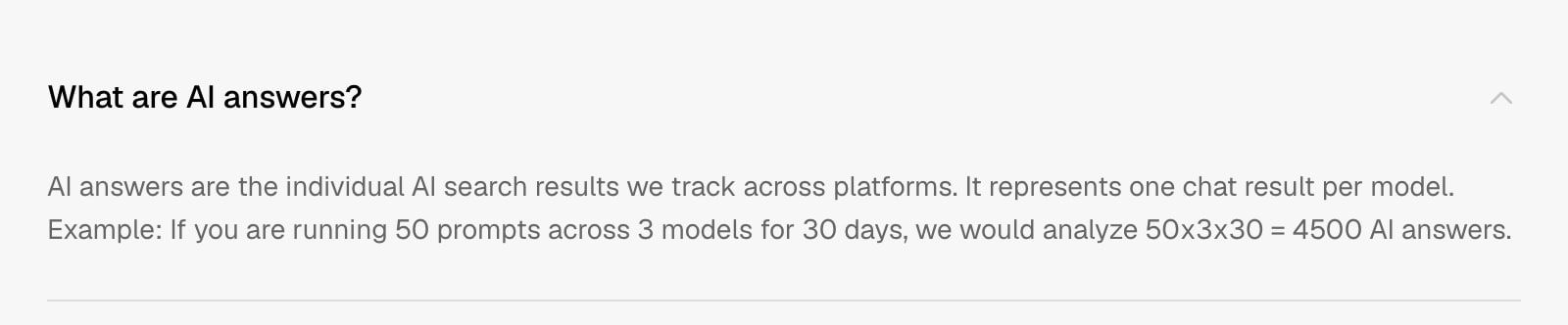
Multiply your topics by about 5 prompts each, add a branded set, then multiply by engines and checks a month to get the answers your plan must cover.
Peec’s docs say to “Start with 3 to 5 broad areas” (Peec docs), and Scrunch’s FAQ multiplies core topics by “5–8” questions each. I use 5 per topic because it keeps a one-brand list near 50.
At 5 to 8 prompts per topic, Semrush’s 25-prompt toolkit covers 3 to 5 topics: fine for a pilot, thin for a whole brand.
- Prompts = topics × prompts per topic + branded prompts.
- Answers a month = prompts × engines × checks a month.
Peec states the second line outright: answers are “Calculated by multiplying tracked prompts by active models and tracking frequency” (Peec pricing, verified 16 Nov 2026). On Otterly, “One credit is one prompt checked once on one engine”, and daily tracking means 31 checks a month (Otterly help).
| Example | Prompts | Engines | Checks a month | Answers a month | What it lines up with |
|---|---|---|---|---|---|
| One brand | 8 topics × 5 + 10 branded = 50 | 3 | 30 (daily) | 4,500 | Peec Starter's stated 4,500 answers |
| Agency, 5 clients | 5 × 40 = 200 | 5 | 30 (daily) | 30,000 | SE Visible Core's '~30,000' answers |
| Smallest pilot | 5 | 1 | 30 (daily) | 150 | Ahrefs: '5 prompts on 1 platform = 150 checks/mo' |
| One prompt, weekly | 1 | 4 | 10 (how Otterly counts weekly) | 40 credits | 124 credits for the same prompt checked daily on Otterly |
Source: My arithmetic from the formula above, using Peec, SE Visible, Ahrefs and Otterly's published allowances, verified 16 Nov 2026. No prompts were run. Scroll sideways for more columns.
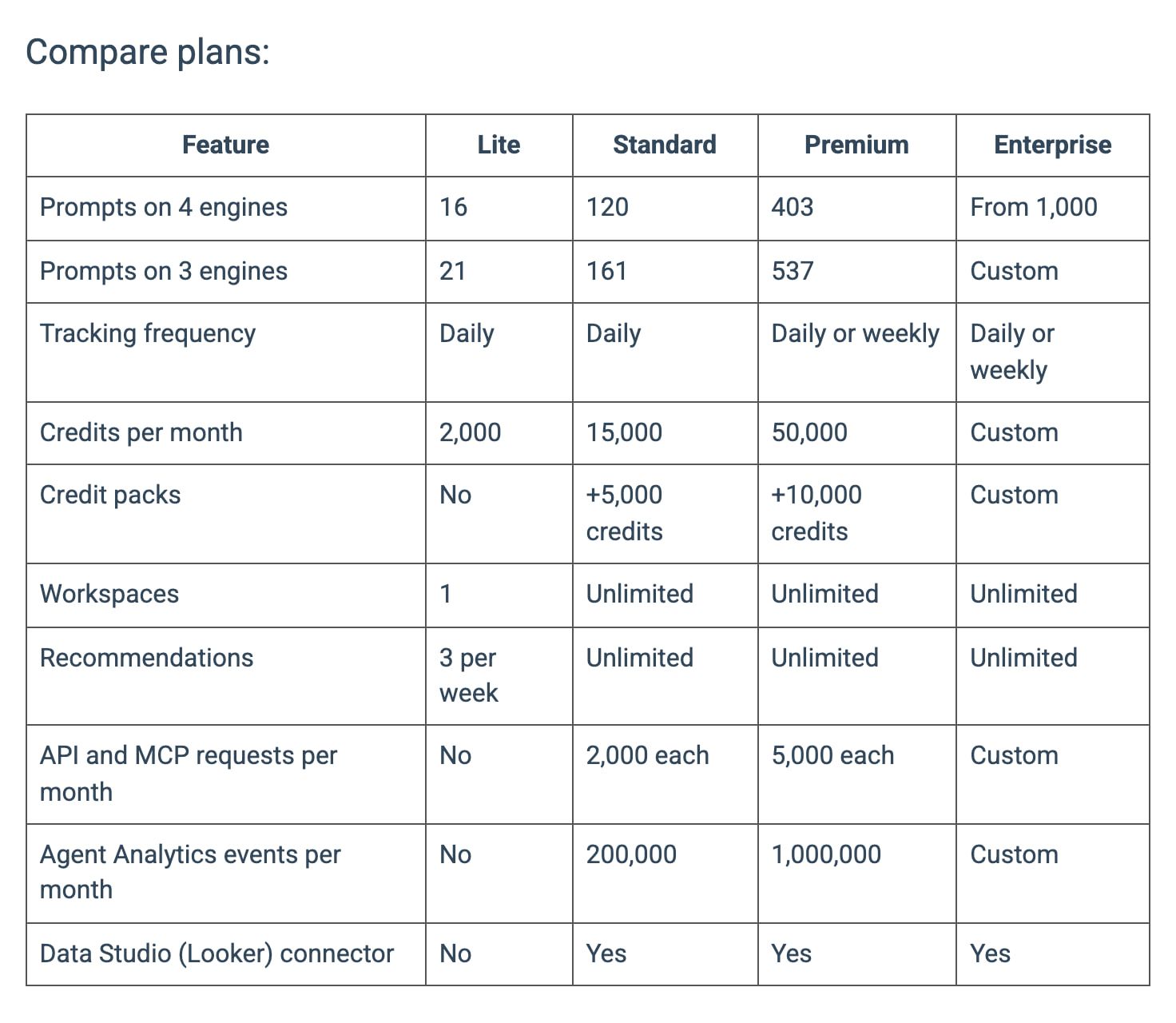
Engines are the multiplier people forget. Otterly Lite’s 2,000 credits cover 16 prompts on 4 engines or 21 on 3, and a Claude check costs 3 credits (Otterly help). On Ahrefs, “Claude consumes 8 checks per update” (Ahrefs Brand Radar).
SE Ranking suggests running prompts “across 2–3 priority AI models” (SE Ranking), and I agree: pick the engines your buyers use, then spend the rest of the budget on prompts.
On Otterly, weekly checks stretch the same credits about 3 times further (124 ÷ 40, my arithmetic), because it counts weekly tracking as 10 checks a month against 31 for daily (Otterly help). The catch is fewer answers to average. To see what your answers a month come to as a bill per tool, enter that number in the calculator.
How much do AI answers change between runs? #
A lot. In SparkToro and Gumshoe’s study, ChatGPT and Google’s AI repeated the same brand list fewer than 1 in 100 times, and Ahrefs found 45.5% of AI Overview citations were new from one check to the next.
Ahrefs, with the biggest sample, followed 43,000+ keywords that each showed at least 16 AI Overviews over about a month and found “a 70% chance of changing from one observation to the next” (Ahrefs, 11 Nov 2025).
Consecutive answers shared “only 54.5% of URLs”, and an AI Overview persisted 2.15 days before changing. The meaning held steady (cosine similarity 0.95), so the sources churn more than the gist. Ahrefs adds that its checks “weren’t daily”, so “the real citation change rate is much higher”. If one of your citations goes missing, what to check before you rewrite the page puts that churn to use.
SparkToro and Gumshoe had 600 volunteers run 12 prompts on ChatGPT, Claude and Google’s AI in November and December 2025: 2,961 runs, roughly 60 to 100 per prompt per tool. From ChatGPT and Google’s AI, the same brand order came back “more like 1 in 1,000” times (SparkToro, 28 Jan 2026). None of the vendor docs I read says how many samples sit behind each check; how AI visibility tools collect answers lists what to ask.
Presence was steadier than position. City of Hope appeared in 69 of 71 ChatGPT answers but was the top mention in only 25. Rand Fishkin’s verdict: “any tool that gives a ‘ranking position in AI’ is full of baloney.”
His practical advice: “visibility % across dozens to hundreds of prompts run multiple times is a reasonable metric.” Gumshoe sells AI tracking, which the post discloses, and the study isn’t peer-reviewed.
Position Digital, an agency, reran 31 SaaS keywords 3 to 4 times each (92 runs) in Google, from one US account, in August 2026. “For 52% of the keywords, Google changed at least one citation between identical repeat searches” (Position Digital, updated 24 Aug 2026).
The top source held better: the #1 URL stayed the same for 25 of 29 keywords (86%), against 69% at #2, 66% at #3 and 44% at #6. It calls its own data “directional”: “One account, one country, one day”.
Engines don’t agree with each other either. Across 540,000 US query pairs from September 2025, Ahrefs found AI Mode and AI Overviews “cited the same URLs only 13.7% of the time” (Ahrefs, 15 Dec 2025). What that means for which Google surface to track first is in AI Mode vs AI Overviews: what changes for tracking.
| Who ran it | Sample | What changed | Their stake |
|---|---|---|---|
| Ahrefs | 43,000+ keywords, 16+ AI Overviews each, about a month, irregular checks | 70% chance an AI Overview changes between checks; 45.5% of cited URLs new | Sells Brand Radar |
| SparkToro × Gumshoe | 2,961 runs of 12 prompts, Nov–Dec 2025 | Same brand list fewer than 1 in 100 runs; same order about 1 in 1,000 | Gumshoe sells AI tracking (disclosed); not peer-reviewed |
| Position Digital | 31 keywords × 3–4 reruns, one day, one account, US | 52% of keywords changed at least one citation; #1 source stable for 86% | Agency; calls it 'directional' |
| Evertune | 10,700 prompts on ChatGPT | ±27 points at 5 repetitions, about 6 at 100 | Sells a platform; method not fully published |
| Ahrefs | 540,000 query pairs, Sep 2025, US | AI Mode and AI Overviews share 13.7% of cited URLs | Sells Brand Radar |
Source: Each study's own page, read 16 Nov 2026. SparkToro read through a text reader after a 403. Scroll sideways for more columns.
My read: the top answer is steadier than the rest, but lists and their order churn. So count how often you appear across many answers and never act on one check. I explain why that’s a share and not a rank in rank tracking vs AI visibility.
So how many runs is enough? #
Judge topics, not single prompts: one prompt checked daily on one engine gives 30 answers a month, too few to tell 20% from 30%, while a 10-prompt topic gives 300.
The arithmetic is the standard 95% margin of error for a share: 1.96 × √(p × (1 − p) ÷ n), where p is how often you appear and n is the number of answers. Below I set p at 20%, as an illustration, not a test.
| Answers a month | Example | Margin of error at 20% | Good for |
|---|---|---|---|
| 30 | 1 prompt, 1 engine, daily | ±14 points | Spotting only large swings |
| 150 | A 5-prompt topic, 1 engine, daily | ±6 points | A first read on a topic |
| 300 | A 10-prompt topic, 1 engine, daily | ±4.5 points | Calling a 10-point change month to month |
| 900 | 30 prompts, 1 engine, daily | ±2.6 points | Smaller moves across a product line |
| 4,500 | 50 prompts, 3 engines, daily | ±1.2 points | A whole-brand number |
Source: My arithmetic: 1.96 × √(0.2 × 0.8 ÷ n). Answers to the same prompt are correlated, so treat these margins as a floor. Scroll sideways for more columns.
Two cautions. Answers to the same prompt are related, so real margins are wider than these. And the formula only partly matches Evertune: at a 10% share it gives about ±26 points at 5 repetitions and ±6 at 100, close to Evertune’s ±27 and about 6, but ±17 at 12 repetitions where Evertune reports ±12.
So my rule: call a change only when the number rests on roughly 300 answers or more, such as a 10-prompt topic on one engine for a month.
SparkToro’s advice that a prompt usually needs running “at least 60-100X” points the same way, and pooling prompts by topic gets you there without paying for 100 runs of every prompt.
What do entry plans actually give you? #
A prompt allowance, but the number that matters is answers per prompt: Peec Starter’s 50 prompts get 90 answers each a month, Nightwatch Starter’s 50 get 30, and Trakkr Growth’s 50 get 240 (pricing pages, 16 Nov 2026).
| Tool | Entry plan, price as shown | Prompts | Engines | How often | Answers per prompt a month (my arithmetic) |
|---|---|---|---|---|---|
| Peec AI | Starter, $95/mo | 50 | 3 models | Daily | 90 (3 × 30) |
| Otterly | Lite, €29/mo (seen in EUR) | 2,000 credits: 16 prompts on 4 engines, 21 on 3 | 4 of 7 | Daily (31 checks) | 124 credits on 4 engines |
| Semrush AI Visibility | $99/mo per domain; billed annually per the pricing page, '$99 per month' per the help center (conflicting) | 25 | ChatGPT and AI Mode named for tracking (help center) | Daily | Not stated |
| SE Visible | Basic, $89/mo ($71 with the annual saving); 14-day trial | 75 | 5 | Daily | 150 (11,250 ÷ 75) |
| Scrunch | Core, $250/mo; 7-day trial (24 Nov) | Not listed; 15,000 AI responses a month | 8 | 'Daily' on the pricing card (24 Nov); FAQ read 16 Nov: daily for 14 days, then every 72 hours | 300 at 50 prompts (15,000 ÷ 50) |
| Promptwatch | Essential, $95/mo | 50 | 'Track all models' | Daily | 120 (6,000 ÷ 50) |
| Nightwatch | Starter, €79/mo (seen in EUR), incl. 500 keywords | 50 | 5 | 'Tracked daily', capped at 1,500 answers | 30 (1,500 ÷ 50) |
| Mangools | Basic, $37.70/mo ($452.40/yr), incl. rank tracking | 500 | OpenAI, AI Overviews, Claude '+5 more' | '2×' per prompt; frequency not stated | Unknown |
| Frase | Starter, $39/mo billed yearly | 20 | 2 (ChatGPT, Google AI) | Daily | About 60 (inferred) |
| Ahrefs | Lite, $129/mo, incl. 150 AI prompt checks | 5 daily on 1 platform | Chosen per prompt | Daily | 30 per platform |
| Trakkr | Growth, $100/mo ($83 yearly); 14-day trial | 50 per brand | 8 | Daily | 240 (12,000 ÷ 50) |
| Profound | Enterprise only, custom; no trial listed (24 Nov) | Tailored and editable | Up to 10 | Daily | Not stated |
Source: Vendors' own pricing and help pages, verified 16 Nov 2026 (US view where shown; Otterly and Nightwatch showed euros), except Profound and Scrunch, read 24 Nov 2026. Answers per prompt = stated monthly answers ÷ prompts, or engines × checks; my arithmetic. Scroll sideways for more columns.
Sources for the table: Peec, Otterly, Semrush pricing and help center, SE Visible, Scrunch, Promptwatch, Nightwatch, Mangools, Frase, Ahrefs, Trakkr and Profound.
A few rows need a note:
- Currency. Otterly and Nightwatch showed me euros, and Otterly’s help says prices are “in USD or EUR, depending on your location” (Otterly help). I print what I saw and don’t convert.
- Scrunch. Its pricing page, read on 24 Nov 2026, shows Core at “$250/mo” for 15,000 AI responses a month on 8 LLMs, with 1 brand, 5 seats and a 7-day free trial. It lists no prompt count. On 16 Nov I read 125 prompts, 5,000 responses and 4 engines on the same plan; the page and its pricing FAQ showed that then, and I dropped those figures because the page no longer matches them. The pricing card now says collection is “Daily”, while the FAQ I read on 16 Nov said new prompts run “daily for the first 14 days”, then “every 72 hours by default” (Scrunch FAQ); I didn’t re-read the FAQ.
- Semrush. The pricing page names mentions from “ChatGPT, Google AI, Gemini, and Perplexity”; the help center says prompt tracking runs on “platforms like Google AI Mode and ChatGPT” and sells 50 more prompts “for $60 per month”. I couldn’t tell which engines one prompt covers.
- Ahrefs. “Tracking one prompt on one platform in one location uses 1 check.” Extra packs run from $50 for 2,500 checks to $250 for 25,000, and Brand Radar AI starts “from $199/mo” (Ahrefs pricing).
- Trakkr sells more prompts in fifties, up to 500 per brand. Mangools’ $37.70 × 12 is exactly $452.40, so the monthly figure may be the annual-billed rate.
- Profound’s pricing page lists one plan, Enterprise, at “Custom”, with no trial (read 24 Nov 2026). The 7-day trial I recorded earlier in November used 50 prompts from a recommended set you couldn’t edit, so it showed the tool rather than your own list. If you get a demo, ask whether it can run your prompts.
Read the last column first. Nightwatch is a rank tracker at heart, and at 30 answers per prompt you’ll need to read its AI data by topic. Mangools’ 500 prompts look generous, but without a stated frequency I can’t tell how many answers sit behind them.
For more on these plans, see what one Peec AI prompt costs, how Otterly’s credits work and how Semrush’s AI toolkit compares with Ahrefs Brand Radar.
Where should your prompts come from? #
From questions buyers already ask: your Search Console queries rewritten as questions, Bing’s grounding queries, and the objections your sales and support teams hear.
Search Console’s Queries view “groups your data by the search query users typed” (Search Console help). It hides anonymized queries, those “that aren’t issued by more than a few dozen users over a two-to-three month period”, and the interface exports up to “1,000 rows” (Google, 19 Oct 2022).
Peec’s tip is to “Pull your top 50-100 non-branded keywords from GSC” and turn them into questions (Peec).
Google’s generative AI report won’t help with wording. It shows AI Overview and AI Mode impressions by page, country, device and date, with no query dimension (Search Console help).
Bing gets closer. Its AI Performance report (public preview since 10 February 2026) lists grounding queries, “the key phrases the AI used when retrieving content that was referenced in AI-generated answers”, across “Microsoft Copilot, AI-generated summaries in Bing, and select partner integrations” (Bing Webmaster blog). It’s a sample, and the phrasing is the AI’s, not the user’s.
Its Topics Portfolio beta (13 October 2026) groups those into topics, “A broad thematic cluster of related grounding queries where your site appears”, and lists “Top Opportunity Queries” where other sites appear and yours doesn’t (Bing Webmaster blog). That list is a ready-made source of non-branded prompts.
Profound suggests gathering prompts from support, sales and users, including a “How did you hear about us?” field (Profound). Peec points to sales objections and discovery call recordings, and SE Ranking’s help adds People Also Ask, AI Overview questions, Reddit, Quora and competitors’ paid keywords (SE Ranking help).
Write more than one phrasing. When SparkToro’s volunteers wrote their own prompts for the same need, the average semantic similarity between them was 0.081, so real buyers word the same question very differently.
| Source | What it gives you | The limit |
|---|---|---|
| Search Console Queries | Real queries people typed, per page | Anonymized queries hidden; interface export capped at 1,000 rows |
| Bing AI Performance grounding queries | Phrases Copilot and Bing's AI used to find your cited pages | A sample; the AI's phrasing, not users'; Copilot, Bing and select partners only |
| Bing Topics Portfolio | Topic clusters and 'Top Opportunity Queries' you're missing | Beta |
| Google's generative AI report | Which pages got AI Overview and AI Mode impressions | No queries at all |
| Sales calls, discovery recordings, support logs | Buyer language and objections | Manual work |
| People Also Ask, AI Overview questions, Reddit, Quora | Question phrasing | No volumes |
| Vendor prompt-volume scores | Relative demand (Peec scores prompts 1 to 5) | Modelled by the vendor, relative to your own keywords |
Source: Google and Bing help pages and blogs; Peec, SE Ranking and Profound guides and docs, read 16 Nov 2026. Scroll sideways for more columns.
Peec’s 1-to-5 score is relative to your own keywords, not a search count (Peec docs).
Should branded prompts sit apart? #
Yes. A prompt that names your brand will nearly always get an answer that mentions you, so keep those in their own group or they inflate your share.
Most guides I read keep the two apart. I’d hold branded prompts to about a fifth of the list, which is where the 10-of-50 split in my pick comes from.
For the non-branded part, weight the middle of the funnel. All three vendors that publish a split put the biggest share on consideration questions, where buyers build shortlists.
| Who | Early (awareness) | Middle (consideration) | Late (brand, decision) |
|---|---|---|---|
| Superlines | 25% | 50% | 25% |
| SE Ranking, per ~100 prompts | 30–40 | 40–50 | 10–20 brand evaluation |
| Peec AI | 10–20 | 20–30 | Not given |
Source: Superlines guide (updated 19 Oct 2026), SE Ranking help center and Peec AI guide (22 Jan 2026), read 16 Nov 2026. Scroll sideways for more columns.
SE Ranking’s help puts it well: “the ratios matter more than the absolute numbers” (SE Ranking help). Its 10 to 20 brand prompts per 100 matches my one-fifth cap.
How often should you change the list? #
Keep a stable core for at least 30 days, review monthly and do a full pass each quarter, so this month’s numbers still compare with last month’s.
SE Ranking says “Track for at least 30 days before drawing conclusions” (SE Ranking), and Peec says “Track for 30 days” (Peec). Superlines suggests you “Check priority prompts monthly and review the whole list quarterly” (Superlines).
Swapping prompts resets your baseline, so add new prompts beside the core rather than replacing it. Report the new ones as their own group until they have a month of history.
What would I pick for your team? #
For one brand, 50 prompts on Peec AI Starter; for a pilot, Otterly Lite; for several product lines, SE Visible Core; for agencies, SE Visible Agency at 25 to 50 prompts per client.
| Your situation | How many prompts | My pick | Why |
|---|---|---|---|
| One brand, small team | About 50: 40 non-branded, 10 branded; daily on 3 engines | Peec AI Starter, $95/mo | Holds exactly 50 on the 3 models you choose: 4,500 answers. Promptwatch Essential ($95) and Trakkr Growth ($100, all 8 engines) hold the same 50 |
| A pilot on a small budget | 16–21 | Otterly Lite, €29/mo as shown to me | Drop to 3 engines for 21 prompts. Enough for 3 or 4 topics, not a full picture. Frase Starter's 20 prompts ($39 billed yearly) is the alternative |
| You track keyword rankings too | 50, plus 500 keywords | Nightwatch Starter, €79/mo as shown to me | One bill for both, but 30 answers per prompt a month, the thinnest here |
| B2B, several product lines | About 150: 30–50 per line | SE Visible Core, $189/mo | 200 prompts on 5 engines, daily: room for 3 to 5 lines. Nightwatch Professional (€159, 150 prompts) if you also track keywords |
| Agency | 25–50 per client to start | SE Visible Agency, $399/mo | 1,000 prompts across 30 projects: about 33 a project if all are full (my arithmetic) |
| Enterprise | Start at 100, grow by topic | A quote-based plan such as Profound Enterprise | Profound's own advice; Enterprise lists up to 10 engines |
Source: My picks, from vendors' pricing pages verified 16 Nov 2026 and the studies above. Euro prices are as the pages showed me. Scroll sideways for more columns.
Why Peec over Trakkr for one brand, when Trakkr gives 240 answers per prompt for $5 more? Both check daily, but Trakkr’s extra answers come from engines your buyers may never use, while Peec puts all 50 prompts on the 3 that matter (Peec pricing, Trakkr pricing). If you can’t say which engines your buyers use, take Trakkr.
For several product lines I’d take SE Visible Core’s 200 prompts at $189 over stretching a 50-prompt plan, because 30 to 50 prompts per line is what it takes to read each line on its own (SE Visible pricing). Its 14-day trial lets you check the engines first.
For agencies, 25 to 50 per client matches both SE Ranking’s 20-to-40 starter and Semrush’s 25 per domain. I priced agency plans client by client in AI visibility tools for agencies.
For enterprise, Profound says “Aim to start with a list of 100 prompts” and that users “generally track anywhere from 100 to 1,000 prompts” (Profound). Its pricing page, read 24 Nov 2026, lists Enterprise as the only plan, at “Custom”, with a “Get a Demo” button and no trial, so you’ll need a sales call either way. Profound retired Starter and Growth for brands in September 2026; the history is in what Profound costs now.
Claims I'd check before you rely on them
- ThriveStack’s table of 35 to 150 prompts with error margins. It rests on an unpublished “audit of 50,000 multi-engine model probes”, gives ±2.1% at 60 prompts but ±4.2% at 50, and quotes an expert and institute I found no other trace of (ThriveStack). None of its numbers appear anywhere else on this page.
- “5–8 questions per topic” from Scrunch. Scrunch’s own blog says “12–15 questions per cluster” (Scrunch blog). Both are Scrunch’s advice; neither cites evidence.
- Scrunch’s Starter plan at $300 for 350 prompts, or Core at 125 prompts. One earlier fetch of Scrunch’s pricing page returned Starter, and a 16 Nov browser read showed Core at 125 prompts. On 24 Nov the page shows Core at $250 a month for 15,000 AI responses on 8 LLMs and lists no prompt count, so pages quoting either figure are out of date (how Scrunch’s versions line up).
- Profound’s Starter and Growth plans, or its free trial. Profound retired both plans for brands in September 2026 and its pricing page lists no trial (read 24 Nov 2026). Its FAQ says the $399 and $499 prices tied to them are no longer available for new subscriptions.
- Position Digital’s sample size. Its method says 31 keywords; its source-stability section says 29.
- Evertune’s ±12 points at 12 repetitions. The standard formula gives about ±17 at that share (see the cautions above).
FAQ
Is 25 prompts enough?
For a pilot, yes. Semrush's AI Visibility toolkit includes 25 prompts tracked daily, which covers 3 to 5 topics at 5 to 8 prompts each. It's too few for a full picture of one brand, so I'd plan on about 50.
How many times should each prompt run?
Many times, or pool prompts by topic. SparkToro says a prompt usually needs running 'at least 60-100X', and Evertune sees 'tight margins of error at 100 repetitions'. Few plans run one prompt that often, so read prompts by topic: 10 prompts checked daily on one engine give 300 answers a month.
Should I track daily or weekly?
Daily if your plan allows it. Ahrefs found an AI Overview persisted about 2.15 days before changing, and fewer checks leave fewer answers to average. On Otterly, weekly tracking counts as 10 checks a month against 31 for daily, so it stretches credits about 3 times further. That suits a pilot or a tight credit budget.
Do I need to track every AI engine?
No. Track the 2 or 3 engines your buyers use, as SE Ranking suggests. Just don't treat engines as interchangeable: Ahrefs found AI Mode and AI Overviews cited the same URLs only 13.7% of the time.
Does Search Console show the prompts people use?
No. Its generative AI report shows impressions in AI Overviews and AI Mode by page, country, device and date, with no queries. The regular Queries report and Bing's grounding queries are the closest free sources of question wording, though Bing's phrasing is the AI's, not the user's.
How many prompts per client should an agency track?
25 to 50 to start. SE Visible's Agency plan holds 1,000 prompts across 30 projects, about 33 per project if you fill all 30, and Semrush's toolkit includes 25 per domain. Add more for clients whose buyers research in AI chat.
Sources
38 sources, accessed to .
Official pricing, docs, changelogs and status pages 26
- Peec AI: pricing and answer formula
- Peec AI docs: setting up your prompts
- Otterly AI: pricing
- Otterly AI help: pricing and credits (updated 10 Nov 2026)
- Semrush: AI Visibility toolkit pricing
- Semrush knowledge base: AI Visibility toolkit
- SE Visible (SE Ranking): pricing
- Scrunch: pricing (Core plan, 15,000 AI responses a month; read 24 Nov 2026)
- Scrunch FAQ: plan pricing (read 16 Nov; showed the older 125-prompt Core, not re-read)
- Scrunch FAQ: how data is collected and how often
- Scrunch FAQ: how many prompts to track (vendor advice)
- Promptwatch: pricing
- Nightwatch: pricing, shown in euros
- Mangools: plans and pricing, incl. AI Search Watcher
- Frase: pricing, incl. AI prompts
- Ahrefs: pricing, AI prompt checks and packs
- Ahrefs: Brand Radar, how checks are counted
- Profound: pricing (Enterprise only, no trial listed; read 24 Nov 2026)
- Trakkr: pricing
- Trakkr help: prompts and plan limits (vendor advice)
- SE Ranking help: how to choose which prompts to track
- Search Console help: Performance report, Queries
- Google Search Central blog: a closer look at Performance data (19 Oct 2022)
- Search Console help: Generative AI performance report
- Bing Webmaster blog: AI Performance public preview (10 Feb 2026)
- Bing Webmaster blog: Topics Portfolio beta (13 Oct 2026)
Other blogs 12
- Ahrefs (vendor research): AI Overviews change every 2 days, Nov 2025
- Ahrefs (vendor research): AI Overviews vs AI Mode citations, Dec 2025
- SparkToro with Gumshoe (sells AI tracking): AI recommendation consistency, Jan 2026
- Position Digital (agency research): AI Overview citations across reruns, Aug 2026
- Evertune (sells an AI visibility platform): repetitions per prompt, Jul 2026
- Peec AI (vendor guide): choosing prompts for LLM tracking, Jan 2026
- SE Ranking (vendor guide): how to choose prompts to track, Apr 2026
- Profound (vendor guide): designing prompts for AI visibility tracking, Feb 2026
- seoClarity (vendor guide): choosing prompts to track, Sep 2026
- Superlines (vendor guide): what prompts to track, updated Oct 2026
- Scrunch blog (vendor guide): right-sizing AI search tracking
- ThriveStack (vendor page): prompt count claims, not used as evidence
Last updated: 24 November 2026. Facts verified 16 Nov 2026, except the Profound and Scrunch plans, re-read 24 Nov 2026. Researched and drafted with AI tools; owner review is pending.


