How AI visibility tools work, and why their numbers differ
AI visibility tools run your prompts through ChatGPT, AI Mode and others, by browser or API. I compared 11 vendors' own docs to show what that changes.

Short on time?
Short on time? Here's my take.
- You want the raw answers behind every number
- Peec AI Starter
- $95 a month for 50 prompts on 3 engines (verified 17 Nov 2026). Browser automation, logged out, daily, and you can open the last 100 chats per prompt.
- A pilot on a small budget
- Otterly Lite
- Collects from each engine's website (Claude by API), daily, with a country per prompt.
- You already pay for Semrush
- Semrush AI Visibility toolkit
- Says answers come 'from real requests and not via any APIs of LLMs'. Ask about login state and repeats.
- Enterprise that wants prompt-demand data
- Profound
- Captures the consumer browsing experience and sells prompt volumes from a consented panel. Ask how the panel is sourced.
- Any tool that collects by API
- Read it as model behaviour
- Its numbers show how the model answers, not what your buyers see in the app.
Prices verified . Methods from vendors' own docs; prices verified 17 Nov 2026. No vendor paid to be included, and sponsors can't buy a verdict.
Updated 24 November 2026: Scrunch’s pricing card now lists collection as daily, which conflicts with its FAQ, and Ahrefs now claims 588 million+ prompts.
Two tools, the same prompts, different numbers. Most of the gap comes from how each tool collects its answers: which engine it asks, through which door, from where, how often, and which formula turns mentions into a score.
So I read 11 vendors’ own docs on how they collect, plus the four vendor pages that argue the two main methods, to show what each number measures and what to ask before you buy. For the tools themselves, start at my AI visibility hub.
What happens when a tool tracks a prompt? #
It sends your prompt to an AI engine on a schedule, saves the answer, and counts which brands and links appear. Every score you see is built from those saved answers.
The pipeline has five steps, and each one is a place two tools can differ:
- A prompt list: yours, or drawn from the vendor’s database.
- An engine and a location for each prompt.
- Capture: the tool gets an answer through the engine’s app or its API.
- Parsing: brand mentions, cited links and the order they appear in.
- Aggregation: ratios across many answers become visibility, share of voice and position.
Peec’s docs show how much of that you can inspect. Each saved chat records the platform, whether a web search ran and the location it was prompted from, and you can view “the last 100 chats for each prompt” (Peec docs).
The same page separates citations, “Sources explicitly referenced within the AI response text”, from sources, “All URLs the AI model accessed”. In Peec’s own research on Perplexity, 64% of retrieved URLs were never cited (Peec research). The method is thin, but it’s a reason to ask which one a tool means when it says you “appeared”.
Where do the prompts come from? #
Mostly from you. Suites also sell prompt databases built from search data or user panels, so “prompt volume” is an estimate, not a count of what people typed.
- Ahrefs “takes real queries from its keyword database” and “expands them into natural questions via People Also Ask and semantic fanout”, for “588 million+ search-backed prompts” (Ahrefs Brand Radar, read 24 Nov 2026; the figure grows between my reads).
- Semrush says: “We source billions of real prompts from AI search clickstream data and Google’s keyword dataset for AI Overviews”, with “over 317 million prompts” across 117 regional databases (Semrush KB). It doesn’t say whose clickstream.
- Profound’s Prompt Volumes come from “hundreds of millions of real, consented user conversations, updated weekly” (Profound).
Profound’s panel has been questioned. In 2025 The Register reported a Profound sales rep citing “150+ million real user conversations”, “primarily clickstream data where a user has opted in”, and an outside expert doubting consent through browser extensions. Profound’s reply: “All data we use is 100 percent opt-in by the end-user and both GDPR- and CCPA-compliant.”
Panels have blind spots by design: SparkToro’s March 2026 study with Datos used a desktop-only panel and counted each prompt session as one search (SparkToro). Any volume figure inherits choices like those. And Semrush’s page says its database is “updated daily on a rolling basis” while its summary mentions monthly updates, so ask which applies.
Interface or API: what’s the difference? #
An interface tool types the prompt into the same chat page a person uses and saves what comes back. An API tool asks the model directly, which may skip web search, citations and the app’s layout.
Peec states the interface case plainly: “Instead of APIs, Peec AI uses browser automation to interact with AI platforms through their web interfaces”, where “the platform decides which model to use and whether it runs a web search” (Peec docs). That’s the point: the app makes choices an API call doesn’t.
Some surfaces leave no choice. Waikay’s guide notes that AI Overviews “has no public API access” (Waikay), and Promptwatch says it reads AI Overviews and AI Mode from real Google results pages (Promptwatch).
The API case is consistency: “Same prompt, same model version, same parameters, every time”, in Waikay’s words. Vendors don’t even agree on cost: Waikay calls scraping “up to 10x cheaper”, Promptwatch calls the API “cheaper and simpler than automating a browser”.
Conductor, which uses “API-based monitoring” with web-search grounding, argues that “Most AI platforms explicitly prohibit automated scraping in their terms of service” (Conductor). That’s its claim. Google’s terms bar “using automated means to access content from any of our services in violation of the machine-readable instructions” (Google Terms) but say nothing about trackers specifically, and I couldn’t open OpenAI’s terms. I wouldn’t treat the terms question as settled either way.
Superlines, which runs a hybrid, frames it best: the key question is “which AI experience a tool measures”, and interface results still aren’t “proof of what every user sees” (Superlines).
What does the evidence actually show? #
That the two methods give different answers, not which one is right. The only sizeable comparison is Surfer’s: 1,000 prompts, one sample each, run by a vendor that sells the interface method.
Surfer put 1,000 prompts through ChatGPT, Perplexity, Gemini, AI Mode and AI Overviews on 4 August 2026, collecting 13,779 answers from the apps and from APIs (Surfer). The brands named overlapped only 15.5% to 23.8%, or 21.3% to 31.6% after cleaning up brand names.
The direction isn’t fixed. ChatGPT’s API named more brands than the app (13.8 against 7.9) but cited far fewer sources (3.1 against 12.1), while Perplexity’s API cited more than its app (19.5 against 10.3). Surfer doesn’t disclose location or login state and calls its own method “the only right approach”.
| Who | Sample | What they found | What they sell |
|---|---|---|---|
| Surfer | 1,000 prompts on 5 products, one sample each, 4 Aug 2026 | 15.5% to 23.8% brand overlap; ChatGPT's app cites about 4 times more sources than its API, Perplexity the reverse | An interface-collected tracker |
| seoClarity | 1 prompt on ChatGPT, undated | Outputs 'far from identical'; its table and text disagree on API citations | AI tracking; the post doesn't say which method its tool uses |
| Writesonic | 1 query | The platform cited 'over a dozen sources', the API almost none | A tool that says it scrapes web interfaces |
| Conductor | No study | Argues the API is precise and scraping fragile and against platform terms | API-based monitoring |
Source: Each vendor's own page, read 17 Nov 2026. Every row is the vendor's own test or argument. Scroll sideways for more columns.
seoClarity’s table labels the API output “Raw model text only” while its text says the API output “Includes citations from relevant sources” (seoClarity). Writesonic’s comparison is in its docs.
Nobody outside has checked the samplers either. Trakkr, which says outright that it’s “a rival to Otterly”, found “No third-party validation or sampling-error study found publicly” for Otterly (Trakkr), and I found none for any tool.
Which method does each tool say it uses? #
Most tools I read say they collect from the consumer interface for the big engines, and several switch to an API for one or two, usually Claude, DeepSeek or Mistral.
| Tool | Method, in its own words | Logged in? | Location | How often | Citations stored |
|---|---|---|---|---|---|
| Peec AI | 'browser automation' through web interfaces; its channel examples include 'Perplexity API' | Logged out | Recorded per chat (e.g. United States) | Daily | Yes, plus all URLs the model accessed |
| Otterly | 'the website of the AI search'; 'API for Claude tracking' | Not stated | A country per prompt | Daily (weekly counted in credits) | Yes |
| Scrunch | 'browser automation and official platform APIs', per platform | Not stated | Not stated | FAQ: daily for 14 days, then every 72 hours; Core pricing card (24 Nov): 'Daily' | Full response and citations |
| Profound | 'consumer browsing experience rather than from model APIs' | Not stated | '150+ regions' | Not stated | Not stated on the page I read |
| Semrush AI toolkit | 'real requests and not via any APIs of LLMs' | Not stated | 117 regional databases | Prompt Tracking daily; Brand Performance weekly | Yes |
| Ahrefs Brand Radar | Not stated | Not stated | Not stated | Index monthly; custom prompts up to daily | Index of cited sources |
| Promptwatch | Browser sessions for live-search engines; 'provider APIs, on purpose' for DeepSeek and Mistral | Not stated | The monitor's country | Cadence page not read | Yes |
| Writesonic | Says it scrapes 'the actual web interfaces' | Not stated | 'different geographical points' | Not stated | Yes |
| Superlines | Interface for ChatGPT, AI Overviews, AI Mode, Perplexity, Gemini, Copilot, Grok; Claude by API with web search; DeepSeek, Mistral by API | Not stated | Not stated | Not stated | Yes |
| Waikay | Both: API, plus scraping for AI Overviews and Copilot | Advises 'clean, fresh accounts' | Not stated | Not stated | Not stated |
| Conductor | API with web-search grounding | Not applicable (API) | Not stated | Claims 'real-time' | Claims yes |
Source: Each vendor's own docs, help or info page, read 17 Nov 2026 (Scrunch FAQ and pricing card and Ahrefs re-read 24 Nov). 'Not stated' means the pages I read are silent, not that the tool can't. Scroll sideways for more columns.
Sources for the table: Peec and its model channels, Otterly, Scrunch, Profound, Semrush, Ahrefs, Promptwatch, Writesonic, Superlines, Waikay and Conductor.
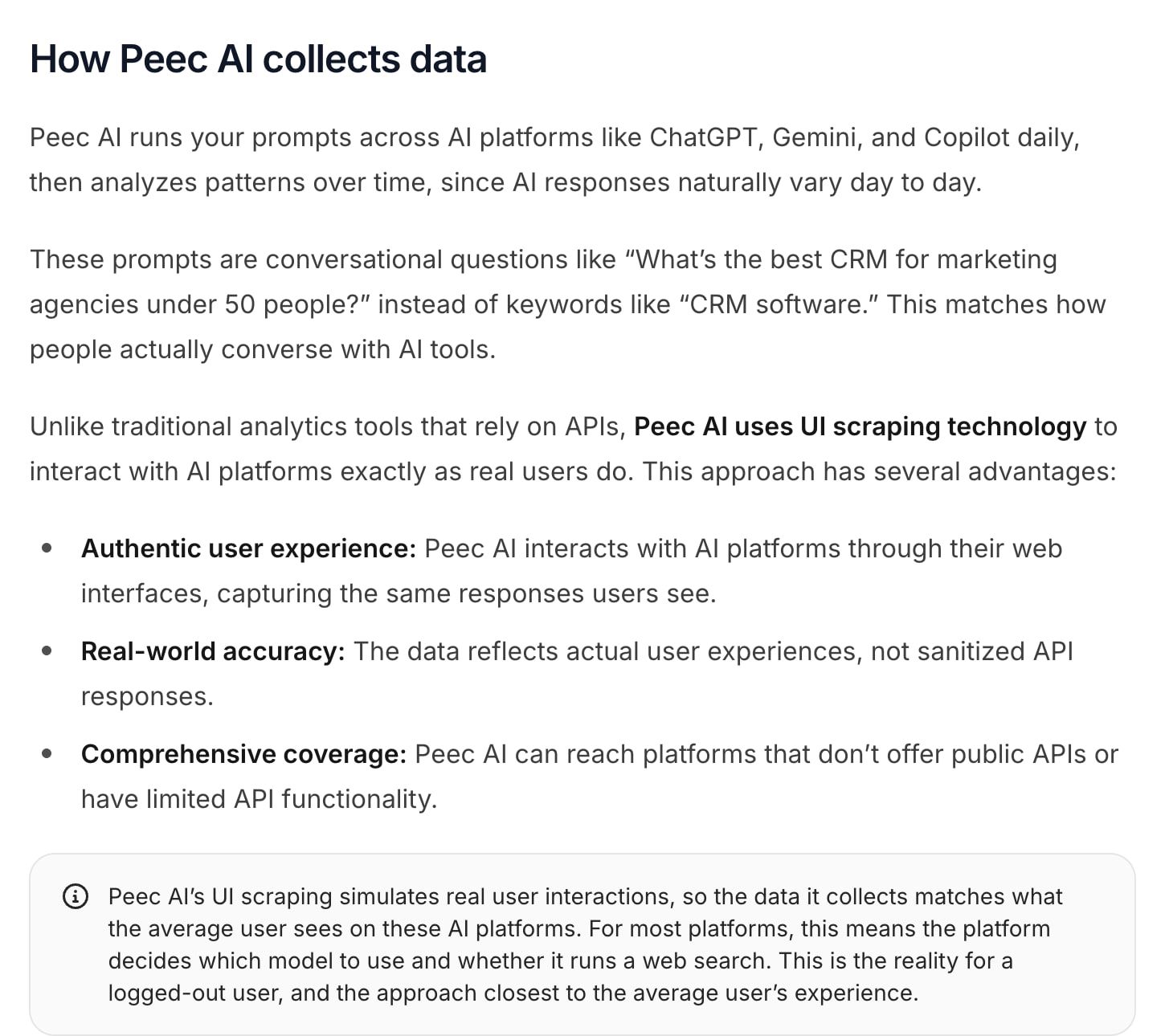
Two pages ranking for this question get the method wrong. Conductor’s best-platforms guide puts Peec in its API column, while Peec’s own docs say browser automation. And Laura de Castro’s November 2025 newsletter says “Most platforms use general APIs from the models to recreate responses” (Laura de Castro), which isn’t what most of these vendors’ docs say today.
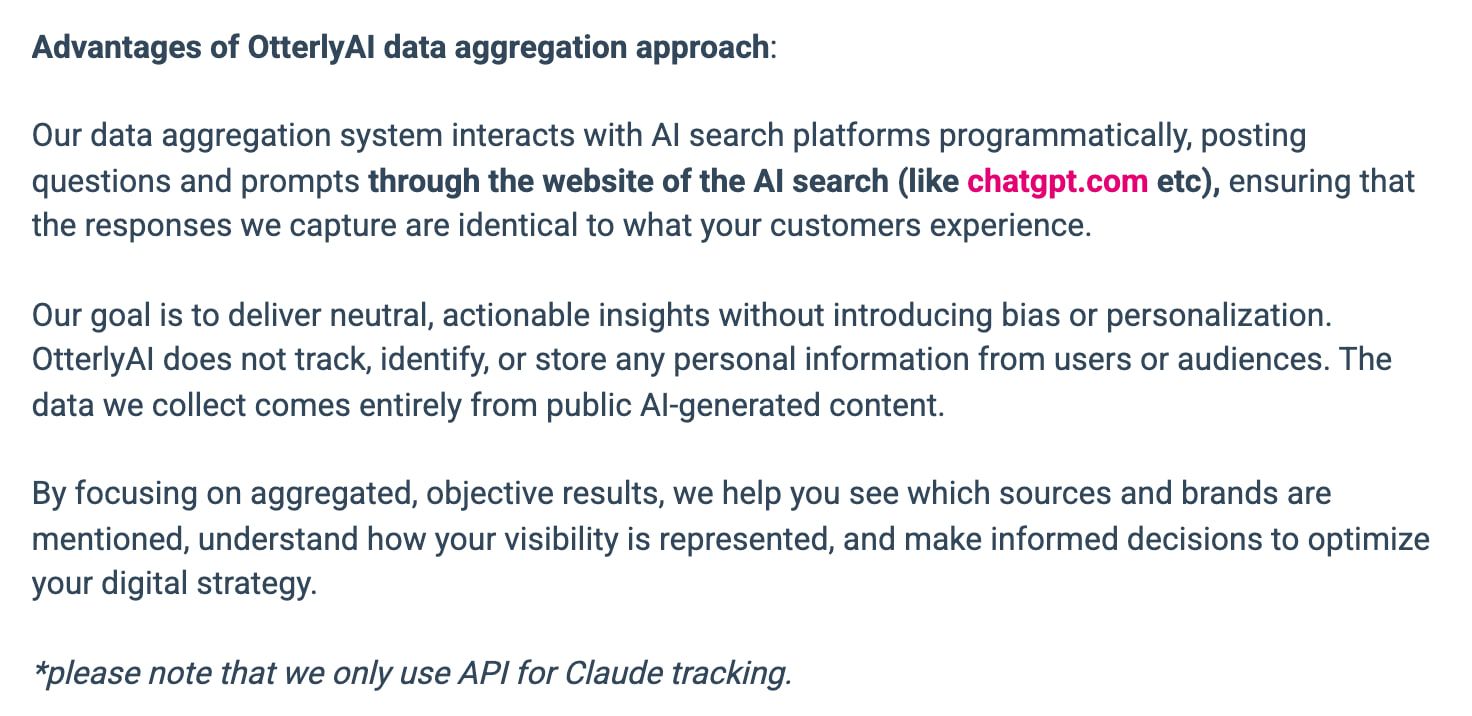
The real pattern is hybrid. Otterly says “we only use API for Claude tracking”; Promptwatch and Superlines call DeepSeek and Mistral by API; even Peec’s channel list includes “Perplexity API”. So ask per engine, not per tool, and see which AI engines to track for how to choose them. I compare two of these head to head in Otterly vs Peec AI, and the two $95 plans in Promptwatch vs Peec AI.
Do login and location change the answer? #
It can. Peec collects logged out and says that’s closest to the average user; Conductor argues logged-out sessions over-represent older models. Neither shows data.
Peec calls logged out “the approach closest to the average user’s experience” (Peec docs). Conductor says logged-out sessions over-represent older models (Conductor), and Waikay advises collecting “from clean, fresh accounts”. No tool I read claims to see a signed-in user’s personalised answers; de Castro calls what they capture a “neutral baseline”.
Location is better documented. Otterly says “each prompt in OtterlyAI can be assigned to a specific country” (Otterly), Peec records where each chat was prompted from, and Promptwatch says “Live-search runs are made from the monitor’s country”. Profound lists “150+ regions”; Scrunch and Superlines don’t say. If you sell in more than one country, confirm the tool sets location per prompt before you compare markets.
How many runs make a real number? #
More than one. Ahrefs found an AI Overview had a 70% chance of changing between observations and lasted about 2.15 days, so a single check is a snapshot.
Across 43,000+ keywords over about a month, consecutive AI Overviews shared “only 54.5% of URLs”, and because “our checks weren’t daily”, the real rate is likely higher (Ahrefs). In SparkToro and Gumshoe’s 2,961 runs of 12 prompts, the same brand list came back fewer than 1 in 100 times, and SparkToro says a prompt usually needs running “at least 60-100X” (SparkToro, read 16 Nov).
Metehan Yesilyurt calls a single weekly run “a poll, not a measurement” (metehan.ai), and Waikay recommends “at least five to ten runs per prompt”. Yet the docs I read describe how often a prompt is checked, not how many samples sit behind each check. So ask.
Pooling prompts by topic is the practical fix. I size that in how many prompts you should track: about 300 answers a month behind a topic before you call a change.
How do mentions turn into a score? #
By simple ratios, but each tool picks a different one, so 30% in one tool and 30% in another aren’t the same thing.
| Tool | Metric | How it's calculated |
|---|---|---|
| Peec AI | Visibility | Responses mentioning your brand ÷ all responses × 100 |
| Peec AI | Share of voice | Your brand's mentions ÷ all brand mentions × 100 |
| Peec AI | Position | Your average rank across the responses where you appear |
| Otterly | Brand coverage | Prompts that mention you ÷ all prompts |
| Otterly | Share of voice | Your brand mentions ÷ all brand mentions × 100 |
| Otterly | Domain coverage | Prompts citing your domain ÷ all prompts |
| Profound Index | Visibility | Share of responses where a brand was mentioned (weekly, ChatGPT, US) |
| Semrush | AI Visibility Score | How often you're mentioned compared with the median mentions of auto-picked competitors |
Source: Peec AI docs, Otterly help center, Profound blog and Semrush knowledge base, read 17 Nov 2026. Scroll sideways for more columns.
Sources: Peec visibility, share of voice and position; Otterly KPIs; Profound Index; Semrush.
Look at the denominators. Peec’s visibility counts responses; Otterly’s brand coverage counts prompts. Semrush compares you with competitors it picks itself, so its benchmark may not be the set you’d choose.
Share of voice moves with the competitor list. Peec’s own example: 4 mentions against a competitor’s 12 is 25%.
Add two more competitors with 4 mentions each and the same answers give 4 ÷ 24, about 17% (my arithmetic, an illustration). Nothing in the answers changed. I go further in what AI share of voice measures, and where it misleads.
Why do some engines cost more? #
Plans bill by answers, prompts × engines × days, and some engines carry a premium, Claude most clearly. Vendors don’t say why.
Peec counts answers by “multiplying tracked prompts by active models and tracking frequency”. Starter is $95 a month for 50 prompts on 3 models (4,500 answers), Pro $245 for 150 prompts and Advanced $495 for 350, with an extra model at $30, $70 or $140 a month depending on plan (Peec pricing, verified 17 Nov 2026).
Otterly says “Claude counts as 3 credits per check; every other engine counts as 1”, with daily tracking counted as 31 checks a month and weekly as 10 (Otterly). On Ahrefs, “Claude consumes 8 checks per update” (Ahrefs). Otterly collects Claude by API, and neither vendor explains the premium.
So choose engines before you count prompts. To turn your mix into a monthly bill, use the AI visibility cost calculator.
What should you ask a vendor before you buy? #
Eight questions, one per column of the tables above. A vendor that answers all eight in writing is telling you what its numbers mean.
- Interface or API, engine by engine?
- Logged in or logged out?
- Which country does each prompt run from, and how is it set?
- How often is each prompt checked, and how many samples sit behind each check?
- Can I open the raw answers behind every number?
- Do you store citations and the sources the model accessed separately?
- How exactly is your visibility or share-of-voice score calculated, and who’s in the competitor set?
- How do you log model or interface changes, such as Peec’s model channels (Peec docs)?
Which one should you pick? #
The tool that documents its method for the engines your buyers use. On what vendors publish today, here’s where I’d start.
- You want the raw answers behind every number: Peec AI Starter, $95 a month (verified 17 Nov 2026). Its docs answer more of the eight questions than any other I read: method, logged out, daily, location, and the last 100 chats per prompt.
- A pilot on a small budget: Otterly Lite. Website collection (Claude by API), daily, a country per prompt. I couldn’t confirm a US-dollar price, so see Otterly’s pricing explained.
- You already pay for Semrush: its AI Visibility toolkit. Ask about login state and repeats; I compare it in Semrush’s AI toolkit vs Ahrefs Brand Radar.
- Enterprise that wants prompt-demand data: Profound. Ask how the panel is sourced, given The Register’s questions; Peec AI vs Profound covers the trade-off.
- Any tool that collects by API: read its numbers as how the model behaves, not what your buyers see in the app.
If you only need Google’s AI features for your own pages, start free: what Search Console shows about AI Overviews. For which kind of measurement you need at all, see whether you need rank tracking, AI visibility or both.
FAQ
Do AI visibility tools use the ChatGPT API?
Mostly not for ChatGPT itself. Peec, Otterly, Profound, Semrush, Writesonic, Promptwatch and Superlines say they collect from the consumer interface for the main engines, and several use APIs for Claude, DeepSeek or Mistral. Conductor collects by API by design.
Are AI visibility tools accurate?
They capture real answers, but answers change between runs and each tool counts differently, so one check is a snapshot. Ahrefs found a 70% chance that an AI Overview changed from one observation to the next. I found no outside study that validates any tool's sampling.
Why do two tools show different visibility scores for the same brand?
Different prompts, engines, locations, collection methods and formulas. Peec's visibility counts responses while Otterly's brand coverage counts prompts, and share of voice moves whenever the competitor set changes.
Do these tools see personalised answers?
Not as far as their docs say. Peec says it collects logged out, and none of the tools I read claims to see a signed-in user's answers.
Where does 'prompt volume' come from?
It's modelled. Ahrefs builds prompts from its keyword database, Semrush from AI search clickstream data and Google keyword data, and Profound from a consented panel of user conversations. None is a count of what people typed into ChatGPT.
Why does tracking Claude cost more?
Otterly charges 3 credits for a Claude check against 1 for other engines, and Ahrefs says Claude uses 8 checks per update. Neither says why. Otterly collects Claude by API, the one engine it doesn't read from the website.
Sources
34 sources, accessed to .
Official pricing, docs, changelogs and status pages 19
- Peec AI docs: how Peec collects answers
- Peec AI docs: understanding chats, citations and sources
- Peec AI docs: model channels
- Peec AI docs: visibility formula
- Peec AI docs: share of voice formula
- Peec AI docs: position
- Peec AI: pricing and answer formula
- Otterly help: how OtterlyAI collects data (17 Jul 2026)
- Otterly help: pricing and credits (10 Nov 2026)
- Otterly help: brand report KPI definitions (5 Oct 2026)
- Scrunch FAQ: how data is collected and how often (undated)
- Scrunch pricing: Core card lists collection as daily
- Profound: product information page (last updated Sep 2026)
- Semrush knowledge base: where AI Visibility data comes from
- Semrush knowledge base: AI Visibility toolkit
- Ahrefs: Brand Radar, prompts and checks
- Promptwatch academy: how Promptwatch collects data
- Writesonic docs: why it monitors real AI platforms (18 Jun 2025)
- Google Terms of Service (effective 30 Jul 2026)
News and press 1
Other blogs 14
- Superlines (sells a hybrid tool): API vs UI data, updated Oct 2026
- Surfer (sells an interface-collected tracker): app vs API answers, Aug 2026
- seoClarity (sells AI tracking): scraping vs API, Aug 2025
- Conductor (sells API-based monitoring): scraping vs API, Jan 2026
- Conductor (vendor): best AI visibility platforms, Sep 2026
- Waikay (vendor guide): data-gathering methods, undated
- Profound (vendor): introducing the Profound Index, Nov 2025
- Peec AI (vendor research): retrieval vs citation, Feb 2026
- Ahrefs (vendor research): AI Overviews change every 2 days, Nov 2025
- SparkToro with Gumshoe (sells AI tracking): AI recommendation consistency, Jan 2026
- SparkToro with Datos: search across 41 websites, Mar 2026
- Laura de Castro (newsletter): how AI visibility tools really work, Nov 2025
- Metehan Yesilyurt (blog): how AI visibility tools collect data, Sep 2026
- Trakkr (a rival to Otterly): Otterly data accuracy review, Aug 2026
Last updated: 24 November 2026. Facts verified 17 Nov 2026, except the Ahrefs prompt count and Scrunch’s cadence, re-read 24 Nov. Researched and drafted with AI tools; owner review is pending.


