Cookie choice. With your OK, this site loads Google Analytics and Microsoft Clarity, which set cookies to tell visits apart. Clarity also records clicks, scrolling and mouse movement, so I can replay how a page is used. If you reject, neither loads. Privacy details
Don't fund an AI-visibility tracker on a conversion multiplier. Read your own GA4 AI Assistant channel, define one conversion and wait for 20 or more before comparing. The studies split by sample, and nearly every multiplier comes from a seller.
Pay monthly for your first quarter, then go yearly on a suite you use every month. Yearly only breaks even at month 10 or 11 on every tool I priced except Ubersuggest. Stay monthly on AI trackers: allowances change, renewal fees can move and yearly saves only 15%.
Don't buy link-building or a bigger backlink tool for AI answers. Ahrefs found mentions beat links in AI Overviews (0.664 vs 0.218), and broad samples show near-zero link signal. All ten are vendor-run correlations. Keep existing links; spend new money on earned mentions.
Don't buy an optimizer or AI-writing tool on these two tests: both are vendor-run and observational. Spend the first month on a check of 10 rewritten pages against 10 untouched ones, and keep a tool only if it makes your writers add first-hand data.
Build most of your tracked prompts around comparing named options, with a few discovery and brand prompts. Treat SparkToro's 6.9% as one panel's number, not a forecast, and don't change budget on these studies: every one comes from a firm that sells data or tracking.
Earn mentions on Reddit and YouTube first: both make the top five of every blended list I read. Add Wikipedia and editorial coverage for ChatGPT, LinkedIn and G2 if you sell software. Use Peec's March 2026 list for which sites, Similarweb's for how much.
Quote 39.8%, from the only randomized study (Agarwal & Sen, June 2026): that's the drop in outbound organic clicks when an AI Overview shows, about 18.5% across all searches. Size your own exposure in Search Console's free report before you buy a tracker.
Quote about 40% for all Google searches (Comscore, desktop, June 2026), not 80%. The 80% is real for commercial and brand keyword lists, so if that's what you track, track AI Overviews on every keyword; SE Ranking Core is my pick. Otherwise, sample first.
Read Semrush and Ahrefs traffic as rough and directional: the largest head-to-head, run by Ahrefs, found median misses of 49.52% and 68.36%. Use Search Console for your own site, Ahrefs for competitors' organic traffic, and scale it by your own ratio.
Stay in. On the one site with public numbers, Google's AI features drove an estimated 21% of its clicks, and opting out took nearly all its AI impressions away. Want to stop AI training or pull a few pages? Those need different switches.
OpenAI's 'one-fifth' is an unpublished count of queries, and queries aren't clicks: in Ahrefs' October data Google sent about 69 times ChatGPT's share of visits (my arithmetic). Keep SEO first and add one cheap AI tracker; my pick is Trakkr Growth at $100 a month.
Monthly and annual prices, tracked keywords, update frequency, seats and AI prompts for 13 SEO suites, rank trackers and content tools, each row dated.
A dated log of price changes, plan rewrites, acquisitions and policy changes at SEO and AI visibility tools, each linked to the page it came from.
26 rows
About this section
This section holds the numbers behind CiteMuse’s comparisons: dated price tables, a calculator, a log of what vendors changed and a glossary. Each figure carries the day I read it and a link to the vendor page, so you can check it before you rely on it.
Vendors in this category bill in prompts, credits, checks, keywords and seats, and they change plans every few weeks. A price is only useful with the date it was true and the unit it buys.
The AI visibility pricing table has 42 plans from 17 vendors, with prompts, engines, check frequency and cost per 1,000 AI answers. The SEO tool pricing table has 44 plans from 13 vendors, with tracked keywords, update frequency, seats and AI prompts. The pricing tracker puts both on one page.
All 86 rows were read on 13 November 2026. Nightwatch and AccuRanker bill in euros on the pages I read, so they keep their own columns instead of a converted dollar price.
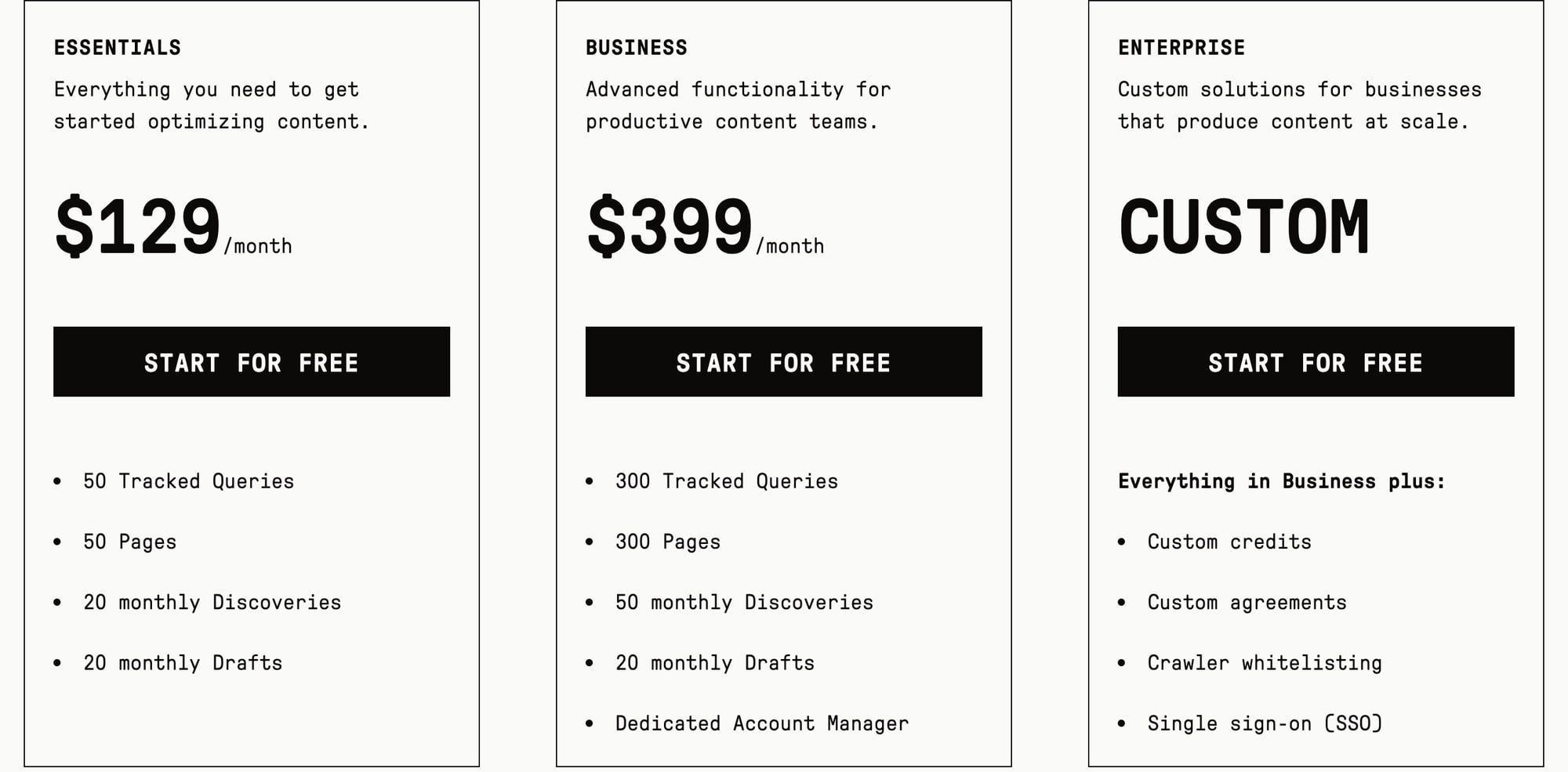
Every row in the SEO tool table starts from a card like these. Clearscope's page shows Essentials at $129 and Business at $399 a month, with what each plan allows listed underneath; I log the price, the allowance and the date I read it. Screenshot: Clearscope pricing page, 13 Nov 2026 · Screenshot of a public page (commentary/review)
The calculator takes the AI answers you track a month (prompts × engines × checks) and shows each tracker’s cheapest self-serve plan that covers it, at monthly-billing prices. It covers Peec, Otterly, Scrunch, AthenaHQ, SE Visible, Ahrefs prompt packs and Trakkr in dollars, and Nightwatch in euros.
Tools that don’t define how many answers a prompt buys stay out, so the calculator never guesses a figure.
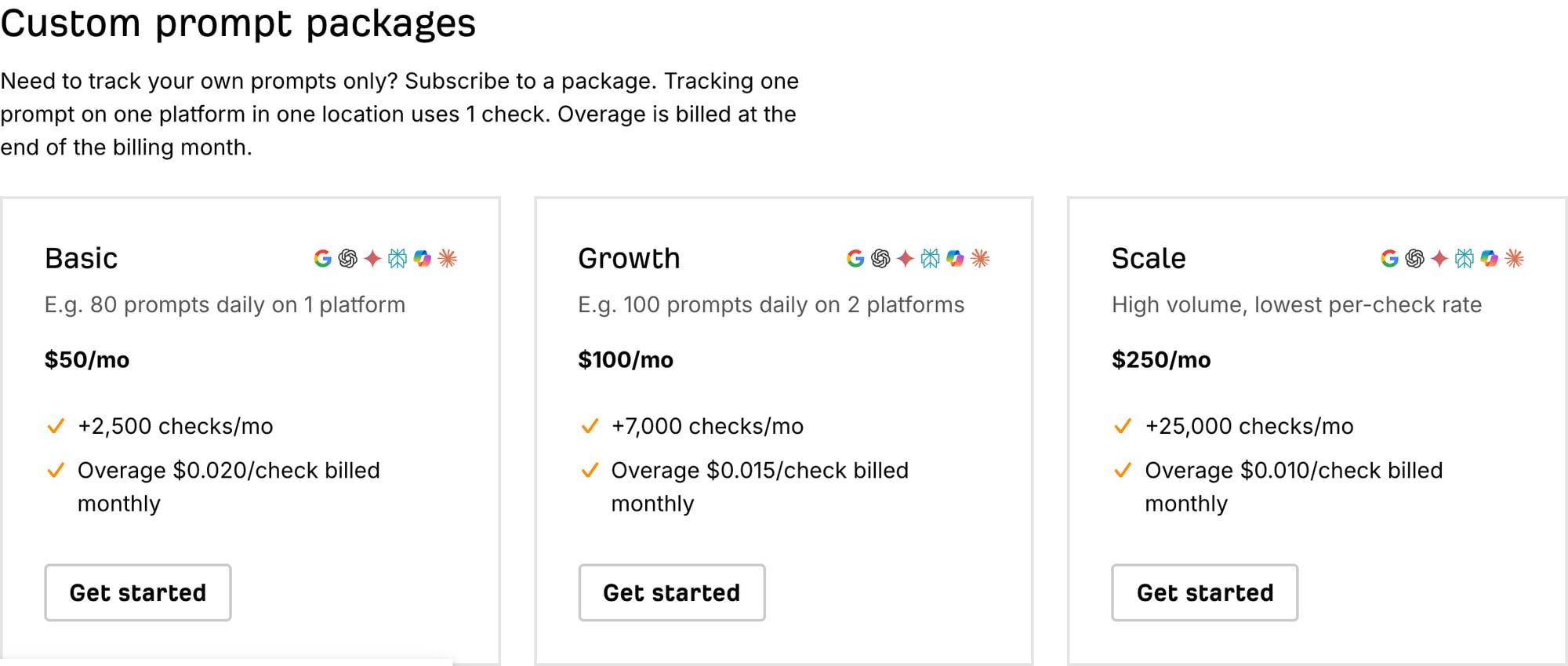
Ahrefs sells prompt tracking by the check: one prompt on one platform in one location uses one check. The calculator reads these three packs, including the overage per check once you pass the allowance. Screenshot: Ahrefs pricing page, Custom prompt packages, 13 Nov 2026 · Screenshot of a public page (commentary/review)
This autumn, Peec added a 24-month dormant period to its terms on 11 November, and PricingSaaS logged AccuRanker’s repricing in the week of 2 November. Rows from pricing trackers are marked “reported”, because the vendor published no date. For market-size claims, I lined up every public ChatGPT vs Google search number with what each one counts. For how often AI Overviews show up at all, I traced every AI Overview share, from 18% to 88% back to its sample.
The tables are licensed CC BY 4.0: you can share and adapt them with credit and a link. Each has a CSV at /data/<slug>.csv, for example /data/ai-visibility-pricing.csv, and its page gives a citation line.