Do AI-written pages get cited more? Two vendor tests
Otterly's AI-written site drew 70% of a pair's citations; Surfer's optimized pages got 1.71x. Both vendors sell tools. What each test can't show.

Short on time?
Short on time? Here's what I would do.
- You are thinking of buying an optimizer or AI-writing tool to win citations
- Don't, on these two tests
- Both are vendor-run and observational, and the pages measured came from the vendor's own workflow or editor.
- You already pay for one
- Keep it if it makes writers add your own data
- Then run four weeks of 10 changed pages against 10 untouched ones.
- You publish AI-assisted drafts
- Edit and fact-check by hand
- Google's guidance calls manual fact-checking 'critical'. Add something only you have.
- My pick
- Spend month one on the 10-and-10 check, not a licence
- That's my reading of two vendor tests, not a finding.
Prices verified . Verified 23 Nov 2026. The picks are my reading of public pages; I did not use any of these tools. No vendor paid to be included, and sponsors can't buy a verdict.
Surfer (page updated 13 November) and Otterly (17 November) have each posted tests that seem to say AI-written or optimized pages get cited more. Each firm sells a tool. I read both, three older studies and Google’s guidance to see what they can and can’t show. For the wider data picture, start at my data hub.
What did Otterly test? #
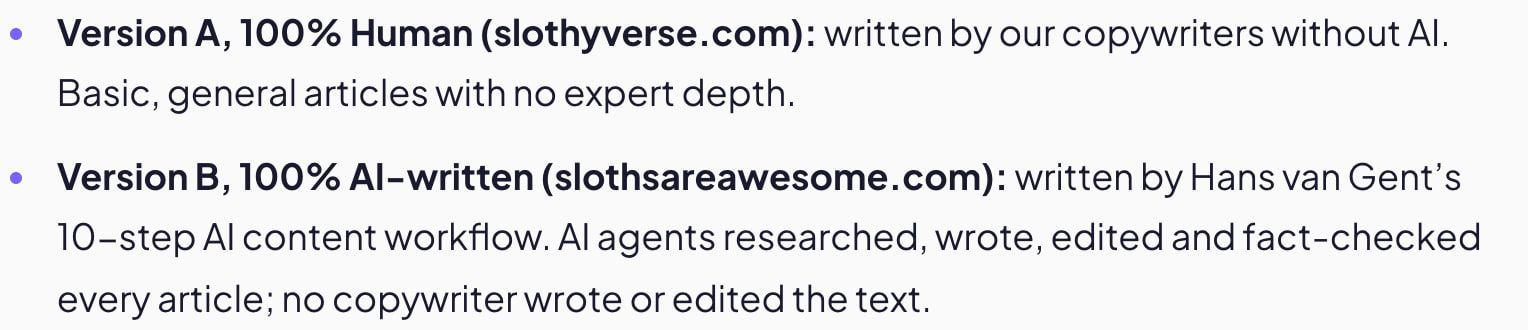
Otterly built two new sites on the same 100 sloth questions, one by copywriters and one by an AI workflow. After “over 5 months”, its AI-written site had 70% of the pair’s AI citations (Otterly). Otterly sells AI-search monitoring and a free trial.
Version A, slothyverse.com, was written by “our copywriters without AI”, which Otterly describes as “Basic, general articles with no expert depth”. Version B, slothsareawesome.com, was 100% AI from a 10-step workflow built by Hans van Gent, Head of SEO at the agency Seeders, whom Otterly names as a research collaborator. It used 200+ templates, statistics and internal data, at about 40-45 minutes an article.
The results, from Search Console, Bing Webmaster Tools, Otterly’s tracker and its Agent Analytics:
- AI citations: the AI site had 70% of the pair’s (2.3x), but both sites together held only 0.6% of all citations on the 100 prompts.
- Google: 65% of clicks and impressions went to the AI site, with a click-through rate under 0.5% on both.
- Bing: Bing Webmaster data had the human site with 58% of Bing AI citations, while Otterly’s tracker on Copilot had the AI site at 68%.
- By engine: the AI site’s citation share ran from 100% on ChatGPT to 58% on Gemini.
The page says “One experiment can’t prove a cause”. It also lists one low-competition niche, two sites, US-only prompts, and one page (“What Color Are Sloths?”) driving 22% of the AI site’s impressions. The Bing figure comes from Bing Webmaster Tools’ AI Performance report, which Otterly says covers every query where Microsoft’s AI cited a site, not only its 100 prompts, and Bing’s own post calls its data “a sample of overall citation activity” (Bing). So the two Bing numbers don’t measure the same thing.
What did Surfer test? #
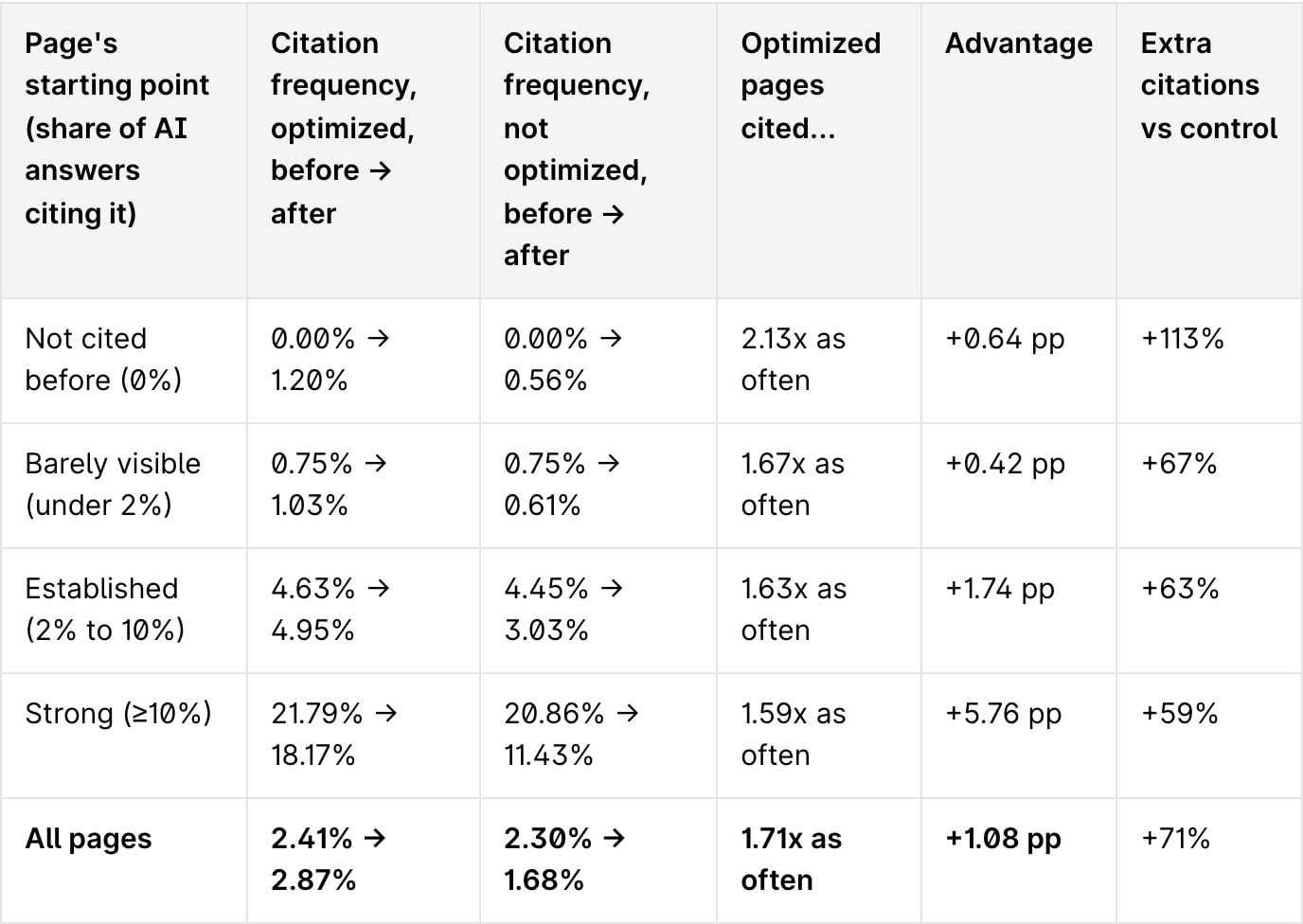
Surfer compared 2,432 pages edited in its Content Editor with 24,286 matched pages. Over 28 days, the optimized pages were cited 1.71x as often (Surfer). Surfer sells that editor and an AI Search Analytics plan.
An “optimized” page was imported into the Content Editor, edited within 7 days, with at least 5% of its content changed. Each got up to 10 random control pages with the same starting share of AI answers in the same month. The data comes from Surfer’s own AI Search Analytics (ChatGPT, Perplexity, Gemini, AI Mode and AI Overviews, February to October 2026).
Optimized pages went from 2.41% to 2.87% of AI answers; controls from 2.30% to 1.68%. The headline says “~2x”, but the table says 1.71x, which is 2.87 divided by 1.68.
By my arithmetic, that means optimized pages rose about 19% while controls fell about 27%. The controls’ fall is a bit more than half of Surfer’s +1.08-point advantage. Surfer’s limits call the study “Observational, not an A/B test”, with optimized pages “compared with matched pages from across the web, not randomly assigned”, so I read it as showing association only.
Do the two tests agree? #
Not really. Otterly tests who wrote the pages and by what workflow. Surfer tests whether edits in an optimizer help existing pages. Neither reads the other, and both are observational.
Otterly’s confound is the bigger one. The AI site had templates, data and a workflow built by an SEO agency’s head of SEO, against “basic” copywriter text, so I read it as two workflows, not AI against human.
The same vendor also got the opposite on Google. In its capybara test (page updated 5 August), two sites of about 1,000 fully AI posts each, published in under a day with an unnamed tool, were “silently” deindexed by Google, with no manual action in Search Console; the cause is Otterly’s inference (Otterly).
Copilot supplied 2,718 citations to one of them, and ChatGPT, Gemini and Google’s AI answers about zero. In Otterly’s words: “Microsoft Copilot absorbed the AI slop. Google and ChatGPT did not.” Otterly’s experiment index lists a February post claiming a 40x win for an AI page; I did not open it, so I make no claim about it.
One niche, one workflow or one data source can swing the answer. I wouldn’t generalize either test.
What can’t each test show? #
Mostly cause. Here are the two new tests next to three older ones, each by a firm that sells what it measures.
| Test | Run by (sells...) | Sample | What it compared | What it can't show |
|---|---|---|---|---|
| Otterly, sloth sites (17 Nov 2026) | Otterly (AI-search monitoring) | 2 sites, 100 prompts, 7 engines, about 5 months | AI workflow vs basic human copy | Authorship alone; one niche; Bing sources disagree |
| Surfer, optimized pages (updated 13 Nov 2026) | Surfer (optimizer, AI tracker) | 2,432 optimized vs 24,286 controls, 28 days | Pages edited in Surfer's editor vs matched pages | Cause; the controls fell; 'optimized' is Surfer's definition |
| Graphite (Oct 2025) | Graphite (growth agency) | 31,493 keywords | Share of AI-written pages in Google and in citations | Edited AI content; anything after June 2025 |
| Ahrefs (Jul 2025) | Ahrefs (detector, Brand Radar) | 1.9M AI Overview URLs | AI share of cited pages vs citation order | Who wrote what; detector error |
| Semrush (Apr 2026) | Semrush (SEO tools) | 42,000 blog pages | AI share at each Google rank | AI citations; process |
Source: Otterly, Surfer, Graphite, Ahrefs and Semrush study pages. Read 23 Nov 2026. Scroll sideways for more columns.
Do older studies change that? #
Not much. They measure Google rankings or the mix of cited pages, and each uses a detector with error. In my read:
- Graphite (Google data from June 2025): ChatGPT and Perplexity citations ran 82% human and 18% AI. It used Surfer’s detector (4.2% false positives, 0.6% false negatives) and did not evaluate heavily human-edited AI content (Graphite).
- Ahrefs (July 2025): top-three AI Overview citations were 3.6% pure AI, 8.6% pure human and 87.8% mixed. The correlation between AI share and citation order was 0.017, “effectively zero”, and it notes detectors carry false-positive risk (Ahrefs). I’d quote the correlation, not the headline.
- Semrush (April 2026): Google rankings only, classified with GPTZero. Pure AI held #1 about 9% of the time against 80% for human. “The finding isn’t that AI is inherently bad; it’s that search rewards human originality” (Semrush).
Surfer’s own analysis of an 18-21 August Google spam update shows AI-written share at 48.6% among the biggest losers and 49.0% among the biggest winners, so AI authorship didn’t separate them there. That is Google rankings, English only.
What does Google say about AI-written pages? #
Google’s guidance allows AI help but warns about scale. It says generative AI “can be particularly useful when researching a topic”, and that using AI tools “to generate many pages without adding value for users may violate” its scaled-content abuse policy (Google).
Manual fact-checking is “critical”, and it suggests considering adding information on how your content was created. The AI optimization guide repeats the scaled-content warning. Google’s October Think with Google piece is about brand authority and says nothing on AI-written content.
None of this says how Google or an AI engine ranks or cites AI text. For the commodity-content wording, see my read of Google’s “Top 10” listicle line.
How would I test it myself? #
Rewrite 10 pages, leave 10 similar ones alone, and check the same 20 prompts by hand for four weeks. This is my suggestion, scaled down from Surfer’s matched-controls design.
| Step | What to do | Why |
|---|---|---|
| Week 0 | Pick 20 pages of similar standing and choose the 10 to rewrite at random. List 20 prompts they should answer. Check by hand which pages are cited | A baseline |
| Week 1 | Rewrite the 10: add your own data, prices or screenshots | First-hand content |
| Weeks 2-4 | Re-check the same 20 prompts weekly | Same method each time |
| Week 4 | Compare cited counts: changed vs untouched | Surfer's matched-controls idea |
Source: My suggestion, adapted from the design Surfer discloses. Verified 23 Nov 2026. Scroll sideways for more columns.
Ten pages can’t prove a cause either. They tell you whether your own pages move, which is the question a purchase depends on. My guide to measuring AI visibility covers the manual audit, and how to get mentioned in ChatGPT covers what the evidence backs.
So what would I do? #
Don’t buy an optimizer or AI-writing tool on these numbers. Run the 10-and-10 check first, and keep a tool only if it makes your writers add something first-hand.
- Thinking of buying: wait a month and run the check. For what a licence costs, see Surfer pricing.
- Already paying: keep it for the data and screenshots it prompts writers to add. My read of older score studies is in do content optimization tools work.
- Publishing AI-assisted drafts: edit and fact-check them by hand.
- Skip: mass-producing pages. Google’s scaled-content line is the clearest warning I found.
That’s my reading of two vendor tests, not a verdict on either tool. I’ll update this post if anyone without a product to sell publishes a replication.
FAQ
Do AI-written pages get cited more by AI answers?
Otterly's AI-written test site drew 70% of a two-site pair's AI citations. It was one niche, two sites, and the AI site had a heavy workflow with templates, statistics and internal data against basic human copy. It isn't shown as a general rule.
What did Surfer's study measure?
Citation frequency 28 days before and after, for 2,432 pages edited in Surfer's Content Editor against 24,286 matched pages. Optimized pages were cited 1.71x as often. Surfer says the pages were matched, not randomly assigned, so I read it as showing association only.
Why is Surfer's number 1.71x and not 2x?
Surfer's headline says '~2x', but its table says 1.71x. By my arithmetic from its four percentages, optimized pages rose about 19% while the matched controls fell about 27%.
Does Google penalize AI-written content?
Google's guidance allows AI help, but says generating many pages without adding value for users may violate its scaled-content abuse policy. These tests can't show how Google or any AI engine treats AI text.
Is there any neutral test?
I found none. Every study I read comes from a firm that sells a tool or service tied to what it measures: Otterly, Surfer, Graphite, Ahrefs and Semrush.
How can I test this on my own pages?
Rewrite 10 pages and leave 10 similar ones alone, pick 20 prompts they should answer, and check by hand each week for four weeks. It's my suggestion, scaled down from Surfer's matched-controls design.
Sources
11 sources, accessed .
Official pricing, docs, changelogs and status pages 4
Other blogs 7
- Otterly.AI (sells AI-search monitoring): AI vs human writing experiment, updated 17 Nov 2026
- Otterly.AI: 2,000 AI blogs experiment, updated 5 Aug 2026
- Otterly.AI: GEO experiments index
- Surfer (sells the Content Editor and AI Search Analytics): optimized-pages study, updated 13 Nov 2026
- Graphite (growth agency): AI content in search and LLMs, 14 Oct 2025
- Ahrefs (sells SEO tools): AI Overviews and AI-generated content, 14 Jul 2025
- Semrush (sells SEO tools): does AI content rank, 1 Apr 2026
Last updated: 23 November 2026. Facts verified 23 Nov 2026. Researched and drafted with AI tools; owner review is pending.


