Google told CMOs to stop 'Top 10' listicles. Is that you?
Think with Google said stop 'Top 10' listicles. Search Engine Journal reads it as generic tips posts. Six questions to sort what to rewrite, keep or cut.

Short on time?
Short on time? Here's what I would do.
- Generic 'Top 10 Things to Consider' posts
- Rewrite around your own data or a real example
- Merge thin near-duplicates. Delete last: Google calls deleting a last resort.
- A 'best X' roundup you compared or priced yourself
- Keep it, and say how you compared
- Google's reviews guidance asks for first-hand evidence behind a ranked list.
- A self-ranked 'best X' list with you at number one
- Rewrite it to disclose and compare honestly
- The only evidence of risk is correlation in one analyst's sample. Rewrite before it matters.
- Wondering about an audit tool
- A spreadsheet and six questions
- No tool needed to sort posts into rewrite, keep, merge or delete.
Prices verified . Verified 23 Nov 2026. The checklist and the keep/rewrite picks are my reading of Google's pages, not Google's words. No vendor paid to be included.
On 19 November, Google’s Think with Google account posted on X a line pairing “Stop the ‘Top 10’ listicle” with leading with first-hand expertise, according to Search Engine Journal.
I read that report, the Google pages behind it and the studies on “best” lists. This post says what Google wrote, what it didn’t, and how to sort your own posts. For the tools side, start at my SEO tools hub.
What did Google actually say? #
Search Engine Journal reports that Think with Google’s 19 November X post said “AI didn’t make your brand invisible in Search. Your content did.”, paired with “Stop the ‘Top 10’ listicle”. I didn’t open the post, so that’s SEJ’s account.
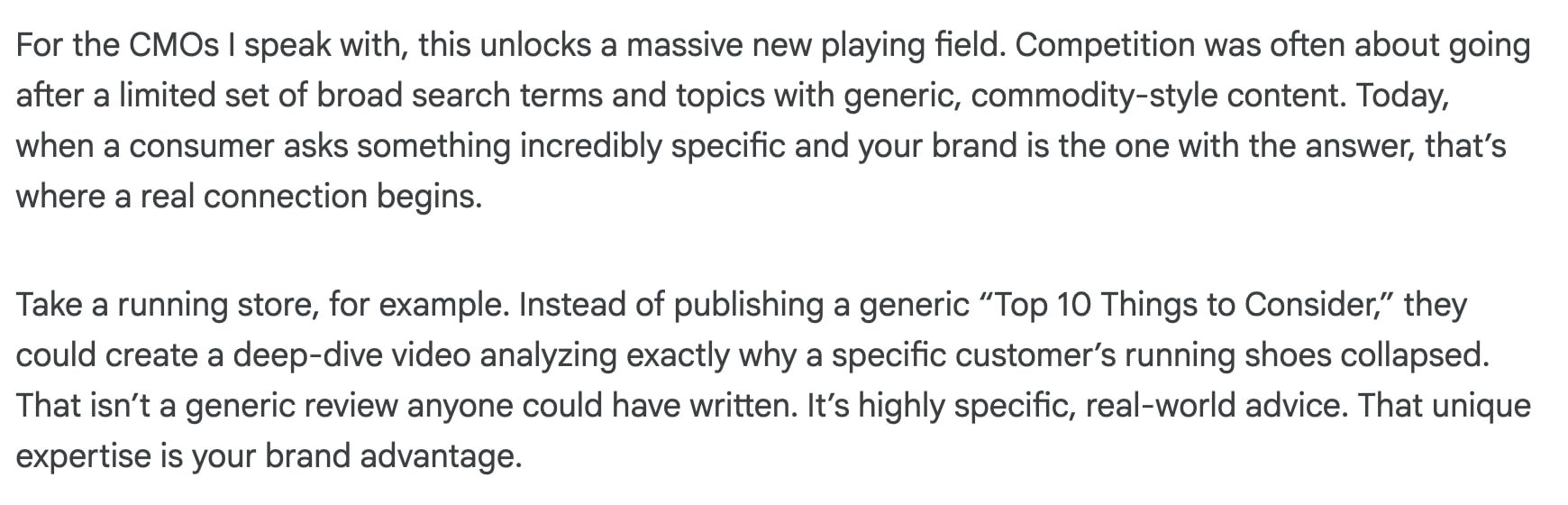
The article behind it is by Brendon Kraham, a Google VP, and dates from 14 October. Its generic example is “Top 10 Things to Consider”; its first-hand example is a running store’s video analyzing why a customer’s shoes collapsed. It says unique expertise “isn’t a generic review anyone could have written” (Think with Google).
The article also cites a Google-commissioned Ipsos study (December 2025): AI-search users visit about 12 touchpoints, nearly three times as many as non-AI journeys. That’s about how people shop, not about listicles. For how AI Overviews pick sources, see how AI Overviews choose sources.
Is that a rule for ‘best X’ pages? #
I found no sign of it. SEJ says neither Kraham’s article nor Google’s guide mentions self-promotional “best” lists.
Think with Google is Google’s marketing site for advertisers. Search guidance lives on Search Central, so a VP’s example is not a ranking rule. SEJ also reports two reactions: Ross Hudgens wrote “Not of the type you’re thinking of.”, and Lily Ray asked whether Google really told CMOs this.
So what is “commodity content”? #
Content “often based on common knowledge, which could originate from anyone”, which “typically adds little unique insight”, per Google’s AI optimization guide. The guide’s example is “7 Tips for First-Time Homebuyers”.
The opposite is content that “provides unique expert or experienced takes that go beyond common knowledge”. The word “listicle” doesn’t appear on that page, so “generic tips posts” is the fairer reading of what Google targets.
The guide also says a first-hand review offers a perspective from personal experience, while a summary “simply restates information already available elsewhere”.

Are “best X” lists losing? #
The evidence conflicts. Lily Ray tracked mostly SaaS sites with many self-ranked lists losing visibility in early 2026, while Kevin Indig’s August data shows listicles still in the top 10 for 55.1% of queries.
| Source | When | What it looked at | What it found | Limit |
|---|---|---|---|---|
| Lily Ray (Substack and SEJ column) | 3–5 Feb 2026 | Seven mostly SaaS sites in Sistrix | Six sites with a stated Sistrix visibility drop of 29% to 49% in early 2026; 10 to 340 self-promotional listicles per site | Hand-picked sites; correlation; other tactics present; no Google statement |
| Kevin Indig, Growth Memo (via PPC Land) | 24 Aug 2026 | 60,000 US queries, 5.32 million result rows, a 47-hour window | A listicle in the top 10 for 55.1% of queries; 62% of vendor-authored listicles gained estimated traffic (median +38%) | One crawl wave; unvalidated classifier; traffic is estimated; paywalled |
| Think with Google | 14 Oct and 19 Nov 2026 | An article and an X post | 'Top 10 Things to Consider' as the generic example | A marketing piece for CMOs, not Search guidance |
Source: Lily Ray's Substack and SEJ column, PPC Land on Growth Memo, Think with Google and SEJ. Read 23 Nov 2026. Scroll sideways for more columns.
Ray wrote that it “seems possible this volatility reflects ongoing refinements to Google’s reviews system” and that “Self-promotional listicles may only tell one part of the story” (Substack); her SEJ column adds that Google made no statement.
Indig’s data, via PPC Land, has the share of position-one results that are listicles falling from 18.9–20.2% in January to 15.1–15.6% in August, yet he says he can’t trace that decline to self-promoting vendor lists. Relevant Audience adds that listicles reach the top three for 54.5% of queries asking for ideas, options or “best” items, against 10.2% for implicit queries. The newsletter itself is paywalled.
The samples, periods and metrics differ, so I won’t pick a winner on causation.
How do you check one of your own posts? #
Ask six questions, all built from Google’s own wording. This is my checklist, assembled from Google’s pages; it isn’t a Google test.
- Original information? “Does the content provide original information, reporting, research, or analysis?” (helpful content guidance)
- More value than what already ranks? “Does the content provide substantial value when compared to other pages in search results?”
- First-hand? “Does your content clearly demonstrate first-hand expertise and a depth of knowledge”
- Written for search engines first? “Is the content primarily made to attract visits from search engines?”
- Who, how and why? Is it clear who wrote it and how it was made? Google calls Why “perhaps the most important question”.
- Could anyone have written it? The guide’s test for commodity content: “common knowledge, which could originate from anyone”.
If a post fails three or more, it’s a rewrite candidate. That threshold is mine.
Which posts do you keep, rewrite, merge or delete? #
Rewrite the generic ones around your own data, keep roundups where you compared things yourself, and delete last. The picks below are mine; the wording in the last column is Google’s.
| Post type | My pick | Google's wording |
|---|---|---|
| Generic 'Top 10 Things to Consider' tips post | Rewrite around your own data or a real example | Commodity content "typically adds little unique insight" |
| Near-duplicate pages for query variants | Merge into one stronger page | A separate page for every query variation to manipulate rankings or AI responses "violates Google's scaled content abuse spam policy" |
| A roundup you compared or priced yourself | Keep, and say how you compared | Ranked lists should "stand on their own"; "best overall" needs first-hand evidence |
| A self-ranked 'best X' list with you first | Rewrite to disclose and compare honestly | No Google statement; risk evidence is Lily Ray's correlation only |
| An old post still earning clicks | Leave it, or improve it | "Deleting content is a last resort" |
Source: Google's AI optimization guide, reviews guidance and core updates guide; Lily Ray's analysis. Read 23 Nov 2026. Scroll sideways for more columns.
The core updates guide says “Consider how you can improve your content in meaningful ways”, and that if you’re considering deleting entire sections, “that’s likely a sign those sections were created for search engines first, and not people”. It also warns against “quick fix” changes; my core update guide covers the timing.
Are “best X” roundups safe? #
Safer if they show how you compared. Google’s reviews guidance says ranked lists should “stand on their own”, and that “best overall” should be explained with first-hand evidence.
It also asks you to “Explain what sets something apart from its competitors.” and to “Consider including links to multiple sellers”. The page carries no date and is titled “How To Write Reviews”, so I couldn’t confirm it’s the current canonical version.
That’s my reading, not a ruling on roundups. This site publishes comparison posts too, so weigh my view with that in mind.
So what would I do? #
Don’t delete anything on the strength of a tweet. Sort first, rewrite second, and cut last.
- This week: list your posts in a spreadsheet and run the six questions on the top 20 by traffic.
- Rewrite: generic tips posts, around data or an example only you have.
- Keep: roundups where you compared or priced things, with a short note on how.
- Don’t buy a tool: do content optimization tools work? and my SEO tool stack on a budget explain why.
I’ll update this post if Google says more about “best X” pages.
FAQ
Did Google say 'best X' listicles are bad?
I found no such statement. Search Engine Journal says neither Brendon Kraham's Think with Google article nor Google's AI optimization guide mentions self-promotional 'best' lists, and the guide never uses the word listicle.
What is commodity content?
In Google's guide, it's content often based on common knowledge, which could originate from anyone, and that typically adds little unique insight. Its example is '7 Tips for First-Time Homebuyers'.
Should I delete my old 'Top 10' posts?
Not first. Google's core updates guide says 'Deleting content is a last resort' and suggests improving content in meaningful ways. Rewrite or merge before you cut.
Are comparison and roundup pages still okay?
As I read Google's reviews guidance, yes when they show first-hand evidence. It asks that ranked lists stand on their own and that 'best overall' be explained with first-hand evidence. That's my reading, not a ruling on roundups.
Is the Ipsos study about listicles?
No. The Google-commissioned Ipsos study cited in the Think with Google article is about how people shop: AI-search users visit about 12 touchpoints, nearly three times as many as non-AI journeys.
Do I need a tool to audit this?
No. A spreadsheet listing your posts and the six questions in this post is enough to sort them into rewrite, keep, merge or delete.
Sources
11 sources, accessed .
Official pricing, docs, changelogs and status pages 5
- Think with Google: Building brand authority in the Gemini era of Search, Oct 2026
- Google Search Central: optimizing for generative AI features
- Google Search Central: creating helpful, reliable, people-first content
- Google Search Central: core updates guide
- Google Search Central: reviews guidance (page titled 'How To Write Reviews')
News and press 4
- Search Engine Journal: Google told CMOs to stop 'Top 10' listicles, 20 Nov 2026
- Search Engine Journal: Lily Ray on self-promotional listicles, 5 Feb 2026
- PPC Land: vendor listicles gain 38% median traffic, on Kevin Indig's study, 25 Aug 2026
- Relevant Audience: Google listicle study and query phrasing, 28 Aug 2026
Last updated: 23 November 2026. Facts verified 23 Nov 2026. Researched and drafted with AI tools; owner review is pending.


