Did the November 2026 core update hit you? How to check
Google's November 2026 core update began Nov 10 and may run to about Nov 24. When to judge your data, which tools to trust, and what to leave alone.

Short on time?
Short on time? Here's what I would do.
- Everyone
- Search Console's Performance report
- Wait one full week after Google's dashboard shows an end date, then compare with 3–9 Nov. It's free.
- You already pay for a rank tracker
- Your tracker, then Search Console
- Use it to find which keywords and pages moved. Confirm in Search Console before acting; ignore one-day drops on page 2.
- Is it me or everyone?
- Semrush Sensor or another sensor
- Market-wide context only. It says nothing about your site.
- Retail and ecommerce
- A year-over-year view against Thanksgiving week 2025
- Don't touch money pages before Cyber Monday unless something is technically broken.
- A big drop that lasts after it ends
- Google's self-assessment questions
- Improve the pages. Google calls deleting content a last resort.
Prices verified . Dates and Google guidance verified 16 Nov 2026. No vendor paid to be included, and sponsors can't buy a verdict.
Google started its November 2026 core update on 10 November, a little over two weeks before Black Friday, and on 16 November it’s still rolling out.
Here are the dates that matter, the free check Google recommends, which tool shows what, and what to leave alone. For the tools themselves, start at my SEO tools hub.
What did Google actually announce? #
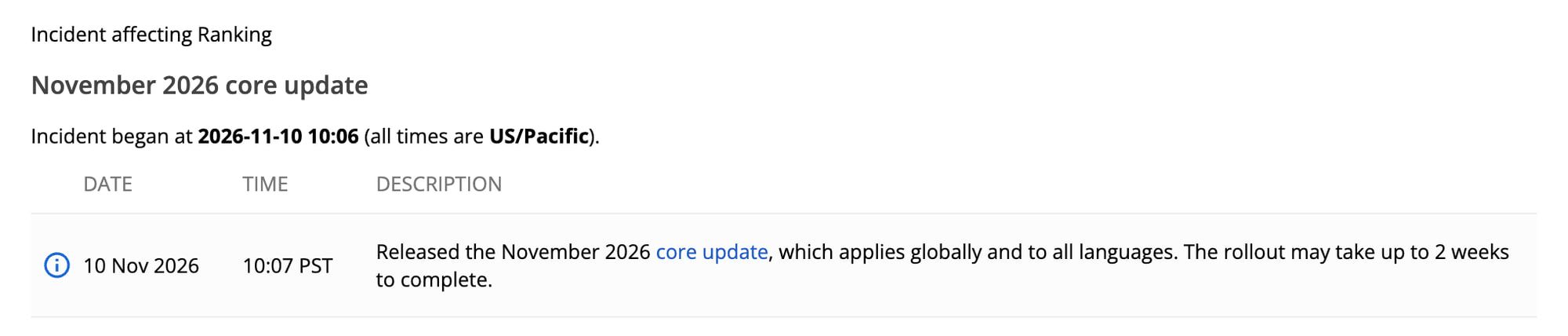
Google released the November 2026 core update on 10 November at 10:06 Pacific. Its dashboard says it “applies globally and to all languages” and that “The rollout may take up to 2 weeks to complete” (Search Status Dashboard).
The only description from Google I found came in a LinkedIn post, as reported by Search Engine Roundtable and Search Engine Journal: “This is a regular update designed to better surface relevant, satisfying content for searchers from all types of sites.”
It’s the third core update of 2026, after March and May; February’s was for Discover only (dashboard history). Core updates, Google says, “don’t target specific sites or individual web pages” (core updates guide).
The agency Momentic ties it to AI-generated answers, but that’s its own reading, and I found no vendor study yet on which kinds of sites moved.
Expect a lot of movement either way. After March’s overlapping spam and core updates, which SE Ranking says are “difficult to clearly separate”, 79.5% of top-3 URLs in its 100,000-keyword sample changed position (SE Ranking study).
Is it over yet? #
Not as of 16 November. Google’s Search Status Dashboard still shows only the release note, with no end date.
This year’s two earlier core updates ran 12 days 4 hours (March) and 11 days 21 hours (May), per the dashboard history. If November matches them, it would end around 22 November (my arithmetic, not a Google forecast).
“Up to 2 weeks” from 10 November is about 24 November, Google’s outer limit, not a promise. Search Engine Roundtable counts a median of 14 days across 23 core updates, with March 2024 the outlier at 45 (SER).
How do you tell if it hit you? #
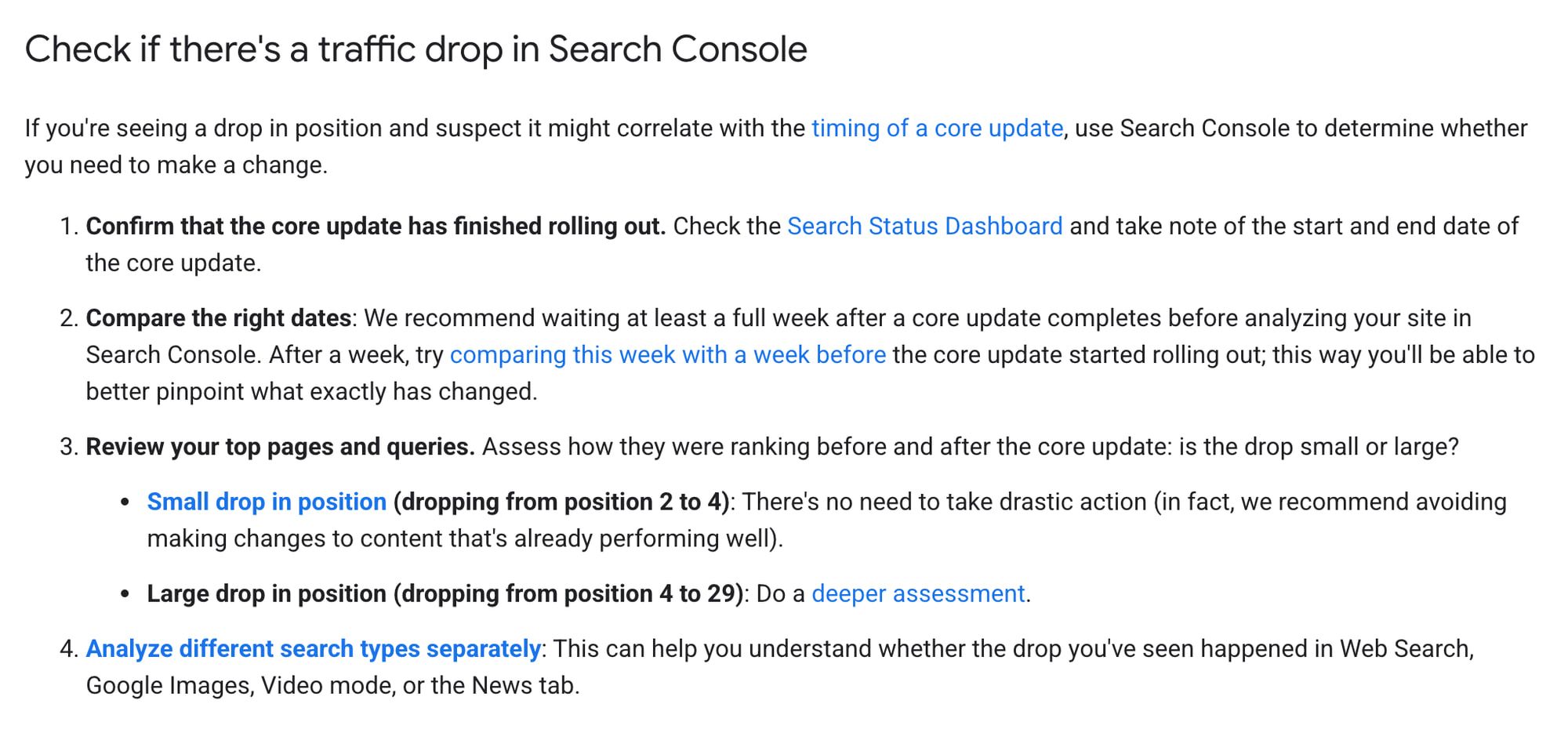
Wait until the dashboard shows an end date, give it one more full week, then compare that week in Search Console with 3–9 November, the week before the rollout began.
That’s my reading of Google’s core updates guide: “Confirm that the core update has finished rolling out”, then “We recommend waiting at least a full week after a core update completes before analyzing your site in Search Console.” It then suggests comparing “with a week before” the start, which Search Engine Journal reads as “a week prior to Nov. 10”.
The check, from that guide and Google’s traffic-drop guide:
- In the Performance report, use Compare for the two weeks.
- Look at your top pages and top queries.
- Check Web, Images, Video and News separately.
- Sort pages by the clicks difference to see which lost most.
- Mark 10 November and 9–11 November with a custom annotation: right-click the chart, “Add annotation”, up to 120 characters, visible to everyone on the property.
Which tool shows what? #
Search Console is the only one here that shows your real clicks. A rank tracker shows where your tracked keywords sit, a volatility sensor shows whether everyone’s rankings are moving, and Ahrefs estimates traffic, including competitors’.
| Tool | What it shows | How fresh | What it can't tell you |
|---|---|---|---|
| Search Console Performance report | Your real clicks, impressions, CTR and position, by query, page, country, device and search type | Daily; 16 months of history | Why you moved, or whether it was the update or the holidays |
| Search Console generative AI report | Impressions of your links in AI Overviews and AI Mode | Daily; undercounted 9–11 Nov | Clicks, queries or positions |
| Rank tracker (SE Ranking, Semrush Position Tracking) | Daily position per tracked keyword, desktop and mobile, down to city level | Daily; Semrush keeps daily points for 60 days, then weekly | Traffic; vendors report some fetches since September returned swapped or one-word results |
| Semrush Sensor, WireBoard and other sensors | A market-wide volatility score (Semrush: 0–10, by category) | Daily (Semrush); WireBoard says real time | That your site moved |
| Ahrefs Site Explorer | Estimated organic traffic with Google-update markers; works on competitors | Daily, weekly or monthly views | Your real clicks |
Source: Google Search Console help and Search Central docs, Semrush, SE Ranking, Ahrefs and WireBoard pages, verified 16 Nov 2026. Scroll sideways for more columns.
Semrush Sensor “measures SERP volatility on a scale of 0-10”, where 5–8 counts as high and 8–10 very high; its Personal Score needs an SEO Toolkit subscription (Semrush KB). WireBoard blends several providers into one score and calls it “Free for everyone” (WireBoard). Ahrefs calls its traffic figure “an estimate” (Ahrefs help), and its guide shows update markers on Site Explorer graphs.
SE Ranking tracks daily “on every plan” (SE Ranking); Semrush Position Tracking “tracks daily results for 60 days”, then weekly (Semrush KB). I compare the two in SE Ranking vs Semrush, and cover when daily tracking is worth paying for in Mangools vs SE Ranking.
You don’t need to buy anything for this check. For what a rank tracker measures that Search Console doesn’t, see rank tracking vs AI visibility tracking.
What else is messing with your numbers? #
Two things: a logging error undercounted Search Console’s Generative AI report on 9–11 November, and since September some rank trackers have recorded swapped or one-word Google results that, by those vendors’ accounts, real searchers didn’t see.
The first is small. Google’s data anomalies page says “A logging error caused a decrease in impressions on the Generative AI performance report in Search” and that it “affects data logging only” (SER reported it too). The note names only that report, so the main Performance report stays your baseline; just skip 9–11 November in the AI report.
Two days into the update, Google put Gemini 4 Hydrogen in Search; here’s what that means for AI Mode tracking. For the AI click data due on 3 December, see will Search Console finally show AI Overview clicks?
The second is bigger, and each vendor measured it differently:
- Nozzle: 8.0% of pages swapped (“poisoned”) from 13 September to 9 October, against 0.17% before (PPC Land), and, per SEJ’s summary, 80% of the poisoning lasted for a single check (SEJ).
- DemandSphere: about 11% of its daily results pages (PPC Land).
- AccuRanker: 0.28% to 3.23% on desktop on 20–25 October, after its own checks (AccuRanker).
- One-word results: in SE Ranking’s sample, 96.5% of affected groups started at position 9 or lower; Nozzle saw dropped words on 12.6% of page-2 results against 2.2% on page 1 (SEJ).
Google hasn’t commented, and none of these rates is audited. My rule: before you report a tracker drop, especially at position 9 or below, confirm it in Search Console clicks. If you’re weighing AccuRanker, I compare it in Nightwatch vs AccuRanker. My guide to junk results in rank trackers has the 3 November numbers and a check you can run.
What about Black Friday? #
If the rollout runs the full two weeks, the first week you can judge (25 November to 1 December) includes Thanksgiving, Black Friday and Cyber Monday, so retail sites should add a year-over-year comparison. Even an end around 22 November leaves Thanksgiving and Black Friday in the week after.
| Date (2026) | What happens | What it means for your data |
|---|---|---|
| 3–9 Nov | The week before the start | Your baseline week in Search Console |
| 8–9 Nov | Ranking chatter before any announcement | Unconfirmed; don't read it as the update |
| 9–11 Nov | Logging error in the generative AI report | AI report impressions undercounted; rankings not affected |
| 10 Nov, 10:06 PT | Rollout starts | Day one of 'up to 2 weeks' |
| About 22 Nov | End date if it runs as long as March or May (my arithmetic) | Possible, not promised; wait for Google's note |
| About 24 Nov | Google's two-week outer limit | Latest end if Google's estimate holds |
| 26, 27, 30 Nov | Thanksgiving, Black Friday, Cyber Monday | Holiday traffic lands in the first week you can judge |
| 1 Dec | End of the first full week after a 24 Nov finish | Earliest day to judge if it runs the full two weeks |
| About 2 Jan 2027 | Semrush's daily ranks for 3–9 Nov turn weekly (my arithmetic) | Export your tracker baseline before then |
Source: Google Search Status Dashboard, core updates guide and data anomalies page; OPM federal holidays; PPC Land; Search Engine Roundtable (9 Nov); Semrush KB. Verified 16 Nov 2026. Scroll sideways for more columns.
The holiday dates come from PPC Land, and the 8–9 November row from SER’s report that tools “seem a bit off”.
Google’s traffic-drop guide treats seasonality as its own cause of drops and points to a year-over-year compare in Search Console, plus Google Trends. Thanksgiving 2025 fell on 27 November (OPM), so compare your post-update week with that holiday week last year.
Should you change pages now? #
No. Google’s core updates guide says “Avoid doing ‘quick fix’ changes” and, for a small drop, “There’s no need to take drastic action.”
For a large drop it says “Do a deeper assessment”; recovery can come “in a few days, but it could take several months”, sometimes “waiting until the next core update”.
Ahrefs is blunter: “Never make changes while an algorithm update is still rolling out” (Ahrefs). Momentic suggests pruning (or improving) pages and reviewing HTML changes mid-rollout; I’d follow Google, because you can’t judge a change against numbers that are still moving.
If a large drop lasts after it ends, work through Google’s self-assessment questions, such as “Does the content provide original information, reporting, research, or analysis?” Improve before you remove; the core updates guide says “Deleting content is a last resort”.
The exception is real breakage. Google’s traffic-drop guide lists technical issues, security problems and spam actions as separate causes. Those aren’t the “quick fix” changes Google warns about (my reading, not its wording), so fix them now. If your links sit on pages users publish through someone else’s tool, what Google’s user-generated spam guidance changes is a separate check.
So what would I do this week? #
Leave content alone, write down the dates and book the review. Everyone judges in Search Console; a tracker shows where to look, a sensor gives context, and retail sites add the year-over-year view.
My checklist, with dates:
- Today (16 Nov): annotate 10 November and 9–11 November in Search Console.
- Today: export 3–9 November from Search Console, and from your tracker if you have one.
- From about 22 Nov: check the dashboard daily for an end date.
- End date plus 7 days (1 Dec if it ends on 24 Nov): run the comparison, year over year if you sell online.
I’ll update this post when Google posts the end date.
FAQ
When will the November 2026 core update finish?
Google hasn't said. Its dashboard says the rollout 'may take up to 2 weeks to complete' from 10 November, which puts the outer limit at about 24 November. This year's March and May core updates each took about 12 days, so it could end sooner. Watch the Search Status Dashboard for the end date.
How long should I wait before checking Search Console?
At least a full week after the dashboard shows the update has finished, as Google recommends. Then compare that week with 3–9 November, the week before the rollout began. If it ends on 24 November, that first full week runs 25 November to 1 December.
Why does my rank tracker show a drop that Search Console doesn't?
Since September, some trackers have recorded swapped or one-word Google results that, by the vendors' accounts, real searchers didn't see; the one-word results mostly start at position 9 or lower. Vendors measured different rates (Nozzle 8.0%, DemandSphere about 11%, AccuRanker 0.28% to 3.23% after its checks), and Google hasn't commented. Trust Search Console clicks.
Does the Search Console AI report bug affect my rankings?
No. Google says a logging error lowered impressions in the Generative AI performance report from 9 to 11 November and 'affects data logging only'. Its note names only that report, so the main Performance report still works as your baseline.
Should I delete or rewrite pages that dropped?
Not while it's rolling out. Google says to avoid 'quick fix' changes, that a small drop needs no drastic action, and that 'Deleting content is a last resort'. If a large drop lasts after the update ends, work through Google's self-assessment questions and improve the pages.
Is this update about AI Overviews?
Google hasn't said so. The only description from Google I found is that this is 'a regular update designed to better surface relevant, satisfying content for searchers from all types of sites.' One agency reads it as being about AI answers, but that's its own interpretation, and I found no data yet on which kinds of sites moved.
Sources
27 sources, accessed .
Official pricing, docs, changelogs and status pages 14
- Google Search Status Dashboard: November 2026 core update incident
- Google Search Status Dashboard: ranking update history and durations
- Google Search Central: what site owners should know about core updates
- Google Search Central: debugging drops in Search traffic
- Google Search Central: creating helpful content (self-assessment questions)
- Search Console help: data anomalies, incl. the 9–11 Nov 2026 logging error
- Search Console help: Generative AI performance report (Search)
- Google Search Central blog: custom chart annotations in Search Console (Nov 2025)
- US Office of Personnel Management: federal holidays (Thanksgiving 2025 and 2026)
- Semrush knowledge base: Semrush Sensor
- Semrush knowledge base: Position Tracking
- SE Ranking: Rank Tracker
- Ahrefs help: how the organic traffic metric is calculated
- WireBoard: SERP volatility score
News and press 9
- Search Engine Roundtable: Google November 2026 core update, 10 Nov 2026
- Search Engine Journal: Google November 2026 core update, 10 Nov 2026
- PPC Land: core update runs up to 2 weeks before Black Friday, 10 Nov 2026
- Search Engine Roundtable: Generative AI report data bug, 12 Nov 2026
- Search Engine Roundtable: ranking volatility chatter, 9 Nov 2026
- PPC Land: Nozzle finds swapped results on 8% of pages, 19 Oct 2026
- PPC Land: DemandSphere finds wrong results on 11% of daily checks
- Search Engine Journal: Nozzle's analysis of poisoned results, 14 Oct 2026
- Search Engine Journal: rank trackers find one-word results, 3 Nov 2026
Last updated: 16 November 2026. Facts verified 16 Nov 2026. Researched and drafted with AI tools; owner review is pending.


