Is Google cracking down on user-generated spam?
On 26 Oct Google told platforms and tools to keep shared and generated pages out of its index. It's guidance, not a crackdown. Here's what to stop.

Short on time?
Short on time? Here's my take.
- Agencies and SEOs
- Stop new placements on user-published pages
- No new links or AI visibility placements on shared AI chats, app builders or free hosts. List the ones you have; expect some to drop out of the index.
- You run a platform or tool
- Noindex by meta tag or X-Robots-Tag
- Make it the default for shared and generated pages, not robots.txt alone, and verify the domain in Search Console.
- A normal site with comments or a forum
- Keep your current defences
- Nothing new to do: ugc or nofollow on untrusted links, moderation and CAPTCHA on sign-up.
Prices verified . Google's guide, changelog and policies verified 17 Nov 2026. No vendor paid to be included, and sponsors can't buy a verdict.
On 26 October Google widened its guide on user-generated spam to cover tools that let people publish shared pages, generated content and web apps. One trade headline called it a crackdown.
I read Google’s changed guide, its changelog and spam policies, and the trade coverage, to see what Google actually wrote, who it touches and what I’d stop doing. For the tools side, start at my SEO tools hub.
What did Google change on 26 October? #
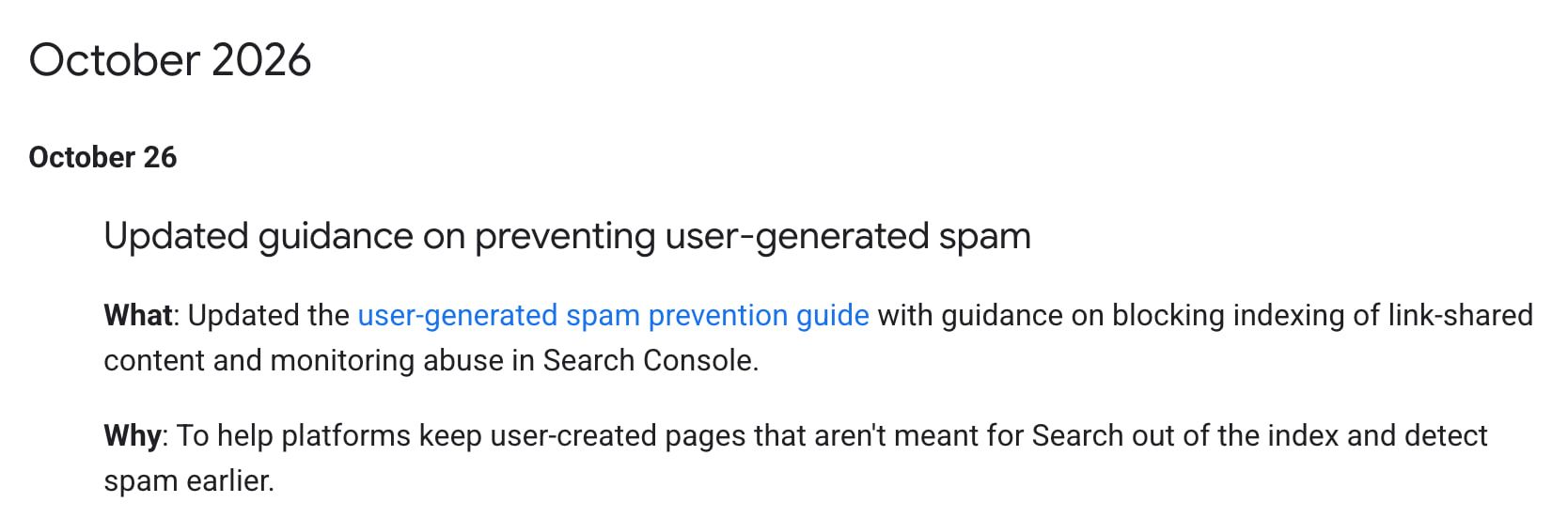
It widened its user-generated spam guide to cover tools that let users publish shared pages, generated content or web apps, and added a section telling them to keep those pages out of the index.
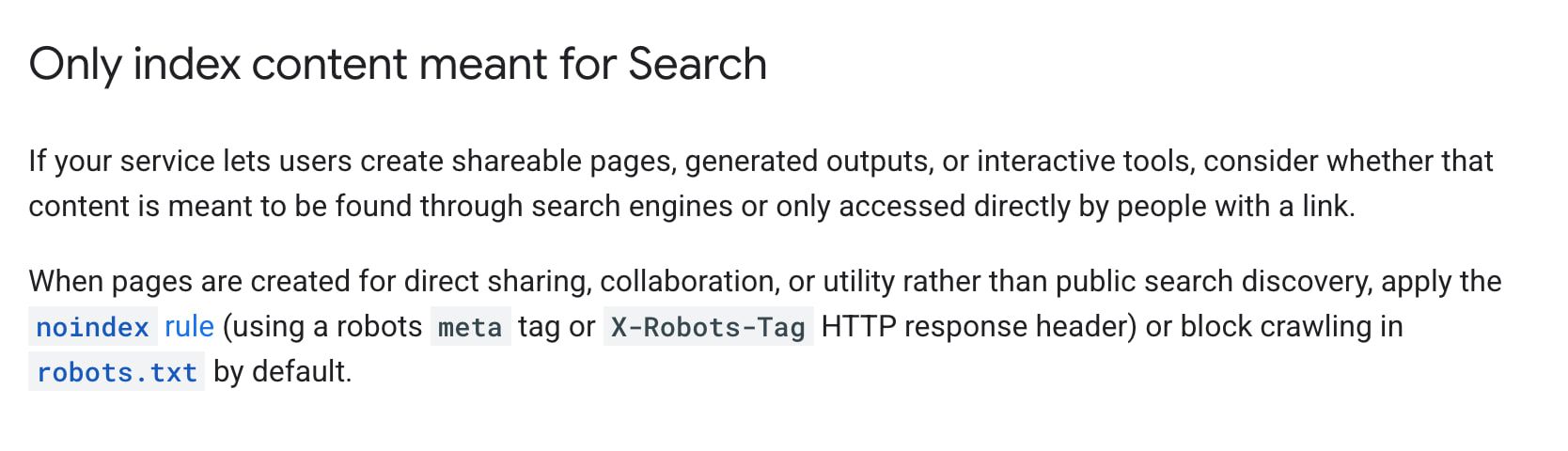
The guide, “Prevent user-generated spam on your site and platform”, now covers “Hosting platforms and tools that let users publish shared pages, generated content, or web apps” (Google guide). Its new section, “Only index content meant for Search”, is about pages “created for direct sharing, collaboration, or utility rather than public search discovery”. For those, Google says to apply noindex by default, through the robots meta tag or the X-Robots-Tag header, or to block crawling in robots.txt.
It also says to “Verify your site or subdomain in Search Console so you receive email alerts if Google issues a manual action”, and to watch the Page Indexing and Search performance reports for unexpected spikes.
Google’s changelog dates the change 26 October and gives the reason: “To help platforms keep user-created pages that aren’t meant for Search out of the index and detect spam earlier” (documentation updates). Search Engine Journal covered it on 28 October, the date some write-ups use, and Search Engine Roundtable listed it in its November roundup.
Is this a new spam rule? #
No. Google filed it as updated guidance, and its changelog lists no change to the spam policies. The policies that already apply, user-generated spam and, where third parties ride a host’s reputation, site reputation abuse, are the same as before.
The changelog entry is titled “Updated guidance on preventing user-generated spam”, and I found no spam-policy or site reputation entries in it from September to November (documentation updates).
Google’s spam policies already define user-generated spam as “spammy content added to a site by users through a channel intended for user content”, including “Spammy accounts on hosting services that anyone can register for” (spam policies). Site reputation abuse covers third-party content published “mainly because of that host’s already-established ranking signals”, where third parties include “users of that site, freelancers, white-label services”. Google says hosting user content, as forums do, isn’t a violation by itself.
The new guide doesn’t mention site reputation abuse at all. What changed is who the advice is addressed to.
Who does it affect? #
Mostly platforms and tools that publish pages for their users. Agencies feel it second-hand, because the shared pages they’ve used for links or AI visibility may stop being indexed.
Google named no platforms. Search Engine Roundtable reports that Marie Haynes asked on X whether AI tools and app builders could face manual actions, and that Lily Ray suggested it could target tools like Claude artifacts, ChatGPT pages and Facebook posts. Those are commentators’ examples, not Google’s.
| Who | What's new for them | What Google says to do | Risk if ignored |
|---|---|---|---|
| Platforms and tools that publish user pages (commentators' examples: shared AI chats, app builders) | Named in the guide's scope since 26 Oct | Noindex shared and generated pages by default; verify in Search Console; watch for indexing spikes | Under the spam policies, lower rankings or removal; manual actions |
| Agencies and SEOs using those pages for links or AI visibility | Indirect: platforms may noindex the pages | Nothing addressed to them; the user-generated spam and site reputation policies already apply | Placements drop out of the index; spam policies if the aim is manipulation |
| Sites with comments, forums or profiles | Nothing new | ugc or nofollow on untrusted links, moderation, CAPTCHA on sign-up | Manual action on spammy sections, as Google warned in 2021 |
Source: Google's prevent-abuse guide and spam policies; Search Engine Roundtable, Search Engine Journal. Verified 17 Nov 2026. Scroll sideways for more columns.
The agency row is where I’d pay attention. Google’s spam policies count attempts to “manipulate generative AI responses in Google Search” as spam, found “through automated systems and, as needed, human review”, and violators “may rank lower in results or not appear in results at all” (spam policies). In my reading, a placement built only to get a brand into AI answers fits that description uncomfortably well.
For sites with comments, the advice hasn’t moved: mark untrusted links nofollow or ugc, consider noindexing posts from new users until they build a reputation, and add reCAPTCHA or similar on sign-up (Google guide).
What’s the catch with robots.txt? #
Google’s new section allows noindex or a robots.txt block, but its own indexing docs say a blocked page can still show up, because Google never sees the noindex.
Google’s block-indexing page says that for noindex to work, the page “must not be blocked by a robots.txt file”; otherwise “the crawler will never see the noindex rule”, and the page can still appear in results (block-indexing doc). PPC Land flagged the same clash.
So if you run a platform, put the meta tag or header on shared pages and leave them crawlable. A robots.txt block on the same paths stops the noindex from working.
Is a crackdown coming? #
Nothing has been announced. Google named no services and set no consequences, and Facebook’s 6 million-plus AI-written answer pages were still indexed in early November.
Search Engine Journal’s headline speaks of a wider crackdown, but its article says the guidance “does not establish that a crackdown is imminent” (SEJ). PPC Land notes the guide gives no numeric thresholds and no consequence for platforms that leave shares indexable. Barry Schwartz called the new section “a significant addition”, which is his view.
On 5 November, SER reported that for Facebook’s AI-generated fb-answers directory, “Google has indexed over 6 million pages and they are ranking”. Glenn Gabe calls it “Scaled content abuse”; Google hasn’t commented. Its policies define that as “when many pages are generated for the primary purpose of manipulating search rankings” (spam policies). Whether Facebook’s pages fit is Google’s call, and it hasn’t made one.
Google has warned since 2021 that tolerated UGC spam “may result in Google taking manual actions against the affected pages” (SEJ, 2021). This year it ran four spam updates, starting 24 March, 24 June, 18 August and 24 September; the last ran 13 days 16 hours (Search Status Dashboard), so all four had finished before the guide changed (my arithmetic). The core update that began on 10 November is separate: here’s how to check whether it hit you.
What would I stop doing? #
New links and AI visibility placements on pages users publish through someone else’s tool. Then I’d list the ones that already exist, because those are the pages most likely to drop out of the index.
My checklist for agencies:
- List client links and placements on user-publish platforms: shared AI chats, app-builder pages, free-hosted pages. Any backlink tool that exports referring pages will do; I compare them in Ahrefs alternatives and Semrush alternatives.
- Stop building new ones.
- For each existing one, check whether the platform already noindexes shared pages: look for a robots meta tag or an
X-Robots-Tagheader. - Verify each client site and subdomain in Search Console so manual action alerts arrive by email.
- Watch the Page Indexing and Search performance reports for unexpected spikes, as Google’s guide suggests.
If you run a platform, noindex shared and generated pages by default with the meta tag or header, keep them crawlable, and verify the domain in Search Console. If you’re weighing AI visibility work for clients, AI visibility tools for agencies covers the measurement side.
I’ll update this post if Google announces enforcement or names a platform.
FAQ
What is Google's user-generated spam policy?
Google's spam policies define user-generated spam as 'spammy content added to a site by users through a channel intended for user content', including spammy accounts on hosting services anyone can register for. A separate Google guide tells sites and platforms how to prevent it.
What changed in Google's UGC spam guidance in October 2026?
On 26 October Google widened its guide to cover hosting platforms and tools that let users publish shared pages, generated content or web apps. It added a section, 'Only index content meant for Search', telling them to keep those pages out of the index by default.
Is Google issuing manual actions against AI tools or app builders?
None has been announced. Google named no services and set no consequences in the guide. Commentators asked about AI tools and app builders, but those are their questions, not Google's statements.
Should I use noindex or robots.txt for shared pages?
Noindex, by robots meta tag or X-Robots-Tag header, with the page left crawlable. Google's own docs say a robots.txt block stops its crawler from seeing the noindex, so the page can still appear in results.
Is UGC spam the same as site reputation abuse?
No. User-generated spam is spam users add through channels meant for user content. Site reputation abuse covers third-party content published mainly to benefit from a host's existing ranking signals, and Google says hosting user content, as forums do, isn't a violation by itself.
How do I get alerted to a manual action?
Verify your site or subdomain in Search Console. Google's guide says that's how you receive email alerts if it issues a manual action.
Sources
11 sources, accessed to .
Official pricing, docs, changelogs and status pages 5
- Google Search Central: prevent user-generated spam on your site and platform
- Google Search Central: documentation updates, 26 Oct 2026 entry
- Google Search Central: spam policies for Google web search
- Google Search Central: block indexing with noindex
- Google Search Status Dashboard: ranking update history (2026 spam updates)
News and press 6
- Search Engine Roundtable: Google's user-generated spam guidance for tools, 26 Oct 2026
- Search Engine Journal: Google's wider UGC spam guidance, 28 Oct 2026
- PPC Land: Google tells platforms to noindex link-shared pages by default, 26 Oct 2026
- Search Engine Roundtable: Facebook's AI answer pages indexed in Google, 5 Nov 2026
- Search Engine Journal: Google warns of manual actions for UGC spam, 27 May 2021
- Search Engine Roundtable: November 2026 Google webmaster report
Last updated: 17 November 2026. Facts verified 17 Nov 2026. Researched and drafted with AI tools; owner review is pending.


