Will Search Console finally show AI Overview clicks?
Search Console shows AI Overview impressions, not clicks. From 3 Dec the CMA wants Google to share AI click data for UK searchers. Should you wait?

Short on time?
Short on time? Here's what I would do.
- You already pay for AI Overview tracking
- Keep your tracker
- The CMA rules don't ask for keyword, competitor or per-feature data, which is what a tracker gives you.
- Small site, no tracker yet
- Search Console's free generative AI report
- Don't buy a tracker this month. Use the free impressions report now and look again after 3 Dec.
- Big UK audience, weighing the AI opt-out
- Wait for the 3 Dec click data
- Don't switch AI features off before you can see what they send you.
- Few or no searchers in the UK
- Plan without this data
- Google hasn't promised it anywhere outside the UK.
Prices verified . CMA rules and Google help pages verified 16 Nov 2026. No vendor paid to be included, and sponsors can't buy a verdict.
From 3 December 2026, the UK’s competition regulator wants Google to show sites how searchers in the UK engage with their content in AI Overviews and AI Mode, clicks included. I read the CMA’s four documents to see what that data has to include and what it leaves out, and whether it’s a reason to stop paying for AI Overview tracking.
My short answer: keep the tracker. For the tools themselves, start at my AI visibility hub.
Where are your AI Overview clicks today? #
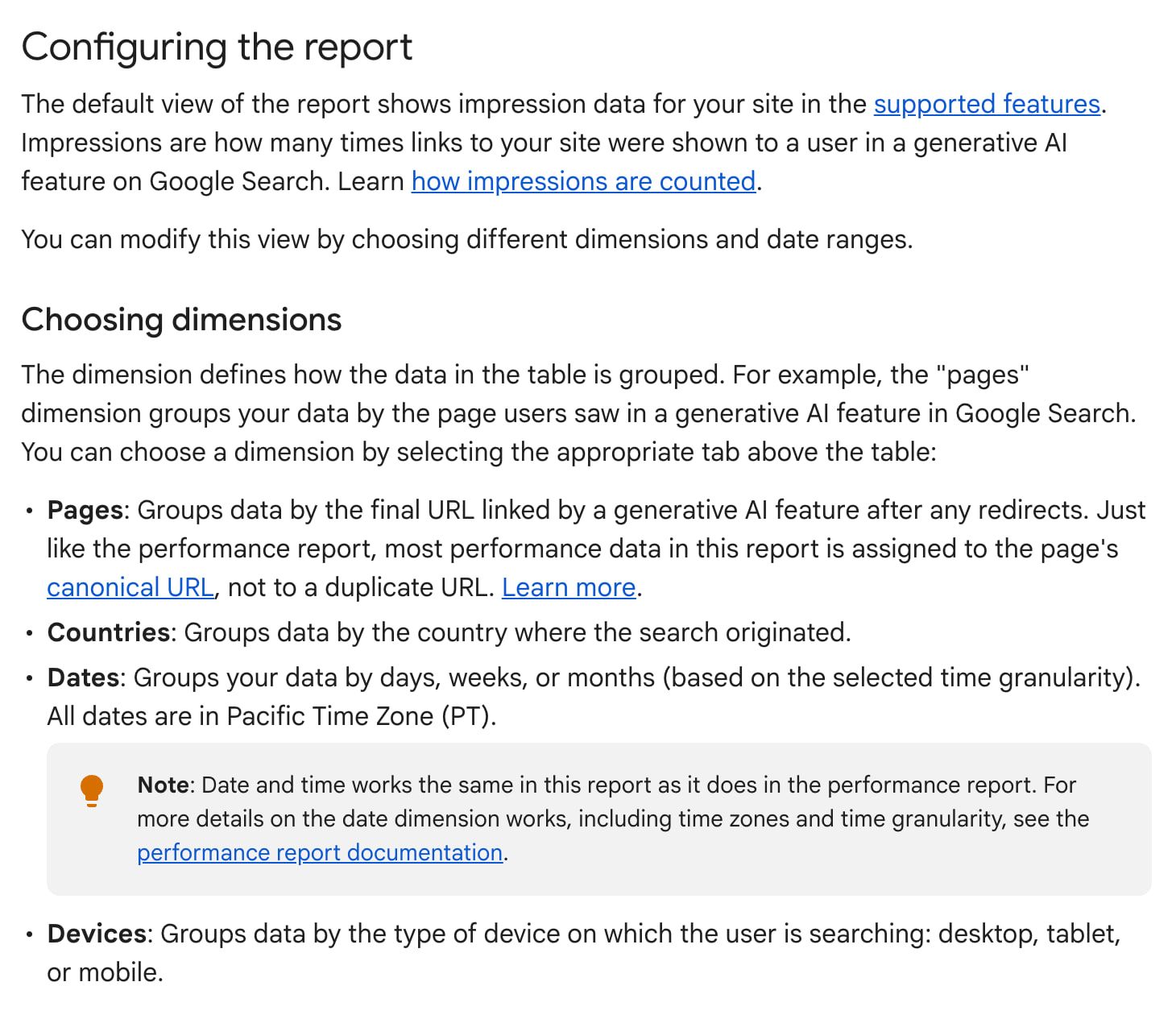
Inside your normal Search Console Performance report, mixed in with every other Web click. Google’s generative AI report shows impressions only, by page, country, device and date.
Google defines the report’s one metric like this: “Impressions are how many times links to your site were shown to a user in a generative AI feature on Google Search.” It covers AI Overviews and AI Mode together and lists no clicks, click rate or position (Search Console help). Every site has had it since 31 August 2026 (Search Central blog). Everything else the report shows, and its blind spots, is in Search Console and AI Overviews: what the report shows.
The clicks are counted, just not separated. Google says “Clicking a link to an external page in the AI Overview counts as a click,” and “all links in the AI Overview are assigned that same position” (how Search Console counts). Search Engine Journal found no search appearance filter that pulls them out (SEJ, 2 Nov).
One wrinkle: a logging error lowered impressions in the AI report from 9 to 11 November, and Google says it “affects data logging only” (SER). I cover that in my November core update post, and the evergreen version of this answer lives in rank tracking vs AI visibility tracking.
What does Google have to give you by 3 December? #
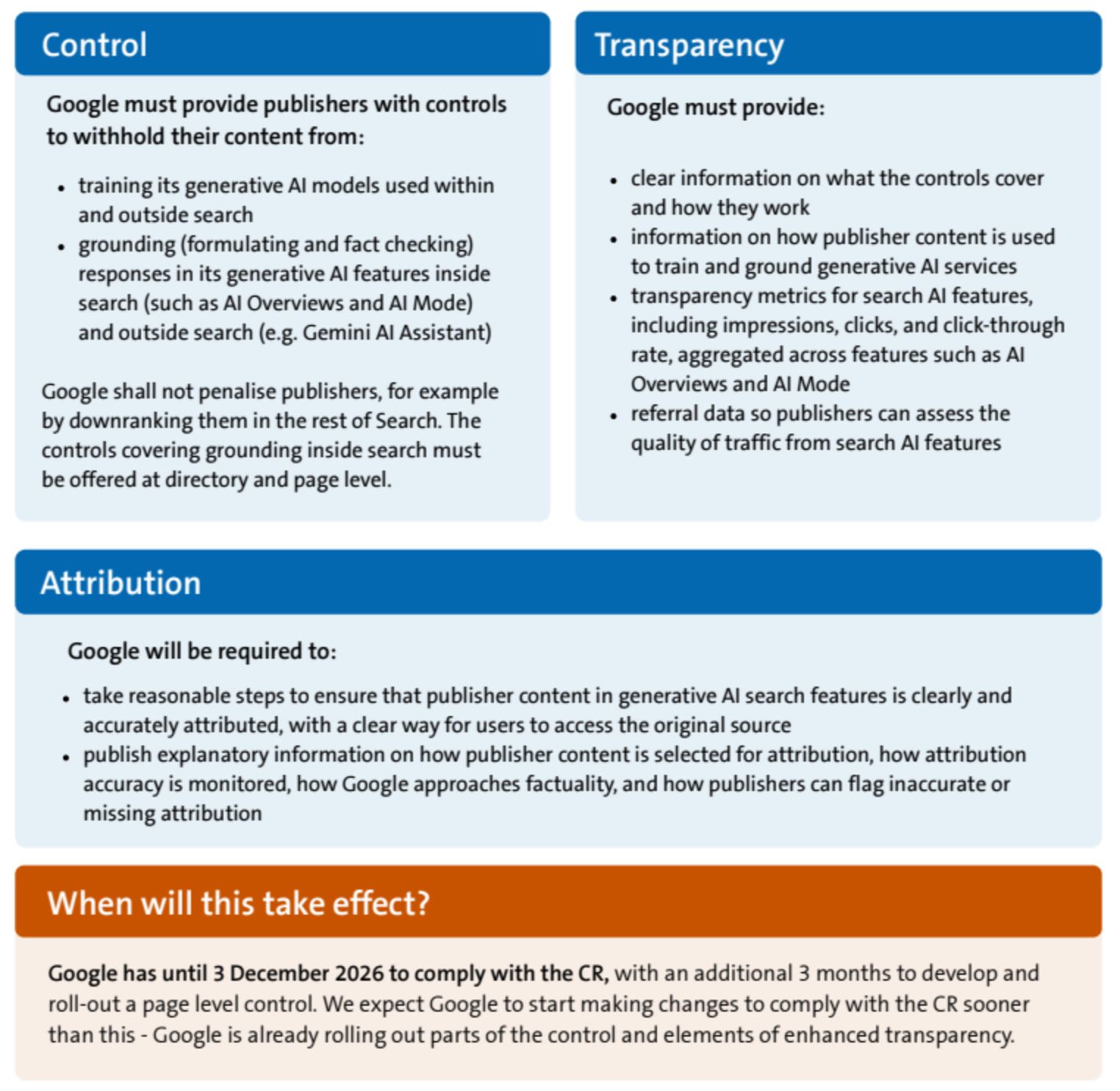
For searchers located in the UK: data on how people engage with your content in Google’s AI features. The CMA spells that out as impressions, clicks and click-through rate, per site and kept apart from organic results.
The binding line is short. The CMA’s notice says “Google shall provide publishers with clear and detailed metrics on user engagement with their Search Content where it is used in its search generative AI features” (CMA notice, 3 Jun 2026).
The detail sits in the CMA’s interpretative notes. Paragraph 8 lists impressions, click-throughs “and a means by which publishers can easily identify those clicks”, and click-through rate. Paragraph 9 wants the data “on a disaggregated basis for each publisher”, “fully disaggregated from other elements of general search”, through a platform “such as Google Search Console”.
The CMA’s summary adds “referral data so publishers can assess the quality of traffic”. It also says Google “is already rolling out parts of the control and elements of enhanced transparency”.
There are two catches. Search Console is the CMA’s suggestion, not a requirement: Google may “take a different approach where it is able to demonstrate to the CMA that its approach complies” (notice).
And Google hasn’t said what it’ll do. On 2 November Gary Illyes wrote: “The team is super interested in giving more data, data that makes sense, but we don’t have anything to announce yet,” as reported by Search Engine Journal and Search Engine Roundtable.
SER read that as a hint that click data may not come, and John Mueller called that reading odd, per the same SER report. My reading: the requirement binds from 3 December, but the shape of the data is Google’s to propose.
Is this UK only? #
Yes, as written. The rules cover AI answers “shown to any natural or legal persons located in the UK” (notice), and the CMA says Google can judge that by “the location reported by their device” (notes).
So it’s about where searchers are, not where a site is based. My reading: a US site with readers in the UK is covered for those readers’ searches, and a British site’s American visitors aren’t.
Google hasn’t confirmed it will give the same data elsewhere, Digiday reported on 9 November.
Will you get keyword-level data? #
Nothing in the CMA’s text asks for it. Expect per-site numbers with AI Overviews and AI Mode combined: no queries, no competitors and no split between the two features.
The CMA’s summary describes metrics “aggregated across features such as AI Overviews and AI Mode”. The notice talks about engagement with publishers’ own “Search Content”, so nothing about a rival’s pages. The notes mention a user query only to define an impression; they don’t ask for query or keyword data.
That gap is the job a tracker does. Here’s how the three line up.
| What you want | Search Console today | Expected from 3 Dec (searchers in the UK) | AI Overview tracker |
|---|---|---|---|
| AI impressions | Yes, by page, country, device and date; AI Overviews and AI Mode combined | Yes, plus where your content is attributed | For each keyword you track |
| AI clicks and click rate | No; the clicks sit inside your Web totals | Required: clicks, click rate and a way to identify those clicks | No; a tracker sees results pages, not your clicks (my reading) |
| Query or keyword level | No query dimension | Not in the CMA's text | Yes, for keywords you choose |
| Competitors | No | No; it covers your own content | Yes |
| AI Overviews vs AI Mode | Combined | Not expected: 'aggregated across features' | Tracked separately in some tools |
| Where searchers are | Worldwide since 31 Aug 2026 | Located in the UK | Locations you choose |
| Price | Free | Free | Paid |
Source: CMA notice, interpretative notes and summary; Google Search Console help and Search Central blog; verified 16 Nov 2026. Tracker column: my reading of the trackers in my AI Overviews roundup. Scroll sideways for more columns.
For which trackers record your citation in AI Overviews and AI Mode, see which rank trackers really track AI Overviews.
Which dates should you watch? #
3 December for the data, 3 January 2027 for Google’s first compliance report to the CMA, and 3 March 2027 for page-level controls.
| Date | What happens | What it means for you |
|---|---|---|
| 3 Jun 2026 | CMA imposes the requirement; Google launches its AI reports for some sites | The clock starts |
| 31 Aug 2026 | The generative AI report reaches every site worldwide | Impressions only, free |
| 2 Nov 2026 | Illyes: nothing to announce yet | No product news from Google |
| 9–11 Nov 2026 | Logging error in the AI report | Skip these days when you read AI impressions |
| 3 Dec 2026 | Requirement in force, except the page-level control | Look in Search Console on 4 Dec |
| 3 Jan 2027 | Google's first compliance report due (covers 3 Jun to 3 Dec) | Google's account of what it delivered |
| 3 Mar 2027 | Page-level control in force (nine months after 3 Jun, my arithmetic; Digiday agrees) | Finer control over how pages are used in AI features |
| 3 Jul 2027 | Second compliance report due | A second check on what changed |
Source: CMA notice, compliance reporting notice and summary; Google Search Central blog; Search Engine Journal; Search Engine Roundtable; Digiday. Verified 16 Nov 2026. Scroll sideways for more columns.
The report dates come from the CMA’s compliance reporting notice, which also says the CMA “expects to issue a subsequent notice” making Google publish a summary or non-confidential version. That public summary will be the first place to read what Google says it delivered. The requirement itself runs until 10 October 2030 unless the CMA changes it (notice).
That page-level control is about AI features in Search. Stopping AI companies from training on your pages is a separate setting, which I cover in the new AI training opt-out.
How can you estimate AI clicks until then? #
Only roughly. Cyrus Shepard switched his site out of Google’s AI features for 28 days and estimated a 0.9% AI click-through rate, with about 21% of its clicks coming from AI features (Zyppy).
Search Engine Journal frames those numbers “more as a directional yardstick than Google gospel” (SEJ, 9 Nov). I walk through how he got there, and whether you should copy him, in what one site’s AI Overviews opt-out showed.
For a wider view, Pew found people clicked a traditional result in 8% of visits with an AI summary against 15% without one, and clicked a link inside the summary in “just 1%” of visits (Pew, 22 Jul 2025). I compare Pew with the randomized study and six others in what the AI Overview click studies say.
Analytics won’t fill the gap. Google’s new guide to spotting Search traffic says “The Referer header doesn’t include the search query that the user entered,” and it doesn’t mention AI features (Google; SER).
So what would I do? #
Keep the tracker, write down the dates, and decide with real numbers in January. Whatever Google ships on 3 December covers searchers in the UK only and gives totals, not the keyword and competitor view you pay a tracker for.
My picks:
- You pay for AI Overview tracking: keep it.
- Small site, no tracker: don’t buy one this month; read the free generative AI report and look again after 3 December.
- Big UK audience, thinking about the AI opt-out: wait until you can see what AI features send you before you switch anything off.
- Few searchers in the UK: plan as if this data won’t reach you.
My checklist:
- Today: note your AI impressions for the last few weeks from the generative AI report, skipping 9–11 November.
- 4 December: open Search Console and look for anything new in the Performance and generative AI reports.
- Early January: if UK click data has arrived, set a month of it beside your tracker’s keyword view and decide whether the tracker still earns its fee.
- After 3 January: watch for the public summary of Google’s first compliance report.
I’ll update this post after 3 December.
FAQ
Does Search Console show AI Overview clicks now?
Not as a separate number. A click on a link in an AI Overview counts as a normal click inside your Web totals, and the generative AI report shows impressions only, by page, country, device and date.
Is Google adding AI click data to Search Console?
Google hasn't said. The CMA requires engagement metrics, which it describes as impressions, clicks and click-through rate, for searchers in the UK from 3 December 2026, and names Search Console only as an example platform. On 2 November Google's Gary Illyes said the team had nothing to announce yet.
Will I get the data if my searchers aren't in the UK?
Not under these rules. They cover AI answers shown to people located in the UK, judged by device location. It's about where searchers are, not where your site is based, and Google hasn't confirmed the same data anywhere else.
Will AI Overviews and AI Mode be reported separately?
Not on the CMA's terms. Its summary describes metrics aggregated across features such as AI Overviews and AI Mode, and today's generative AI report combines them too.
Can I see AI Overview clicks in Google Analytics?
Not by any method Google documents. Google's guide to spotting Search traffic says the Referer header doesn't include the query, and it doesn't mention AI features.
Should I cancel my AI Overview tracker?
No. The CMA's rules ask for per-site totals for searchers in the UK, not keyword, competitor or per-feature data, which is what a tracker gives you. Decide again after a month of real data.
Sources
16 sources, accessed .
Official pricing, docs, changelogs and status pages 8
- CMA: notice imposing the publisher conduct requirement on Google, 3 Jun 2026
- CMA: interpretative notes to the publisher conduct requirement
- CMA: compliance reporting notice (report dates)
- CMA: publisher conduct requirement summary, 3 Aug 2026
- Search Console help: generative AI performance report (Search)
- Search Console help: how clicks, impressions and position are counted
- Google Search Central blog: generative AI performance reports, 3 Jun 2026
- Google Search Central: identify traffic from Google Search
Independent benchmarks and published studies 1
News and press 6
- Search Engine Journal: no AI click reporting news yet, ahead of the UK deadline, 2 Nov 2026
- Search Engine Roundtable: click data for Search Console AI reporting, 2 Nov 2026
- Search Engine Roundtable: generative AI report data bug, 12 Nov 2026
- Search Engine Roundtable: Google's new doc on identifying Search traffic, 12 Nov 2026
- Digiday: as publishers await click data, the opt-out decision gets harder, 9 Nov 2026
- Search Engine Journal: Google's AI features sent one site an estimated 21% of its clicks, 9 Nov 2026
Last updated: 16 November 2026. Facts verified 16 Nov 2026. Researched and drafted with AI tools; owner review is pending.


