The new AI training opt-out, and what it doesn't block
Google, Microsoft, OpenAI and Anthropic back one robots.txt line to opt out of AI training. What it blocks, what it doesn't, and when it starts.

Short on time?
Short on time? Here's what I would do.
- You don't want AI companies training on your content
- Add the __usage_ai-training block
- Keep your GPTBot and ClaudeBot rules too. The new line adds to them; it doesn't replace them.
- You want to stay in Gemini Apps answers
- An explicit Google-Extended allow
- Google can then train on your pages. There's no way to split the two with Google today.
- Bing and Copilot
- ai-training:disallow, grounding left alone
- Set ai-grounding:disallow only if you want out of Copilot; disallowextended if you only object to third-party grounding.
- You use NoArchive or NoCache to keep Bing out of AI
- Bing's new tags
- The old tags stop counting after 1 Mar 2027. A temporary setting opens on 15 Dec.
- You want out of AI Overviews
- Search Console's AI control, not this line
- It's a different switch with a different cost.
Prices verified . Company pages and the IETF draft verified 16 Nov 2026. No vendor paid to be included, and sponsors can't buy a verdict.
On 30 October, Google and Microsoft said they’d read one shared robots.txt line that tells AI companies not to train on your pages, built on a draft standard written by an Anthropic engineer. I read each company’s own pages to see what that line blocks, what it leaves alone, and when it starts to count.
The short version: add it, keep your other rules, and know that once Google supports it, it costs you Gemini Apps citations unless you allow Google-Extended yourself. For the wider picture, start at my AI visibility hub.
What changed on 30 October? #
Google and Microsoft announced support for one shared robots.txt token that means “don’t train on this”, built on an IETF draft by an Anthropic engineer. OpenAI said the same day that it plans to follow.
Google’s post says it plans to support a shared control “based on work from the AIPREF working group” at the IETF (Google, 30 Oct). Bing published its version the same day (Bing), alongside the draft by K. Kelley of Anthropic (IETF draft).
OpenAI’s own post says it will honour the shared signal, aims to implement it in the coming months, and will keep the robots.txt controls it already offers (OpenAI, 30 Oct). Search Engine Journal and PPC Land report the same.
What’s the exact line? #
Add a group for the user-agent __usage_ai-training with Disallow: /. A User-Agent: * group doesn’t count, and you can allow folders back, such as a press kit.
This is the draft’s own example:
User-Agent: __usage_ai-training
Disallow: /
Allow: /press-kit/
The draft says wildcard groups “MUST NOT be interpreted as matching the policy token” (IETF draft). So a blanket Disallow for every bot expresses no training preference at all under this scheme.
It’s about use, not crawling: “This policy token is not a directive for crawling behavior.” It asks companies not to use your pages for training, which the draft defines as “Using an asset to modify the learned parameters of a generative AI model”.
Who honours it, and from when? #
Nobody fully, yet. Anthropic has started, Google targets early 2027, Microsoft starts on 1 February 2027, and OpenAI aims for the coming months.
| Company | Status on 16 Nov | When | Where it says so |
|---|---|---|---|
| Anthropic | Started implementing; 'It'll take us some time to add support across our services' | Under way | The draft author's IETF email, 30 Oct |
| Plans to support it | Early 2027 (crawler docs; the blog says 'in 2027') | Google crawler docs and Search Central blog | |
| Microsoft (Bing) | Plans to honour training and grounding preferences as it crawls | From 1 Feb 2027 | Bing blog, 30 Oct, and Bing's FAQ |
| OpenAI | Plans to implement it and keep its own bot controls | In the coming months, no date | OpenAI's post, 30 Oct |
Source: Kelley's IETF email, Google crawler docs and blog, Bing blog and FAQ, OpenAI's post; verified 16 Nov 2026. Scroll sideways for more columns.
Kelley’s email says “Anthropic has already started implementing support for this draft” and that it “complements our existing crawler controls rather than replacing them” (IETF list). That second line is why I’d keep your existing bot rules.
Google’s crawler docs say it plans to support user-agent: __usage_ai-training in early 2027 (Google crawler docs). Search Engine Journal put the rest plainly on 1 November: “none of the three companies currently supports the line”, its three being Google, Microsoft and OpenAI.
Will blocking training hide you from AI answers? #
Mostly no. AI Overviews and AI Mode, ChatGPT search, Claude’s search and Copilot use separate controls. The exception is Gemini Apps: Google plans to treat your opt-out as a Google-Extended block, which also stops Gemini Apps grounding.
Google says that if you opt out with the shared line and don’t mention Google-Extended, it plans to treat it “as if the publisher had disallowed” Google-Extended (Google, 30 Oct). Google-Extended covers training future Gemini models and grounding in Gemini Apps and Vertex AI, and it “does not impact a site’s inclusion in Google Search nor is it used as a ranking signal” (crawler docs).
Google’s post adds that sites that “specifically allow Google-Extended are eligible to appear in responses and receive clicks via grounding in Gemini Apps”. My reading: an explicit Google-Extended line wins over the mapping, so User-Agent: Google-Extended with Allow: / keeps you eligible for Gemini Apps, but Google may then train on your pages.
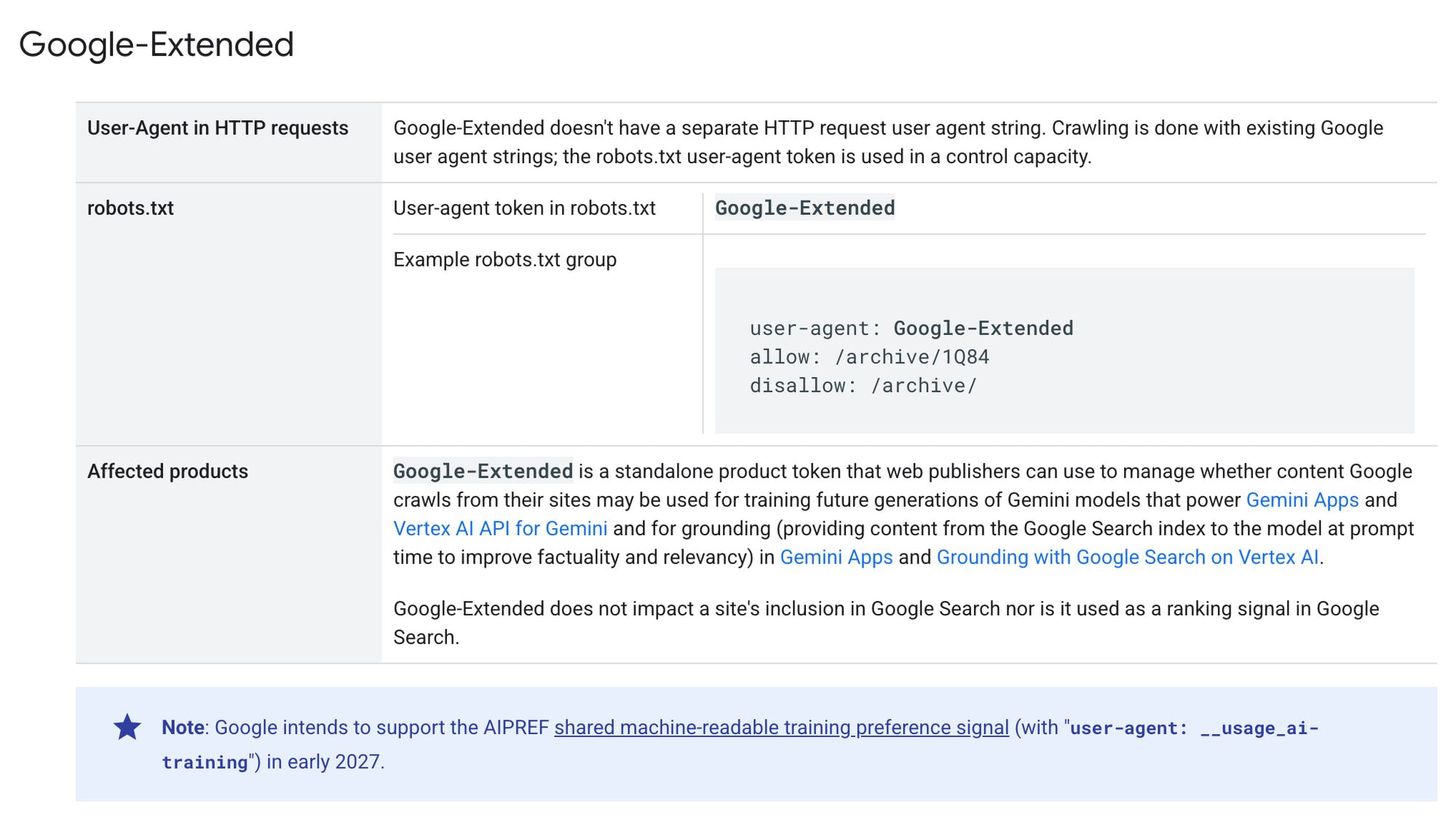
Elsewhere, the answer bots are separate. OpenAI says OAI-SearchBot surfaces sites in ChatGPT search, GPTBot is for training, and “Each setting is independent of the others” (OpenAI). Anthropic lists ClaudeBot for content that “could potentially contribute to” training and Claude-SearchBot “to improve search result quality” (Anthropic).
AI Overviews have their own switch. Search Console’s AI control removes you from them, and Google says “This control doesn’t affect AI training” (Search Console help).
The other route, nosnippet, keeps a page out as “a direct input for AI Overviews and AI Mode” but drops its normal snippet too (robots meta tag docs). I cover that decision in should you opt out of AI Overviews?
What about Bing’s grounding switch? #
It’s separate and page-level only. ai-grounding:disallowextended keeps you in Copilot but out of third-party grounding services; ai-grounding:disallow takes you out of Microsoft’s AI answers. Classic Bing results don’t change.
Bing reads the training preference from the shared robots.txt line, or per page from <meta name="Bingbot" content="ai-training:disallow"> or the matching X-Robots-Tag header. Grounding works only through the meta tag or header: “There is no site-wide robots.txt grounding preference” (Bing).
Bing says these preferences “do not change eligibility for traditional Bing search results”, and “Neither choice guarantees inclusion, traffic, or payment.”
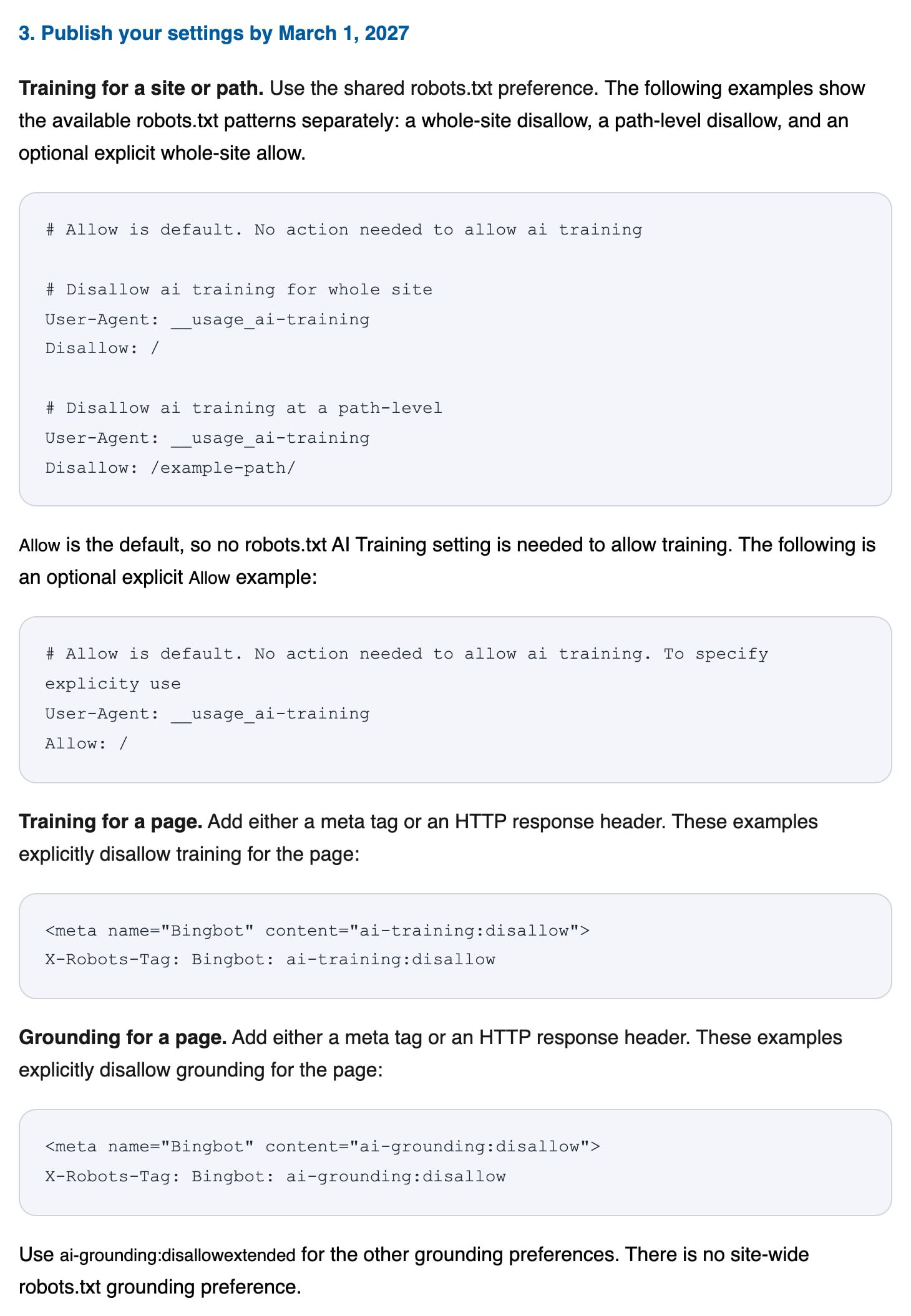
The 15 December date only matters if you use NoArchive or NoCache to keep Bing out of AI. That day Bing opens a temporary grounding preference in Bing Webmaster Tools for those sites; there’s no temporary training setting (Bing FAQ).
New preferences count from 1 February 2027 as pages are recrawled. 1 March 2027 is the deadline to publish your preferences: after it, NoArchive and NoCache “will no longer be read as a preference for training or grounding”, and affected pages without a temporary preference default to Allow for grounding until recrawled. Temporary preferences expire on 30 September 2027.
What does each setting do? #
They split three ways: some stop training, some keep you out of AI answers, and only nosnippet touches classic search. Here’s each one, with the date it starts working.
| Setting | Blocks training? | Keeps you out of AI answers? | Classic search affected? | Live when? |
|---|---|---|---|---|
| User-Agent: __usage_ai-training, Disallow: / | Yes, where honoured | Google: Gemini Apps grounding (mapped to Google-Extended). Others: no | No | Anthropic started; Google early 2027; Bing 1 Feb 2027; OpenAI in the coming months |
| Google-Extended disallow | Gemini training | Gemini Apps and Vertex AI grounding; not AI Overviews or AI Mode | No | Now |
| Search Console AI control | No | AI Overviews, AI Mode, Discover's AI features | No, per Google | Now (every site since 31 Aug 2026) |
| nosnippet | No | AI Overviews and AI Mode (as a direct input) | Yes: your normal snippets go too | Now |
| GPTBot disallow | OpenAI training | No (ChatGPT search uses OAI-SearchBot) | No | Now |
| ClaudeBot disallow | Anthropic training | No (Claude-SearchBot is separate) | No | Now |
| Bing ai-training:disallow | Microsoft training | No | No | 1 Feb 2027 |
| Bing ai-grounding:disallowextended | No | Third-party grounding services only; Copilot keeps you | No | 1 Feb 2027 |
| Bing ai-grounding:disallow | No | Copilot and Microsoft's other AI answers | No | 1 Feb 2027 |
Source: Google blog, crawler docs, robots meta tag docs and Search Console help; Bing blog and FAQ; IETF draft and email; OpenAI's post and crawler page; Anthropic's crawler page. Verified 16 Nov 2026. Scroll sideways for more columns.
So what would I set? #
The shared line plus the bot rules you already have, with Googlebot, Bingbot and the search bots left alone. This is my default, not any company’s recommendation:
User-Agent: __usage_ai-training
Disallow: /

User-Agent: GPTBot
Disallow: /

User-Agent: ClaudeBot
Disallow: /
Robots.txt is a request, not a lock. The draft doesn’t define what happens when a GPTBot group and the shared line disagree, and Search Engine Journal notes OpenAI’s docs don’t say either, which is one more reason to keep both. To see which crawlers and agents still arrive, count AI bot and agent visits with Clarity or your CDN logs. Google says user-triggered agents such as Google-Agent generally ignore robots.txt, so for those the question moves to your firewall: allowing Google-Agent.
My picks:
- You don’t want your content trained on: use the block above. Don’t block OAI-SearchBot, Claude-SearchBot, Googlebot or Bingbot, or you’ll start losing AI answers and search. If you want ChatGPT to name you, how to get mentioned in ChatGPT starts from the same crawler rules.
- You want Gemini Apps citations: add
User-Agent: Google-ExtendedwithAllow: /, knowing Google may then train on your pages. - Bing: add
ai-training:disallowif you like, leave grounding alone unless you want out of Copilot, and usedisallowextendedif only third-party grounding bothers you. - You rely on NoArchive or NoCache: switch to the new tags before 1 March 2027.
- You manage clients: make this your house default and flag the Gemini trade-off to each client. For the reporting side, see AI visibility tools for agencies.
To check afterwards whether AI answers still mention you, rank tracking vs AI visibility tracking explains what each kind of tool measures.
In the UK, the CMA expects Google to change Google-Extended so publishers can opt out of training and of grounding for its wider AI services, but it doesn’t make Google remove content already added to the models behind its search AI features (CMA notes). For the click data those same rules require, see will Search Console finally show AI Overview clicks?
I’ll update this post when Google, Microsoft or OpenAI start reading the line.
FAQ
What do I add to robots.txt to opt out of AI training?
A group for the user-agent __usage_ai-training with Disallow: /. A User-Agent: * group doesn't count, and you can add Allow lines for folders you're happy to share, such as a press kit.
Does __usage_ai-training work today?
Partly. Anthropic has started implementing it. Google plans support in early 2027 and Microsoft from 1 February 2027, and OpenAI says it aims to implement it in the coming months. Robots.txt is a request either way.
Will blocking AI training remove me from AI Overviews?
No. Google maps the line to Google-Extended, which doesn't affect inclusion in Google Search. Leaving AI Overviews and AI Mode takes Search Console's AI control or nosnippet, which is a different decision.
Will it remove me from Gemini?
From Gemini Apps answers, yes, once Google supports the line, because Google will read it as a Google-Extended block unless you name Google-Extended yourself. Google says sites that explicitly allow Google-Extended are eligible for Gemini Apps grounding, which also means Google may train on them.
Does blocking GPTBot hide me from ChatGPT search?
No. OpenAI says ChatGPT search uses OAI-SearchBot while GPTBot is for training its models, and 'Each setting is independent of the others.'
What's the difference between Bing's disallow and disallowextended?
ai-grounding:disallowextended keeps your pages in Microsoft's own AI experiences, such as Copilot, but out of third-party grounding services. ai-grounding:disallow keeps them out of Microsoft's generated answers. Neither changes classic Bing results.
Does opting out remove content already used for training?
The draft doesn't say so: it applies the robots.txt in effect when a page was retrieved. In the UK, the CMA doesn't require Google to remove content already added to the models behind its search AI features.
Sources
17 sources, accessed .
Official pricing, docs, changelogs and status pages 12
- Google Search Central blog: a shared AI training control, 30 Oct 2026
- Google crawler docs: common crawlers, including Google-Extended
- Google Search Central: robots meta tag rules (nosnippet)
- Search Console help: Search generative AI control
- Bing blog: clearer preferences for training and grounding, 30 Oct 2026
- IETF draft: Machine-Readable Training Preference Signal, 30 Oct 2026
- IETF ai-control list: the draft author's announcement, 30 Oct 2026
- OpenAI: making it easier for websites to express AI training preferences, 30 Oct 2026
- Bing Webmaster Tools help: new AI preferences (FAQ)
- OpenAI docs: OpenAI's crawlers and user agents
- Anthropic help: Anthropic's crawlers and how to block them
- CMA: interpretative notes to the publisher conduct requirement
News and press 3
- Search Engine Journal: Google, Microsoft and OpenAI plan to honor a shared AI training opt-out, 1 Nov 2026
- PPC Land: Google, Microsoft, OpenAI and Anthropic back one AI training opt-out, 31 Oct 2026
- Search Engine Journal: Cloudflare lets sites disallow AI training without blocking Googlebot, 15 Sep 2026
Last updated: 16 November 2026. Facts verified 16 Nov 2026. Researched and drafted with AI tools; owner review is pending.


