How to get your brand mentioned in ChatGPT answers
Want ChatGPT to mention your brand? OpenAI says ads won't do it. What the evidence backs: crawler access, third-party 'best X' lists and reviews.

Short on time?
Short on time? Here's my take.
- Do today, free
- Let OAI-SearchBot and PerplexityBot in
- OpenAI says sites that opt out of OAI-SearchBot won't be shown in ChatGPT search answers. Blocking GPTBot only affects training.
- Fund first
- Third-party 'best X' lists and review sites
- Most of the evidence I found points here: lists made up 43.8% of page types in Ahrefs' 750-prompt study.
- Don't fund for mentions
- ChatGPT ads, or a Business Hub claim
- OpenAI says ads don't influence answers and a claim doesn't guarantee visibility. Claim Business Hub to measure, if you're eligible.
- Measure it
- Business Hub, then Peec AI Starter
- Business Hub gives free 28-day counts. Peec Starter is $95 a month for 50 prompts on 3 models (verified 17 Nov 2026).
Prices verified . Facts from OpenAI, Perplexity, Wikipedia and vendor research, verified 17 Nov 2026. No vendor paid to be included, and sponsors can't buy a verdict.
Every guide on this promises a playbook, and every one I found is written by a company selling the fix. I read OpenAI’s and Perplexity’s own pages, Ahrefs’ and SparkToro’s studies and the top three guides in my search to separate the levers with evidence from the ones without.
Below: what controls whether ChatGPT can cite you at all, which sites it leans on, what OpenAI says won’t help, and how to tell if anything is working. For the measurement tools, start at the AI visibility hub.
How does ChatGPT decide which brands to name? #
OpenAI doesn’t publish how it picks brands. When ChatGPT searches, it can only cite pages its search crawler may read, and studies show it leans on third-party lists, Wikipedia and Reddit.
That’s the honest starting point. OpenAI’s help article on ChatGPT search blocked my research tools, so I can’t tell you which search providers it uses or when it searches rather than answering from training. Any guide that names a provider with certainty should show you OpenAI’s page saying so.
What is documented: the crawler rules (next section), and a growing pile of vendor studies on which pages get cited. Those studies are the best evidence available, but they come from companies selling tracking, and none measures what happens after you change something.
One more limit. Even Google, about its own AI features, says “No third-party tool has access to our internal ranking or AI systems” (Google). The same is true of ChatGPT: every playbook, including this one, works from the outside.
Can ChatGPT see your site? #
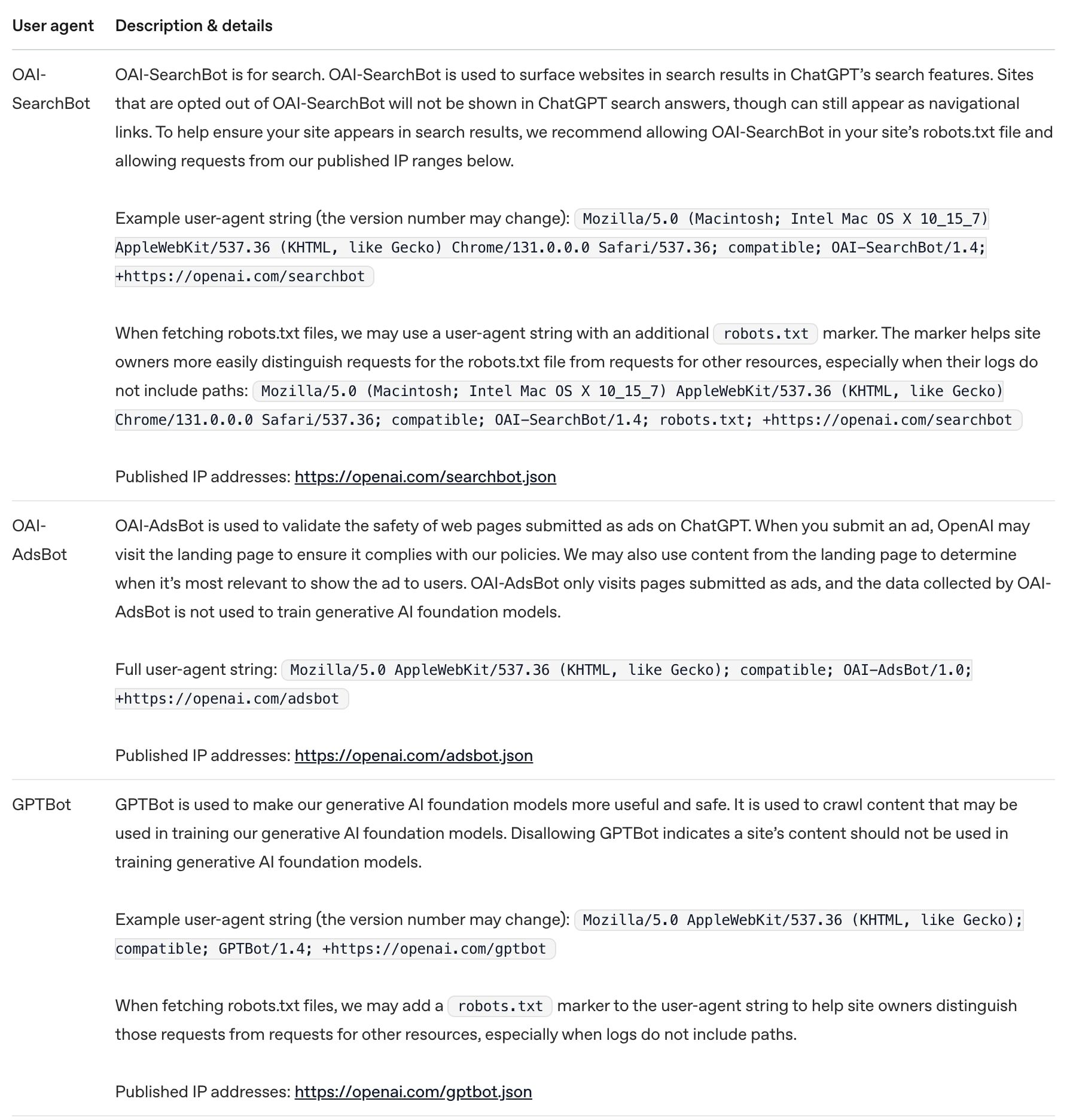
Check robots.txt first. OpenAI says sites that opt out of OAI-SearchBot “will not be shown in ChatGPT search answers”. Blocking GPTBot only opts you out of training.
OpenAI’s crawler page lists three agents and says each robots.txt setting works on its own (OpenAI). Changes take about 24 hours to apply.
| Agent | What it's for | Block it and… |
|---|---|---|
| OAI-SearchBot | 'OAI-SearchBot is for search' | You won't be shown in ChatGPT search answers (navigational links can still appear) |
| GPTBot | Content 'that may be used in training our generative AI foundation models' | You're out of training; search answers aren't affected |
| ChatGPT-User | Fetches a page when a user's request needs it | 'robots.txt rules may not apply'; it isn't used to decide what appears in search |
Source: OpenAI's crawler documentation, read 17 Nov 2026. Scroll sideways for more columns.
So if your site blocks every AI bot to stay out of training, you may also have blocked yourself out of ChatGPT search. I go through the settings for each company in the AI training opt-out.
Which sites does ChatGPT cite most? #
Wikipedia and Reddit top most studies for ChatGPT, followed by Forbes, TechRadar and LinkedIn. Reddit’s share has swung a lot in 2026, though.
Peec’s March 2026 study of 30 million sources in the US ranks ChatGPT’s top five as Wikipedia, Reddit, Forbes, TechRadar and LinkedIn (Peec). Similarweb’s January–February 2026 data for ChatGPT on the web puts wikipedia.org at 13.15% and reddit.com at 11.97% of citation events (Similarweb).
Then Reddit dropped. Tinuiti reports ChatGPT’s Reddit share falling from a “steady 3.8%” to about 0.5% from mid-August 2026 (Tinuiti). And the list moves daily: Ahrefs found the most-cited domains change “about 14%” from one day to the next (Ahrefs).
My read: aim for the kinds of sites that keep showing up (reference pages, review sites, editorial roundups) rather than chasing whichever domain led last quarter. I compare nine such studies in which sites AI answers cite most.
Which levers are worth paying for? #
Third-party “best X” lists and review sites have the most evidence behind them. General PR has a strong correlation, but the study behind it covers only Google’s AI Overviews.
| Lever | Cost to you (my estimate) | What the evidence says | How you'd see a change |
|---|---|---|---|
| Allow OAI-SearchBot and PerplexityBot | Minutes | Opted-out sites 'will not be shown in ChatGPT search answers' (OpenAI) | Business Hub mentions; tracker citations |
| Get onto third-party 'best X' lists | Outreach time | 43.8% of page types across 750 recommendation prompts; higher list position, more recommendations (Ahrefs) | Mention rate on category prompts |
| Your own comparison or 'best X' page | Writing time | Showed up in 34% of software answers that recommended the publisher (Ahrefs) | Your URLs in citations |
| Reviews and community (G2, Reddit, YouTube) | Ongoing effort | Reddit and Wikipedia lead ChatGPT citations in several studies; Reddit fell in Aug 2026 | Cited domains on your prompts |
| Brand mentions in general (PR) | High | Correlates with AI Overview visibility (0.664 vs 0.218 for backlinks); Google only, not causal | Mention rate over months |
| Clear, answer-first pages | Writing time | Microsoft's advice for Copilot; Google says no special format is needed | Citations of your URLs |
| Wikipedia article | Only if you're notable | Conflict-of-interest editing 'strongly discouraged' | Not directly |
| ChatGPT ads | Media spend | OpenAI says ads don't influence answers | Ad clicks only |
| Claim Business Hub | Free, plus an ID check | 'Doesn't guarantee increased visibility' (OpenAI) | Gives you mention and click counts |
Source: OpenAI, Ahrefs (4 Dec 2025 and 26 May 2025), Peec, Similarweb, Tinuiti, Microsoft, Google and Wikipedia, read 16–17 Nov 2026. Costs are my plain-language estimates, not quotes. Scroll sideways for more columns.
The listicle evidence is the strongest I found. Ahrefs looked at 750 top-of-funnel prompts about software, products and agencies, and 26,283 source URLs. “Best X” blog lists “represented 43.8% of all page types” (Ahrefs, 4 Dec 2025).
Two details matter for planning. 79.1% of the 1,100 lists had been updated in 2025, and “35% of cited best lists were published on low authority domains”, so small, fresh lists count. Brands higher up a list were more likely to be recommended, though Ahrefs flags list length as a caveat.
Note what that 43.8% isn’t: it’s a share of page types for recommendation prompts, not of all ChatGPT citations. The top guide in my search for this topic drops that context in its key takeaways (MADX).
The PR row needs a label. Ahrefs’ study of 75,000 brands found branded web mentions correlated with AI Overview visibility at 0.664, against 0.218 for backlinks (Ahrefs, 26 May 2025). That’s Google’s AI Overviews, not ChatGPT, and Ahrefs itself says correlation isn’t causation. I found no comparable ChatGPT study. The nearest ones are lined up in my comparison of ten backlink and brand-mention studies.
Should you write your own “best X” list? #
It can work: Ahrefs found brands’ own lists appeared in 34% of software answers that recommended them. But a list that ranks yourself first costs reader trust.
The effect was much smaller outside software: 17.2% for agencies and 4% for products (Ahrefs). Ahrefs also notes the trust trade-off.
My view: write honest comparison pages where you can genuinely help a buyer decide, and say plainly that it’s your product. A page that ranks you first in every category is easy for readers to dismiss, and Google says seeking inauthentic mentions “isn’t as helpful as it might seem” (SEJ on Google’s guide).
What won’t get you mentioned? #
Buying ChatGPT ads or claiming a Business Hub listing: OpenAI says ads don’t influence answers and a claim doesn’t guarantee visibility. Paying for a Wikipedia article without disclosure breaks Wikipedia’s rules.
Ads first. OpenAI’s January 2026 principles say: “Ads do not influence the answers ChatGPT gives you” (OpenAI, 16 Jan 2026). Its August update repeats that ads are “clearly labeled and separate from ChatGPT’s answers” (OpenAI, 31 Aug 2026). That’s OpenAI’s statement; nobody outside can audit it. Evertune, the third result in my search, pitches ChatGPT ads to “close the gaps” without mentioning it (Evertune). More in ads in AI answers.
Business Hub launched in beta on 10 November 2026, free (OpenAI). OpenAI’s help says claiming “doesn’t guarantee increased visibility” (OpenAI Help). Its value is the numbers it gives you, which I cover below and in what ChatGPT Business Hub shows.
Wikipedia is the trap I’d most want a marketer to avoid. Its guideline says “COI editing is strongly discouraged”, asks you to propose changes on talk pages, and says paid editors “must disclose who is paying them” (Wikipedia).
Microsoft is blunt too. Bing’s guidelines say GEO “doesn’t guarantee citations” and now include a “Prompt Injection and AI Manipulation” section, per SEJ.
What about Perplexity? #
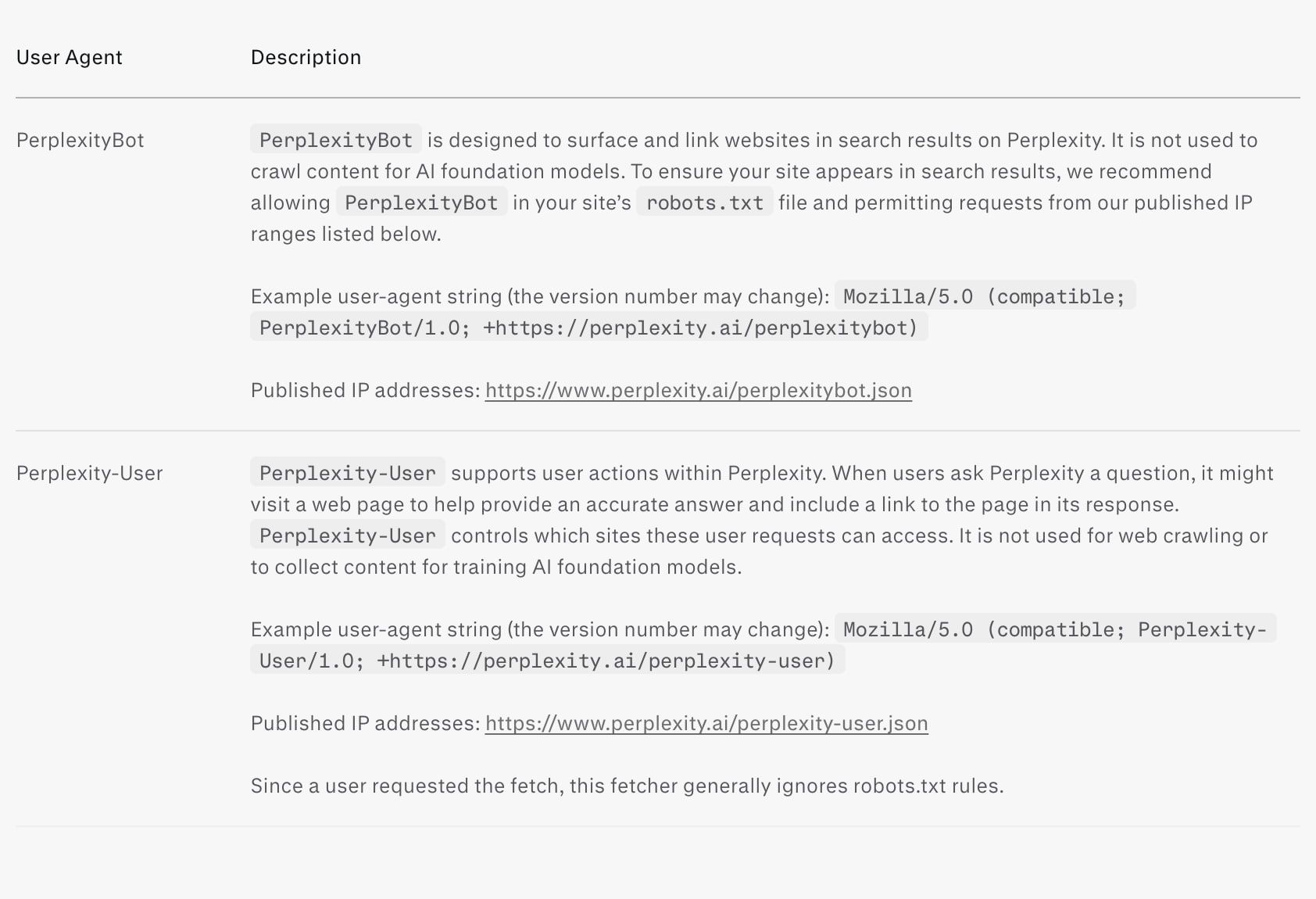
Same idea, different bot. Perplexity says PerplexityBot surfaces sites in its search results and isn’t used for training.
Perplexity’s page describes PerplexityBot as “designed to surface and link websites in search results on Perplexity”, “not used to crawl content for AI foundation models”. Perplexity-User, which fetches pages for a user’s request, “generally ignores robots.txt rules”, and changes “may take up to 24 hours” (Perplexity).
Its cited sites lean more toward community and reviews. Peec’s study ranks Perplexity’s top five as Reddit, YouTube, LinkedIn, Wikipedia and G2 (Peec). If Perplexity matters to your buyers, review profiles and video earn a bigger share of your effort.
How do you know it’s working? #
Track how often you’re named across many runs of the same prompts. One check proves nothing: SparkToro found the same brand list less than 1% of the time.
SparkToro and Gumshoe ran 12 prompts 60 to 100 times each on ChatGPT, Claude and Google’s AI. On ChatGPT and Google’s AI the same list of brands came back less than 1% of the time (Claude was slightly steadier), and in the same order less than 0.1%, as Search Engine Journal reported. How often a brand appeared across many runs was the steadier number. Gumshoe sells AI tracking.
Start free. Business Hub shows mentions, website clicks and discovery topics over the past 28 days, after a Persona identity check. For an online business, a mention counts when ChatGPT references your website; your brand name alone doesn’t count (OpenAI Help).
It’s ChatGPT only, it doesn’t show individual prompts, and OpenAI’s pages describe no competitor view. When you need those, Peec AI Starter is $95 a month for 50 prompts on 3 models of your choice, run daily, with unlimited competitors (Peec pricing, verified 17 Nov 2026).
How long any lever takes, nobody has published: I found no study timing them for ChatGPT. So take a baseline before you change anything, or you won’t be able to see the change when it comes.
For a free method, see how to measure AI visibility without a tool, size your prompt set with how many prompts to track, and count the visits that follow with ChatGPT traffic in GA4.
What do the top guides get wrong? #
Mostly the numbers. These are the claims I checked on the three pages that ranked in my search.
Claims to check before you act on them
- “Ahrefs found 43.8% of ChatGPT’s cited pages are ‘best of’ listicles.” That’s MADX’s key takeaway. Ahrefs’ figure is 43.8% of page types across 750 recommendation prompts, not of all ChatGPT citations (Ahrefs).
- “Community platforms captured 52.5% of all citations.” MADX cites Otterly for this; Otterly’s own report gives the 52.5% split both ways round, so I wouldn’t rely on it.
- Feature articles get “roughly 31.5% of citations”. Evertune’s own analysis of the top 10,000 cited sources, with little method on the page.
- Ads as a mention lever. OpenAI says ads don’t influence answers.
- No sources at all. Xponent21’s FAQ gives eight bullets with no data (Xponent21).
What would I fund first? #
Crawler access today, third-party lists next, measurement from the start. Here’s my order, on the evidence I read.
- Check robots.txt today. Allow OAI-SearchBot and PerplexityBot. It’s free and it’s the one lever OpenAI documents.
- Fund third-party placements. Get onto the “best X” lists and review sites in your category. Most of the evidence points here.
- Write your own honest comparison pages. Useful in software especially, as long as you’re open about whose product it is.
- Keep PR going, but don’t buy it for ChatGPT. The strong correlation is Google-only.
- Skip ads and Wikipedia shortcuts for mentions. OpenAI says ads don’t change answers, and undisclosed paid Wikipedia edits break its rules.
- Measure before and after. Claim Business Hub if you’re eligible, and add Peec AI Starter when you need competitors and Perplexity.
Agencies running this for clients can compare options in AI visibility tools for agencies.
FAQ
Can you pay to be mentioned in ChatGPT?
Not in the answer itself, according to OpenAI. ChatGPT ads appear separately and labelled, and OpenAI says 'Ads do not influence the answers ChatGPT gives you.' That's OpenAI's statement; nobody outside can audit it.
Does blocking GPTBot remove me from ChatGPT?
No. OpenAI's crawler page says GPTBot collects content that may be used for training, while OAI-SearchBot is for search. Sites that opt out of OAI-SearchBot 'will not be shown in ChatGPT search answers', and each setting works on its own.
Does claiming my business in ChatGPT help me get mentioned?
OpenAI says claiming a Business Hub listing 'doesn't guarantee increased visibility'. It's still worth claiming if you're eligible, because it shows 28 days of mention and click counts for free after an identity check.
How long does it take to get mentioned in ChatGPT?
No public study I found measures it. The one firm timeline is technical: OpenAI says robots.txt changes for its crawlers take about 24 hours to apply. Earning places on third-party lists and review sites takes as long as the outreach does.
Should I get a Wikipedia page?
Only if your company is notable enough for one, and not by writing it yourself. Wikipedia says conflict-of-interest editing is 'strongly discouraged', changes should be proposed on talk pages, and paid editors must disclose who pays them.
How do I check whether ChatGPT mentions my brand?
Run the same prompts many times and count how often you appear, not once. In SparkToro and Gumshoe's study, ChatGPT and Google's AI returned the same brand list less than 1% of the time. Business Hub gives free 28-day counts; Peec AI Starter tracks 50 prompts on 3 models for $95 a month.
Sources
22 sources, accessed to .
Official pricing, docs, changelogs and status pages 10
- OpenAI: overview of OpenAI crawlers (OAI-SearchBot, GPTBot, ChatGPT-User)
- OpenAI Help: setting up your business on ChatGPT (read in a browser)
- OpenAI: introducing businesses in ChatGPT, 10 Nov 2026 (read in a browser)
- OpenAI: our approach to advertising, 16 Jan 2026 (read in a browser)
- OpenAI: a milestone in expanding access to AI, 31 Aug 2026 (read in a browser)
- Perplexity: crawlers (PerplexityBot, Perplexity-User)
- Wikipedia: conflict of interest guideline
- Microsoft Advertising blog: optimizing content for AI search answers, 8 Oct 2025
- Google Search Central: optimizing your website for generative AI features
- Peec AI: pricing
News and press 3
Other blogs 9
- Ahrefs (vendor research): 'best X' lists in AI recommendations, 4 Dec 2025
- Ahrefs (vendor research): 75,000 brands and AI Overview visibility, 26 May 2025
- Ahrefs (vendor research): how cited domains change day to day, 3 Nov 2026
- Peec AI (vendor research): most-cited domains by engine, Mar 2026
- Similarweb (vendor research): most-cited domains in LLMs, Jan–Feb 2026
- Tinuiti (agency research): AI citations and Reddit's drop, 2 Nov 2026
- MADX Digital (sells AI search services): how to get mentioned in ChatGPT, Sep 2026
- Xponent21 (sells SEO and AI visibility): how do I get mentioned in ChatGPT, undated
- Evertune (sells AI visibility and ChatGPT ad tooling): how to get mentioned on ChatGPT, Jun 2026
Last updated: 17 November 2026. Facts verified 17 Nov 2026; OpenAI’s Business Hub pages were read on 16 Nov. Researched and drafted with AI tools; owner review is pending.


