Is AI sentiment tracking worth paying for?
AI sentiment scores run on different scales, and no plan I read sells them alone. I compared 13 tools’ definitions and plans before you pay.

Short on time?
Short on time? Here’s what I would do.
- You were pitched sentiment as the reason to buy
- Don’t. Pick the tracker on prompts, engines and price
- No plan I read sells sentiment alone. It comes bundled with tracking, so it should be a tiebreaker, not the reason.
- You already pay for a tracker that has it (Peec, Otterly, Semrush)
- Use it as a trend flag
- Read the counts and the quoted themes, not the number, and note the date whenever a vendor changes its model.
- Sentiment really matters to your purchase
- Otterly
- Its score is defined (-100 to +100, shown with a count) and it is on every plan from Lite. I judged it from its docs and plan pages. To check what AI says is true, Peec’s Brand Perception does that job.
- Reporting to a client or a board
- Never put scores from two tools on one chart
- The scales and denominators differ, so the lines would measure different things.
- A vendor quotes you a sentiment accuracy figure
- Ask who tested it
- Every accuracy number I found is the vendor’s own.
Prices verified . Evidence read 24 Nov 2026. The picks are my reading of it, not a finding in any study. No vendor paid to be included, and sponsors can’t buy a verdict.
Someone pitched you “sentiment” as a reason to buy an AI-visibility plan. I read the definitions and plan pages for 13 tools, so you can see what the number is, whether it travels between tools, and what it costs.
Every figure here is a vendor’s, apart from the arithmetic I label as mine, and I say whose. The rest of this topic lives in my AI visibility hub.
What does an AI sentiment score measure? #
It measures how an AI answer frames your brand, labelled positive, neutral or negative and then rolled into one number. Each vendor does the roll-up differently, and most don’t publish the model behind the labels.
Peec’s docs put it as “the overall tone of AI responses when they mention your brand, on a scale from 0 to 100” (Peec docs). Semrush frames it as “evaluating how favorably AI platforms describe your brand and whether those descriptions are accurate” (Semrush).
So it is the tone of the answer, not what your customers think. A score only exists for answers that mention you, which matters later.
Can you compare scores across tools? #
No. The scales and methods differ: one tool scores tone from 0 to 100, another nets positive against negative from -100 to +100, another uses -1 to 1, another reports a percent of positive answers.
| Tool | What it reports | Scale | Method the vendor states |
|---|---|---|---|
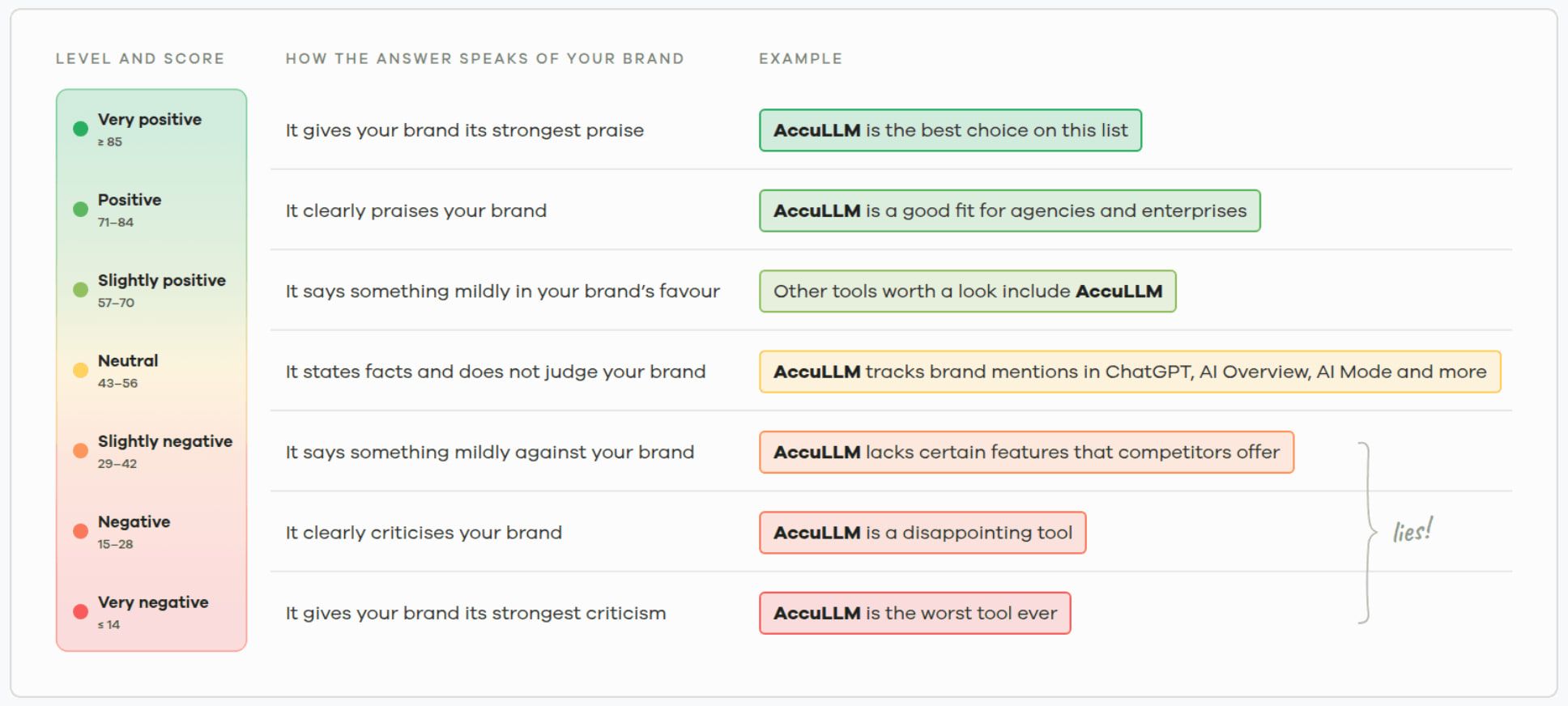
| AccuRanker (AccuLLM) | One score per brand per answer, mapped to 7 levels | 1-100 | Scores each brand’s passage; levels published (85+ very positive, 43-56 neutral, 14 and below very negative) |
| Peec | Overall tone of answers that mention you | 0-100 | Looks for positive, neutral and negative language; no formula; “most sentiment scores fall between 65 and 85” |
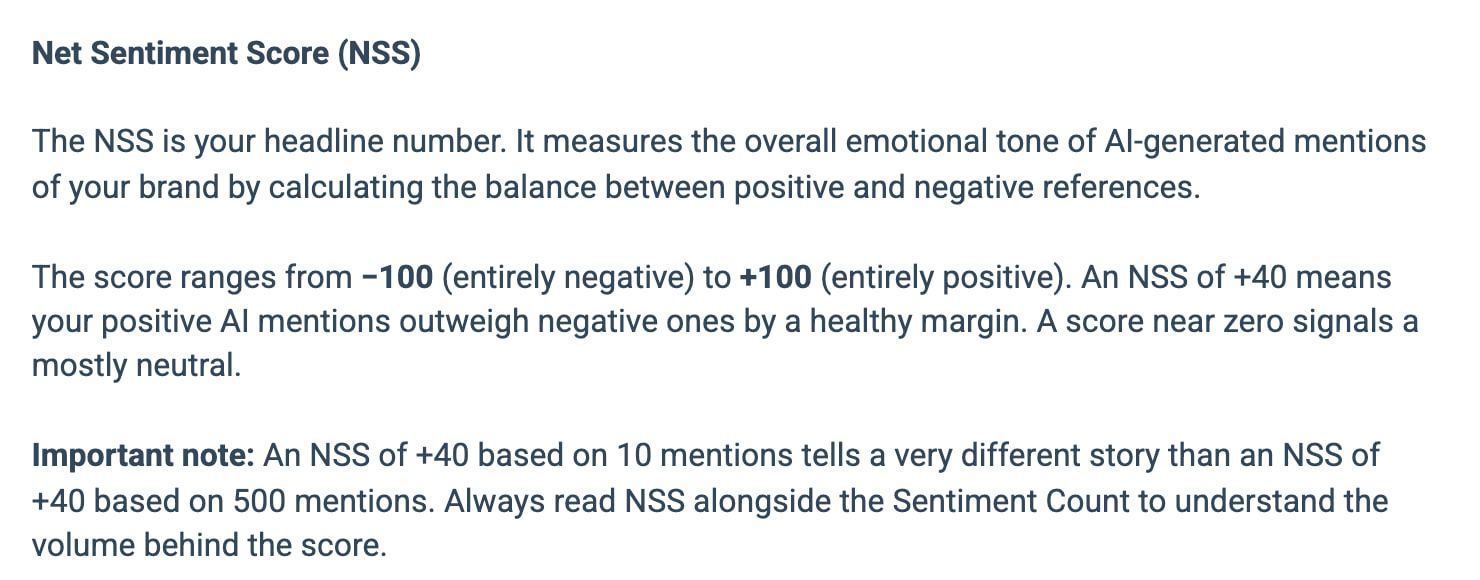
| Otterly | Net Sentiment Score, a percent breakdown and a count | -100 to +100 | Based on the balance of positive and negative mentions; formula on a page I did not open |
| AirOps | Sentiment score plus short themes | 0-100; positive 60-100, neutral 40-59, negative 0-39 | (Positive mentions + half of neutral mentions) / total brand mentions |
| Amplitude | Percent of positive responses | Percent | Neutral and failed responses excluded; mixed counts toward both totals |
| Similarweb | Sentiment Score | -1 to 1 | Each response that mentions the brand is classed positive, neutral or negative, then aggregated; no method or accuracy given |
| Rank Math | A percentage per brand and per query | Percent; endpoints not explained | Not stated |
| Profound | Overall score, themes and claims | Not stated | Average of positive sentiment across each tracked AI model; claims weighted by how often mentioned |
| Semrush | Sentiment inside Brand Performance | Not stated | “Assesses the tone and attributes used”; no method |
| Ahrefs Brand Radar | Positive, neutral and negative mentions by platform and aspect | Not stated | Not stated |
| SE Visible | A net sentiment metric (dedicated page “coming soon”) | Not stated | NLP classes language as positive, neutral or negative |
| Surfer, seoClarity | Labels per prompt (Surfer); per statement (seoClarity) | Not stated | seoClarity: an AI model reads each answer one statement at a time |
Source: Vendor docs, help pages and blogs read 24 Nov 2026; links in the notes below. “Not stated” means the page I read doesn’t say, not that the vendor has no method. Scroll sideways for more columns.
Where each row comes from:
- AccuRanker: its 23 November blog post lists the seven levels, from 85 and up down to 14 and below.
- Peec: the sentiment docs give the 0-100 scale, the “65 and 85” remark and no formula.
- Otterly: its help page says the score “ranges from -100 (entirely negative) to +100 (entirely positive)”.
- AirOps: the docs give the formula as “Positive mentions plus half of neutral mentions, divided by total brand mentions (0-100)”, with the three bands.
- Amplitude: its docs say “The overall sentiment score is the percentage of positive responses”. Amplitude is a product-analytics vendor.
- Similarweb: its sentiment page was truncated in my read.
- Rank Math: the KB page shows examples such as 61% and 74% without explaining the endpoints.
- Profound: its docs call the overall score “the average of positive sentiment across each tracked AI model”.
- Semrush: the toolkit page says Brand Performance analyzes share of voice, brand sentiment and key narratives, with reports updated weekly.
- Ahrefs: its 31 October product roundup, in French, says Brand Radar now shows positive, neutral and negative mentions, with breakdowns by platform and by aspect such as price, service and quality. The Brand Radar page says you can “Monitor brand sentiment across AI search” and carries no availability notice. I found no scale or method, and I could not confirm which plans include it, as of 24 November 2026.
- SE Visible: its sentiment page describes the NLP step and says “Coming soon”, while its homepage shows a “Net sentiment” metric in its dashboard preview and feature list. I read that as the metric existing and the dedicated feature not yet launched.
- Surfer and seoClarity: Surfer’s update and seoClarity’s page give labels and no scale.
Here is why it matters. Take ten answers about a brand: 4 positive, 4 neutral, 2 negative. This is my arithmetic from the vendors’ definitions, an illustration and not data.
- AirOps-style: (4 + half of 4) / 10 = 60, the bottom edge of AirOps’ “positive” band.
- Amplitude-style: neutral answers excluded, so 4 positive of 6 counted = 66.7%.
- A net-style score: (4 positive minus 2 negative) / 10 = +20. This line is my assumption of what a net score does, because I did not open Otterly’s formula page.
Same answers, three different numbers on three different scales. A “70” is not “good” by itself either. Peec’s own docs say most of its scores fall between 65 and 85, so a 70 falls inside the range Peec says is typical.
Peec’s remark is its own statement about its own scores, not a benchmark across tools.
Which plans include sentiment, and what do they cost? #
Every plan I read that lists sentiment bundles it. I found no sentiment-only plan, so the question is whether sentiment should change which tracker you buy.
| Tool | Plan that includes it | Price I saw | What the page doesn’t say |
|---|---|---|---|
| Peec | All four plans (Starter, Pro, Advanced, Enterprise) | Starter $95 for 50 prompts; Pro $245; Advanced $495 (page shows “$”, no currency code) | The sentiment formula or model |
| Otterly | All four plans (Lite, Standard, Premium, Enterprise) | Lite €29 on the EUR view I loaded; $29 on the US view I recorded 13 Nov in my Otterly pricing post | How the score is computed, on the pages I opened |
| Semrush | Inside the AI Visibility Toolkit | $99 a month for 1 project, 1 Brand Performance domain and 25 prompts; extra domains $99 each a month | A scale or method |
| Similarweb | AEO Intelligence | $99 for 1 user, 3 months of history and 150 prompts | Billing period and currency |
| SE Visible | Not stated; a net sentiment metric is shown, the sentiment page says coming soon | Basic $89, Core $189, Agency $399 monthly (“$”, no currency code); 14-day trial | Which plan has sentiment |
| Profound | Docs say all plans; the pricing page lists Enterprise only | Custom, request a demo | Any price. Starter and Growth are retired |
| Ahrefs Brand Radar | Not stated | Not stated (the page lists no sentiment price) | Plans, scale and method |
| AccuRanker (AccuLLM) | Not stated | No published price on any official page I read | Plan and price |
| Rank Math | Needs an active Rank Math AI subscription | No price on the page | What the subscription costs |
| Surfer (AI Search Analytics) | Brand Sentiment is listed under core analytics on the product’s plan (Surfer help page, 24 Nov 2026) | Not read for this post | Scale and method |
| AirOps, Amplitude, seoClarity | Not stated | Not stated | Plan and price |
Source: Pricing pages and docs read 24 Nov 2026. Only the Otterly row has a second view (13 Nov). The other dollar prices carry no currency code, so a US-browser check is still due. Scroll sideways for more columns.
The plan rows come from Peec’s pricing page, Otterly’s pricing page, Semrush’s KB, Similarweb and SE Visible. On Peec, sentiment shares a row with position and share of voice, ticked on all four plans. I priced Peec and Otterly in more detail in my Peec pricing and Otterly pricing posts.
Profound is the awkward one. Its docs say “Sentiment is available on all plans”, and its June 2026 post says the new sentiment product is “available today for all Profound users”. Its pricing page now lists only Enterprise, with Starter and Growth retired in September 2026. I print no Profound sentiment price. My Profound pricing post covers the rest.
Semrush is the one with a clear price. Its toolkit costs $99 a month and sentiment is part of it. My Semrush and Ahrefs comparison covers what else the $99 buys.
A trade roundup priced Profound by Starter and Growth plans, which Profound has since retired, so I left the roundup’s prices out. Programming Insider’s list never explains how any tool calculates sentiment, and it carries no sponsorship or affiliate label I could find.
How accurate are the scores? #
I found no outside test of any of them. The only accuracy figures are the vendors’ own, and one vendor, AccuRanker, publishes numbers.
AccuRanker’s blog post says 99% of its scores land within one level of its labels, up from 80% with the old model. It adds that about four in five land exactly on the label, and that scores are “not fully deterministic, so there is slight noise, usually a point or two”.
It also says the labels were made with language models and corrected by hand, and that about half the passages were in English. All of that is vendor-reported, and the post states no price or plan.
One piece of my own reading: “within one level” is a loose bar. AccuRanker’s five middle levels are each 14 points wide, so two scores in neighbouring levels can sit anywhere from 1 to about 27 points apart (43 in neutral and 70 in slightly positive, for example). That is my arithmetic from the published thresholds. The post doesn’t say whether a label carries a number, so I can’t say how far off a one-level miss really is.
The other vendors hedge instead of publishing a rate:
- Otterly: “Always read NSS alongside the Sentiment Count”, and “N/A is not the same as a neutral or zero score” (Otterly help). It also says one response can carry several sentiment attributes.
- Semrush: descriptions of a brand can be “totally true or hallucinated by AI” (Semrush).
- Profound: “LLMs don’t always provide 100% accurate responses” (Profound blog). That is a general line, not a claim about its sentiment accuracy.
- AirOps: themes “are refined over time as new data comes in” (AirOps docs). The page gives no accuracy or stability figure.
- seoClarity: gives no accuracy rate. Its page says “About two in five things AI says about a brand consist of plain facts” with no source (seoClarity).
I could not read any practitioner threads. The only caveats I found come from vendors writing about their own scores, and they sell those scores, so weigh them that way.
What changed at AccuRanker on 23 November? #
AccuRanker moved all accounts to a new sentiment model on 23 November 2026, so a chart will show a step that day, with fewer negative scores and more neutral ones. That is the one dated event in this topic.
Its post says AccuLLM “switched to a new sentiment model for all accounts” and that your sentiment history “shows a step on that date”. It says you can contact support to have earlier answers scored with the new model.
It reports that about 1% of brand mentions were negative in the authors’ data. That is one vendor’s dataset, and I found no other source reporting a share.
The lesson is for any tool: a vendor can change the model and your trend line moves without anything changing in the answers. If you track sentiment, write the change date next to the chart.
I could not find an AccuLLM price on any official page, and my AccuRanker pricing post says the same.
What can a sentiment number not tell you? #
It can’t tell you why an answer reads the way it does, whether the claim is true, or whether anyone acts on it. It also depends on the prompts you chose.
Peec’s score covers responses “when they mention your brand”, and AirOps divides by brand mentions. An answer that leaves you out has no score, so a high figure can sit next to low visibility. My share of voice post covers that side, and it says plainly that share of voice doesn’t measure sentiment.
For the “why”, you need a different layer. Peec’s Brand Perception scores brand attributes from 0 to 100 and has tabs for Brand, Market, Objections and Fact-checking, and its pricing page puts attribute scoring on all four plans. Custom attributes need Advanced, objections need Pro or above, and fact-checked prompts rise from 5 to 10 to 25 to unlimited across the plans.
Profound’s docs describe themes and attributes tagged with a polarity, such as “opaque pricing” marked negative. AirOps links its themes to retrieved pages across ChatGPT, Perplexity, Gemini, AI Mode and AI Overviews, per its 19 March 2026 announcement.
Now my own reasoning, which no source states: a negative theme isn’t always bad news. A theme such as pricing being unclear is an objection you can answer on a page, so I would read the quoted themes before the number.
For how these tools gather answers in the first place, see how AI visibility tools work. For whether classic rank tracking still has a role, see rank tracking vs AI visibility.
What should you ask before you pay for it? #
Ask for the scale, what is in the denominator, how often each prompt is re-run, and what happens to your history when the model changes. Six checks, each tied to what I read.
- What is the scale? Peec 0-100, Otterly -100 to +100, Similarweb -1 to 1, Amplitude a percent. If a vendor can’t name the endpoints, you can’t read the number. (Table above.)
- How are neutral answers treated? AirOps counts half of them as positive, Amplitude drops them. That choice alone moves the score.
- Is there a count next to the score? Otterly says to read its score “alongside the Sentiment Count”. A +40 from 3 mentions and a +40 from 300 are different facts.
- What happens when the model changes? AccuRanker’s step on 23 November is the example. Ask whether older answers are rescored and whether the change is dated in the chart.
- Which plan, and what price? Sentiment was bundled everywhere I read. If the quote adds a separate line for it, ask why, because I found no sentiment-only plan.
- Who tested the accuracy? In everything I read, the answer was the vendor, or no one.
On how often prompts are re-run, the only run-to-run statement I found is AccuRanker’s “a point or two”. Semrush says its Brand Performance reports are updated weekly, which is about reports, not about how often a prompt is re-run. None of the pages I read gave a re-run frequency for sentiment, so ask.
So what would I do? #
Don’t pick a plan for sentiment. Pick the tracker on prompts, engines and price, and take sentiment as the bundled extra. This is my reading of the evidence, not a finding in any study.
- You were pitched sentiment as the reason to buy. Don’t. No plan I read sells it alone, and no vendor I read shows an outside accuracy test.
- You already pay for a tracker with sentiment (Peec, Otterly, Semrush’s toolkit). Use it as a trend flag. Read the counts and the quoted themes, not the number, and note any model change on the chart, as with AccuRanker’s step.
- Sentiment really matters in your purchase. Otterly, because its score is defined (-100 to +100, shown with a count) and it is on every plan from Lite. That is a judgment from its help page and plan page, and I did not open its formula page. If you need to check what AI says is true, Peec’s Brand Perception does that job, with attribute scores on every plan and more fact-checked prompts on higher plans.
- You report to clients or a board. Never put scores from two tools on one chart. Pick one tool and keep it.
- A vendor offers a “sentiment accuracy” figure. Ask who tested it. Every number I found is the vendor’s own.
If you are weighing Peec against Otterly for other reasons, my Otterly vs Peec comparison covers the rest, and the AI visibility hub has the wider topic.
I’ll update this post if a vendor publishes a method, an outside test appears, or Ahrefs or SE Visible state plans and scales.
FAQ
What is an AI sentiment score?
It is a number for how AI answers frame your brand when they mention it. The answers are labelled positive, neutral or negative and rolled into one figure. Each vendor does the roll-up differently: Peec reports tone from 0 to 100, Otterly a net score from -100 to +100.
Can I compare sentiment scores between tools?
No. The scales and methods differ, and so do the denominators. AirOps counts half of neutral mentions as positive, while Amplitude drops neutral answers entirely, so the same ten answers can come out at 60 on one and 66.7% on the other.
Is AI sentiment tracking worth paying for?
Not on its own. Every plan I read that lists sentiment bundles it, and I found no sentiment-only plan. Pick a tracker on prompts, engines and price, and treat sentiment as the bundled extra.
How accurate is AI sentiment analysis?
I found no outside test of any of these scores. The only accuracy figures are vendors’ own. AccuRanker says 99% of its scores land within one level of its labels, and that scores vary by a point or two between runs.
Did AccuRanker change its sentiment scores?
Yes. On 23 November 2026 it moved all accounts to a new sentiment model, so history charts show a step that day, with fewer negative and more neutral scores. It says support can rescore older answers.
Which tools include sentiment?
Peec and Otterly list it on all four of their plans, and Semrush has it inside its $99 AI Visibility Toolkit. Ahrefs announced it on 31 October 2026 without stating plans. Profound’s docs say all plans, but its pricing page now lists only Enterprise.
Why do AI answers rarely read negative?
I don’t know. AccuRanker says about 1% of brand mentions were negative in its own data, and I found no other source that reports a share. Treat it as one vendor’s observation, not a general rate.
Sources
25 sources, accessed .
Official pricing, docs, changelogs and status pages 16
- Peec docs: sentiment
- Peec docs: Brand Perception
- Peec: pricing
- Otterly help: sentiment analysis
- Otterly: pricing (EUR view)
- AirOps docs: sentiment
- Amplitude docs: AI Visibility sentiment
- Similarweb: AI brand visibility sentiment analysis
- Rank Math KB: track brand sentiment
- Profound docs: about sentiment
- Profound: pricing
- Semrush KB: AI Visibility Toolkit
- Ahrefs: Brand Radar (no sentiment price on the page)
- SE Visible: AI brand sentiment (marked coming soon)
- SE Visible: homepage
- Surfer: AI Search Analytics help page (core analytics list)
News and press 1
Other blogs 8
- AccuRanker: brand sentiment in AI answers, 23 Nov 2026 (the vendor sells AccuLLM)
- AirOps: announcing AI search sentiment, 19 Mar 2026 (the vendor sells a managed service)
- Profound: new sentiment product, 3 Jun 2026 (the vendor sells the product)
- Profound: how to track brand sentiment in answer engines, 10 Feb 2026 (the vendor sells the product)
- Semrush: AI sentiment analysis, a marketer’s guide, 15 Jun 2026 (the vendor sells the toolkit)
- Ahrefs (French): new features, October 2026, published 31 Oct 2026
- Surfer: sentiment analysis update, 15 Jan 2026 (the vendor sells the product)
- seoClarity: AI sentiment accuracy analysis (undated; the vendor sells ArcAI)
Last updated: 24 November 2026. Evidence verified 24 Nov 2026. Researched and drafted with AI tools; owner review is pending.


