What AI share of voice measures, and where it misleads
AI share of voice is your share of brand mentions in AI answers. I read how 8 tools count it, where it misleads and which number to report.

Short on time?
Short on time? Here's my take.
- Reporting to a boss or client
- Visibility: the share of answers that name you
- Per engine, with the prompt set named. Peec's Visibility and Otterly's Brand Coverage define it most plainly.
- A competitive slide
- Share of voice, with the rival list printed
- Peec, Otterly and Nightwatch use the plain mentions formula. Without the list beside it, the number means little.
- The content or PR team
- Citation share
- Profound's Citation Share or Otterly's Domain Coverage show which of your pages AI answers use as sources.
- A board-level 'how big is our slice'
- Ahrefs Brand Radar's weighted share
- Weighted by search demand. Label it a modelled estimate, as Ahrefs itself does.
- Never
- Compare scores across tools
- Different prompts, engines, rivals and counting rules. Borrowed targets like '30%' come with no study behind them.
Prices verified . Definitions from each vendor's own docs and guides, read 17 Nov 2026. No vendor paid to be included, and sponsors can't buy a verdict.
AI share of voice is your brand’s mentions as a share of all brand mentions in a set of AI answers. It’s the number bosses ask for, and the one tools disagree on most, because each counts it differently.
I read how 8 tools define it in their own docs, worked through what moves it, and set out which version to report to whom. This page is about the metric. For how many prompts and runs you need, see how many prompts to track; for whether you need an AI tracker at all, see rank tracking vs AI visibility.
What does AI share of voice measure? #
Your brand’s mentions as a share of all brand mentions in a set of AI answers you chose: your prompts, your engines, your competitor list. Change any of the three and the number changes.
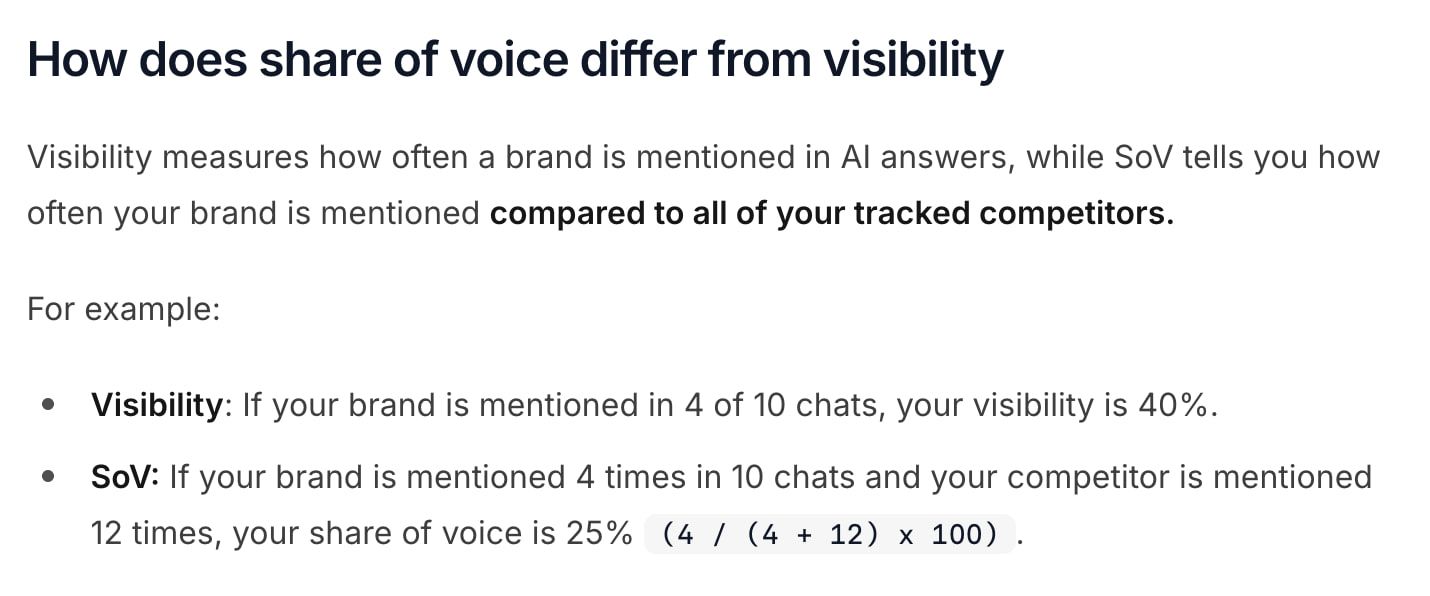
The plain formula is your mentions ÷ all tracked brand mentions × 100. Peec’s docs put it as “SoV = (Number of times your brand was mentioned) /(Total number of brand mentions) × 100”, with an example: “If your brand is mentioned 4 times in 10 chats and your competitor is mentioned 12 times, your share of voice is 25%” (Peec docs).
Its sibling is visibility, the share of answers that name you at all. Peec’s Visibility Score is “(Number of responses mentioning your brand / Total responses) × 100” (Peec docs).
The difference matters. Visibility asks how often you come up. Share of voice asks how much of the conversation is yours, which depends on who else you count. My glossary keeps both definitions side by side.
How do the tools define it? #
Differently. Some count answers that name you, some count every brand mention, one weights by search demand, and Semrush doesn’t publish its formula. Elogic, an agency, says it well: “there is no single industry-standard formula” (Elogic).
| Tool | Metric | Counts | Divided by | Counting rule | Weighting |
|---|---|---|---|---|---|
| Peec | Visibility | Answers that mention you | All answers | Per answer | None |
| Peec | Share of Voice | Times you're mentioned | All brand mentions | Doesn't say if two mentions in one answer count twice | None |
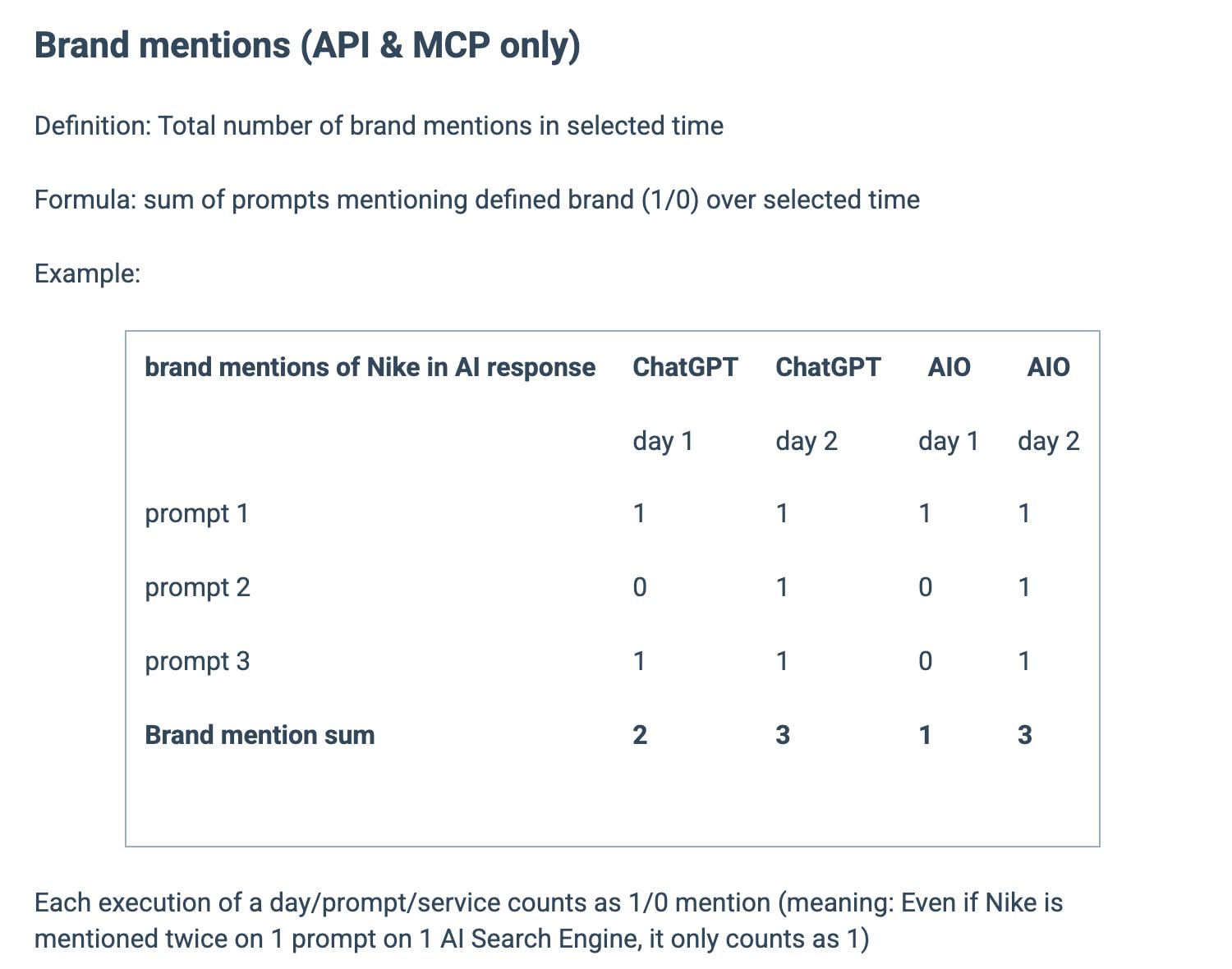
| Otterly | Brand Coverage | Prompts that mention you | All prompts in the period | 1 or 0 per prompt, day and engine | None |
| Otterly | Share of Voice | Your brand mentions | All brand mentions | 1 or 0 per check | None |
| Profound | Visibility Score | Answers that mention you | Answers that mention at least one brand | Per answer | None |
| Profound | Share of Voice | Wording says answers; example uses mentions | All brand mentions | Mixed units | None |
| Profound | Citation Share | Citations to your domain | All citations | Per citation | None |
| Ahrefs Brand Radar | AI Share of Voice | Your estimated impressions | Impressions of answers naming any tracked brand | Once per answer | Google search volume × platform ratio |
| Semrush | AI Visibility score; Share of Voice | Score: topic coverage and mention consistency | Not published | Not published | 0–100 composite; share-of-voice formula not published |
| Scrunch | AI share of voice | Answers that explicitly mention you | Answers (implied) | Per answer | None stated |
| Nightwatch | AI SOV | Your brand mentions | All brand mentions across tracked prompts | Not stated | None |
| LLM Pulse | Mention, citation and weighted SoV | Mentions; your citations; position weights | All mentions; all citations; all weights | Per run | 1/n by position, weighted version only |
Source: Each vendor's docs, help page or guide, read 17 Nov 2026. 'Answers' means AI responses. Scroll sideways for more columns.
Sources for the table: Peec, Otterly, Profound, Ahrefs help, Semrush KB 1607 and KB 1496, Scrunch, Nightwatch and LLM Pulse.
A few rows need a note:
- Otterly scores each prompt 1 or 0. Its mention count is the “sum of prompts mentioning defined brand (1/0) over selected time”, so three mentions in one answer still count once. For AI Overviews, it leaves out prompts that showed no AI Overview, and it also publishes a Brand Visibility Index built from brand coverage and average position (Otterly blog).
- Profound’s glossary says its share of voice “divides the number of responses that mention your brand by the total number of brand mentions across all responses”, which mixes answers and mentions. Its own example, “20 mentions out of 100 total brand mentions”, uses mentions on both sides.
- Ahrefs Brand Radar: “A single mention is counted when a brand appears at least once in an AI generated response.” Its share of voice then weights each answer by impressions, built from Google search volumes and a platform ratio.
- Semrush’s AI Visibility score “(0–100) combines two factors”, topic coverage and mention consistency, and its Brand Performance reports, “updated weekly”, analyse “your Share of Voice, sentiment, and the narratives”. No Semrush page I read gives the share-of-voice formula.
- Scrunch defines AI share of voice as “the percentage of AI responses that explicitly mention your brand”, which other tools would call visibility.
The glossaries ranking for this search drift too. HubSpot’s switches from mentions to responses between two examples (HubSpot), and Gracker’s method divides mentions by mentions while its FAQ divides answers by mentions (Gracker).
Why does the competitor list change the number? #
Because competitors sit in the denominator. Add a rival that’s named often and your share drops, even if nothing about you changed.
Here’s an illustration with made-up numbers, not data from any brand or tool. Say you track 100 AI answers. Your brand is named in 40 of them; two rivals in 30 and 20, once each.
| Scenario | Your mentions | All brand mentions | Share of voice | Visibility |
|---|---|---|---|---|
| You plus two rivals | 40 | 90 | 44% | 40% |
| Add a third rival, named in 60 answers | 40 | 150 | 27% | 40% |
| Back to two rivals, but count it when you're named twice in 10 answers | 50 | 100 | 50% | 40% |
Source: Made-up numbers to show the arithmetic: share of voice = your mentions ÷ all brand mentions. My calculation, not a measurement of any brand. Scroll sideways for more columns.
One busy rival cut the share from 44% to 27%, and counting repeat mentions lifted it to 50%. To build that rival list from real answers, see which competitors AI names instead of you. Visibility never moved. That’s why I’d never report a share of voice without the competitor list beside it.
Ahrefs shows the same effect from weighting. In its worked example, a brand has a 67% basic share but 31% once answers are weighted by search demand (Ahrefs blog). Its help page warns the figure “can change a lot depending on how you’ve set up the entities” (Ahrefs help).
Ahrefs’ weights use a platform ratio of 0.115 for ChatGPT, 0.011 for Gemini and 0.01 for Perplexity. It’s frank about the result: “Impressions are a modeled estimate of exposure, not a count of people who saw an answer.”
Mention, citation or weighted: which is which? #
A mention means the answer names you; a citation means it links to your page; weighted versions count position or search demand. The same brand can come third on one and first on another.
LLM Pulse, which sells a tracker, works an example where one brand has a 20% mention share, 16.8% position-weighted and a 31.4% citation share: third, fourth and first among five brands (LLM Pulse). Its citation formula is “(Citations of your domain / Total citations across all sources) × 100”.
Ahrefs puts the gap in one line: “A brand can be mentioned without its website being cited, and a page can be cited without the brand being recommended” (Ahrefs blog).
| Audience | Report | Why | Tools that define it plainly |
|---|---|---|---|
| CMO or client | Visibility, per engine, prompt set named | Doesn't move when you add a rival; easy to explain | Peec Visibility, Otterly Brand Coverage, Profound Visibility Score |
| Competitive pitch | Share of voice with the competitor list printed | Only means something against a named set | Peec, Otterly, Nightwatch |
| Content or PR team | Citation share or domain coverage | Shows which pages earn sources | Profound Citation Share, Otterly Domain Coverage, LLM Pulse citation SoV |
| Board, 'how big is our slice' | Impressions-weighted share, labelled a modelled estimate | Weights prompts by search demand | Ahrefs Brand Radar |
Source: My recommendation, reasoned from the vendor definitions above (read 17 Nov 2026). Scroll sideways for more columns.
LLM Pulse also says “Position-weighted SoV needs at least 3 to 5 repeats per prompt to stabilise”, one more reason I keep weighted numbers off a client’s headline slide.
Can you compare scores across tools? #
No. Different prompts, engines, competitor lists and counting rules give different numbers for the same brand, so 30% in one tool and 20% in another tell you nothing.
AuthorityTech audited nine platforms’ methods, and discloses that it owns one of them. Its conclusion: “AI visibility scores from different tools are not comparable numbers” (AuthorityTech). The docs above bear it out: Otterly counts once per prompt, day and engine, Ahrefs once per answer but weighted by demand, and Peec doesn’t say.
Engines differ too. Gracker warns that “a blended number can hide a weak engine” (Gracker), so I’d report one number per engine and the blend only as a summary.
If you switch tools, start a new baseline rather than joining the two lines on one chart.
How much does it move between runs? #
A lot. AI answers change from run to run, so read the trend over several periods, never one reading.
Ahrefs found an AI Overview had “a 70% chance of changing from one observation to the next” (Ahrefs), and in SparkToro and Gumshoe’s study the same brand list came back fewer than 1 in 100 times (SparkToro). I went through those studies, and how many answers it takes to trust a number, in my guide to sizing a prompt list.
Isn’t share of voice an SEO metric? #
It was first. In rank trackers it means your share of estimated clicks across tracked keywords, weighted by search volume and click-through. Same name, different number.
- Ahrefs Rank Tracker divides “Total clicks your target receives from all Tracked keywords” by “Total clicks going to all result in the SERP”, and calls it “equivalent to ‘visibility score’ used by other platforms” (Ahrefs help).
- Semrush Position Tracking calculates it “taking into account the total combined volume of all of your keywords”, “weighted more by the actual number of searches and estimated traffic” (Semrush KB).
- Keyword.com uses “Expected CTR × Search Volume” per keyword, with click-through from “industry models” (Keyword.com).
So one client deck can hold two “share of voice” numbers that measure different things. Label them search share of voice and AI share of voice, and never plot them on the same axis.
What can’t it tell you? #
Whether AI answers recommend you, say good things about you, or send anyone to your site. Share of voice counts names; it doesn’t measure sentiment, traffic or real exposure. I cover how vendors score tone in what AI sentiment scores measure.
Ahrefs lists what its own metric leaves out: sentiment, whether the answer recommends you, traffic or conversions, and how many people saw the answer (Ahrefs blog). Semrush, which sells a score, says “no platform can provide exact numbers on visibility” (Semrush KB).
It also covers only the prompts you chose. A 20% share is 20% of your prompt set, not of the market, a trap I explain in what neither rankings nor AI visibility can prove.
And the AI platforms don’t report it for you. Asked about ChatGPT’s Business Hub, OpenAI’s spokesperson told Digiday: “Share of voice isn’t part of this beta.” What the Hub does show is in ChatGPT’s Business Hub.
What’s a good score? #
There isn’t one you can borrow. Ahrefs says “There isn’t a universally good AI share-of-voice score”, because the number depends on your prompts, engines and rivals.
Nightwatch’s guide calls “30% AI SOV or platform parity” “a reasonable first target” and says “15% may represent category leadership” (Nightwatch). It names no study or dataset for either, and LLM Pulse’s target bands don’t cite one either. I wouldn’t put any of them in a client goal.
Set your own baseline instead: fix the prompts, engines and rivals, read a few months, and judge the direction.
So which number should you report? #
Visibility per engine for bosses and clients, share of voice only with the rival list printed, citation share for content teams, and Ahrefs’ weighted share, labelled as an estimate, for the board.
Why visibility first? It’s the only one of these numbers that doesn’t move when you add a rival, and you can explain it in one sentence. Rand Fishkin, writing up SparkToro’s study, lands in the same place: “visibility % across dozens to hundreds of prompts run multiple times is a reasonable metric” (SparkToro).
Whatever you report, print these five things beside it:
- The prompt set: how many prompts, on which topics.
- The engines: one number per engine.
- The competitor list, by name.
- The counting rule: per answer or per mention, weighted or not.
- The period, and how many checks sit behind it.
To choose the tool, I compared plans in Peec AI vs Profound and Semrush’s AI toolkit vs Ahrefs Brand Radar. How trackers collect their answers is in how AI visibility tools work, and the rest of the category is in the AI visibility hub. To see which sites already win those mentions, read which sites AI answers cite most.
FAQ
How do you calculate AI share of voice?
Divide your brand's mentions by all tracked brand mentions across a fixed set of prompts, then multiply by 100. Peec's example: mentioned 4 times while a competitor is mentioned 12 times is 25%. Ahrefs Brand Radar weights the same idea by search demand instead.
What's the difference between AI visibility and share of voice?
Visibility is the share of AI answers that name you at all. Share of voice is your share of all brand mentions in those answers, so it changes when you add or drop a competitor; visibility doesn't.
Why is my share of voice different in two tools?
Different prompts, engines, competitor lists and counting rules. Otterly counts one per prompt, day and engine, Ahrefs weights answers by search demand, and Semrush doesn't publish its formula, so the numbers aren't comparable.
What is a good AI share of voice?
There's no benchmark you can borrow. Ahrefs says there isn't a universally good score, and the 30% target in Nightwatch's guide names no study or dataset behind it. Fix your prompts, engines and rivals and judge the direction over several periods.
Does share of voice include citations?
Usually not. Share of voice counts brand names in answers; citation share counts links to your domain as a share of all citations. In LLM Pulse's example one brand ranks third on mentions and first on citations.
Is AI share of voice the same as SEO share of voice?
No. In rank trackers such as Ahrefs, Semrush and Keyword.com, share of voice is your share of estimated clicks or traffic across tracked keywords, weighted by search volume and click-through rate.
Sources
22 sources, accessed to .
Official pricing, docs, changelogs and status pages 10
- Peec AI docs: Visibility Score
- Peec AI docs: Share of Voice
- Otterly help: brand report KPI definitions
- Profound docs: glossary
- Ahrefs help: Brand Radar AI visibility metrics (3 Sep 2026)
- Semrush knowledge base: AI Visibility data
- Semrush knowledge base: getting started with the AI Visibility toolkit
- Semrush knowledge base: Position Tracking overview (search share of voice)
- Ahrefs help: Rank Tracker share of voice (3 Sep 2026)
- Keyword.com support: share of voice and visibility metrics
News and press 1
Other blogs 11
- Otterly blog (vendor): Brand Visibility Index, updated 13 Jan 2026
- Ahrefs blog (sells Brand Radar): AI share of voice, 22 Oct 2026
- Scrunch (vendor how-to): measuring AI share of voice
- Nightwatch blog (vendor): AI share of voice, undated
- LLM Pulse (vendor): three share-of-voice formulas, updated 16 Nov 2026
- Gracker (vendor glossary): AI share of voice, modified 6 Nov 2026
- Elogic (agency glossary): AI share of voice, Nov 2026
- HubSpot (vendor glossary): AI share of voice
- AuthorityTech (owns an audited platform): 9-platform methodology audit, updated 12 Nov 2026
- Ahrefs (vendor research): AI Overviews change every 2 days, Nov 2025
- SparkToro with Gumshoe (sells AI tracking): AI recommendation consistency, Jan 2026
Last updated: 17 November 2026. Definitions verified 17 Nov 2026. Researched and drafted with AI tools; owner review is pending.


