Should you opt out of AI Overviews? One site's numbers
One site opted out of AI Overviews and AI Mode for 28 days. They'd been sending it an estimated 21% of its clicks. Should you opt out too?

Short on time?
Short on time? Here's what I would do.
- Most sites that earn from search clicks
- Stay in
- On the one site with public numbers, AI features drove an estimated 21% of its Google clicks.
- You want to stop AI training
- The training controls, not this switch
- Google says this control doesn't affect AI training.
- You want a few pages out
- nosnippet on those pages
- The only per-page option today. Those pages lose their normal snippets too.
- News publisher in Top Stories
- Stay in for now
- Google hasn't said what the switch does to Top Stories shown inside AI Overviews.
- Big audience in the UK
- Stay in until the 3 Dec click data
- The CMA wants Google to show AI click data for searchers in the UK from 3 Dec. Decide with real numbers.
Prices verified . Google help pages and the CMA notice verified 16 Nov 2026. No vendor paid to be included, and sponsors can't buy a verdict.
Since 31 August, every site can switch itself out of Google’s AI Overviews and AI Mode in Search Console. Cyrus Shepard did it with his own site for 28 days and published the numbers.
I read his write-up, Google’s help pages and three bigger datasets to see what his result means for yours. For more dated numbers like these, start at my data hub.
What happened when one site opted out? #
Cyrus Shepard switched his site out of Google’s AI features on 1 September 2026 and back in on 29 September. Its AI impressions, 500 to 1,000 a day, fell by more than 99%.
He compared the 28 days out with 28 days back in, an “interrupted time-series” design, and published the write-up in his newsletter on 5 November (Zyppy). He’d shared first results on LinkedIn on 30 October, as Search Engine Roundtable reported.
His headline estimate: AI features sent about 21% of the site’s Google clicks directly (SEJ, 9 Nov). Counting a lift he saw on regular listings, strongest on the pages with the most AI visibility, he puts it at about 23%; he doesn’t pin down the cause.
He saw most of the drop within an hour, by his account; Google’s own help page says exclusion happens “within 1-2 days after the control goes live”. His conclusion: staying in is “the only reasonable action to take”.
Where does the 21% come from? #
By comparing total clicks with AI on and off, because Search Console can’t show AI clicks on their own. AI features were about 10% of impressions, with an estimated 0.9% click-through rate against 0.4% for the site.
Google counts a click on a link in an AI Overview as a normal click and gives all links in one AI Overview the same position (Search Console help). The generative AI report shows impressions only (help). So no report splits out AI clicks, and Shepard had to infer them.
| Step | Number | Note |
|---|---|---|
| AI share of his Google impressions | About 10% | Final figure in his 5 Nov write-up; SER's 30 Oct report of his LinkedIn post said about 8% |
| AI click-through rate | About 0.9% (range 0.7–1.1%) | His estimate from total clicks with AI on and off |
| Site-wide Google click-through rate | About 0.4% | Across all his Google results |
| AI share of his clicks | About 21% direct; about 23% with the lift on regular listings | His estimate, checked against matched queries and positions |
| My check | 10% × 0.9% ÷ 0.4% ≈ 22% | My arithmetic with his rounded figures; close to his 21% |
Source: Zyppy newsletter (5 Nov 2026), Search Engine Journal (9 Nov) and Search Engine Roundtable (30 Oct); verified 16 Nov 2026. Scroll sideways for more columns.
You can run the same sum on your own numbers: AI share of impressions × AI click rate ÷ your site’s click rate. The 0.7–1.1% range is one site’s estimate, not a rule.
Is one site enough to go on? #
No, and he says so. He’d done “a fair bit of optimizing” on his site to win AI citations, and he notes that “AI visibility varies wildly across publishers” (Zyppy).
SER called it a “super limited study based on a small sample size”, and SEJ suggests reading it “more as a directional yardstick than Google gospel”. I’d read it the same way: one site’s test gives you a ballpark, not your number.
Bigger datasets measure different things, so set them beside it rather than against it:
- Pew: from the browsing of 900 US adults in March 2025, people clicked a traditional result in 8% of visits with an AI summary against 15% without one, and clicked a link inside the summary in “just 1% of all visits” (Pew). For every major click study lined up by method, see do AI Overviews cut your clicks?
- Ahrefs: across 118,671 sites in October 2026, “AI Search” sent 0.46% of traffic against 27.55% for search, by its own categories, which overlap (Ahrefs).
- Graphite: “AI accounts for less than 1% of traffic on average to websites”, using US Similarweb data for Q2 2026 (Graphite).
The Ahrefs and Graphite figures count referrals from AI chatbots as a share of all traffic. Shepard’s 21% is the share of Google clicks that came through AI Overviews and AI Mode. Different denominators, so they don’t contradict each other.
What does the switch actually do? #
It removes your site from AI Overviews, AI Mode and Discover’s AI features within a day or two. Google says it isn’t a ranking signal and doesn’t stop AI training.
Google’s help page says excluded sites “won’t receive any traffic or impressions from these features”. It also says “this control isn’t used as a ranking or inclusion signal affecting other parts of Search” and “This control doesn’t affect AI training.”
You set it per property, and a child property can override its parent. Leaving Google Search entirely is a different job, for which Google points to noindex.
Google began testing the switch with a subset of site owners on 3 June, the day of the CMA’s notice (PPC Land), and says it reached all websites worldwide by 31 August. Older guides that call it limited to a small group, such as AIOSEO’s July page, are out of date.
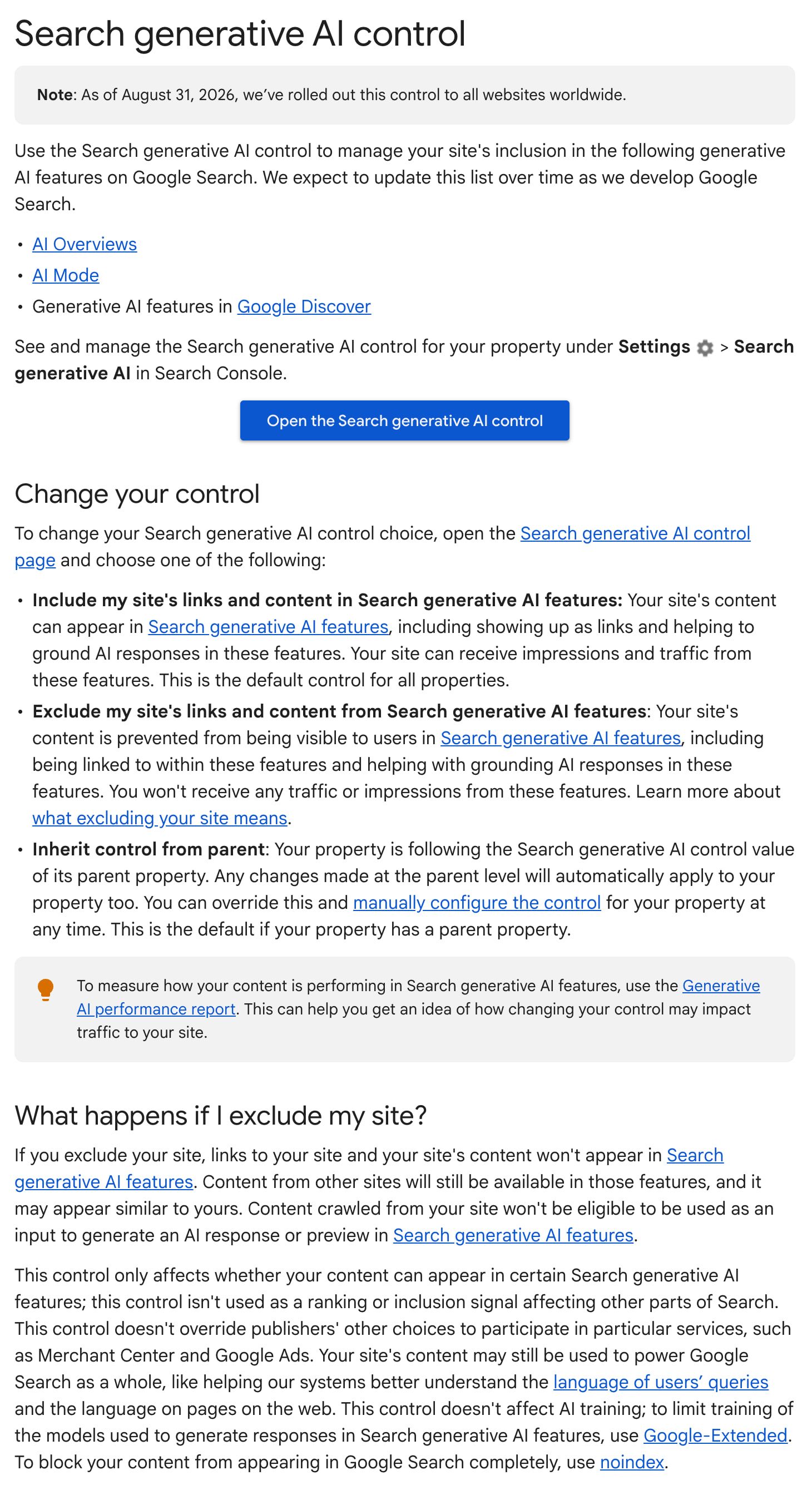
It’s all or nothing. You can’t drop AI Mode and keep AI Overviews, and a publishers’ trade body is pressing the CMA to split them, Digiday reports.
There’s no page-level setting yet. The CMA’s rules give Google until 3 March 2027 for a page-level control: nine months after its 3 June notice, by my arithmetic, and the date Digiday reports. From 3 December those rules also bar Google from penalising publishers who use the controls, for example “by downranking their Search Content” (CMA notice).
Until then, the per-page route is nosnippet, which “will also prevent the content from being used as a direct input for AI Overviews and AI Mode” (robots meta tag docs). It also strips the page’s normal snippet: an “all-or-nothing approach”, in SEJ’s words (SEJ, 1 Aug). These controls take a page out but none puts one in; how AI Overviews choose their sources covers what Google has said about how pages get in.

If what you want is to stop AI training, this is the wrong switch; see the new AI training opt-out.
Should you opt out? #
Almost certainly not. Here’s my pick for each case I found evidence for.
| Your situation | My pick | Why |
|---|---|---|
| Most sites that earn from search clicks | Stay in | On one site, AI features drove an estimated 21% of clicks, and opting out removed nearly all its AI impressions |
| Small AI share in your generative AI report | Stay in | Little is at stake either way; the AI share of impressions drives the cost |
| You object to AI training | Wrong switch: use the training controls | Google says the control doesn't affect AI training |
| You want a few pages out | nosnippet on those pages | The only per-page option today; those pages lose their snippets |
| News publisher in Top Stories | Stay in for now | Google hasn't said what the switch does to Top Stories shown inside AI Overviews |
| Big audience in the UK | Stay in until the 3 Dec click data | From 3 Dec the CMA wants AI click data for searchers in the UK, and bars retaliation for using the controls |
| You want out of Google Search altogether | noindex, not this switch | Google points to noindex for that |
Source: My picks, based on Google's help pages, the CMA notice, Shepard's write-up, Search Engine Journal and Digiday; verified 16 Nov 2026. Scroll sideways for more columns.
On Top Stories, Search Engine Journal raised the question in August, citing one vendor’s tracking that I couldn’t check, and Google hasn’t answered it. Until it does, I wouldn’t flip the switch on a news site.
Publishers are holding off opt-out tests until they see click data, Digiday reports. As Chris Dicker put it there: “That is the metric that will determine whether they [publishers] turn it off or not.”
So what would I do? #
Stay in, then put a rough number on what AI features send you. It takes three steps in Search Console:
- Open the generative AI report and note your AI impressions for the last 28 days.
- Divide by your total impressions for the same dates in the Performance report. That’s your AI share.
- Multiply by 0.7–1.1% and divide by your site’s click-through rate. That’s a rough AI share of your clicks, built on one site’s estimate.
If the answer looks big, that’s more reason to stay in. If it looks tiny, there’s little to gain from switching off either.
With a big UK audience, check again after 3 December; I follow that in will Search Console finally show AI Overview clicks? For trackers that record your AI Overview citations by keyword, see which rank trackers really track AI Overviews, and for how that differs from Search Console, rank tracking vs AI visibility tracking.
FAQ
How do I opt out of AI Overviews?
Use the generative AI control in Search Console. It's set per property, covers AI Overviews, AI Mode and Discover's AI features, and Google says it applies within 1–2 days. For single pages, nosnippet is the only option today, and it removes those pages' normal snippets too.
Does opting out of AI Overviews hurt my rankings?
Google says the control isn't used as a ranking or inclusion signal for other parts of Search. From 3 December 2026, the UK regulator's rules also bar Google from penalising publishers for using the controls, for example by downranking them.
Does it stop Google training on my content?
No. Google's help page says: 'This control doesn't affect AI training.' Training is a separate decision, made with Google-Extended and the new shared robots.txt line.
Can I opt out of AI Mode but stay in AI Overviews?
No. The control covers AI Overviews, AI Mode and Discover's AI features together. Digiday reports that a publishers' trade body is pressing the CMA to have them split.
How much traffic do AI Overviews send?
On one site, an estimated 21% of Google clicks came through AI features. Pew found people clicked a link inside an AI summary in 1% of visits. Ahrefs and Graphite put AI chatbots under 1% of all website traffic. Each measures something different.
Can I see my AI Overview clicks in Search Console?
No. The generative AI report shows impressions only, and AI Overview clicks are counted as normal clicks. The CMA wants Google to provide AI click data for searchers in the UK from 3 December 2026.
Sources
17 sources, accessed .
Official pricing, docs, changelogs and status pages 6
- Search Console help: Search generative AI control
- Search Console help: generative AI performance report (Search)
- Search Console help: how clicks, impressions and position are counted
- Google Search Central: robots meta tag rules (nosnippet)
- Google Search Central blog: generative AI performance reports, 3 Jun 2026
- CMA: notice imposing the publisher conduct requirement on Google, 3 Jun 2026
Independent benchmarks and published studies 1
News and press 6
- Search Engine Roundtable: AI Overviews and AI Mode CTR from one opt-out, 30 Oct 2026
- Search Engine Journal: Google's AI features sent one site an estimated 21% of its clicks, 9 Nov 2026
- Search Engine Journal: what opting out of Google's AI search features means now, 1 Aug 2026
- Digiday: as publishers await click data, the opt-out decision gets harder, 9 Nov 2026
- PPC Land: Google gives site owners a toggle to exit AI Overviews and AI Mode, 20 Jul 2026
- OSnews: Google offers an opt-out of AI search results, 3 Jun 2026
Other blogs 4
Last updated: 16 November 2026. Facts verified 16 Nov 2026. Researched and drafted with AI tools; owner review is pending.


