How do AI Overviews pick the pages they cite?
AI Overviews cite pages Google can index and snippet, found by its ranking systems and fan-out searches. What six studies show, and what to change.

Short on time?
Short on time? Here's my take.
- The short answer
- Google's normal ranking, plus fan-out searches
- AI Overviews cite pages Google has indexed and can snippet, found by its core ranking systems for your query and related searches. The weights aren't published.
- What to work on
- Your rankings, and the sub-questions
- Ranking helps, but six studies put the top-10 share between 16.7% and 76%. Cover the questions a fan-out search would ask.
- What to skip
- Paid schema or llms.txt fixes
- Google says they aren't needed, and Ahrefs' schema test found no lift for pages already cited.
- See your citations free
- Search Console's generative AI report
- Which of your pages get AI impressions, by country and device.
- See them per keyword, daily
- SE Ranking Core
- $129 a month ($103.20 billed annually), verified 17 Nov 2026. My pick in the AI Overview tracker roundup.
Prices verified . Google docs and studies read 17 Nov 2026. No vendor paid to be included, and sponsors can't buy a verdict.
Google hasn’t published how it picks AI Overview sources, but it has said more than most guides quote. The rest comes from vendor studies whose headline numbers run from 16.7% to 76%.
I read Google’s documentation and six studies to separate what’s documented from what’s guessed, and to show how to see which of your pages get cited. My AI visibility tool picks are in the AI visibility hub.
What does Google say about how sources are picked? #
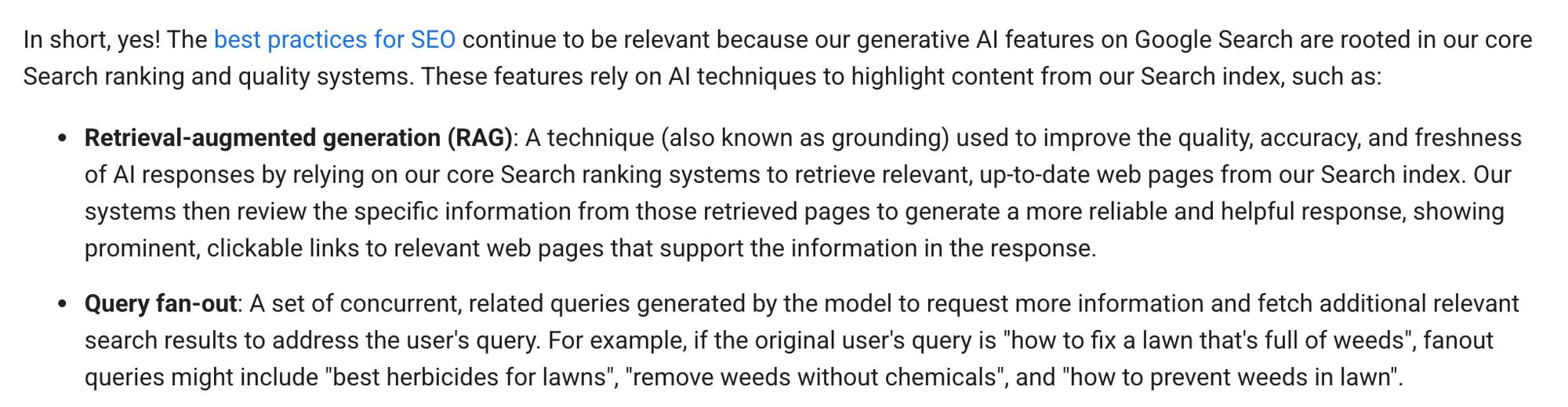
Its AI features use Google’s core ranking systems to retrieve relevant, up-to-date pages from its index, and may fan a question out into related searches to find more supporting links. It doesn’t publish the weights. What studies say about links and brand mentions is in my comparison of ten backlink and mention studies.
Google’s AI optimization guide says the features use “our core Search ranking systems to retrieve relevant, up-to-date web pages from our Search index”, then show “prominent, clickable links to relevant web pages that support the information in the response” (Google). It defines fan-out as “A set of concurrent, related queries generated by the model to request more information”.
The AI features doc adds that fan-out means “issuing multiple related searches across subtopics and data sources”, which lets Google “display a wider and more diverse set of helpful links” (Search Central). How AI Mode’s citations differ from AI Overviews’ is in AI Mode vs AI Overviews.
Google’s most direct statement is from 2024. Liz Reid wrote that the AI Overviews model “is integrated with our core web ranking systems”, is designed for “identifying relevant, high-quality results from our index”, and that AI Overviews “are built to only show information that is backed up by top web results” (Google, 30 May 2024).
On content, Google asks for the same thing in several places. John Mueller wrote “Focus on making unique, non-commodity content” (Search Central blog, May 2025), and the optimization guide describes it as content that “provides unique expert or experienced takes that go beyond common knowledge and the ordinary”.
| Question | Documented by Google? | Where |
|---|---|---|
| Must the page be indexed and snippet-eligible? | Yes | AI optimization guide |
| Must the site allow AI features in Search Console? | Yes | AI optimization guide |
| Are pages retrieved by core ranking systems? | Yes | AI optimization guide; Reid, May 2024 |
| Does it use fan-out searches? | Yes ('may' for AI Overviews) | AI features doc |
| Is special markup or an AI text file needed? | No, Google says it isn't | AI optimization guide |
| Can preview controls limit use? | Yes | Robots meta tag doc |
| How are the signals weighted? | Not published | Nowhere |
| Do E-E-A-T, domain authority or clicks decide it? | Not documented | No primary evidence either way |
| Do Google's patents describe what runs today? | Not documented | Agency inference only |
Source: Google Search Central docs and blog posts, read 17 Nov 2026. Scroll sideways for more columns.
Which pages can be picked at all? #
Pages that are indexed and can show a snippet, on a site that hasn’t been excluded from Google’s AI features in Search Console. Google says there are no extra technical requirements.
The optimization guide’s wording: “a page must be indexed and eligible to be shown in Google Search with a snippet”, and the site “must be included in Search generative AI features in Search Console”. Meeting both doesn’t guarantee anything; it only makes a page eligible. Whether E-E-A-T-style signals decide the pick is a separate question, and I went through what Google says about E-E-A-T and AI answers.
The AI features doc is just as plain: “There are no additional requirements to appear in AI Overviews or AI Mode, nor other special optimizations necessary.” That one sentence rules out most of the paid “AI Overview optimization” checklists you’ll find.
How does it work, step by step? #
Four steps, as far as Google has described them: check eligibility, decide whether an AI Overview helps, retrieve pages for the query and its fan-out searches, then show the supporting links.
- Eligibility. Indexed, snippet-eligible, and the site included through the Search Console control. nosnippet and max-snippet limit what can be used.
- Should an AI Overview show? Only “when our systems determine that it is additive to classic Search”.
- Retrieval. Core ranking systems retrieve relevant, up-to-date pages for your query and for the related searches the model fans out to.
- Supporting links. The answer shows links “that support the information in the response”.
What’s missing is everything between steps 3 and 4: which retrieved pages become links, and why. Ahrefs notes that “Google doesn’t expose the simulated fan-out queries” (Ahrefs, Mar 2026), so nobody outside Google can see the searches behind a citation.
Does ranking well get you cited? #
It helps, but it isn’t enough. Six studies put the share of cited pages that also rank in the top 10 anywhere from 16.7% to 76%, depending on what they counted.
| Who | Published | Sample | What 'top 10' meant | Finding | Their stake |
|---|---|---|---|---|---|
| Ahrefs | 21 Jul 2025 | 1.9M citations from 1M AI Overviews | Top 3 citations per answer only | 76.1% rank top 10 | Sells Brand Radar |
| Semrush | 21 Jul 2025 | 5,000 keywords, desktop, one snapshot | All AI Overview URLs vs organic top 10 | About 67% of URLs (86% of domains) | Sells an AI toolkit |
| BrightEdge | 18 Sep 2025 | 9 industries; size not given | 'Overlap with organic rankings', undefined | 54.5% overlap; 16.7% of citations from the top 10 | Sells search software |
| Ahrefs | 2 Mar 2026 | 863K results pages, 4M cited URLs | First 10 blocks, or blue links only | 37.9% (blocks); 37.10% (blue links) | Sells Brand Radar |
| Position Digital | Updated 24 Aug 2026 | 31 keywords, 92 runs, US, one account | Live organic top 10 | 33.2% | SEO agency |
| Surfer | Updated 9 Sep 2026 | 9,719 answers | Top 10 of the query or its fan-out queries | 70% | Sells an AI tracker |
Source: The studies' own pages, read 17 Nov 2026 (Semrush: its [AI Mode comparison study](https://www.semrush.com/blog/ai-mode-comparison-study/)). Every one is by a company that sells SEO tools or services. Scroll sideways for more columns.
Position still matters. In Position Digital’s data, pages ranking 1 to 3 were cited 58.6% of the time, 4 to 6 at 41.4% and 7 to 10 at 35.9%; it also found “54.4% of top-10 results are never cited at all” (Position Digital). That’s 31 keywords, so treat it as a direction, not a measurement.
Surfer found its “core” sources ranked at position 8.34 on average against 18.71 for the rest, though its author admits “I’m not sure about the ‘why’” (Surfer). Its 70% counts the top 10 “not only to the original query but also to the related, fan-out queries”, which is why it’s so much higher than Ahrefs’ 2026 figure.
If you track rankings already, rank tracking vs AI visibility covers what each number can and can’t tell you.
Why do the studies disagree so much? #
Mostly because they count different things: the top 3 citations or all of them, blue links or every block on the page, the query you typed or the searches Google fans out to.
Ahrefs is the clearest case. Its July 2025 study found “76.10% of AI Overview-cited pages rank in the top 10”, but analysed only “the top 3 most visible citations in each response” (Ahrefs, Jul 2025). Its March 2026 study counted every cited URL and found 37.9%.
Ahrefs reads the drop as a real shift: “Google is selecting far fewer pages straight from the original SERP (~76% in July 2025 vs. ~38% today)”. In the same post it says “we’ve also improved our parsing methodology”, and its working explanation is fan-out (Ahrefs, Mar 2026). So the methods differ, and Ahrefs itself thinks part of the change is real.
BrightEdge is the hardest to read. Its overlap “grew from 32.3% to 54.5%”, yet “Only 16.7% of citations come from top 10 results” (BrightEdge), and it defines neither measure.
My reading: don’t average these. Two things hold up. Where a study breaks citations down by position (Position Digital, Surfer), higher-ranked pages get cited more often, and in all six a sizeable share of citations comes from pages outside the top 10 for the query you typed, most likely through fan-out.
Does schema or llms.txt help? #
Not on the evidence. Google says no special markup or AI files are needed, and Ahrefs found adding schema didn’t lift citations for pages that were already cited.
Google’s guide is blunt: “You don’t need to create new machine readable files, AI text files, markup, or Markdown to appear in Google Search”. It says llms.txt “will neither harm nor help”, and “Structured data isn’t required for generative AI search, and there’s no special schema.org markup you need to add” (Google).
Ahrefs tested it on 1,885 pages that added JSON-LD between August 2025 and March 2026, each against 3 matched control pages, 30 days before and after (Ahrefs, May 2026). AI Overview citations fell 4.6%, a “Small but statistically significant decline”; AI Mode (+2.4%) and ChatGPT (+2.2%) were “Statistically indistinguishable from zero”.
There’s a limit: “Every page in the dataset had 100+ AI Overview citations in February 2025.” So schema showed no lift for pages already cited, and nobody has tested it on pages that aren’t.
Preferred Sources is a label, not a lever. PPC Land’s report of Google’s 27 May post says links from sources a user prefers “will carry a visible “Preferred” badge” in AI Overviews and AI Mode, and nothing in it says those links are included more often (PPC Land).
Can you stop Google citing a page? #
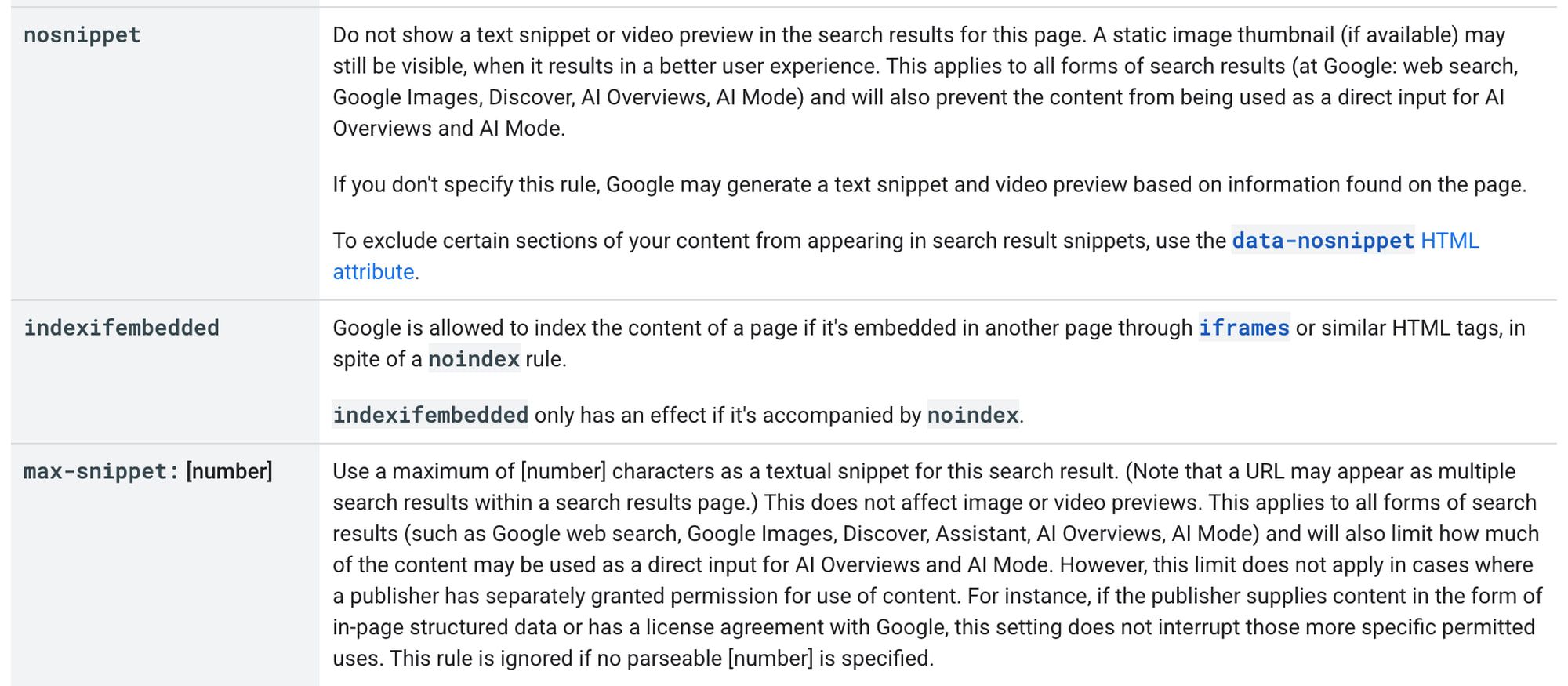
Yes. nosnippet stops a page being used as a direct input for AI Overviews and AI Mode, max-snippet limits how much is used, and Search Console has a site-wide AI control.
Google’s robots meta doc says nosnippet “applies to all forms of search results (at Google: web search, Google Images, Discover, AI Overviews, AI Mode)” and will “prevent the content from being used as a direct input for AI Overviews and AI Mode”. max-snippet “will also limit how much of the content may be used as a direct input for AI Overviews and AI Mode” (Google).
The AI features doc lists nosnippet, data-nosnippet, max-snippet and noindex as the controls that limit what’s shown. These are the only documented levers that take a page out; none of them puts one in. What opting a whole site out cost one publisher is in should you opt out of AI Overviews?
Why do your citations keep changing? #
Because AI Overviews change often. Ahrefs found a 70% chance of a change between checks, and Position Digital saw 52% of its keywords swap at least one citation on a rerun.
Ahrefs found an AI Overview has “a 70% chance of changing” between observations, with only 54.5% of URLs shared between consecutive answers, and a typical overview lasting about 2.15 days (Ahrefs). Position Digital found the first citation held steadier: it stayed the same for 25 of 29 keywords (86%).
So one check tells you little. How many checks you need before calling a change is worked through in how many prompts to track. Google is also still moving links around: PPC Land reports a 15 October post saying Google is “launching updates to show inline links higher up in responses more frequently” (PPC Land). The layout tests are tracked in Google keeps testing AI Overview citations.
How can you see which of your pages get cited? #
For free, Search Console’s generative AI report shows which pages got AI impressions. To see the keyword and your place in the overview, you need a tracker that records the cited URL.
The report counts “how many times links to your site were shown to a user in a generative AI feature on Google Search”, by page, country, device and date, for all sites since 31 August 2026 (Search Console help). It combines AI Overviews and AI Mode and shows no queries, so it tells you which pages, not why. The walkthrough is in what Search Console’s AI report counts and misses.
For keyword-level citations, SE Ranking Core was my overall pick in the AI Overview tracker roundup: daily AI Overview tracking with your link and its position, at $129 a month or $103.20 billed annually (SE Ranking, verified 17 Nov 2026).
Claims that don't hold up (checked 17 Nov 2026)
- “76% of AI Overview citations rank in the top 10,” as current fact. Bluetree still cites it. That’s Ahrefs’ July 2025 figure for the top 3 citations per answer; its March 2026 study found 37.9%.
- “About 8 sources per AI Overview” from unnamed outside studies. Bluetree credits it to “Independent studies” in one place and to Surfer’s dataset in another. It’s Surfer’s vendor study: “On average, AIO shows 8 sources per response”.
- “Add AI Overview schema.” Google says there’s no special markup to add, and Ahrefs found no lift for cited pages.
- Patents as proof of what Google runs today. Omnius walks through six patents and labels its reading as inference. I’d treat any page that doesn’t as guesswork.
- Position Digital’s sample. Its method says 31 keywords and its repeat-run section says 29. I use 31 for the main figures and 29 for the reruns.
What would I change on a page? #
My reading, not a tested recipe: keep it indexable and snippet-eligible, answer the sub-questions a fan-out search would ask in clear passages, keep facts current and dated, and don’t pay for schema markup or llms.txt fixes for this.
- Check eligibility first. Make sure the page is indexed, isn’t blocked by nosnippet, and that your site hasn’t been excluded through the Search Console control.
- Work the pages that already rank. Higher positions are cited more often in Position Digital’s and Surfer’s data, so pages in the top 10 are the cheapest wins.
- Answer the questions around the question. Fan-out searches subtopics, and Ahrefs thinks that’s why so many citations come from outside the top 10. A page that answers the follow-ups clearly has more ways in.
- Say something the other pages don’t. Google keeps asking for “non-commodity” content; I’d read that as original data, prices and examples.
- Skip the shortcuts. No AI text files or special schema; Google and Ahrefs’ test agree they don’t help cited pages.
Then measure. Start with Search Console’s generative AI report, which is free, and add SE Ranking Core only if you need to know which keywords cite you and where. The full free setup, with a monthly manual audit, is in how to measure AI visibility.
FAQ
Do AI Overviews only cite top-ranking pages?
No. Six studies put the share of cited pages that also rank in the top 10 anywhere from 16.7% to 76%, depending on what they counted. Higher positions are cited more often, but many citations come from pages outside the top 10 for the query you typed.
What is query fan-out?
Google defines it as 'a set of concurrent, related queries generated by the model to request more information'. The AI searches for related subtopics as well as your query, which is one reason cited pages don't always rank for it.
Do I need schema or llms.txt to be cited?
No, per Google: there's 'no special schema.org markup you need to add', and llms.txt 'will neither harm nor help'. Ahrefs' test of 1,885 pages found adding schema had no clear effect on pages already cited.
Can I stop AI Overviews using my page?
Yes. nosnippet stops a page being used as a direct input for AI Overviews and AI Mode, max-snippet limits how much is used, and Search Console's generative AI control excludes the whole site.
Why does the cited page change from day to day?
AI Overviews change often. Ahrefs found a 70% chance of a change between observations, and Position Digital saw 52% of its keywords swap at least one citation on a rerun.
How do I check if my site is cited?
Search Console's generative AI report shows, for free, which of your pages got impressions in AI Overviews and AI Mode. For the keyword and your place in the overview, you need a tracker that records the cited URL, such as SE Ranking Core.
Sources
20 sources, accessed .
Official pricing, docs, changelogs and status pages 7
- Google Search Central: optimizing for generative AI features
- Google Search Central: AI features and your website
- Google Search Central: robots meta tag rules (nosnippet, max-snippet)
- Search Console help: generative AI performance report
- Google (Liz Reid): about last week, AI Overviews update, 30 May 2024
- Google Search Central blog (John Mueller): succeeding in AI search, 21 May 2025
- SE Ranking: pricing (Core)
News and press 2
Other blogs 11
- Ahrefs (sells Brand Radar): 76% of AI Overview citations rank top 10, 21 Jul 2025
- Ahrefs: 38% of AI Overview citations in the top 10, 2 Mar 2026
- Ahrefs: does schema help AI citations?, 11 May 2026
- Ahrefs: how often AI Overviews change, Nov 2025
- BrightEdge (sells search software): rank overlap after 16 months of AI Overviews, 18 Sep 2025
- Surfer (sells an AI tracker): where AI Overview sources come from, updated 9 Sep 2026
- Semrush (sells an AI toolkit): AI Mode comparison study, 21 Jul 2025
- Position Digital (SEO agency): AI Overview citation source analysis, updated 24 Aug 2026
- Bluetree (sells link building): how AI Overviews choose sources, updated 12 Oct 2026
- Cypien (consultancy): how Google chooses sources for AI Overviews, 3 Jul 2026
- Omnius (GEO agency): Google's AI search patents, 28 Oct 2026
Last updated: 17 November 2026. Facts verified 17 Nov 2026. Researched and drafted with AI tools; owner review is pending.


