Does schema markup get you cited in AI search?
Google says AI search needs no special schema. I compared the studies, Google’s and Microsoft’s words, and what to ask before you pay for ‘AI schema’.

Short on time?
Short on time? Here’s what I would do.
- Someone is selling you AI schema for citations
- Skip it
- Google says no special markup is needed, the controlled test I found saw no meaningful lift, and no vendor behind a pro-schema claim showed a study.
- Basic markup is already on your site
- Keep it accurate and leave it
- Article, Organization, Product, Review snippet and others still have Google features, and Microsoft lists schema in its own guidance. Treat it as housekeeping, not a citation tactic.
- You were told to add FAQ or HowTo markup
- Skip it for Google
- FAQ rich results ended on 7 May 2026, so the markup no longer buys that feature.
- You still want to know for your own site
- 5-10 pages with markup, 5-10 without
- That is Ahrefs’ suggestion, not mine. Treat the result as yours alone: nobody has shown it works for uncited pages.
- New or ambiguous brand
- Accurate Organization markup is reasonable
- The only support I found is one agency founder’s view that schema is infrastructure for new brands, so it is an opinion, not a finding.
Prices verified . Evidence read 24 Nov 2026. The picks are my reading of it, not a finding in any study. No vendor paid to be included, and sponsors can’t buy a verdict.
Someone is selling you schema for AI search: a plugin, an audit, a monthly retainer. I read what Google and Microsoft say, six studies and case pages, and the rich-result changes since May, so you can decide before you pay.
Every study here comes from a company that sells something related, and I say which one each time. Ahrefs sells an AI-citation tracker, and its result doesn’t help sell schema, which is part of why I weigh it most. The rest of this topic is in my AI visibility hub.
Does schema get your pages cited by AI? #
Not on the evidence I found. Google says no special markup is needed, and the best controlled test I read, Ahrefs’ 1,885 pages, saw no clear gain in AI Mode or ChatGPT and a small drop in AI Overviews.
Here is what Ahrefs did, published 11 May 2026:
- It took 1,885 pages that added JSON-LD between August 2025 and March 2026, each with 100+ AI Overview citations in February 2025.
- It compared citations in the 30 days after the change with the 30 days before, against matched control pages.
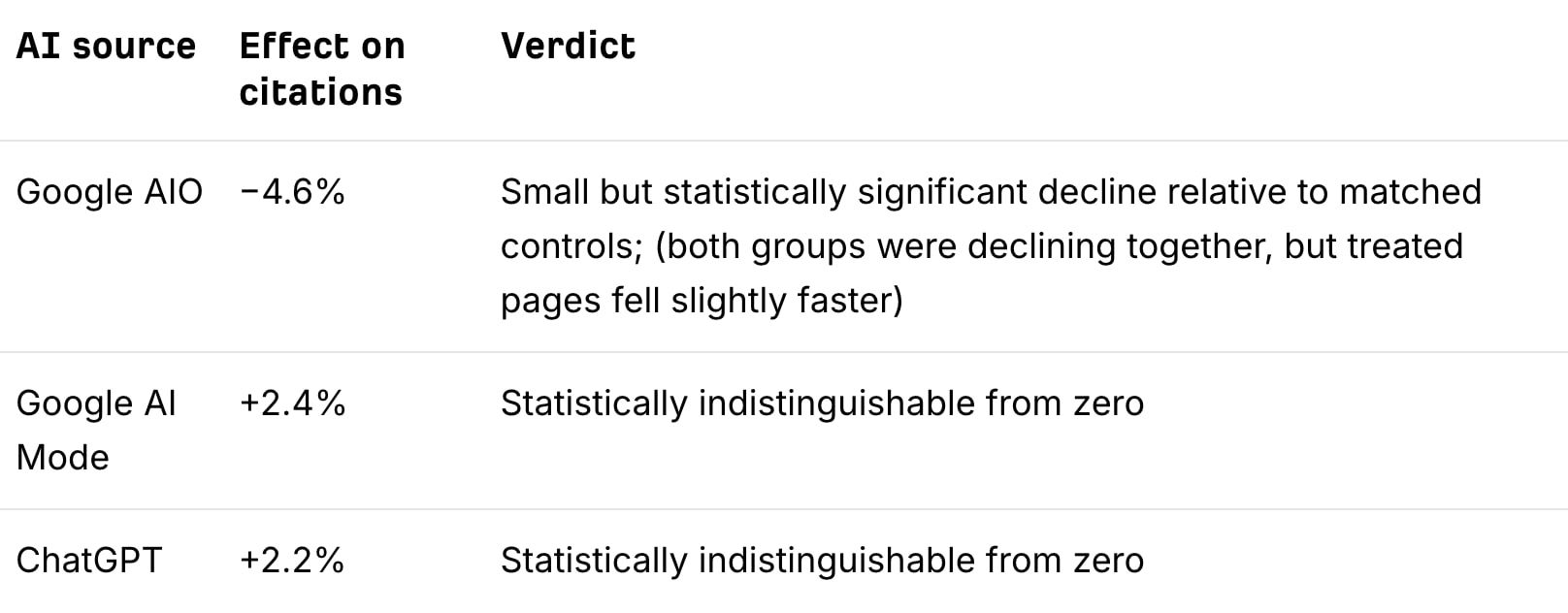
- Result: AI Overviews -4.6% (statistically significant), AI Mode +2.4% and ChatGPT +2.2%. Ahrefs calls the last two indistinguishable from zero.
Ahrefs’ own summary: “The most consistent finding is that not much really changed—schema had no clear positive or negative effect.” It adds that “If you’re already doing the rest of the SEO work well, JSON-LD isn’t going to be the unlock.”
The -4.6% needs care. Ahrefs says both groups were already falling before the change, and the drop works out to an average loss of around 12 daily AI Overview citations per page. I would not read it as “schema hurts”. Ahrefs’ own conclusion is that not much changed.
Its separate correlation across 6 million URLs found AI-cited pages almost three times more likely to have JSON-LD. Read together, that means markup is common on cited pages and adding it didn’t visibly add citations. Ahrefs’ reading is that pages that get cited already have the signals that matter.
One loose end: Ahrefs’ text gives the control group as about 4,000 pages in one place and three per treated page in another. 1,885 times three is 5,655, so both can’t be exact. I write “matched control pages” and don’t pick a number. Search Engine Journal reports all three percentages and the three-controls figure. Search Engine Roundtable reports the -4.6% and the 4,000 controls, and calls the other two results slightly better than control without giving figures.
The limits matter as much as the numbers:
- Every page already had 100+ AI Overview citations, so this says nothing about pages nobody cites.
- The window was 30 days, and only JSON-LD in the HTML was counted (not JavaScript-injected markup, Microdata or RDFa).
- Schema types were pooled, so a lift for one type could hide inside the average.
What does Google say about schema and AI Overviews? #
Google’s AI optimization guide says structured data isn’t required for generative AI search and there’s no special schema.org markup to add. It also says to keep using it for rich results.
The guide’s wording, per Google: “Structured data isn’t required for generative AI search, and there’s no special schema.org markup you need to add.” It sits under a “what you don’t need to do” myth list, and Google’s changelog dates the guide to 15 May 2026.
The other half is just as plain. The same paragraph goes on: “However, it’s a good idea to continue using it as part of your overall SEO strategy, as it helps with being eligible for rich results on Google Search.”

Google’s AI features page agrees. It says “There’s also no special schema.org structured data that you need to add” and that there are “no additional requirements to appear in AI Overviews or AI Mode”. A page still has to be indexed and eligible to show with a snippet, and indexing and serving “isn’t guaranteed”.
Two rules from Google’s policy page matter if you do add markup:
- “Don’t mark up content that is not visible to readers of the page.” The AI features page repeats the point as a best practice.
- A structured-data manual action “means that a page loses eligibility for appearance as a rich result; it doesn’t affect how the page ranks”. It costs you the feature, not your ranking.
Google’s introduction to structured data says markup helps Google “understand the content of a page” and can enable rich results, and recommends JSON-LD. It never says markup affects ranking.
John Mueller’s 2025 advice on AI search is the same: keep the markup matching the visible page. In January 2026 he also gave a personal view on Reddit, “yes, no, and it depends”, and said a comparison site “isn’t going to rank better by adding insurance markup” (Search Engine Roundtable). That is one employee’s comment, and I read it only through SER.
For Google’s other guidance on choosing sources, see how AI Overviews pick the pages they cite. The same guide’s llms.txt note is covered in does llms.txt help, so I won’t repeat it here.
What do the studies show? #
Mixed on metrics, consistent on citations. Ahrefs found no meaningful lift, three others found zero or negative correlation, and one vendor case study found more bot visits. Each counts something different.
| Study | Run by | Sample and window | Metric | Result | Stated limit |
|---|---|---|---|---|---|
| Ahrefs, 11 May 2026 | Ahrefs, sells an AI-citation tracker | 1,885 pages that added JSON-LD, 30 days before vs after, vs matched controls | Citations | AI Overviews -4.6% (significant); AI Mode +2.4% and ChatGPT +2.2% (not significant) | Only pages with 100+ AI Overview citations; JSON-LD in HTML only |
| searchVIU, updated 15 Oct 2026 | searchVIU, sells a crawler | 8 variants of one fictional product on one page, 5 systems, queried 30 Oct 2025; Perplexity and AI Mode asked again after indexing | Whether the system named the price | None named a price that existed only in JSON-LD or hidden markup | One page; run count not stated; not AI Overviews or Copilot |
| Search Atlas, 14 Dec 2025 | Search Atlas, sells SEO software | Sample size not reported | LLM visibility by schema coverage | “No measurable effect” for OpenAI, Gemini and Perplexity | No sample size or statistics; its own caveat on bucket skew |
| SE Ranking, 19 Jan 2026 | SE Ranking, sells an AI toolkit | “Our dataset”; size and method not stated | Correlation with citation count | Near zero: -0.025 to -0.106 for structural types, +0.015 to +0.039 for Article and NewsArticle | Correlation only; not reproducible from the page |
| Seer AI Overviews study, 28 May 2026 | Seer, sells services | 6,354 winning pages from 8,500 keywords, 7-13 May 2026 | First-citation slots in AI Overviews | Sites with the most FAQ and HowTo schema “underperformed by roughly 10x” | Correlation; one-week snapshot; US English |
| Seer AI Lab case study, undated | Seer, sells services | One travel client; page count and window not stated | OpenAI bot log hits | +12% on pages with expanded schema vs -3% on control | Bot visits, not citations; no significance stated |
| Informal tests, 2025-26 | Mark Williams-Cook and Julio C. Guevara, via SER | Single examples and a two-page demo, made-up products or companies | Whether the model returned a value | Values came from visible text, not from JSON-LD alone | Small demos relayed second-hand, not replicated studies |
Source: Pages read 24 Nov 2026: Ahrefs, searchVIU, Search Atlas, SE Ranking, Seer (two pages) and Search Engine Roundtable’s write-ups of the informal tests. Different metrics, so I give no blended total. Scroll sideways for more columns.
Some notes on the table:
- Ahrefs is the only row built as a before-and-after against controls. See the section above for its limits.
- searchVIU tests whether a system names a value placed in one spot on one page. It did not cover AI Overviews or Copilot. Of eight prices, ChatGPT named 3 (all from visible text), Claude 0, Gemini 4, Perplexity 1 and AI Mode 2, the last two only after the page was indexed. Gemini was the only system to read the JavaScript-inserted price on a live fetch. On whether JavaScript content reaches AI indexes, its authors write “A test with one page and one price does not prove it, however.”
- Search Atlas shows box plots with no sample size, and its page promotes the company’s own software.
- SE Ranking also reports that FAQPage pages averaged 3.6 ChatGPT citations against 4.2 without. That is one engine’s count, not a lift.
- Seer’s AI Overviews study says Article plus Breadcrumb “appears sufficient”. It also found Reddit with 0% FAQ schema yet 20.4% of first-citation slots.
- Seer’s AI Lab case study concludes “ChatGPT values well-structured schema”, based on bot visits to one client’s pages.
Seer’s two pages point in opposite directions, and I would not use either to say “Seer says schema works” or “Seer says schema hurts”. One counts server-log hits for a client, the other counts first-citation slots across thousands of pages.
The informal tests come through Search Engine Roundtable’s 2025 write-up and its 2026 “DUCKYEA” follow-up. In the second, Williams-Cook put an address only in made-up, invalid JSON-LD, and ChatGPT and Perplexity still returned it. In his later Search Engine Journal essay he says of the models: “They are reading the HTML and shrugging at the structure.” It is one fictional company. In the same essay he calls schema infrastructure for new and challenger brands, though not a way to win a citation today.
What do Microsoft, OpenAI and Perplexity say? #
Microsoft’s own guidance lists schema among ways to help AI systems understand content. OpenAI’s and Perplexity’s bot pages say nothing about structured data, and silence isn’t proof either way.
| Engine | What the owner’s page says | What it doesn’t show |
|---|---|---|
| Google AI Overviews and AI Mode | Not required; no special markup; keep it for rich results; must match visible text (AI optimization guide, AI features page) | That any markup raises citations, or that none does |
| Bing and Copilot | “Schema is a type of code that helps search engines and AI systems understand your content.” Its checklist says “Use schema, clear headings, and modular layouts.” (Microsoft Advertising, 8 Oct 2025) | How much it matters; I found no Bing or Copilot citation test |
| ChatGPT | OpenAI’s bots page describes OAI-SearchBot, GPTBot and ChatGPT-User and says nothing about structured data | Whether ChatGPT reads JSON-LD. Outside tests found visible text read and JSON-LD-only values not named |
| Perplexity | Its bots page says PerplexityBot is “designed to surface and link websites in search results”; nothing on structured data | Same as ChatGPT: silence, plus the outside tests |
| Claude and the Gemini app | No primary statement found | Everything |
Source: Google, Microsoft Advertising, OpenAI and Perplexity pages read 24 Nov 2026. “Silent” means the page I read doesn’t mention it, not that the company says it is unused. Scroll sideways for more columns.
The Microsoft lines come from a post by Krishna Madhavan, a Principal Product Manager at Bing. It’s real, first-party guidance, but it says schema helps systems understand content, not that it earns citations.
Bing’s AI Performance report, in public preview since 10 February 2026, shows citations, cited pages and grounding queries. The announcement doesn’t mention schema. Its tips are clear headings, tables, FAQ sections, cited sources, fresh content and IndexNow. I explain how to read the report in Bing’s AI Performance report shows citations, not clicks.
You may also see a claim that Microsoft’s LLMs use schema, from Fabrice Canel at SMX Munich in March 2025. It reached Search Engine Roundtable through a LinkedIn post by David Mihm, with no recording, and Williams-Cook argues Canel was talking about freshness and IndexNow. I’d treat it as unsettled and not build a purchase on it.
The OpenAI and Perplexity pages describe their crawlers only. That tells you what the bots are for, not what happens to markup afterwards.
Which rich results can schema still win? #
Schema pays where Google shows a feature for it: products, articles, organization, reviews, events and more. FAQ rich results ended on 7 May 2026, so FAQ markup sold as a visibility boost no longer buys one.
| Feature | Status | Date | Source |
|---|---|---|---|
| FAQ rich result | Ended; docs removed | Notice 8 May 2026, no longer shown from 7 May 2026, docs removed 15 Jun 2026 | Google changelog and FAQ page |
| Practice problems | Removed | 6 Jan 2026 | Google changelog |
| Some types in Search Console | Support removal announced, no list | To start January 2026, announced 5 Nov 2025 | Google Search Central blog |
| Article, Breadcrumb, Organization, Product, Local business, Review snippet, Recipe, Event, Video and others | Listed in Google’s gallery | Page undated | Search gallery page |
| Dataset and Q&A | Unverified | Gallery lists them; page may lag the changelog | Search gallery page |
Source: Google’s changelog, FAQ page, search gallery and Search Central blog, read 24 Nov 2026. The gallery lists 25 features but carries no date. I read only part of the changelog. Scroll sideways for more columns.
The FAQ date is the one a buyer can use today. Google’s changelog says FAQ rich results stopped appearing from 7 May 2026, and the FAQ documentation was removed on 15 June. Ahrefs published four days after the change.
Google also said it keeps using FAQ markup to “better understand” pages, as Search Engine Journal reports the notice (I did not see Google’s full notice text). What that does in practice is unclear, so I wouldn’t call the markup useless. I’d call it unpaid-for.
Google’s November 2025 post said “Starting in January 2026, we’ll remove support for the structured data types in Search Console and its API”, without naming them. Many pages that rank for this topic predate these changes, so check dates before trusting FAQ or HowTo advice.
Because the gallery page is undated, I would check Search Console’s Enhancements reports for the exact type you are being sold. If a report no longer exists for it, that tells you more than a vendor’s pitch.
How do you spot an AI schema pitch worth skipping? #
Ask for a control group, the metric, the window and which pages. A pitch that promises citation lift without those, bundles FAQ or HowTo markup, or marks up hidden content is a skip.
My six checks, each tied to a source:
- A promised lift with no control group. The only before-and-after test I found used matched controls, and it showed no clear gain (Ahrefs).
- No named metric. Citations, server-log hits and correlations are different things. Seer’s +12% is bot hits for one client, not citations.
- An FAQ or HowTo bundle after 7 May 2026. FAQ rich results are gone (Google).
- Markup for content readers can’t see. Google’s policy page forbids it.
- “AI-specific” schema types. Google says no special schema exists for AI Overviews or AI Mode (Google).
- The seller’s own study, or none. WebFX publishes no dataset for its AI claim, says schema “doesn’t guarantee LLM citations”, and sells structured-data audits. seoClarity argues Ahrefs should have tested pages with zero initial AI visibility, but shows no data of its own.
Schema App’s gated report claims benefits for rich results and impressions. I couldn’t see its method, and its public page makes no AI-citation claim. A Search Engine Journal piece promoting a paid tier (Loren Baker, 1 Sep 2026) offers three client examples and no controls.
The checklist works in both directions. Magnet says “Stop paying for markup as a growth lever”, and it is a marketing agency. Search Atlas sells software and promotes it on the page that reports no measurable effect. A seller on either side deserves the same six questions.
What can nobody tell you yet? #
Whether schema helps a page that isn’t cited at all, whether other engines read it, and what happens over more than 30 days. Every causal test I read started from pages already cited or crawled.
What I could not find:
- A statement from OpenAI, Perplexity, Anthropic or Google (for the Gemini app) that their answer systems read JSON-LD. Their bot pages are silent.
- Any test on pages nobody cites. Ahrefs says so itself. Seer’s case study is a different test: bot hits on pages that already had schema.
- Bing and Copilot index tests. searchVIU says its test doesn’t cover AI Overviews or Copilot.
- JavaScript-injected markup. Ahrefs counted only JSON-LD in the HTML, and searchVIU saw only Gemini read a JavaScript-inserted price on a live fetch.
- Use at indexing time. A live-fetch test can’t see what a system stores, and searchVIU’s after-indexing re-check covered only Perplexity and AI Mode on one page.
- Prices. I collected no price for an AI schema service or plugin and name none.
If you run a new or ambiguous brand, Williams-Cook calls schema infrastructure for challenger brands, and I find that plausible. It is one person’s view, not a measured result.
So what would I do? #
Keep accurate basic markup, skip anything sold as an AI-citation fix, and don’t pay for FAQ or HowTo work. This is my reading of the evidence, not a rule from any study.
- Someone is selling you AI schema for citations. Skip. Google says nothing special is needed, the controlled test I found saw no meaningful lift, and the vendors claiming otherwise showed no study.
- You already have basic markup. Leave it, keep it matching the visible page, and check Search Console for the types Google still reports. That is for rich results and because Microsoft lists schema in its guidance.
- A plugin adds FAQ or HowTo markup. Don’t pay to expand it. It no longer buys a Google rich result.
- You want your own answer. Ahrefs suggests testing 5-10 pages with the markup against 5-10 without and comparing over weeks. I did no testing here, so that is its advice, and a small test on pages that already get cited can’t speak for pages that don’t.
- You have the time and money for one thing. Spend it on what Google’s documented controls cover: indexable pages and crawler access. My llms.txt post has that crawler check, and how E-E-A-T shows up in AI answers covers the trust side. For the wider picture, see what GEO is.
I’ll update this post if Google, Microsoft or a larger controlled study changes the picture.
FAQ
Does schema markup help me show up in AI Overviews?
Google says it isn’t required and no special markup exists. In Ahrefs’ test, pages that added JSON-LD saw AI Overview citations fall 4.6% against matched controls, a statistically significant change, on pages that were already cited. Keep markup for rich results, not as an AI Overviews tactic.
Does JSON-LD help ChatGPT cite my page?
I found no evidence it does. Ahrefs measured +2.2% for ChatGPT, which it calls indistinguishable from zero. searchVIU’s test saw no system name a price that existed only in JSON-LD, and OpenAI’s bots page is silent. Seer’s +12% is OpenAI bot log hits for one client, not citations.
Does Bing or Copilot use schema?
Microsoft’s own October 2025 guidance lists schema among ways to help search engines and AI systems understand content. A reported Fabrice Canel remark that Microsoft’s LLMs use schema is second-hand and disputed, so I don’t lean on it. I found no Bing or Copilot citation test.
Should I remove FAQ schema?
Google stopped showing FAQ rich results from 7 May 2026, so the markup no longer buys that feature. Google said it keeps using FAQ markup to understand pages, though the effect is unclear. I found no evidence that removing it changes rankings, so leaving accurate markup alone is a fair call, and so is deleting it.
Is schema still worth it for rich results?
Yes, where Google still shows a feature for it. Its gallery page lists 25 features, including Article, Organization, Product and Review snippet, though the page is undated. The markup must match what readers see, and Search Console’s reports tell you what Google reads on your site.
What should I ask a vendor selling AI schema?
Ask for the control group, the metric, the time window and the pages tested. A pitch that promises citation lift without those, bundles FAQ or HowTo markup after 7 May 2026, or marks up content readers can’t see is a skip. The same questions apply to anyone claiming schema is useless.
Could schema help a page nobody cites yet?
Nobody has shown it, as far as I found. Ahrefs’ test only covered pages with 100+ AI Overview citations and says so. seoClarity argues for testing uncited pages but publishes no data. If you want to know for your site, run the 5-10 versus 5-10 page test Ahrefs describes.
Sources
33 sources, accessed .
Official pricing, docs, changelogs and status pages 13
- Google Search Central: AI optimization guide (changelog entry 15 May 2026)
- Google Search Central: AI features and your website
- Google Search Central: introduction to structured data
- Google Search Central: structured data general guidelines and policies
- Google Search Central: documentation updates (changelog)
- Google Search Central: FAQ structured data page
- Google Search Central: structured data search gallery (undated)
- Google Search Central blog: succeeding in AI search, 21 May 2025
- Google Search Central blog: update on our efforts, 5 Nov 2025
- Microsoft Advertising: optimizing your content for inclusion in AI search answers, 8 Oct 2025
- Bing Webmaster blog: AI Performance in Bing Webmaster Tools, public preview, 10 Feb 2026
- OpenAI: crawlers and user agents (undated)
- Perplexity docs: crawlers (PerplexityBot, Perplexity-User)
Independent benchmarks and published studies 6
- Ahrefs: schema and AI citations study, 11 May 2026 (Ahrefs sells an AI-citation tracker)
- searchVIU: schema markup and AI put to the test, 2 Dec 2025, updated 15 Oct 2026 (the vendor sells a crawler)
- Search Atlas: the limits of schema markup for AI search, 14 Dec 2025 (the vendor sells SEO software)
- SE Ranking: structured data for SEO and LLM visibility, 19 Jan 2026 (the vendor sells an AI toolkit)
- Seer Interactive: what it takes to rank in Google’s AI Overviews, 28 May 2026 (the agency sells services)
- Seer Interactive AI Lab: do AI models reward structured data, one-client case study (undated)
News and press 10
- Search Engine Roundtable: the Ahrefs schema citations study, May 2026
- Search Engine Journal: schema markup didn’t move AI citations in Ahrefs test, 11 May 2026
- Search Engine Journal: FAQ removal and new data challenge schema’s AI search value, May 2026
- Search Engine Roundtable: Google’s generative AI mythbusting guide, 18 May 2026
- Search Engine Roundtable: John Mueller on schema and LLMs, 2 Jan 2026
- Search Engine Roundtable: schema, LLMs and Copilot, 20 Mar 2025
- Search Engine Journal: schema, LLMs and the low bar for evidence in GEO, 16 Jun 2026
- Search Engine Roundtable: ChatGPT and Perplexity read the text, 6 Feb 2026
- Search Engine Roundtable: structured data and AI search visibility tests, 15 Sep 2025
- Search Engine Journal: schema, AI citations and being a trusted source, 1 Sep 2026
Other blogs 4
- WebFX: why structured data matters for AI citations, 9 Oct 2025 (the vendor sells schema work)
- seoClarity: impact of schema on AI search performance, 25 Jun 2026 (the vendor sells a schema tool)
- Schema App: impact of schema markup report (gated; the vendor sells schema tools)
- Magnet: schema will not save AI visibility, 15 Jul 2026 (the agency sells marketing services)
Last updated: 24 November 2026. Evidence verified 24 Nov 2026. Researched and drafted with AI tools; owner review is pending.


