What is generative engine optimization, and is it just SEO?
GEO means getting AI answers to cite you. I read the paper that coined it and Google's and Microsoft's own guidance: what's new, and what's still SEO.

Short on time?
Short on time? Here's my take.
- Most teams
- Keep your SEO budget, skip a GEO retainer
- Google calls optimizing for its AI features 'still SEO'. Surveys show GEO money comes out of search budgets anyway.
- You want to know if AI answers name you
- Search Console's generative AI report + Bing AI Performance
- Search Console's report is free; Bing calls its Webmaster Tools SEO and GEO tools free. Google's covers AI Overviews and AI Mode; Bing's covers Copilot and Bing's AI answers.
- You need ChatGPT and Perplexity, with competitors
- Peec AI Starter
- $95 a month for 50 prompts on 3 models of your choice, run daily (verified 17 Nov 2026).
- An agency pitches you GEO
- Ask what it measures, then ask for case studies
- Which engines, how many runs, what counts as a win. In Fractl's survey, 34% rank case studies as the top credibility signal.
Prices verified . Facts from the GEO paper, Google, Microsoft and vendor pages, verified 17 Nov 2026. No vendor paid to be included, and sponsors can't buy a verdict.
“GEO” now shows up in agency proposals and on tool pricing pages, usually with a new budget line attached. I read the 2023 paper that named it, Google’s and Microsoft’s own guidance, and two marketer surveys to see what’s actually new.
The short version: the groundwork is SEO, and the new part is mostly measurement. Below: what the paper tested, where Google and Microsoft land, and a pick for your situation. For the tools themselves, start at the AI visibility hub.
What does GEO mean? #
Generative engine optimization is work aimed at getting AI answers, like ChatGPT, Perplexity or Google’s AI Overviews, to cite or name your site. AEO (answer engine optimization) and LLMO are other labels for the same work.
Google’s own guide lists AEO and GEO as terms “you may see used” for optimizing for its AI features (Google Search Central). Conductor, which sells an AEO/GEO platform, says “GEO and AEO deal with the same core concept” (Conductor Academy).
Most marketers haven’t switched words. In Fractl’s survey of 343 US marketing decision-makers, 81% still call it “SEO” internally and 19% say “GEO” (PPC Land, 21 Jul 2026). Fractl sells AI workflow services, so read it as a seller’s survey. My glossary entry for GEO keeps the two-line version.
Where did the term come from? #
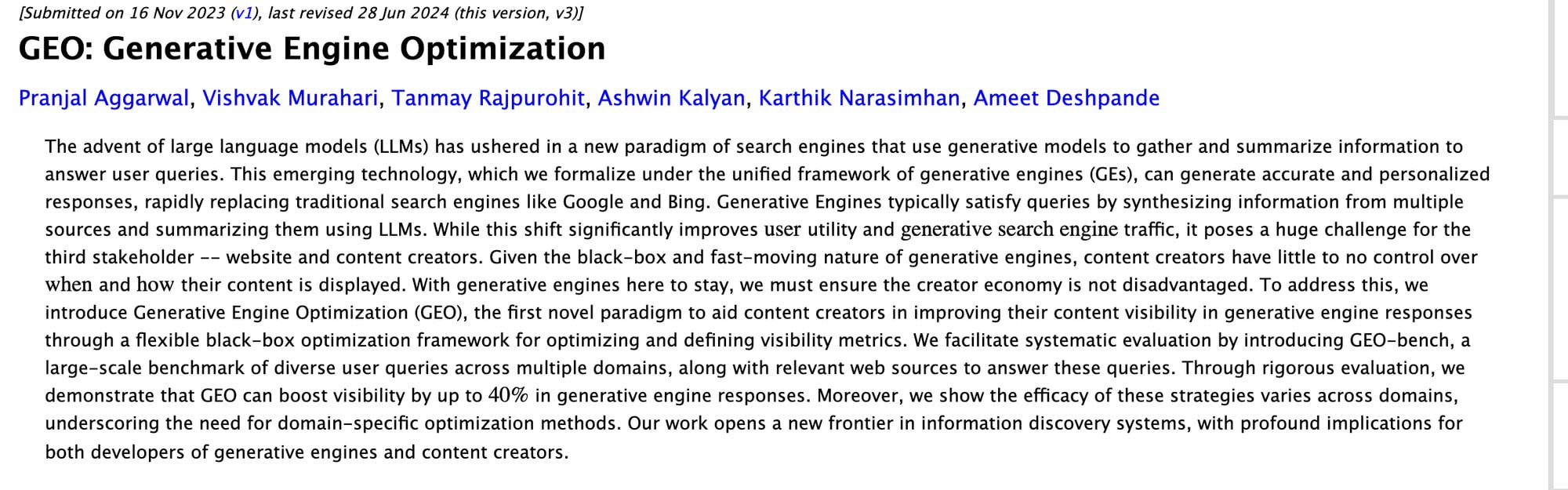
A November 2023 paper by six researchers named it and tested nine ways of rewriting a page to show up more in AI answers. It was later accepted to KDD 2024.
The paper, “GEO: Generative Engine Optimization”, is by Aggarwal, Murahari, Rajpurohit, Kalyan, Narasimhan and Deshpande. It was first posted on 16 November 2023 and revised on 28 June 2024 (arXiv).
Here’s what they built. Their test engine fetched the top 5 Google results for a query and had gpt-3.5-turbo write an answer from them, five samples per query (paper, §3.1). The test set, GEO-bench, has 10,000 queries drawn from nine sources, including MS MARCO, Natural Questions, ELI5 and Perplexity Discover.
Then they rewrote one source page at a time and scored how visible it was in the answer. One score is a position-adjusted word count; the other, a “subjective impression”, is judged by GPT-3.5 itself.
| Rewrite | In plain words | Position-adjusted score |
|---|---|---|
| None (baseline) | The page as it was | 19.3 |
| Quotation Addition | Add quotations | 27.2 (best) |
| Statistics Addition | Add statistics | 25.2 |
| Fluency | Make the text read more fluently | 24.7 |
| Cite Sources | Cite sources in the text | 24.6 |
| Keyword Stuffing | Repeat the query's keywords | 17.7 (below baseline) |
Source: Table 1 of the GEO paper (arXiv 2311.09735), 'Overall' position-adjusted column, read 17 Nov 2026. The table's caption puts the best methods' gain at 41% on this score and 28% on the subjective one. Scroll sideways for more columns.
The abstract rounds that up to GEO that “can boost visibility by up to 40% in generative engine responses”, and adds that effectiveness “varies across domains” (arXiv). So “about 40%” is fair, as long as you remember what it’s 40% of.
The finding I found most useful is in Table 2: lower-ranked pages gained the most. Citing sources cut a rank-1 page’s visibility by 30.3% but lifted a rank-5 page’s by 115.1% (paper). My read is that rewrites help most where a page is otherwise easy to skip.
What doesn’t the paper prove? #
It shows that rewrites lifted a lab score inside a GPT-3.5 engine fed five Google results. It doesn’t measure traffic, real ChatGPT citations or search rankings.
Both scores describe how much of the generated answer drew on a page, and one is judged by an LLM (paper). Neither counts visits, clicks or how often a live assistant cites you.
The real-engine check was small. The authors repeated part of the test on Perplexity with 200 queries, uploading the sources as files. Quotations scored about 22% higher on the position measure, citing sources and adding statistics gained up to 37% on the subjective one, and keyword stuffing did about 10% worse (§6 and Appendix C.1).
The authors list the limits themselves (§9): only two engines, methods that may need to change as engines evolve, query mixes that shift over time, and no test of effects on search rankings, since engines are “black boxes”.
So when a pitch says GEO lifts visibility 40%, ask which engine and which measure. In the paper, it’s a lab engine running GPT-3.5 and a share-of-answer score. I couldn’t find a published study showing the same rewrites change real ChatGPT or Perplexity citation rates.
How is GEO different from SEO? #
The groundwork is the same; the scoreboard is different. SEO counts rankings and clicks, while GEO counts how often AI answers mention or cite you.
| SEO | GEO | Same or different? | |
|---|---|---|---|
| Goal | Rank and earn clicks | Get cited or named inside AI answers | Different outcome, overlapping work |
| Google's view | Its usual guidance | 'Still SEO' for Google's AI features | Same, for Google |
| Microsoft's view | Bing Webmaster Guidelines | A named practice that 'doesn't guarantee citations' (per SEJ) | Mostly the same |
| Technical basics | Crawlable and indexable | The same, plus letting each AI engine's crawler in | Same, plus a robots.txt check |
| Content | Helpful, original pages | Quotations and statistics helped in the lab test | Overlapping |
| Off-site | Links and mentions | Mentions on the sites AI answers cite | Overlapping |
| Measurement | Rankings and Search Console clicks | Prompt runs, mention rate, citations, plus Google's and Bing's own reports | Different: the real new cost |
Source: GEO paper, Google's AI optimization guide and AI features doc, Microsoft's Oct 2025 guidance, SEJ on Bing's guidelines, Peec docs. Verified 17 Nov 2026. Scroll sideways for more columns.
Two rows deserve a note. Crawler access is the one technical step that’s new: each AI engine has its own crawlers, and blocking one for training isn’t the same as blocking it from answers. I cover the settings in the AI training opt-out.
Measurement is where the money goes. Search Console already shows Google’s side for free; ChatGPT and Perplexity answers across competitors need a tool that runs prompts. I line up the two scoreboards in rank tracking vs AI visibility.
What does Google say about GEO? #
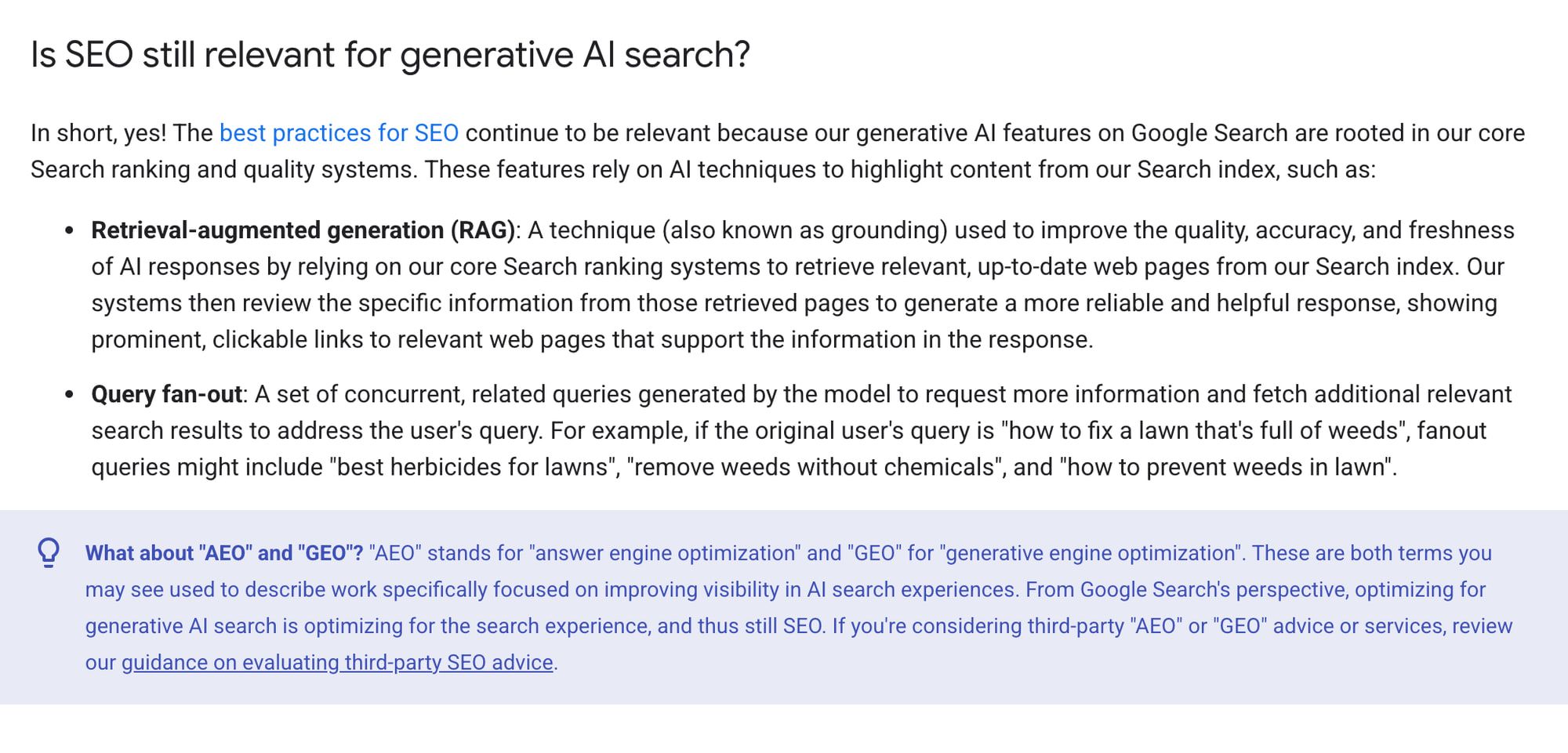
Google says optimizing for its AI features is “still SEO”, and that you don’t need llms.txt files, special schema or chopped-up pages.
Its guide, “Optimizing your website for generative AI features on Google Search”, is plain: “optimizing for generative AI search is optimizing for the search experience, and thus still SEO” (Google). The page carries no date; Search Engine Journal reported it on 15 May 2026 (SEJ).
Its list of things you don’t need reads like a reply to GEO sales decks:
- “Structured data isn’t required for generative AI search.”
- “There’s no requirement to break your content into tiny pieces.”
- “You don’t need to write in a specific way just for generative AI search.”
- On llms.txt-type files: “Google Search ignores them.”
And one line for anyone buying a tool: “No third-party tool has access to our internal ranking or AI systems.” To measure, Google points you to Search Console’s generative AI performance report.
The older AI features doc agrees: “There are no additional requirements to appear in AI Overviews or AI Mode, nor other special optimizations necessary”, and “The best practices for SEO remain relevant”. It describes query fan-out as “issuing multiple related searches across subtopics and data sources”, which I explain in how AI Overviews choose sources.
Google doesn’t say it penalizes GEO. The guide warns about scaled content made to manipulate its AI responses, and SEJ quotes Google saying that seeking inauthentic mentions “isn’t as helpful as it might seem”.
What does Microsoft say? #
Microsoft is the one platform I found that uses the term GEO in its own guidance, and, per Search Engine Journal, Bing’s guidelines say GEO doesn’t guarantee citations.
Per Search Engine Journal’s 27 February 2026 report, Bing’s rewritten Webmaster Guidelines name “Generative Engine Optimization (GEO)” as the work of making content eligible to ground and be referenced in AI answers, and say it “doesn’t guarantee citations” (SEJ). They also add a “Prompt Injection and AI Manipulation” section. Bing’s page didn’t load for my research tools, so that’s SEJ’s account.
Microsoft’s advice is close to Google’s in substance. Its October 2025 post opens: “Whether you call it GEO, AIO, or SEO, one thing hasn’t changed: visibility is everything.” It explains that assistants break pages into pieces, recommends clear headings, Q&A, lists, tables, self-contained sentences and schema, and says there’s “no secret strategy” (Microsoft Advertising blog).
Bing also calls its AI Performance report in Bing Webmaster Tools, launched 10 February 2026, “an early step toward Generative Engine Optimization (GEO) tooling” (Bing Webmaster blog).
On schema the two companies differ. If Bing and Copilot matter to you, Microsoft’s advice is a reason to keep it; just don’t buy it as a fix for Google’s AI features.
Who thinks Google is wrong? #
GEO agencies argue that Google’s guide covers one ecosystem, and that ChatGPT or Perplexity retrieve content differently.
Mike King of iPullRank, an agency that sells GEO services, puts it this way: “Google’s guide describes one ecosystem. Your strategy needs to account for several.” He argues chunking still matters for other retrieval systems (iPullRank, 18 May 2026).
He’s right about scope: Google’s guide only speaks for Google Search. But I found no public study showing that chunked pages earn more ChatGPT citations. My read: follow Google for Google, Microsoft for Copilot, and treat other engine-specific tactics as unproven until someone publishes data. For ChatGPT, I rank the levers by evidence in how to get mentioned in ChatGPT.
What do GEO tools actually measure? #
They run a fixed list of prompts through AI engines and count how often you’re mentioned or cited. The result is a share of the prompts you chose, not of the market.
Peec, for example, runs prompts in the engines’ web interfaces daily while logged out (Peec docs), and defines visibility as responses that mention you divided by all responses (visibility metric). Profound says it captures “the consumer browsing experience” (Profound). I go through collection methods in how AI visibility tools work.
Start with the search engines’ own reports. Search Console’s generative AI report is free and covers AI Overviews and AI Mode. Bing’s AI Performance report covers Copilot and Bing’s AI answers, and Bing calls its Webmaster Tools SEO and GEO tools free (Bing).
When you need ChatGPT and Perplexity with competitor names, Peec AI Starter is $95 a month for 50 prompts on 3 models of your choice, run daily, with unlimited competitors. Pro is $245 and Advanced $495 (Peec pricing, verified 17 Nov 2026). The full breakdown is in Peec AI pricing.
Does GEO need its own budget? #
Usually not a new retainer. Surveys show teams carve GEO out of existing search budgets, and the only clearly new cost is measurement.
| Survey | Sample | Finding | Share of what? |
|---|---|---|---|
| Fractl, via PPC Land (Jul 2026) | 343 US marketing decision-makers | Average 24% toward AI visibility; 18% put nothing in | Search or content budget |
| Scribewise, via Digiday (Mar 2026) | 205 US executives and managers | 55% have a GEO budget; 70% of marketers say GEO is 11–20% | 'That budget', not defined further |
Source: PPC Land, 21 Jul 2026; Digiday, 25 Mar 2026. Both are surveys run by companies that sell marketing services. Different bases, so I don't average them. Scroll sideways for more columns.
The Digiday report quotes Levi of Noise Media calling it “a reallocation of SEO budget towards GEO” (Digiday). In other words, the same money, sliced differently.
Buyers are wary of the label. In Fractl’s survey, “repackaged SEO with AI branding” was the C-suite’s top vendor red flag (33%), 79% see AI search as an evolution of SEO, and 34% rank case studies as the top credibility signal (PPC Land).
What do other guides get wrong? #
Mostly they skip the evidence. Here’s what I found on the pages that ranked in my search.
Claims to check in GEO guides
- Schema as an AI requirement. Wayne McRae’s newsletter recommends it for AI engines (McRae); Google says structured data “isn’t required for generative AI search”.
- “AI answers often cite one or two sources.” BrightEdge’s glossary says so without a source (BrightEdge), and the page carries no date.
- GEO without the paper. Loganix, the top result in my search, never cites the study that coined the term or any Google guidance (Loganix).
- “Up to 40%” without context. None of these pages quotes the paper’s figure; if a guide or pitch does, it’s a lab score in a GPT-3.5 engine, not traffic or live citations.
What would I do? #
Treat GEO as SEO with one new line item: measurement. Here’s my pick for each case.
- Most teams: keep your SEO budget and don’t open a separate GEO retainer. Google itself calls optimizing for its AI features “still SEO”.
- You want to know whether AI answers name you: turn on Search Console’s generative AI report and Bing’s AI Performance report first. Search Console’s report is free; Bing calls its Webmaster Tools SEO and GEO tools free.
- You need ChatGPT and Perplexity, with competitors: Peec AI Starter, $95 a month for 50 prompts on 3 models (verified 17 Nov 2026).
- An agency pitches GEO: ask what it measures, on which engines, over how many runs, and for case studies with before-and-after numbers. Walk away from guaranteed citations.
- Your writers want a tactic: add sourced statistics and quotations, which the lab test rewarded and readers like anyway. Skip keyword stuffing, which scored below doing nothing.
If you’re comparing tools for client work, AI visibility tools for agencies is the next read.
FAQ
Is GEO the same as AEO?
In practice, yes: different labels for the same work. Google's guide lists AEO and GEO as terms 'you may see used' for optimizing for its AI features, and Conductor says 'GEO and AEO deal with the same core concept'. Most marketers still call it SEO: 81% in Fractl's survey of 343 US marketers.
Who coined GEO?
A paper titled 'GEO: Generative Engine Optimization' by Aggarwal, Murahari, Rajpurohit, Kalyan, Narasimhan and Deshpande, first posted to arXiv on 16 November 2023 and accepted to KDD 2024. It tested page rewrites in a lab answer engine built on GPT-3.5.
Does Google support llms.txt for AI Overviews?
No. Google's AI optimization guide says of llms.txt-type files: 'Google Search ignores them.' Its AI features doc adds that there are no additional requirements or special optimizations needed to appear in AI Overviews or AI Mode.
Does schema help GEO?
It depends on the engine. Google says 'Structured data isn't required for generative AI search.' Microsoft's guidance for Bing and Copilot recommends schema alongside clear headings, lists and tables. Keep it if Bing matters to you, but don't buy it as a Google AI fix.
How much should GEO cost?
There's no standard. Fractl's survey found marketers put an average 24% of their search or content budget toward AI visibility; in Scribewise's survey, 70% of marketers said GEO accounted for 11–20% of 'that budget'. The bases differ, so don't average them. Most of it comes out of existing search budgets.
Can anyone guarantee AI citations?
No. Bing's guidelines say GEO 'doesn't guarantee citations', per Search Engine Journal, and Google says 'No third-party tool has access to our internal ranking or AI systems.' Treat any guaranteed-citation pitch as a red flag.
Sources
20 sources, accessed .
Official pricing, docs, changelogs and status pages 8
- Google Search Central: optimizing your website for generative AI features
- Google Search Central: AI features and your website
- Microsoft Advertising blog: optimizing content for AI search answers, 8 Oct 2025
- Bing Webmaster blog: AI Performance in Bing Webmaster Tools, 10 Feb 2026
- Bing Webmaster Tools: about page (free SEO/GEO tools)
- Peec AI docs: how prompts are run
- Peec AI docs: visibility metric
- Peec AI: pricing
Independent benchmarks and published studies 2
News and press 4
Other blogs 6
- iPullRank (sells GEO services): on Google's AI search guidance, 18 May 2026
- Profound (sells AI visibility tracking): how it collects answers
- Conductor Academy (sells an AEO/GEO platform): generative engine optimization, Nov 2025
- Loganix (sells LLM optimization services): generative engine optimization, Jul 2025
- Wayne McRae (newsletter): what is generative engine optimization, Aug 2025
- BrightEdge glossary (sells GEO tracking): generative engine optimization, undated
Last updated: 17 November 2026. Facts verified 17 Nov 2026. Researched and drafted with AI tools; owner review is pending.


