Does llms.txt help you get cited by AI?
Google says Search ignores llms.txt, and the citation studies I read found no link. Here's the evidence and when it's worth 30 minutes.

Short on time?
Short on time? Here's what I would pick.
- Marketing, ecommerce or publisher site
- Leave a plugin-generated file on, 30 minutes at most
- Google says Search ignores it and no study I read links it to citations. Confirm it lists current pages, then move on.
- Docs, API or developer-product site
- Publish one and keep it current
- The only named-assistant fetches I found were coding agents. Thin evidence, but a cheap reason.
- You want more citations
- Check crawler access and indexing
- Make sure OAI-SearchBot, Claude-SearchBot and PerplexityBot aren't blocked and your key pages are indexable.
- A tool is selling you an llms.txt score fix
- Skip the fix
- The score checks that a file exists or loads. It doesn't check whether anyone cites you.
Prices verified . Evidence read 24 Nov 2026. No vendor paid to be included, and sponsors can't buy a verdict.
Adding an llms.txt file takes minutes. Whether it changes who ChatGPT, Perplexity, Claude, Gemini or Google’s AI features cite is a different question, and nothing I read shows that it does.
I went through Google’s own documentation, the crawler pages from OpenAI, Anthropic and Perplexity, and the log and citation studies published so far. My wider picks for tracking AI visibility are in the AI visibility hub.
What is llms.txt, in plain words? #
It’s a Markdown file at yoursite.com/llms.txt that lists a site’s key pages for AI agents. Jeremy Howard proposed it in September 2024, and it’s a proposal, not a standard or an access control (llmstxt.org).
The proposal expects it to matter mainly when an AI reads your pages to answer a question, not for training. Its version 2 says coding agents use these files reliably, which is the author’s claim and comes with no data (llmstxt.org changes).
Unlike robots.txt, the file doesn’t grant or block anything, as Common Crawl put it after analysing 584,107 files from its July 2026 crawl (Common Crawl). I’m leaving the syntax to the spec.
How many sites even have one? #
It depends on who’s counting. The samples I read range from about 10% to 32%, and one tracker works out to about 1% by my arithmetic, so don’t treat any single number as the web.
- SE Ranking: 10.13% of nearly 300,000 domains (SE Ranking).
- Common Crawl: about 11.72% of sampled /llms.txt URLs returned a text body; most of the rest were 404s (Common Crawl).
- Ahrefs: 28% of 137,210 domains in its Web Analytics, an upper bound because its customers skew technical (Ahrefs).
- Search Atlas: 32.2% of its 13,911-domain cohort (Search Atlas).
- Originality.ai: 36,120 sites by May 2026, up from 4,088 a year earlier, out of “3+ million” sites in its dashboard, a subset of the web (Originality.ai). The tracker gives no percentage; by my arithmetic that’s at most about 1.2%.
Common Crawl found 68.27% of the files looked template-generated, with Wix alone at 41.34%. Most files exist because a plugin or builder made one, so rising adoption says little about whether anyone reads them.
What do Google and the AI companies actually say? #
Google says its Search ignores llms.txt and that making one will “neither harm nor help” your visibility. OpenAI, Anthropic and Perplexity document their crawlers and never say llms.txt affects what they cite.
Google’s AI optimization guide says you don’t need to create new machine readable files, AI text files, markup or Markdown to appear in Google Search. It adds that making llms.txt files is fine, but doing so “will neither harm nor help” your visibility or rankings in Google Search, as Google Search “ignores them” (Google).
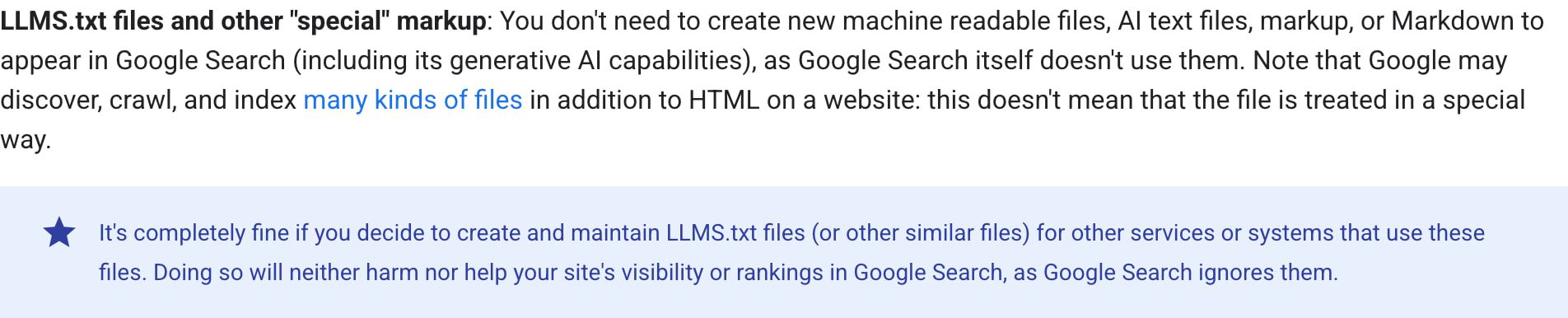
That’s Google Search. Google’s AI features page says there are no additional requirements to appear in AI Overviews or AI Mode, and doesn’t mention llms.txt. I found no statement about the Gemini app. For what Google does say about choosing sources, see how AI Overviews pick the pages they cite.
Google’s John Mueller has said more, but his comments aren’t policy. On Bluesky in June 2025 he wrote “FWIW no AI system currently uses llms.txt” (Search Engine Roundtable), and by June 2026 he was calling it speculative for now on Reddit (Search Engine Journal). The guide is the policy.
Two oddities. Google put llms.txt files on its own developer sites in December 2025 and removed the Search docs copy within about a day. Mueller said it came from a sitewide CMS change and to assume the files exist for other purposes (Search Engine Roundtable).
And Chrome’s Lighthouse has an llms.txt audit under Agentic Browsing, which Search Engine Journal described in May 2026 as experimental (Search Engine Journal). A server error is flagged, and a 404 is not applicable because the file is optional at the moment (Chrome docs).

The docs frame this as browser-agent readiness, not search, and don’t say whether it feeds a score. So it’s a retrievability check, and I wouldn’t read it as a penalty.
| Who | What they say about llms.txt |
|---|---|
| Google (AI guide and AI features page) | Search ignores it; neither harm nor help; no additional requirements for AI Overviews or AI Mode. Both pages are undated |
| Google's John Mueller | No AI system currently uses it (Jun 2025); speculative for now (Jun 2026). One employee, not policy |
| OpenAI | Documents OAI-SearchBot, GPTBot and ChatGPT-User; nothing on llms.txt behaviour |
| Anthropic | Documents ClaudeBot, Claude-User and Claude-SearchBot; nothing on llms.txt |
| Perplexity | Documents PerplexityBot and Perplexity-User; nothing on llms.txt |
| Microsoft or Bing, Gemini app | No statement found |
| llmstxt.org | A proposal; says coding agents use it reliably, with no data |
Source: Pages read 24 Nov 2026. Perplexity and Anthropic each publish an llms.txt for their own docs, which I opened; that isn't a statement about what their answer systems read. Scroll sideways for more columns.
Do AI bots even read the file? #
In the largest sample I read, mostly no: Ahrefs found 97% of valid files got zero requests in May 2026. Smaller samples show OpenAI’s bots fetching it, so the answer depends on whose logs you read.
Ahrefs looked at 137,210 domains with traffic in May 2026, and 28% had a valid file. Of those, 97% got no requests, and the other 3% (about 1,100 domains) drew about 22,000 requests (Ahrefs).
Ahrefs puts AI retrieval bots at about 1.1% of requests (its article states the base both ways, total requests and AI bot requests), and says Slackbot fetched files more often than PerplexityBot. Ahrefs sells AI visibility tools, and its own explainer says there’s no evidence llms.txt improves AI retrieval or traffic (Ahrefs).
Smaller checks point both ways, and none is big enough to settle it. They come from Complete SEO, Evil Martians, Wix Studio, Semrush and an IETF draft, and they’re in the table below. Reboot Online also saw no bot visits to eight pages listed only in llms.txt on two UK sites (Reboot).
| Study | Population | What it found | Whose claim |
|---|---|---|---|
| Ahrefs, May 2026 | 137,210 domains | 97% of valid files had zero requests; retrieval bots about 1.1% of requests | Ahrefs, own data |
| Evil Martians, Sep-Oct 2026 | One site, about 62,000 agent requests | 593 direct fetches of llms.txt or llms-full.txt (170 of them classed as agent reads); 43 of the 47 from named AI assistants were Claude Code | Agency, own site |
| Complete SEO, 2026 | 6,455 plugin sites, opted in | OAI-SearchBot visited /llms.txt on 8.5% of crawled sites, GPTBot 8.4%; most bots fetched once and didn't return | Plugin vendor |
| Wix and Archer | 7 sites, 3 months | OpenAI's Searchbot 5,000+ fetches, mostly 16-24 July (the page doesn't state the year) | Wix, one company |
| Semrush, Aug-Oct 2025 | 1 sister site | GPTBot, PerplexityBot, ClaudeBot, Google-Extended: none | Semrush |
| IETF draft, Oct 2026 | 1 site, 15 days | 0 of 46,155 crawler requests, but the files existed only the last 3 days | One operator |
Source: Studies read 24 Nov 2026. Samples differ, so the rows aren't a ranking of bots. Scroll sideways for more columns.
The populations differ: a big mixed sample, an opt-in plugin sample and one-company logs. I can’t resolve it, so there’s no bot ranking here. A fetch isn’t a read, and a read isn’t a citation.
Does having one change who gets cited? #
No study I read shows it does. SE Ranking and Search Atlas found no meaningful link, and Seer found 73 answers citing an llms.txt URL in about 9.2 million.
All three come from vendors, and I trust them only as far as their methods go.
| Study | Method | Finding | Whose claim |
|---|---|---|---|
| SE Ranking | Nearly 300,000 domains; correlation and XGBoost model | No measurable link to domain-level citations; the model got more accurate without the variable | SE Ranking, rank tracker vendor |
| Search Atlas | 13,911 domains; 83,387 visibility records across six AI platforms | Median difference +0.42 on a 0-100 scale; sign flipped between 90- and 180-day cohorts | Search Atlas, sells an LLM visibility product |
| Seer | About 9.2 million AI answers across 100 client data sets | 73 cited an llms.txt URL, mostly developer docs; 15 were Gemini inventing a path | Seer, GEO agency |
Source: SE Ranking page dated 15 Oct 2026 (Search Engine Journal covered the study on 20 Nov 2025), Search Atlas updated 19 Jun 2026, Seer 10 Nov 2026; all read 24 Nov 2026. Scroll sideways for more columns.
SE Ranking says the file might add more noise than value, but it doesn’t say which AI models it covered or the dates, so I can’t judge how current the result is (SE Ranking; Search Engine Journal). Search Atlas notes its own cohort isn’t random and the design is cross-sectional (Search Atlas).
Seer’s own client tests of llms.txt were 0 for 2 (0 for 3 counting a head-to-head test), and the better-controlled ones had only two to three weeks of post-launch data (Seer). Fifteen of its 73 citations were Gemini inventing a /llms.txt path on a domain, so they say little about files being read.
None of these can show cause, in either direction. I found no controlled before-and-after test showing a lift, which isn’t the same as proving a small effect is impossible.
The usual evidence is weak too. Mark Williams-Cook invented a fake “cats.txt” standard, and it passed the four kinds of evidence cited for llms.txt: bots requested it, Google indexed it, AI answers repeated its details and ChatGPT said it could help. His point is that each of those would happen whether or not the standard works (Search Engine Journal).
Contentful and Similarweb point the same way, but they’re vendors and add no log or citation data I could check, so I don’t count them as extra evidence.
What does the score in my SEO tool measure? #
Mostly whether a file exists or can be fetched. Semrush flags a missing file and counts llms.txt toward a score, while its own blog says it found no correlation with AI results.
Semrush added an AI Search category to Site Audit in July 2025, with a check for a missing llms.txt (Semrush newsroom). Its AI Search Health score also takes in AI bot access, such as robots.txt blocking OAI-SearchBot, and a technical readiness group that lists llms.txt next to schema markup and internal links. I cover whether schema markup earns AI citations separately. Weighting isn’t disclosed (Semrush KB).
Then there’s the same company’s blog, which says there’s no proof the file helps, and that it found no correlation between adding one and better AI results. It calls it a low-cost experiment, not a requirement (Semrush blog).
| Tool | What it checks | Does it score it? | Its own caveat |
|---|---|---|---|
| Semrush Site Audit | Flags a missing llms.txt | Feeds AI Search Health; weighting undisclosed | Semrush's blog found no correlation with AI results |
| Chrome Lighthouse | Whether the file can be retrieved; a 404 is not applicable | Not stated in the docs | Docs say providing the file is optional at the moment |
| Yoast, Rank Math, AIOSEO, Wix | They generate the file | No score described | Rank Math says adoption is still limited |
| Free online checkers | Presence, going by their search listings | Unverified | One page blocked my tools, so I can't describe it |
Source: Vendor pages read 24 Nov 2026. No free checker's scoring page was read. Scroll sideways for more columns.
The generators are the other half. Yoast’s press release says its generator raises the odds your brand’s voice appears in AI answers (Yoast). Rank Math says curating the file improves your chances of being cited properly, and also says adoption is still limited (Rank Math).
AIOSEO says the files show AI search engines the best of your site, with no metrics (AIOSEO). Wix is more careful: it generates the file automatically once you upgrade the site and connect a custom domain, and says only that it can help AI agents understand the business (Wix help).
Those are vendor claims, and no study I read backs the citation wording. I wouldn’t pay for a fix that only checks the file exists.
So is it worth 30 minutes? #
For a marketing site, only if your plugin or builder already makes the file: leave it on and check it lists current pages. For a docs or API site, yes. Don’t pay for fixes. This is my reading, not something any study states.
Leaving it on costs close to nothing and Google says it won’t harm you. The one reason to spend time is a stale file that lists moved or deleted pages.
For docs and developer sites there’s a reason to bother. The only named-assistant fetches I found were coding agents, in one agency’s logs, and the proposal’s author claims coding agents use these files reliably without publishing data. It’s thin evidence, so I’d cap it at 30 minutes.
| Your situation | What I would do | Why |
|---|---|---|
| Marketing or ecommerce site on a plugin or Wix that makes the file | Leave the generated file on; 30 minutes to confirm it lists current pages | Costs little, Google says no harm; expect no citation change |
| Docs, API or developer-product site | Publish one and keep it current, 30 minutes | Coding agents are the only named fetchers I found |
| About to pay for a fix, or rewrite content for it | Skip | No study shows a lift and Google says Search ignores it |
| You want more citations | Check crawler access and indexability first | Documented controls, unlike llms.txt |
Source: My reading of the evidence read 24 Nov 2026, not a published rule. Scroll sideways for more columns.
What would I do with the 30 minutes instead? #
Check that you aren’t blocking the crawlers that decide whether you can appear: OAI-SearchBot, Claude-SearchBot and PerplexityBot, plus indexable, snippet-eligible pages for Google. These are documented controls, which llms.txt isn’t.
- ChatGPT: OpenAI says OAI-SearchBot surfaces sites in ChatGPT search, and a site opted out of it won’t be shown in ChatGPT search answers, though it can still appear as navigational links. GPTBot is about training, and ChatGPT-User isn’t used to decide whether content appears in Search (OpenAI).
- Claude: Anthropic separates ClaudeBot (training), Claude-User (user-directed fetches) and Claude-SearchBot (search quality). It says blocking the last two may reduce your visibility (Anthropic).
- Perplexity: PerplexityBot is the one designed to surface and link sites in results. Perplexity-User is user-triggered and generally ignores robots.txt (Perplexity).
- Google: pages need to be indexed and eligible to show with a snippet (Google).
Mueller made a similar point on Reddit: the most basic agent optimization is not blocking agents (Search Engine Journal). It’s his comment, not Google policy.
Check robots.txt and your firewall or CDN rules together, because a bot allowed in one place can be stopped in the other. My post on whether to allow Google-Agent through your firewall covers one such case, and how to see AI agent traffic on your site shows what to look for afterwards.
Then work on what changes mentions: getting your brand mentioned in ChatGPT answers and how to measure AI visibility, with the rest of the topic in the AI visibility hub.
What couldn’t I confirm? #
- No AI company says it uses the file. I found no such statement from OpenAI, Anthropic, Perplexity, Google (Gemini app) or Microsoft. That’s “none I found”, not proof that none does.
- Nobody has shown cause. The citation work is correlation or counting, from vendors who sell related products.
- The logs disagree and I can’t settle it.
FAQ
Does Google use llms.txt?
No. Google's AI optimization guide says creating llms.txt files is fine but will neither harm nor help your visibility or rankings in Google Search, because Google Search ignores them. That covers Search; I found no statement about the Gemini app.
Does ChatGPT read llms.txt?
OpenAI's bots page describes OAI-SearchBot, GPTBot and ChatGPT-User and says nothing about llms.txt behaviour. Logs are mixed: opted-in WordPress plugin sites saw OAI-SearchBot visit the file on 8.5% of the sites it crawled, while Ahrefs found retrieval bots made about 1.1% of requests in its much larger sample. A fetch isn't a citation.
Do Perplexity or Claude use it?
Their crawler pages say nothing about llms.txt. Both Perplexity and Anthropic publish the file for their own developer docs, which isn't a statement that their answer systems read yours.
Did any study find llms.txt increases citations?
None I read. SE Ranking and Search Atlas both found no meaningful link between having the file and being cited, and Seer found 73 answers citing an llms.txt URL in about 9.2 million. All three are vendor studies, and none can show cause.
Will it hurt if I add one?
Google says it won't harm your Search visibility. The practical risk, in my reading, is a stale file that keeps listing pages you've moved or deleted, so check it lists current URLs.
What does the llms.txt check in Semrush or Lighthouse mean?
Presence or retrievability, not citation results. Semrush Site Audit flags a missing file and counts llms.txt in its AI Search Health score, while Semrush's own blog says it found no correlation with AI results. Lighthouse's audit checks that the file can be retrieved and treats a 404 as not applicable.
Should I block or allow AI crawlers instead?
Allow the search crawlers you want to appear in. OpenAI says sites that opt out of OAI-SearchBot won't be shown in ChatGPT search answers, though they can still appear as navigational links, and Anthropic says blocking Claude-SearchBot may reduce visibility.
Sources
37 sources, accessed .
Official pricing, docs, changelogs and status pages 16
- Google Search Central: AI optimization guide (undated)
- Google Search Central: AI features and your website (undated)
- Chrome for Developers: Lighthouse llms.txt audit
- OpenAI: crawlers and user agents (OAI-SearchBot, GPTBot, ChatGPT-User)
- Anthropic support: does Anthropic crawl data from the web and how can site owners block the crawler
- Perplexity docs: crawlers (PerplexityBot, Perplexity-User)
- Perplexity's own llms.txt for its docs
- Anthropic's own llms.txt for its developer docs
- llmstxt.org: the proposal (Jeremy Howard, 3 Sep 2024; modified 10 Aug 2026)
- llmstxt.org: changes in version 2
- Wix help: understanding your site's llms.txt file (updated 9 Sep 2026)
- Yoast: llms.txt generator launch, press release (June 2025)
- Rank Math knowledge base: LLMS Txt module
- AIOSEO: llms.txt feature page
- Semrush newsroom: optimize for AI search with Site Audit (July 2025)
- Semrush knowledge base: AI Search Health in Site Audit
Independent benchmarks and published studies 11
- Ahrefs: llms.txt study of 137,210 domains, 15 Jun 2026 (Ahrefs sells AI visibility tools)
- Evil Martians: which AI actually reads your site, logs from the agency's own site (Sep-Oct 2026)
- Complete SEO: are AI bots reading llms.txt files, 6,455 plugin sites (14 Jun 2026; the vendor sells AI SEO services)
- Wix Studio AI Search Lab: are AI bots crawling llms.txt files, Archer Education case study
- Semrush blog: llms.txt, 28 Sep 2026 (includes its own log check on a sister site)
- Reboot Online: llms.txt experiment on two UK sites (the agency sells GEO services)
- SE Ranking: does llms.txt impact your AI visibility and citations, dated 15 Oct 2026
- Search Atlas: the limits of /llms.txt for AI search, updated 19 Jun 2026
- Seer Interactive: llms.txt vs an AI info page, 10 Nov 2026
- Common Crawl: a content analysis of llms.txt files from the July 2026 crawl, 31 Aug 2026
- Originality.ai: llms.txt adoption tracker (July 2026)
News and press 6
- Search Engine Roundtable: Google's John Mueller on llms.txt (June 2025)
- Search Engine Journal: Google on llms.txt, from Mueller's Reddit comments (June 2026)
- Search Engine Roundtable: llms.txt files on Google's developer sites, 6 Jan 2026
- Search Engine Journal: Google's llms.txt guidance depends on which product you ask, 20 May 2026
- Search Engine Journal: llms.txt shows no clear effect on AI citations, 20 Nov 2025
- Search Engine Journal: how cats.txt showed llms.txt evidence is weak, 7 Aug 2026
Other blogs 3
Last updated: 24 November 2026. Evidence verified 24 Nov 2026. Researched and drafted with AI tools; owner review is pending.


