Should you allow Google-Agent through your firewall?
Google published how to allow Google-Agent through your CDN or firewall. What it says, what it leaves out, and when letting AI agents in makes sense.

Short on time?
Short on time? Here's what I would do.
- You sell online
- Allow verified Google-Agent
- User agent plus an IP in Google's list, plus the signature if your provider checks it. Never the user agent alone.
- You run a content or lead-gen site
- Keep your rules, read your logs first
- No source I read shows what allowing costs or earns you. Learn how much agent traffic you get first.
- Your terms say 'ask first'
- Settle the terms before the firewall
- That's a legal and risk decision. A firewall guide doesn't make it for you.
- You saw 'Blend: 29 of 200 stores block agents'
- Don't use it as proof about Google or OpenAI
- Its test browser wasn't Google-Agent or ChatGPT's agent.
Prices verified . Facts verified 23 Nov 2026. No vendor paid to be included, and sponsors can't buy a verdict.
On 17 November Google published a guide to letting Google-Agent through your CDN or firewall. The agent isn’t new: Google’s changelog added the user agent on 20 March, and the 17 November entry is the how-to guide.
Four days earlier, OpenAI warned that some sites “may unintentionally block purchases through ChatGPT Wallet” (OpenAI), while United’s terms, as trade press describes them, went the other way. I read all three to work out whether you should let AI agents in.
What did Google publish? #
A help page on allowing Google-Agent, the name for agents hosted on Google’s infrastructure that “perform actions upon user request”. Allowing it in a CDN, WAF or bot-detection service, Google says, stops legitimate requests being blocked while your existing security controls stay in place (Google).
Search Engine Roundtable notes Google-Agent “is not new”. No Google page I read names the product behind it, and PPC Land says the guide leaves traffic volumes open.
How do I know it’s really Google? #
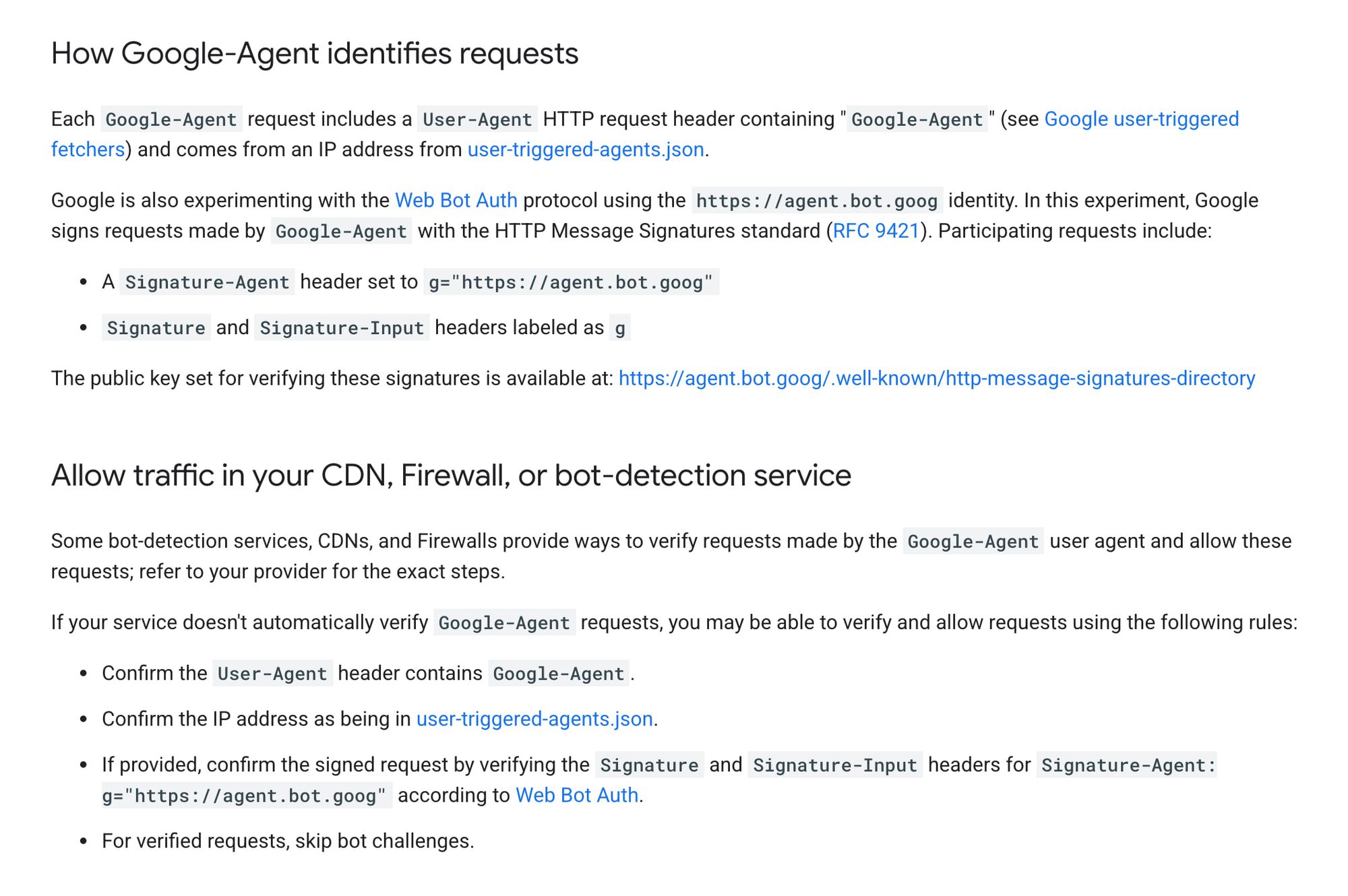
Check three things: the user agent contains “Google-Agent”, the IP is in Google’s published list, and any Web Bot Auth signature verifies. Only then skip bot challenges, which is Google’s fourth step. Google’s fetcher page says the user agent string “can be spoofed”, so the first check alone proves nothing.
The signature is experimental, with identity https://agent.bot.goog. The IP file changes: on 23 November its creationTime read 2026-11-20T15:45:49 and it held 20 prefixes (12 IPv4, 8 IPv6), so a rule you copy once will go stale.
Does robots.txt control it? #
Probably not. Google’s fetcher page says that “because the fetch was requested by a user, these fetchers generally ignore robots.txt rules”, and the new allow guide doesn’t mention robots.txt at all.
My reading, from those two pages, is that your CDN or firewall decides access, and PPC Land reaches the same conclusion. Training crawlers are a separate question: see the AI training opt-out.
What usually stops it getting through? #
Google lists six failure points in its guide. In my words:
- Rule order: the allow rule must run before broad cloud or data-centre blocks, managed bot rules and AI-agent category blocks.
- Challenges: skip HTTP blocks, JavaScript challenges and CAPTCHAs, including on search and form submission.
- The whole shopping path: search, filtering, product pages, add-to-cart, booking and the XHR, GraphQL and
api.*calls behind them. - Rate limits: exempt verified ranges, because many users share one egress pool.
- IP list upkeep: keep your rules in sync with the file.
- Proxies: they must pass on the client IP, user agent and signature headers.
Are other agents different? #
Yes, each says who it is in its own way. OpenAI’s cloud-browser page says ChatGPT uses Web Bot Auth to identify certain automated browser requests, and that “Akamai, Cloudflare, HUMAN, and Vercel verify ChatGPT request signatures automatically”.
| Agent | How to recognise it | How to verify it |
|---|---|---|
| Google-Agent | User agent contains "Google-Agent" | IP in user-triggered-agents.json; signature (agent.bot.goog) if present |
| ChatGPT cloud browser | Signed requests with Signature-Agent set to "https://chatgpt.com" | Your CDN checks the signature; Akamai, Cloudflare, HUMAN and Vercel do it automatically, per OpenAI |
| Meta Muse | No published user agent to name in robots.txt, per SEJ citing Slobodan Manic | Not established; SEJ says access comes down to your terms and bot protection |
Source: Google Search Central, OpenAI developer docs, Search Engine Journal SEO Pulse (21 Nov 2026). Verified 23 Nov 2026. Scroll sideways for more columns.
OpenAI says an exception “can apply site-wide” and to “keep your existing page-level access controls in place”. Cloudflare’s docs describe Web Bot Auth generally and don’t mention either company’s agent.
ChatGPT Wallet is narrow so far. OpenAI announced it on 13 November, initially through dots for US ChatGPT Pro subscribers aged 18 or over with eligible US-issued cards, and PPC Land quotes the merchant playbook: websites “need to ensure agents are not inadvertently blocked” (second report).
Is blocking agents costing stores sales? #
No one I read has measured it. The number going around is Blend Commerce’s audit: 29 of 200 UK and US retailers refused its test browser on two attempts, and the refusals came “from bot protection”. Blend is a Shopify agency; it tested on 8 to 15 September and the page is dated 20 November.
That browser was an unmodified Chromium that, Blend says, did not pose as a crawler or an AI company’s agent. So the test shows bot protection turning away an unfamiliar automated visitor, not that Google-Agent or ChatGPT is blocked. PPC Land adds that Blend’s scoring weights are unpublished and no refusing retailer commented.
United goes the other way. SEJ describes its updated terms as requiring written permission for any AI agent that searches, books or buys, while PPC Land quotes a rule barring AI agents from making, changing or servicing a ticket. I couldn’t open United’s page, so I can’t say which wording is closer.
Who should let agents in? #
It depends on what an agent does on your site, and the table below is my reading, not a study result. Google’s guide covers search, filtering, add-to-cart and booking, which is why sellers are the clearest case.
| Your site | My pick | Why | Who to ask |
|---|---|---|---|
| You sell online (shop, bookings, tickets) | Allow verified agents, keep challenges for the rest | Google lists challenges on search and forms as a failure point; OpenAI warns sites can block purchases unintentionally | Your developer, the CDN account holder, your payments or fraud provider |
| Content or lead-gen site | Keep current rules, check logs first | I found no data on what allowing costs or earns here | Whoever owns analytics and server logs |
| Your terms say 'ask first' | Settle the terms first | A legal and risk decision; SEJ and PPC Land describe United's terms differently | Legal, then security |
Source: My reading of Google Search Central, OpenAI developer docs, SEJ and PPC Land. Verified 23 Nov 2026. Scroll sideways for more columns.
OpenAI’s Wallet announcement also says risk systems may still flag legitimate agent purchases, leading to declines or cancellations, and tells businesses to work with their payment and risk providers, so a US seller should add its payments contact.

What would I do this week? #
If you sell online, ask your developer for an allow rule for verified Google-Agent. Pair it with the check Google describes, and leave challenges on for everything unverified.
- Ask your CDN or bot provider whether it verifies Google-Agent automatically. Google says to follow its instructions if so.
- If it doesn’t, write the rule on user agent plus Google’s IP list, add the signature check if you can, and place it before broad bot blocks.
- Put a refresh date on the IP list. It changed as recently as 20 November.
- Ask your payments provider about ChatGPT Wallet if you sell to US shoppers.
- Check your logs before deciding anything else, using my guide to AI agent traffic.
I found no source showing that allowing agents earns AI recommendations. For that side, start at my AI visibility hub, how AI visibility tools work and whether ChatGPT Business Hub replaces your tracker.
FAQ
What is Google-Agent?
Google's name for agents hosted on its infrastructure that browse the web and act when a user asks. Its fetcher page lists it, and the user agent was added to Google's docs on 20 March 2026. No Google page I read says which product uses it.
Is the Google guide new?
The guide is: Google's changelog dates 'Added guidance on allowing Google-Agent' to 17 November 2026. The user agent isn't, because the same changelog added it on 20 March 2026.
Does Google-Agent follow robots.txt?
Google's fetcher page says that because a user requested the fetch, these fetchers 'generally ignore robots.txt rules'. The new allow guide doesn't mention robots.txt, so reading that as a firewall question is my own inference.
How do I tell real Google-Agent traffic from fake?
Check that the user agent contains 'Google-Agent', that the IP is in Google's user-triggered-agents.json file, and, if the request carries one, that the Web Bot Auth signature verifies. Google says the user agent string can be spoofed, so never rely on it alone.
Does ChatGPT's agent need a separate rule?
OpenAI says its signed cloud-browser visits can be allowed with a site-wide exception, and that Akamai, Cloudflare, HUMAN and Vercel verify the signatures automatically. Other providers verify manually with OpenAI's public key.
Does blocking agents lose sales?
No study I read measured it. Blend, a Shopify agency, found 29 of 200 retailers refused an unmodified Chromium test browser, which was not Google's or ChatGPT's agent.
Sources
16 sources, accessed .
Official pricing, docs, changelogs and status pages 7
- Google Search Central: Allow Google-Agent traffic
- Google Search Central: user-triggered fetchers (Google-Agent row)
- Google Search Central: crawling infrastructure changelog
- Google: user-triggered-agents.json IP ranges
- OpenAI: Introducing ChatGPT Wallet, 13 Nov 2026
- OpenAI: help ensure cloud browser access to your site
- Cloudflare docs: Web Bot Auth
News and press 7
- Search Engine Roundtable: Google-Agent guide, 17 Nov 2026
- PPC Land: six ways sites still block Google's agent, 17 Nov 2026
- PPC Land: OpenAI hands agents a wallet (playbook sentence), Nov 2026
- PPC Land: ChatGPT Wallet without the real card number, Nov 2026
- PPC Land: bot protection blocks Blend's shopping agent at 29 of 200 retailers, 5 Nov 2026
- PPC Land: United bans AI agents from buying, 11 Nov 2026
- Search Engine Journal: SEO Pulse, 21 Nov 2026
Last updated: 23 November 2026. Facts verified 23 Nov 2026. Researched and drafted with AI tools; owner review is pending.


