AI Mode vs AI Overviews: what changes for tracking
AI Overviews show in normal results; AI Mode is a chat you pick. They cite different pages but report as one. Which should you track first?

Short on time?
Short on time? Here's my take.
- Most sites
- Track AI Overviews first
- They appear inside normal results for anyone who searches, and every tracker in my roundup records them.
- You sell something people research and compare
- Add AI Mode
- Google pitches it for 'complex comparisons', and it cites many pages AI Overviews don't.
- Both in one tracker
- SE Ranking Core
- $129 a month ($103.20 billed annually), verified 17 Nov 2026: an AI Overviews tracker plus a separate AI Mode tracker.
- Both on a budget
- Nightwatch Starter
- AI Mode and AI Overview on every plan; €79 a month billed yearly as shown to me on 17 Nov 2026.
Prices verified . Google pages and vendor pages verified 17 Nov 2026. No vendor paid to be included, and sponsors can't buy a verdict.
Your tracker says it covers “AI search”. Google runs two AI surfaces that cite different pages and still show up as one number in its own reports.
I read Google’s docs, help pages and earnings remarks, three vendor studies and five tracker pages to show how the two differ and which one to track first. My tracker rankings live in the rank trackers hub.
What’s the difference between AI Mode and AI Overviews? #
AI Overviews appear inside normal results when Google decides they help. AI Mode is a separate, chat-style search you choose, built for longer questions and comparisons.
Google says an AI Overview is “only shown when our systems determine that it is additive to classic Search”, while AI Mode “is particularly helpful for queries where further exploration, reasoning, or complex comparisons are needed” (Search Central). Its help page calls AI Mode “Google’s most powerful AI search experience”, reached through google.com/ai, the AI Mode button or the Google app (AI Mode help).
Searchers can’t switch AI Overviews off: “Features cannot be turned off”, though the Web filter shows only links (AI Overviews help). On mobile, “Show more” opens a view where you can ask follow-ups in AI Mode.
The line that matters most for tracking is Google’s own: “AI Mode and AI Overviews may use different models and techniques, so the set of responses and links they show will vary.” The AI Mode help page lists Gemini 4 Carbon and Gemini 4 Hydrogen as its models; what that change did to AI Mode data is in Gemini 4 Hydrogen in AI Mode.
| AI Overviews | AI Mode | |
|---|---|---|
| How you get it | Appears in normal results when Google judges it 'additive' | You choose it, or follow up from an AI Overview |
| Built for | A quick snapshot with links to dig deeper | 'Further exploration, reasoning, or complex comparisons' |
| How it searches | May use query fan-out | Fan-out by design; Deep Search can issue hundreds of searches |
| Answer length | Shorter; 1.3 entities on average (Ahrefs) | About 4 times longer; 3.3 entities (Ahrefs) |
| Links | No citation 11% of the time (Ahrefs); about 3 domains (Semrush) | Cited 97% of the time (Ahrefs); about 7 domains (Semrush) |
| Search Console position | All links share one position | Normal positions; a follow-up is a new query |
| Generative AI report | Combined with AI Mode | Combined with AI Overviews |
| GA4 AI Assistant channel | Excluded; lands in Organic Search | Excluded; lands in Organic Search |
Source: Google Search Central, Search, Search Console and GA4 help; Ahrefs (Dec 2025) and Semrush (Jul 2025) studies. Verified 17 Nov 2026. Scroll sideways for more columns.
How does each one find its sources? #
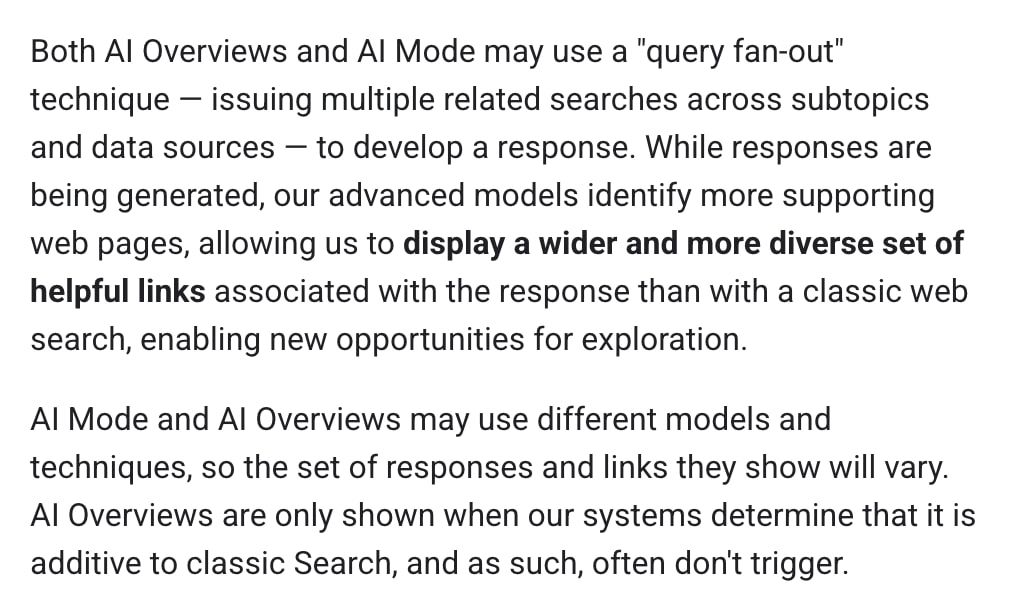
Both pull pages from Google’s index through its core ranking systems, and both may fan a question out into related searches. AI Mode does it by design, and its Deep Search can run hundreds.
Google’s AI optimization guide says its AI features use “our core Search ranking systems to retrieve relevant, up-to-date web pages from our Search index”, and defines fan-out as “A set of concurrent, related queries generated by the model to request more information” (Google). The AI features doc says both surfaces may use it, “issuing multiple related searches across subtopics and data sources”.
At I/O 2025 Google described AI Mode’s version as “breaking down your question into subtopics and issuing a multitude of queries simultaneously on your behalf”, and said Deep Search “can issue hundreds of searches” (Google, May 2025). When AI Mode’s confidence is low, it “will provide a set of web links” instead of an answer.
Google also says “There are no additional requirements to appear in AI Overviews or AI Mode, nor other special optimizations necessary.” My reading: you don’t optimize for each one separately, but you do have to measure them separately. What Google has documented about which pages get picked is in how AI Overviews choose their sources.
Do they cite the same pages? #
Mostly not, though the studies disagree on how much. Ahrefs found the same URLs only 13.7% of the time; Semrush counted a 58% URL overlap with a different method.
Ahrefs compared the two for the same US queries in September 2025, using 540,000 pairs for citations and 730,000 for similarity. They “cited the same URLs only 13.7% of the time”, yet scored “86% on average” for semantic similarity (Ahrefs, Dec 2025). Similar gist, mostly different sources.
Semrush’s study of 5,000 keywords on desktop, one snapshot, found that “AI Mode organic results showed a 58% URL intersection and 88% domain intersection with AI Overviews” (Semrush, Jul 2025). It doesn’t define “intersection” or give data dates, and adds that “correlation doesn’t confirm causation”.
Both are snapshots of a moving target. Ahrefs flags that it used single generations, and that 45% of AI Overview citations change between generations.
| Who | Published | Sample | Finding | Their stake |
|---|---|---|---|---|
| Ahrefs | 15 Dec 2025 | US, Sep 2025; 540,000 query pairs (citations), 730,000 (similarity); single generations | 13.7% same URLs; 86% semantic similarity; 3.3 vs 1.3 entities | Sells Brand Radar, an AI visibility tracker |
| Semrush | 21 Jul 2025 | 5,000 keywords, desktop, one snapshot | 88% domain and 58% URL 'intersection'; about 7 vs 3 unique domains | Sells the AI Visibility Toolkit |
| Otterly | Updated 5 Dec 2025 | 100 top German queries, Oct–Nov 2025; method not stated | AI Overview on 49 of 100; AI Mode on 100 of 100 | Sells an AI tracker covering both |
Source: Ahrefs, Semrush and Otterly study pages, read 17 Nov 2026. All three sell tracking tools. Scroll sideways for more columns.
My reading: they cite a lot of different pages, and how many depends on how you count. For tracking that’s enough to act on. A citation in one tells you little about the other.
Ahrefs found other patterns too. “61% of the time, AI Mode includes every entity that AI Overview mentioned, then adds more on top”, Quora showed up about 3.5 times as often in AI Mode, and videos about twice as often in AI Overviews.
Is Google merging the two? #
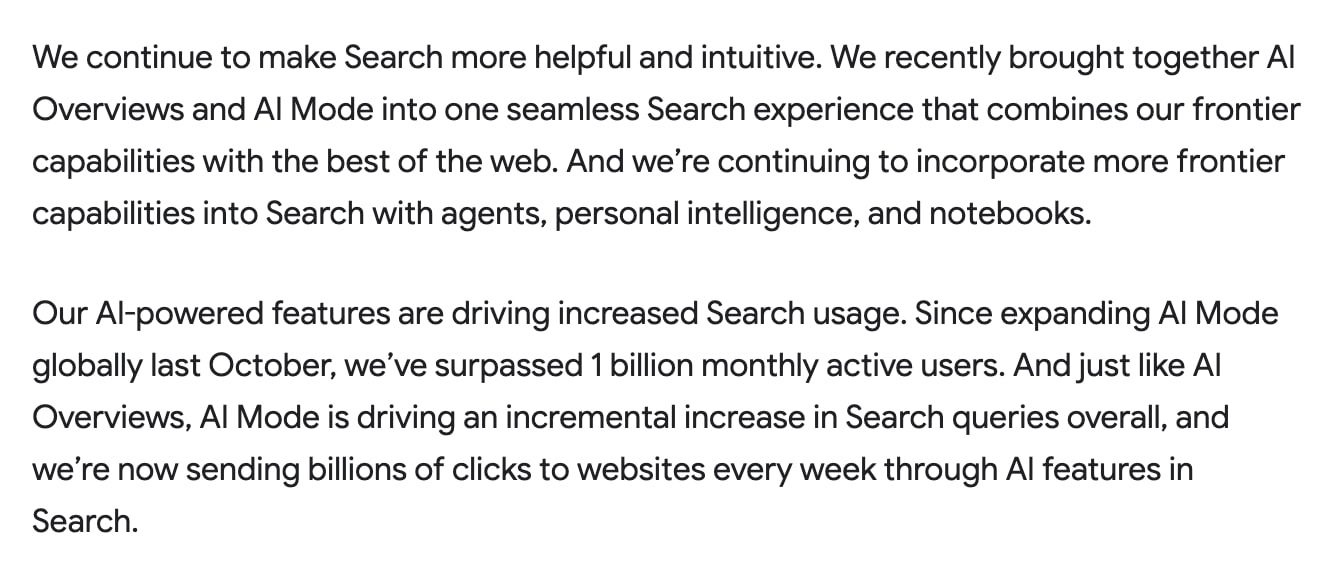
In the product, yes: you can ask a follow-up from an AI Overview and carry on in AI Mode, and Google now describes them as one Search experience. In the reporting, no.
At I/O 2026 on 19 May, Google said “You can easily ask a follow-up question right from an AI Overview, and flow into a conversational back and forth with AI Mode”, and that AI Mode “has surpassed one billion monthly users” (Google, May 2026). In Google’s Q2 2026 CEO remarks on 22 July, the line was “We recently brought together AI Overviews and AI Mode” into a single Search experience (Alphabet Q2 2026).
This was the plan from the start: at I/O 2025 Google said “we’ll graduate many features and capabilities from AI Mode right into the core Search experience”. The Q3 remarks on 28 October added that AI Mode queries “are on average three times longer than traditional searches” and that “one in five AI Mode searches globally use voice, images, or documents” (Alphabet Q3 2026).
My reading: long, multimodal questions don’t fit a keyword list, so AI Mode is better tracked with prompts than with keywords.
How does Search Console count each one? #
Both sit inside the Web search type. All links in an AI Overview share one position, AI Mode links get normal positions, and each AI Mode follow-up counts as a new query. Google has since added temporary threads to AI Mode, and SER reports a thread sidebar; I checked whether that changes what trackers record in does the AI Mode sidebar change your rank tracking.
Google’s help says “all links in the AI Overview are assigned that same position”, AI Mode positions follow the standard results-page method, and “If a user asks a follow-up question within AI Mode, they are essentially performing a new query” (Search Console help). Clicks on external links count in both, and “Search Console doesn’t include data from experiments in Search Labs.”
Glenn Gabe noted in 2025 that AI Mode is “mixed into the Performance reporting under the Web search type”, that follow-ups “essentially reset the position”, and that there’s “no indication in GSC that the query was part of a follow-up question” (GSQi). He argued AI Mode should have had its own search type.
The generative AI report, open to all sites since 31 August 2026, counts AI Overview and AI Mode impressions together, by page, country, device and date (Search Console help). So Dofollow Digest’s January line, “Neither gives you analytics data to distinguish between traditional search, AI Overviews, or AI Mode traffic”, is half out of date: AI impressions are now reported apart from classic results, but clicks and the split between the two aren’t (Dofollow Digest).
The full walkthrough is in how to read Search Console’s generative AI report.
Can GA4 tell them apart? #
No. GA4’s AI Assistant channel covers chat assistants such as ChatGPT and excludes Google’s AI Overviews and AI Mode, so clicks from both land in Organic Search with your other Google traffic.
Google’s help page, read in a browser on 17 November, says the channel covers “sources like ChatGPT, Gemini, Deepseek, Copilot, or Grok. It excludes Google’s AI Overviews and AI Mode.” Organic Search covers “non-ad links in organic-search results, including Google’s AI Overviews and AI Mode” (GA4 help).
So neither of Google’s free tools splits AI Overview visits from AI Mode visits. If you need that split, it has to come from a tracker that records each surface. The free sources that do exist, plus a monthly manual check, are in how to measure AI visibility.
Which tools track which one? #
Most AI Overview trackers I read now offer AI Mode too, often as a separate prompt allowance, and Semrush puts AI Mode prompts behind its AI toolkit or Semrush One.
| Tool, entry plan | AI Overviews | AI Mode | Price |
|---|---|---|---|
| Search Console | Impressions, combined with AI Mode | Impressions, combined with AI Overviews | Free |
| SE Ranking Core | Yes, AI Overviews tracker | Yes, separate AI Mode tracker | $129/mo ($103.20 billed annually), verified 17 Nov 2026 |
| Nightwatch Starter | Yes, on every plan | Yes, on every plan | €79/mo billed yearly as shown to me 17 Nov 2026; €99 monthly (13 Nov) |
| Semrush Position Tracking | Detected as a SERP feature | Prompts need the AI Visibility Toolkit or Semrush One | Toolkit $99/mo per domain, billed annually, verified 17 Nov 2026 |
| SE Visible Basic | Yes, as a prompt engine | Yes, as a prompt engine | $89/mo ($71 billed annually), verified 17 Nov 2026 |
Source: Vendor pricing, product and help pages, verified 17 Nov 2026; Nightwatch's monthly price from my 13 Nov roundup. Scroll sideways for more columns.
SE Ranking’s AI Mode tracker counts “the number of brand mentions and links to your domain in AI Mode answers” and “the average position of your brand’s links”, captured “directly from live AI Mode conversations”, with AI Overviews in a separate tracker (SE Ranking). Core is $129 a month, $103.20 billed annually (pricing).
Nightwatch lists “ChatGPT Gemini Perplexity AI Mode AI Overview” on Starter, Professional and Agency; Starter covers 500 keywords, 50 prompts and 1,500 AI answers, daily (Nightwatch). Its page showed me euros, so I don’t convert.
Semrush’s Position Tracking spots SERP features “including AI Overviews”, but “Prompts to track in ChatGPT Search and Google AI Mode are available only with an AI Visibility Toolkit subscription or a Semrush One subscription” (Semrush KB). SE Visible Basic tracks 75 prompts daily on ChatGPT, AI Overviews, AI Mode, Gemini and Copilot (SE Visible).
All ten trackers I ranked, and how to spot one that only tracks AI Overviews under an AI Mode label, are in which rank trackers really track AI Overviews and AI Mode. For Semrush against Ahrefs, see Semrush AI toolkit vs Ahrefs Brand Radar.
Claims to read carefully (checked 17 Nov 2026)
- Ahrefs’ 61%, read as odds for your brand. One ranking guide turns it into the odds that a brand in an AI Overview also appears in AI Mode. Ahrefs measured something narrower: how often AI Mode includes every entity the AI Overview named.
- “AI Mode appears for all search queries.” SE Ranking’s FAQ says so. AI Mode answers what you type into it, but Google says it may return “a set of web links” when confidence is low.
- No separate analytics for either. Impressions now have their own report, combined for both; clicks don’t.
- Otterly’s citation totals. 30,353 AI Mode citations against 2,498 for AI Overviews, from 100 German queries with no method given (Otterly). I wouldn’t plan around one country’s sample.
Which one should you track first? #
AI Overviews, for most sites. They appear inside normal results for everyone who searches your keywords, and every tracker in my roundup records them. Add AI Mode if you sell something people research and compare.
- Most sites: AI Overviews first. That’s where the audience already is, and it fits the keyword list you track today. For how often they show at all, see how many searches show AI Overviews.
- You sell something people compare: add AI Mode. Google pitches it for “complex comparisons”, it passed a billion monthly users, and Ahrefs’ 13.7% means tracking AI Overviews alone would miss most of its citations.
- Both in one tracker: SE Ranking Core, $129 a month ($103.20 billed annually), verified 17 Nov 2026. It was my overall pick in the AI Overview tracker roundup, and the AI Mode tracker reports your links’ average position.
- Both on a budget: Nightwatch Starter, AI Mode and AI Overview on every plan, €79 a month billed yearly as shown to me (US price not re-checked). I compare it in Nightwatch vs AccuRanker.
- No budget: Search Console’s generative AI report. It’s free and Google’s own count, but it can’t split the two.
If you’re unsure whether you need AI numbers at all, rank tracking vs AI visibility sets them side by side.
FAQ
Is AI Mode the same as AI Overviews?
No. AI Overviews appear inside normal results when Google decides they help; AI Mode is a chat-style search you choose. Google says they 'may use different models and techniques', so their answers and links vary.
Do AI Mode and AI Overviews cite the same sources?
Often not. Ahrefs found the same URLs only 13.7% of the time; Semrush counted a 58% URL intersection with a different method. Both are single snapshots.
Can Search Console separate AI Mode from AI Overviews?
No. Both sit in the Web search type, and the generative AI report counts their impressions together.
How does Search Console count AI Mode positions?
Like a normal results page: each link gets its own position, and a follow-up question counts as a new query. All links in an AI Overview share one position.
Does GA4 show AI Mode traffic?
Not separately. GA4's AI Assistant channel excludes Google's AI Overviews and AI Mode; those visits land in Organic Search.
Does my AI Overview tracker cover AI Mode?
Check the plan. Nightwatch lists both on every plan, SE Ranking has a separate AI Mode tracker, and Semrush needs the AI Visibility Toolkit or Semrush One for AI Mode prompts.
How many people use AI Mode?
Google says more than 1 billion monthly users, at I/O 2026 and on its Q2 2026 earnings call.
Sources
23 sources, accessed .
Official pricing, docs, changelogs and status pages 16
- Google Search Central: AI features and your website
- Google Search Central: optimizing for generative AI features
- Google Search help: AI Mode
- Google Search help: AI Overviews
- Search Console help: how impressions, position and clicks are counted
- Search Console help: generative AI performance report
- Google Analytics help: default channel group (AI Assistant), read in Chrome
- Google: AI Mode at I/O 2025, 20 May 2025
- Google: Search at I/O 2026, 19 May 2026
- Google: CEO remarks, Q2 2026 earnings, 22 Jul 2026
- Google: CEO remarks, Q3 2026 earnings, 28 Oct 2026
- Nightwatch: pricing, shown in euros
- Semrush knowledge base: Position Tracking
- SE Ranking: AI Mode tracker
- SE Ranking: pricing (Core)
- SE Visible (SE Ranking): pricing
Other blogs 7
- Ahrefs (sells Brand Radar): AI Overviews vs AI Mode study, 15 Dec 2025
- Semrush (sells an AI toolkit): AI Mode comparison study, 21 Jul 2025
- Otterly (sells an AI tracker): German AI Mode vs AI Overviews study, updated 5 Dec 2025
- Glenn Gabe (GSQi): AI Mode in Search Console, updated Jun 2025
- Dofollow Digest #54 (newsletter): AI Mode vs AI Overviews, 9 Jan 2026
- Thrive (agency): AI Overviews vs AI Mode, 27 Aug 2026
- Conductor (sells SEO software): AI Mode explainer, updated 20 Aug 2025
Last updated: 17 November 2026. Facts verified 17 Nov 2026. Researched and drafted with AI tools; owner review is pending.


