How many searches show AI Overviews? About 40%, not 80%
The 'over 80%' headline leans on commercial and brand keyword lists. Panels of real searches say about 40%. Every number traced, and what to track.

Short on time?
Short on time? Here's my take.
- Quoting one number for all searches
- About 40% (Comscore, June 2026)
- 39.4% of Google desktop searches on Comscore's panel. The 80% describes keyword lists, not all searches.
- Your keywords are commercial or brand terms
- SE Ranking Core, tracking AI Overviews on every keyword
- Expect 80–90% of them to show one. Nightwatch is my pick on a tighter budget (verified 13 Nov).
- Mostly informational, local or EU keywords
- Two checks of your own list before you pay
- Shares run much lower for short, local and EU searches. If most of yours still show one, use the pick above.
Prices verified . Figures and Google's docs verified 17 Nov 2026. No vendor paid to be included, and sponsors can't buy a verdict.
A trade headline on 26 October said AI Overviews now show up on over 80% of Google searches. I traced every number behind it, and the answer depends on whose searches you count.
Below: each figure with its sample and date, why they disagree, and which one fits the keywords you track. For more numbers you can check and reuse, start at my data hub.
So is it really 80%? #
Not for all searches. The 80% comes from vendor keyword lists weighted to commercial and brand terms; the best mid-2026 panels of real searches put it near 40%.
Barry Schwartz of Search Engine Roundtable wrote that “AI Overviews now show up for over 80% of Google Searches”. He built that on three vendor sources: Semrush, SE Ranking’s “82.5% of US brand searches”, and seoClarity’s Mark Traphagen saying “over 62% of queries but it can be 55% to 84% depending on industry”. The post gives no country or device for the 80%.
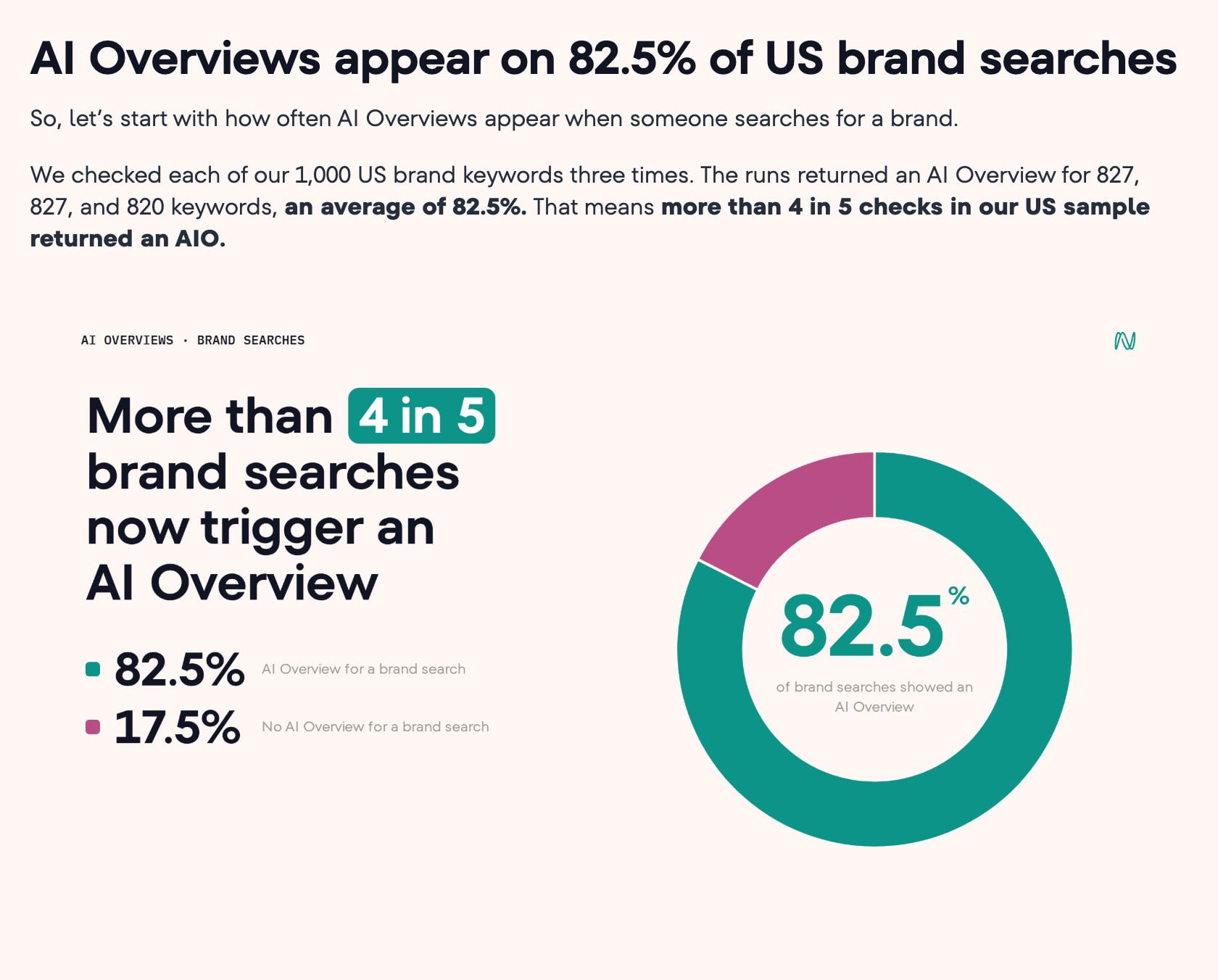
The two big numbers are real, just narrow. Semrush found AI Overviews on 88% of a fixed panel of 400 US desktop commercial keywords in August 2026 (Semrush). SE Ranking found 82.5% across 1,000 US desktop brand keywords in October (SE Visible).
Panels that watch what people actually search land lower. Comscore says “Google desktop searches with an AI overview grew from 25.8% in July 2025 to 39.4% in Jun 2026” (Comscore). SER’s own July post quoted Similarweb at “about 43% of all queries” (SER, 30 Jul).

SER’s trend line doesn’t hold up either. Its “up from 50% in June of last year” links to that 30 July 2026 post, and the “about 15%” before that links to an April 2025 post giving a range of “5% to over 30% of searches” (SER, Apr 2025). So I use dated rows instead of a line.
Where does each number come from? #
Eight sources publish a share. Seven fall in two families, panels of real searches and keyword or prompt lists a vendor chose; seoClarity counts searchers. Don’t average the rows; each one counts something different.
| Source | Share with an AI Overview | What was counted | Sample and place | Data from | Sells AI Overview tracking? |
|---|---|---|---|---|---|
| Pew Research Center | 18% | Real searches by a panel of people | 68,879 searches by 900 US adults | Mar 2025 | No |
| Comscore | 39.4% | Real Google desktop searches by its panel | Panel size and country not given in the release | Jun 2026 | No (sells measurement) |
| Similarweb (via SER) | About 43% | All queries, per SER's quote | Not stated in what I read | Quoted 30 Jul 2026 | Sells AI search data |
| seoClarity | More than 80% of searchers | Searchers who saw any AI-generated response (people, not searches) | 300+ client analytics accounts plus clickstream queries; country not stated | Nov 2026 (page updated 16 Nov 2026) | Yes |
| BrightEdge | About 48% | Keywords it tracks | Count, country and device not stated | Feb 2026 | Yes |
| SE Ranking (SE Visible) | 82.5% | Brand keywords, average of 3 checks | 1,000 keywords, US desktop | Oct 2026 | Yes |
| Peec AI | 86.7% | Prompts with buying intent | 500,000 prompts; country mix not stated | Apr 2026 | Yes |
| Semrush | 88% (97% by search volume) | Commercial keywords | 400-keyword fixed panel, US desktop | Aug 2026 | Yes |
Source: Each source's own page, except Similarweb (quoted by Search Engine Roundtable). Verified 17 Nov 2026. Scroll sideways for more columns.
For context, two broad 2025 lists found far less: Semrush saw AI Overviews on 15.69% of 10M+ keywords in November 2025, after 24.61% in July (Semrush study), and Ahrefs on about 16% of 156 million US keywords (Ahrefs). That isn’t the start of a line ending at 88%. The samples differ, so the numbers can’t be chained.
Why do the numbers disagree so much? #
Because they count different things: real searches by a panel of people, or a fixed list of keywords a vendor chose.
Semrush picked commercial modifiers on purpose: alternatives, “best X for Y”, price, reviews and brand vs brand, in banking, ecommerce and software. Weighted by search volume, coverage was 97.08%, and the 12% of keywords without an AI Overview were “less than 3%” of volume (Semrush).
SE Ranking used brand names. Peec counted 500,000 “business-oriented prompts, typically with clear buying intent”, with navigational searches left out, and found AI Overviews on 86.7% in April 2026 (Peec).
A panel records everything people type, including the short and navigational searches where AI Overviews are rarer (next section). In my reading, that’s most of the distance between 40% and 80%.
Who’s counting matters too. Every keyword-list source in the table sells AI Overview tracking, and the studies I read end with a pitch for it. That doesn’t make the numbers wrong; it’s a reason to read the sample line before the headline.
seoClarity shows how much the unit matters. Its report page, updated 16 November 2026, says “more than 80% of all searchers now experience an AI-generated response”, based on “300+ client analytics accounts” plus clickstream queries (seoClarity). That counts people who saw an AI answer at least once, not the share of searches that show one. The 62% is a figure Traphagen gave SER, and I couldn’t find a seoClarity study behind it.
BrightEdge sits in between: about 48% of the keywords it tracked in February 2026, so “approximately 52% of queries still have no AI Overview at all” (BrightEdge).
Does the kind of keyword change the odds? #
A lot. Longer and question-style searches trigger far more AI Overviews than one- or two-word ones, and country matters as much as wording.
- Length: Pew found AI summaries on “Just 8% of one- or two-word searches” against “53% for searches with 10 words or more”, and 60% for searches starting with a question word (Pew). Peec’s prompts ran from 64.6% at two words to 89.1% at 11–15 words (Peec research). How much those AI Overviews cost in clicks is a separate question: what the click studies say.
- Brand size and industry: in SE Ranking’s study, brands under 50,000 searches had one in all three checks 85.2% of the time against 63.3% for brands over 1 million, and industries ran from 92% (electronics) to 58.3% (food and beverages) (SE Visible).
- Country: Peec measured 76% inside the EU against 90.3% outside, with France at 0% (Peec). SE Ranking found 40.4% for German brand keywords against 82.5% in the US.
A list of short local terms in Germany will look nothing like a US list of “best X for Y” questions.
Do AI Overviews come and go? #
Yes. SE Ranking checked 1,000 US brand keywords three times in October, and 11.4% switched between showing an AI Overview and not.
87% had one in at least one check and 75.6% in all three; the 82.5% headline is the average of the three (SE Visible). In Germany, 22.2% switched. A single check of your list is a sample, not a rate, so check twice before you decide anything.
Does Google publish its own number? #
Google doesn’t publish a share. Its docs say AI Overviews show only when its systems judge them “additive to classic Search”, and that they “often don’t trigger”.
The full line: they “are only shown when our systems determine that it is additive to classic Search” (Search Central). Google’s help page adds that they appear “when our systems determine that generative AI can be especially helpful”, that “Features cannot be turned off”, and that the Web filter shows “only text-based links without features like AI Overviews” (Google help).
Keeping your own pages out of AI Overviews is a separate control with its own cost; I cover it in should you opt out of AI Overviews?
What would I do? #
Track AI Overviews on every keyword if your list is mostly commercial or brand terms. If it’s mostly informational, local or EU, measure your own share first.
- Export your tracked keywords and tag each one commercial, brand, informational or local.
- Check your tracker’s AI Overview or SERP-feature column on two dates a week apart. No tracker yet? Sample 50 keywords the same way.
- If most show an AI Overview in both checks, track AI Overviews on all of them. If it’s a minority, track only those.
For the tracker itself, my pick in which rank trackers really track AI Overviews is SE Ranking Core, with Nightwatch on a tighter budget (verified 13 Nov). SE Ranking also published the brand study above; I picked its tracker on features, not on that study. Plans are in SE Ranking pricing and Semrush pricing.
When you quote a number to a client, give its sample: “about 40% of Google desktop searches (Comscore, June 2026)” for the market, and your own two-check share for your list. For what AI Overview tracking adds next to AI visibility tools, see rank tracking vs AI visibility.
I’ll update this post when a newer panel figure comes out.
FAQ
What percentage of Google searches show an AI Overview?
About 40% on the best mid-2026 panel data. Comscore counted 39.4% of Google desktop searches in June 2026, and Search Engine Roundtable quoted Similarweb at about 43%. Vendor lists of commercial or brand keywords show 80–90%.
Where does the 'over 80%' figure come from?
From Search Engine Roundtable's 26 October summary of three vendor sources: Semrush (88% of 400 US commercial keywords), SE Ranking (82.5% of 1,000 US brand keywords) and a 62% figure seoClarity's Mark Traphagen gave SER. seoClarity's own report page has no 62% study; it now says more than 80% of searchers see an AI-generated response, which counts people, not searches.
Do branded searches show AI Overviews?
Often, in the US. SE Ranking found one on 82.5% of 1,000 US brand keywords in October 2026, averaged over three checks, but 40.4% of its German brand keywords. Smaller brands scored higher than the biggest ones.
Does Google publish how often AI Overviews appear?
No. Its docs say AI Overviews are shown only when its systems determine they're 'additive to classic Search', and that they 'often don't trigger'.
Why do AI Overview studies disagree so much?
They count different things. Panels record every search real people make, including short and navigational ones; vendor studies use fixed lists of commercial, brand or buying-intent keywords. Country, device and date differ too, so the rows can't be averaged.
Can I turn AI Overviews off?
Not as a searcher: Google's help page says 'Features cannot be turned off', though the Web filter shows only text links. Keeping your own site out of AI Overviews is a separate control, which I cover in my opt-out post.
Sources
16 sources, accessed .
Official pricing, docs, changelogs and status pages 2
Independent benchmarks and published studies 2
News and press 3
Other blogs 9
- Semrush (sells AI Overview tracking): AI Overviews on commercial keywords, 21 Oct 2026
- Semrush (sells AI Overview tracking): AI Overviews study, refreshed 15 Dec 2025
- SE Visible by SE Ranking (sells AI Overview tracking): AI Overviews on branded searches, 22 Oct 2026
- Peec AI (sells AI search tracking): 500,000 prompts and AI Overviews, 28 May 2026
- Peec AI research: how often AI Overviews appear
- BrightEdge (sells SEO software): AI Overviews one year on, 12 Feb 2026
- seoClarity (sells SEO software): AI search trend report, updated 16 Nov 2026
- Ahrefs (sells SEO tools): insights from 56 million AI Overviews, 2025
- Searchlab (SEO agency): AI Overviews statistics, updated 6 Nov 2026
Last updated: 17 November 2026. Facts verified 17 Nov 2026. Researched and drafted with AI tools; owner review is pending.


