Why your rank tracker shows junk results on page 2
Since mid-September, some rank trackers have logged unrelated Google results, mostly at position 9 and below. Who filters them, and what to check.

Short on time?
Short on time? Here's what I would do.
- Everyone
- A second check, then Search Console
- Don't report a drop at position 9 or lower until it repeats and, where there's data, Search Console agrees.
- Choosing or renewing a tracker
- AccuRanker
- The most detailed public account of how it re-fetches and rejects bad pages.
- Want a documented filter and fixed history
- SE Ranking
- Documents a filter, automatic rechecks and corrected history, by its own account.
- On Semrush or Nightwatch
- Ask support in writing
- Semrush says it added checks without detail; I found nothing public from Nightwatch.
- Agencies
- A one-line caveat in client reports
- Page-2 positions have been noisy since mid-September; show trends over several days.
Prices verified . Vendor statements read 16 Nov 2026. Every rate here is that vendor's own number. No vendor paid to be included, and sponsors can't buy a verdict.
If your rank tracker shows a keyword sliding off page 1 since mid-September, the drop may not be real. Several tracker vendors have recorded Google pages that don’t match the search, mostly at position 9 and below.
Here’s what their data says, which trackers say they filter it, and what to check before you report a drop. For trackers in general, start at my rank trackers hub.
What’s going on with page 2? #
Since mid-September, several tracker vendors have recorded Google results pages that don’t match the search. In SE Ranking’s study, 96.5% of the affected blocks began at position 9 or lower, 3.5% at 6 to 8, and none in the top 5.
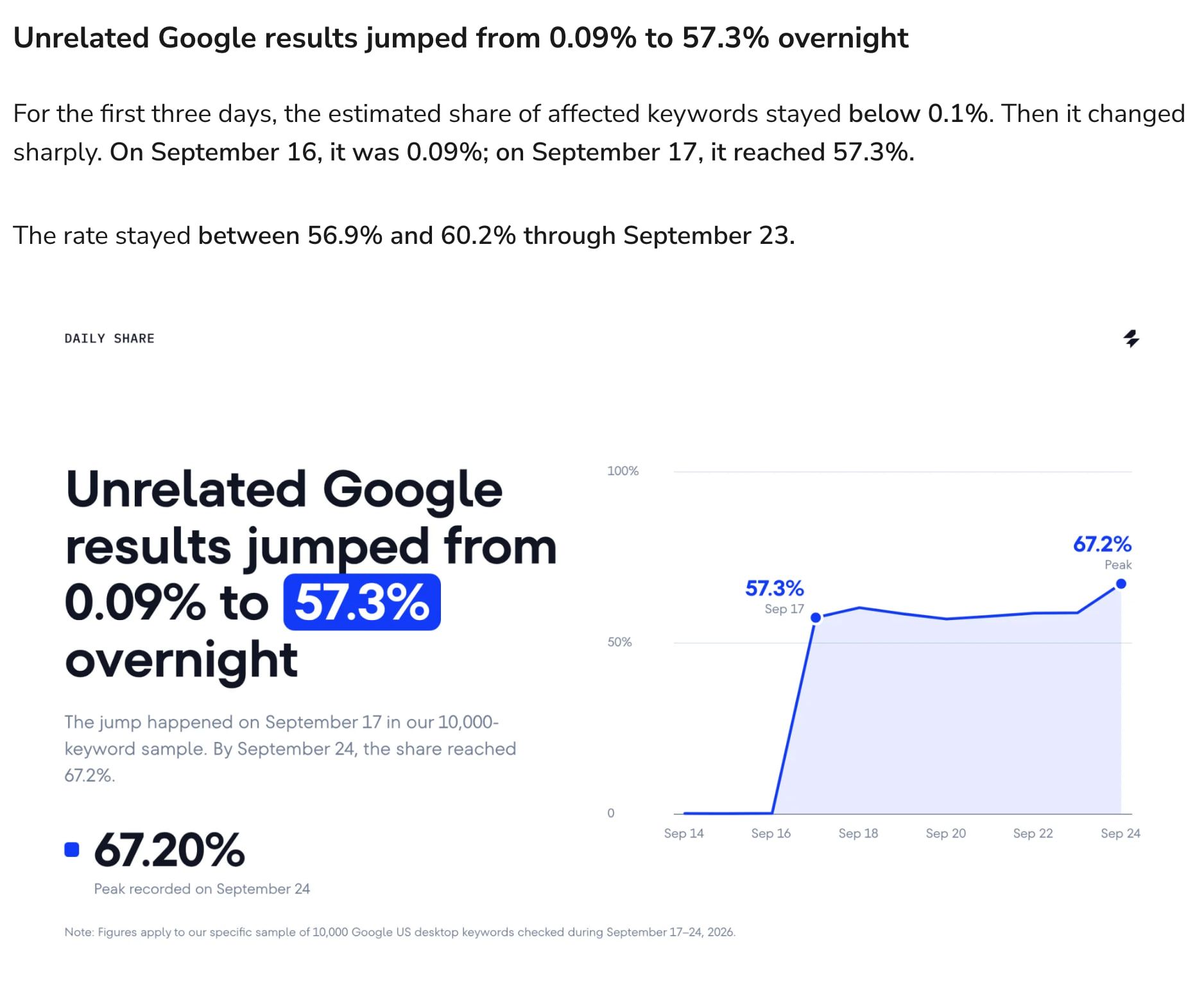
SE Ranking checked 10,000 US desktop keywords from its research index, not customer projects. Affected keywords jumped from 0.09% on 16 September to 57.3% on 17 September and peaked at 67.2% on 24 September; 84% of flagged cases matched just one word of the query (SE Ranking’s study of unrelated Google results).
The replacements skew toward a few big sites: Facebook appeared in 45.2% of flagged cases, Reddit in 41.3% and Instagram in 31.6%, in the same study.
Google hasn’t explained any of it. Search Engine Journal says “Google hasn’t publicly explained the results”, and PPC Land says Google has made no public statement. I won’t guess at a reason either.
For context only: Google’s spam policies class automated rank checks without express permission as machine-generated traffic. Google hasn’t linked that policy to these pages.
Is it all the same problem? #
No. Nozzle sees two faults: “poisoned” pages that answer your full query but swap the usual sites for unfamiliar ones, and pages where Google answers only one word of it (Nozzle).
Both can show up in a tracker as the same sudden drop. The difference matters when you check: a one-word page gives itself away when you look at it, while a poisoned page answers your query, so it’s harder to spot.
Nozzle’s data comes from keywords its customers track, across 52 countries on desktop, iPhone and Android. One-word pages hit page 2 from 16 September and page 1 from 20 September (Nozzle). Separately, Nozzle says page 2 is poisoned about 1.5 times as often as page 1 (Nozzle).
Older guides, like Morningscore’s from March, blame sync timing, Google tests, location and personalisation when a tracker disagrees with a manual search. Those causes are real, but that guide predates this and doesn’t cover it.
Is it still happening? #
Yes, as of Nozzle’s 3 November updates. One-word pages eased, but poisoned pages hit their worst day yet on 2 November. Each number below is one vendor’s own metric, so don’t compare them as one rate.
| Vendor and fault | What it measured | Result |
|---|---|---|
| SE Ranking, one-word or unrelated | Share of 10,000 US desktop keywords affected, 14–24 Sep | 0.09% on 16 Sep, 57.3% on 17 Sep, 67.2% peak on 24 Sep |
| Nozzle, one-word | Share of judged results pages ignoring part of the query, page 1 or 2 | 13.1% since 16 Sep (0.06% before); 39.9% peak on 28 Sep; 10.7% in the week of 2 Nov |
| Nozzle, one-word, by page | Week of 2 Nov | Page 2: 10.4%; page 1: 0.35% |
| Nozzle, poisoned | Share of desktop pages swapped, page 1 or 2 | 27.6% average since 13 Sep (0.28% before); 68.6% on 2 Nov, the worst day |
| AccuRanker, poisoned | First desktop fetches, 24 Oct | 40% |
| AccuRanker, poisoned, after checks | Stored desktop keyword-days failing its sandwich check, 1-in-200 sample, 20–24 Oct | 0.28% (20 Oct) to 3.23% (24 Oct) |
Source: SE Ranking study (3 Nov 2026), Nozzle research pages (updated 3 Nov 2026), AccuRanker blog (19 Oct 2026, data to 26 Oct). Read 16 Nov 2026. Scroll sideways for more columns.
Many older reports quote Nozzle’s October snapshots; I use only its 3 November figures. Nozzle also found that in 61.8% of its one-word cases since 16 September, the keyword’s next check (within three days) answered the full query again, which is why a one-day drop deserves suspicion (Nozzle).
How do trackers deal with it? #
The ones that say how mostly re-fetch. AccuRanker saw 40% of its first desktop fetches poisoned on 24 October, but after its checks only 0.28% to 3.23% of stored desktop keyword-days failed.
That gap is the buyer’s question. Google serving junk is one thing; your tracker saving it as your ranking is another.
| Tracker | Public note? | What it says it does | Date |
|---|---|---|---|
| AccuRanker | Yes, detailed | Re-fetches with another session when fewer than half of recent sites remain, rejects cut-down pages, runs a sandwich check, suggests triggering a refresh in its app | 19 Oct 2026, with data to 26 Oct |
| SE Ranking | Yes, study and fix | Filters unreliable pages before reports since October, rechecks sudden drops automatically, says it corrected about 95% of history within two weeks | 3 Nov 2026 |
| Semrush | Statement only | Says it put 'additional checks' in place; its Position Tracking help says nothing about filtering | Oct 2026, via PPC Land |
| Nozzle | Research and spotting tips | Classifies both faults; no product fix described on the pages I read | Updated 3 Nov 2026 |
| Nightwatch | Nothing I found | Changelog's latest entry is 6 Feb 2026 | Checked 16 Nov 2026 |
| Others (Mangools, Moz, Ahrefs, Wincher) | Not searched | Ask before you renew | — |
Source: AccuRanker blog, SE Ranking study, PPC Land (quoting Semrush via Search Engine Roundtable), Semrush KB, Nozzle research, Nightwatch changelog. Read 16 Nov 2026. All fixes are self-reported. Scroll sideways for more columns.
AccuRanker’s write-up is the most specific I read. It also says plainly that “A sudden ranking drop is not always a real change in your SEO performance”, and tells you to compare with Search Console and ask your tracker how it detects and re-checks.
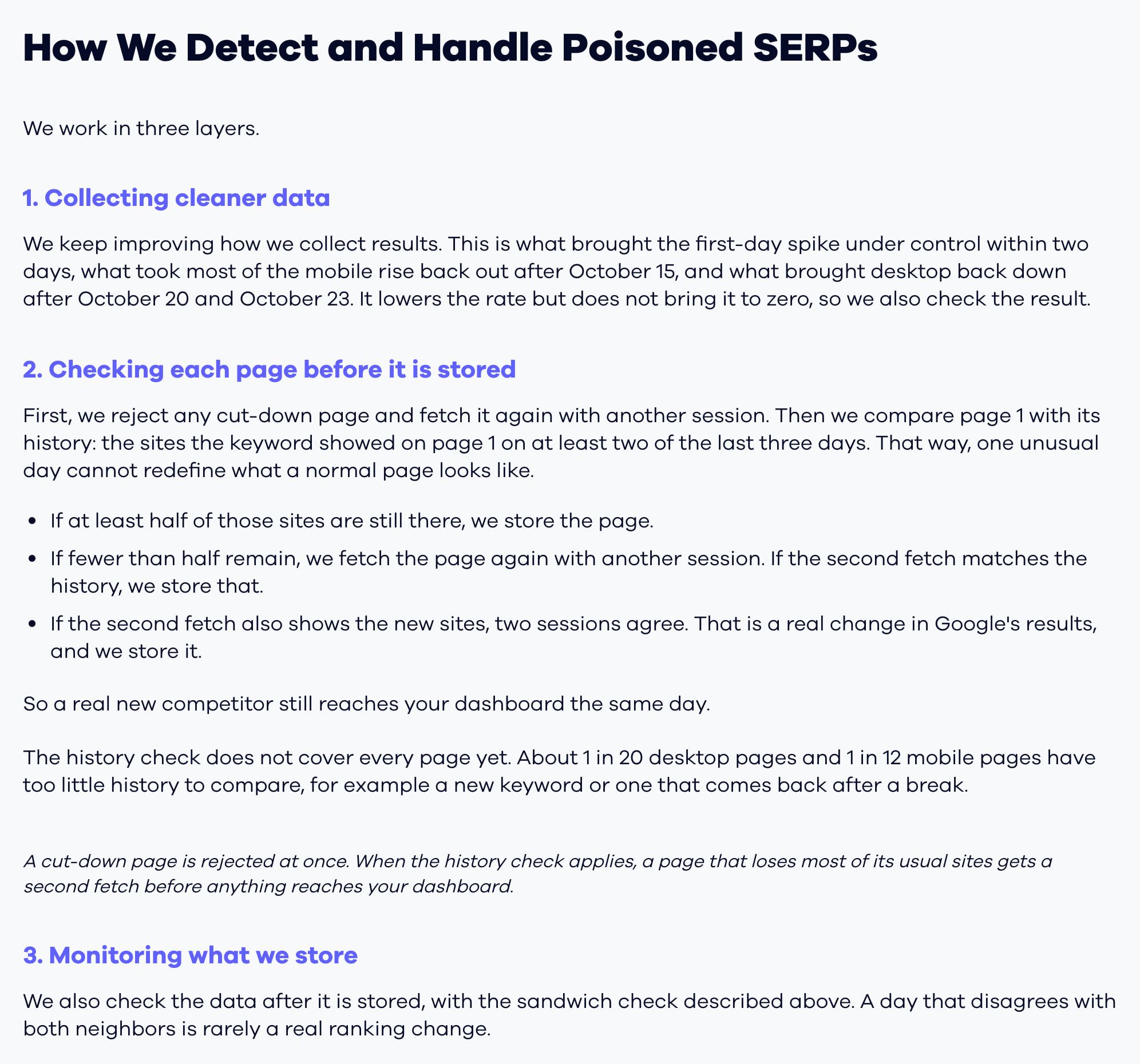
SE Ranking’s study describes its October filter, automatic rechecks for sudden drops and status-page updates, and asks you to treat a sudden, isolated move “as a signal to verify, not a verdict”. Semrush told SER that “The impact on the rankings our users track has been limited” (PPC Land); its Position Tracking help doesn’t describe the checks.
Nightwatch’s changelog has no entry since 6 February 2026. That’s an absence of a public note, not proof it doesn’t filter.
I compare two of these trackers in Nightwatch vs AccuRanker and two more in SE Ranking vs Semrush. SE Ranking’s plans are in SE Ranking pricing.
Can Search Console settle it? #
Partly. It shows real clicks and impressions, but it counts an impression only when your result “appears in the current page of results”, so page-2 keywords may have little data either way (Search Console help).
That makes it good for confirming a real drop on page 1 and weak for a keyword at position 14. No impressions there doesn’t prove the tracker wrong, and a few impressions don’t prove it right. For a wider take on what each tool measures, see rank tracking vs AI visibility. Why your tracker and Search Console disagree shows how to line the two up.
What should you check before reporting a drop? #
Six checks, drawn from Nozzle’s spotting tips, AccuRanker’s advice and SEJ’s checklist. If two or more point to junk, wait.
- Did it last one day? In Nozzle’s data, most one-word pages were back to normal on the keyword’s next check.
- Did many usual competitors vanish at once? That’s the poisoned pattern AccuRanker’s history check looks for.
- Are the results about one word of your keyword? Nozzle’s tells: the title shows your full query with no “Showing results for”, pagination stops early, and one domain fills several spots.
- Is it at position 9 or lower? That’s where SE Ranking found almost all of it.
- Does Search Console agree, where it has data?
- Has your tracker re-checked? Use a refresh if it offers one, and ask whether it reviews page 2 (SEJ).
If you’re also checking for the November core update, which began on 10 November, my core update guide has the dates. Run this list first, so you don’t blame the update for junk pages.
So what would I do? #
Wait for a second check before reporting anything at position 9 or below, and ask your tracker how it handles this in writing. Here’s who I’d point where:
- Everyone: a page-2 drop is a signal to verify. Confirm it on the next check and in Search Console before it goes in a report.
- Choosing or renewing a tracker now: AccuRanker, for the most detailed public method. SE Ranking if you want a documented filter and corrected history, by its own account.
- On Semrush: ask support how page 2 is handled. It says it added checks but hasn’t published them.
- On Nightwatch or anything else: I found nothing public, so ask before you renew.
- Agencies: add one line to client reports saying page-2 positions have been noisy since mid-September, and show trends over several days instead of single-day moves.
I’ll update this post if Google comments or a vendor publishes newer numbers.
FAQ
Why does my rank tracker show unrelated results?
Since mid-September 2026, several tracker vendors have recorded Google pages that answer only one word of the query, or that answer it with the usual sites swapped out. Google hasn't explained either, so treat a sudden page-2 change as something to verify.
Is my site really dropping on page 2?
Maybe not. Check whether the drop lasts past the next check, whether many usual competitors vanished at once, whether the results are about one word of your keyword, and what Search Console shows where it has data. In Nozzle's data, most one-word pages were back to normal on the keyword's next check.
Does this affect the top 5?
Not in SE Ranking's study: 96.5% of affected blocks began at position 9 or lower, 3.5% at positions 6 to 8, and none in the top 5. Nozzle found its swapped-results fault on page 1 too, though less often than on page 2.
Is it fixed now?
Not as of Nozzle's 3 November 2026 updates. One-word pages eased to 10.7% in the week of 2 November, but swapped results hit their worst day yet on 2 November, at 68.6% of the desktop pages Nozzle judged.
Which rank trackers filter these results?
AccuRanker and SE Ranking have published how they detect and re-check bad pages. Semrush says it added checks but hasn't published detail. I found nothing public from Nightwatch, so ask any vendor in writing before you renew.
Can Search Console prove a page-2 drop is fake?
Partly. Search Console shows real clicks and impressions, but it counts an impression only when your result is on the page someone actually saw, so page-2 keywords may have little data either way.
Sources
12 sources, accessed .
Official pricing, docs, changelogs and status pages 4
News and press 3
Other blogs 5
- SE Ranking (sells rank tracking): unrelated Google results study, 3 Nov 2026
- Nozzle (sells rank tracking): Google plays dumb, 22 Oct 2026, updated 3 Nov
- Nozzle (sells rank tracking): poisoned Google SERPs, 10 Oct 2026, updated 3 Nov
- AccuRanker (sells rank tracking): how it handles poisoned SERPs, Oct 2026
- Morningscore (sells rank tracking): why trackers differ from manual search, Mar 2026
Last updated: 16 November 2026. Vendor figures verified 16 Nov 2026 against their own pages. Researched and drafted with AI tools; owner review is pending.


