Do content optimization tools actually help you rank?
Every content-score study I found shows a weak link to rankings, and vendors ran them all. What scores measure, cost per article, and who should skip.

Short on time?
Short on time? Here's my take.
- Your writers know the subject
- Skip a paid optimizer
- The best published correlation is weak, and every study comes from a vendor.
- You brief freelance writers
- NeuronWriter Bronze
- $23 a month or $230 a year for 25 documents (verified 17 Nov 2026): under $1 an article if you use them all.
- You also want AI-answer tracking in one tool
- Frase Starter
- $39 a month billed yearly or $49 monthly, with 20 prompts a day on ChatGPT and Google AI (verified 13 Nov 2026).
- You want to try the idea for free
- Ahrefs Free
- One AI Content Helper document a month (verified 17 Nov 2026).
Prices verified . Studies and tool details from the vendors' own pages; prices verified 13 and 17 Nov 2026 as marked. No vendor paid to be included, and sponsors can't buy a verdict.
Content optimizers sell a score that’s supposed to move with your rankings. I read every score-versus-ranking study I could find, plus each vendor’s own definition of its score, to work out whether a small team should pay for one at all.
The short answer is that the link is weak and every study comes from a company that sells a tool. Below is what the scores measure, what the studies found, what one optimized article costs, and who should skip. For the wider toolkit, start at the SEO tools hub.
What does a content score actually measure? #
How closely your draft matches the words, headings and length of the pages already ranking for your keyword. It doesn’t measure links, trust, or whether your page answers the question better than theirs.
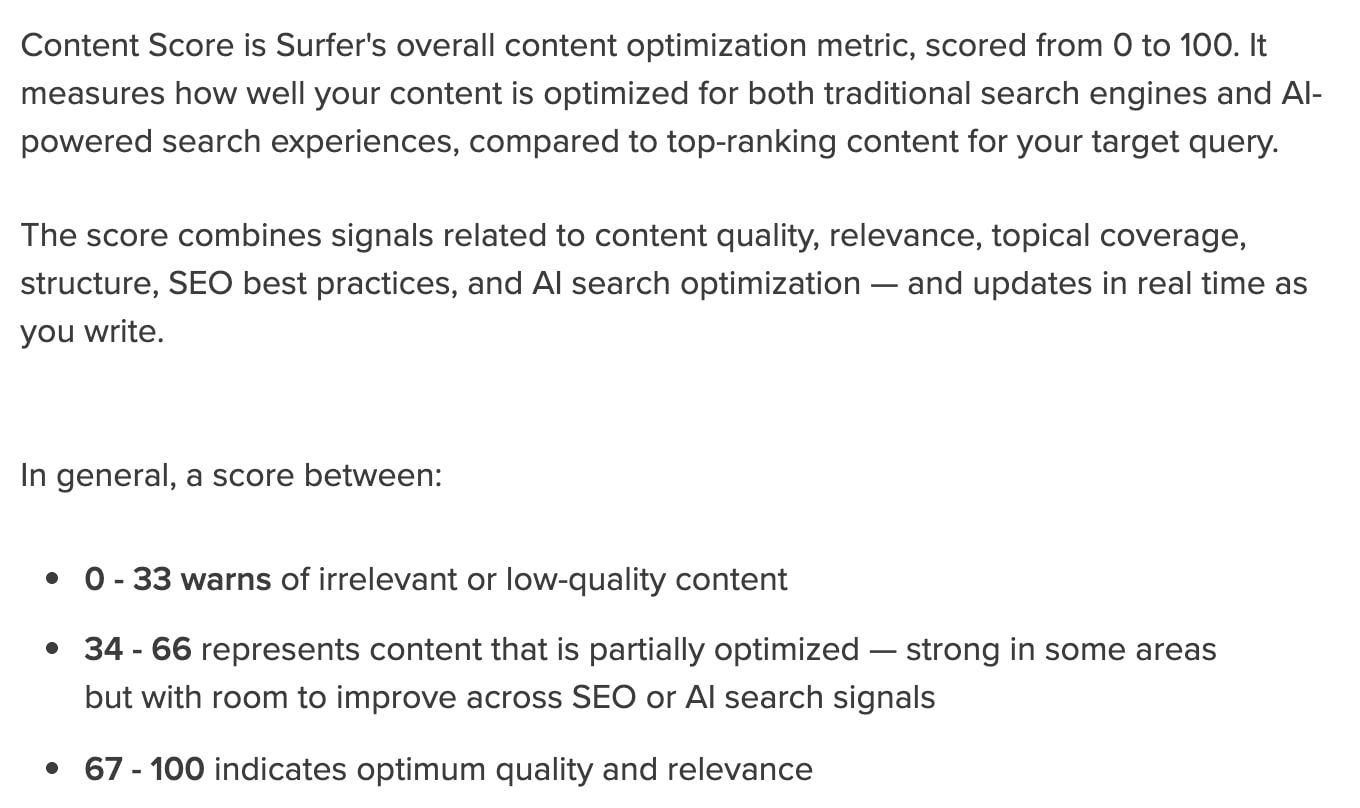
Surfer says “Content Score is Surfer’s overall content optimization metric, scored from 0 to 100.” It now combines an SEO Score with an AI Search Score (facts coverage and upfront intent alignment), built from main, partial and NLP terms, title, H1, headers, length, images, hidden content and internal links, measured against the top 20 pages. The Surfer help pages I read mention E-E-A-T only as writing guidance in the Content Editor, not as a named score input. A score of 67 to 100 “indicates optimum quality and relevance” (Surfer docs).
Clearscope says “Content Grades are Clearscope’s measure of content relevance and comprehensiveness.” A term’s importance is “how much the keyword appears in the competitors’ articles”, from 10 (must include) down to 1, and suggested usage is “a guide rather than a rule” (Clearscope support). Its help page makes no claim about rankings.
Frase says its SEO Score “measures how well your content aligns with on-page traditional search best practices”, next to separate GEO and EEAT scores, each out of 100. What an E-E-A-T score can and can’t tell you is in does E-E-A-T matter for AI answers?. “Keywords only count toward your SEO score when they appear as a whole word”, and its reasoning is blunt: “If competitors consistently mention something you don’t, Google notices.” (Frase docs)
What they share: every score is built from competitors’ pages. A high score means your draft looks like what already ranks. That’s a useful checklist, but it isn’t evidence that Google will prefer you.
What did the studies find? #
Weak links between scores and rankings, roughly 0.1 to 0.3 on a scale where 1 would mean scores and positions line up perfectly. Every study was run by a company that sells a content tool.
| Study | Who ran it | Sample | Result | Their own caveat |
|---|---|---|---|---|
| Content score study, updated 21 May 2025 | Ahrefs, which sells AI Content Helper | 20 keywords, 5 tools | AI Content Helper and NeuronWriter 0.24, Clearscope 0.14, Surfer and Frase 0.10 | Small sample; 'correlation may not be causation' |
| Content Score study, updated 9 Sep 2026 | Surfer | 10,000 queries, about 1M results | 0.28 overall; 0.19 to 0.2961 by intent | None stated |
| Rebuttal post, 26 Jun 2025 | Clearscope | Cites an Ahrefs page | '.30 vs .27', Clearscope ahead of Surfer | 'correlation this low doesn't meaningfully predict rankings' |
| Originality.ai study, date unknown | Originality.ai, whose optimizer is now retired | Not available | '26% vs 17.5%', Surfer ahead, per Clearscope | Study page is gone |
Source: Ahrefs, Surfer, Clearscope and Originality.ai pages, read 13 and 17 Nov 2026. Ahrefs' coefficients are from its 3 Nov 2026 table. Scroll sideways for more columns.
Ahrefs took 20 random keywords, scored every result on each page in five tools (dropping Reddit, Quora and YouTube where tools couldn’t score them), and averaged Spearman and Kendall correlations within each keyword. It used ChatGPT to turn Clearscope’s letter grades into numbers, and its headline finding was “weak correlations everywhere” (Ahrefs study).
The study page shows its coefficients only in an image. The figures in my table come from Ahrefs’ November 2026 article: “AI Content Helper and NeuronWriter scored highest (0.24), followed by Clearscope (0.14)”, with Surfer and Frase at 0.10, from “an admittedly small-scale test” (Ahrefs). Ahrefs makes AI Content Helper, so it tied for first in its own test.
Surfer looked at 10,000 queries and their top 100 results, about a million entries, and found that “Surfer’s Content Score correlates with Google rankings at 0.28” (Surfer study). By intent it ranged from 0.19 on instructional and short-fact queries to 0.2961 on consequence queries. The study has no limitations section, and it sets its result against a 0.17 average for backlinks that it credits to Ahrefs; I didn’t check that figure.
Clearscope says Ahrefs, “a third-party platform with no skin in the game”, put Clearscope ahead “in both correlation models: .30 vs .27” (Clearscope). Those aren’t Ahrefs’ current figures, and Ahrefs sells a competing optimizer. Clearscope’s own conclusion is the most honest line in the set: “correlation this low doesn’t meaningfully predict rankings anyway.”
Originality.ai is the one I can’t check. Clearscope says Surfer cites an Originality.ai study “showing their score at 26% vs. Clearscope at 17.5%”, but that link now opens a product page that says “The Originality.ai Content Optimizer has been retired within the app” (Originality.ai).
Why doesn’t a weak correlation mean much? #
Because the tools build their targets from the pages that already rank, a draft that matches them shows overlap with the winners, not a cause of winning. And on my reading, a coefficient near 0.2 means scores and positions move together only loosely.
Ahrefs puts the case for its own product carefully: “While correlation may not be causation, even a weak positive correlation means content scores can still move the needle.” It also warns that Spearman is “more prone to being swayed by small sample size and outliers”, and that each tool “pulled a slightly different SERP” (Ahrefs study).
Its tools roundup is open about the conflict. Its author writes “I work at Ahrefs, and we make an AI content optimization tool called AI Content Helper”, then “But that does make me biased”, and concludes that “optimizing on-page text does genuinely improve ranking performance, at least by a little” (Ahrefs). Its competitor sections were written by people from Surfer, Frase and Clearscope.
geotoolbox, which sells its own analyzer, frames it in a way I agree with: “the score clears the first gate, topical relevance, and then real ranking factors take over” (geotoolbox). A score can tell you you’ve missed an obvious subtopic. It can’t make a page rank that lacks links, trust or a better answer.
What does Google say about word counts? #
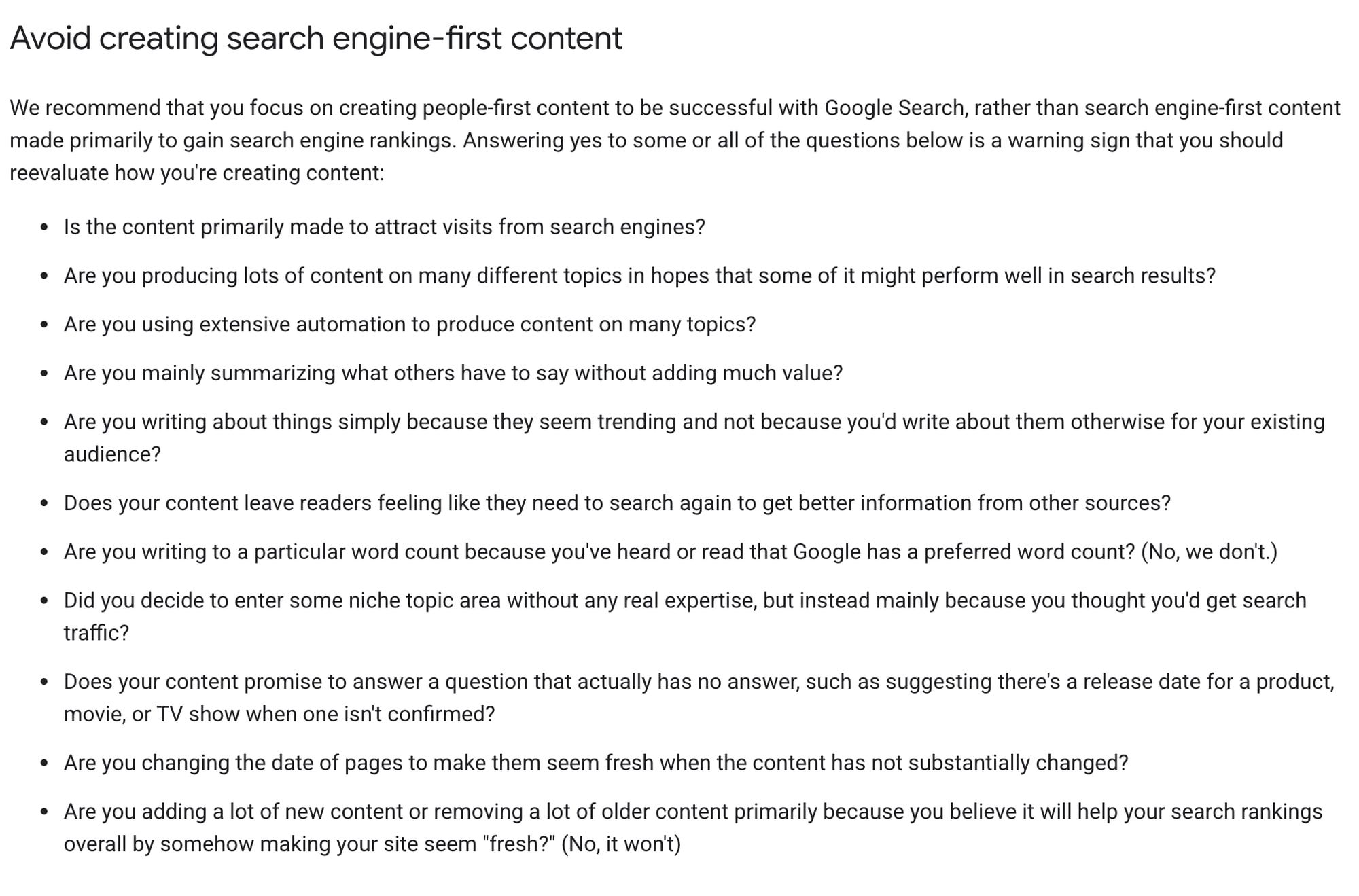
Google lists writing to a word count as a warning sign of content made for search engines first. That matters, because length is one of the inputs most optimizers grade.
Two of the questions in Google’s “search engine-first” checklist are worth pinning above any content editor (Google Search Central):
- “Are you writing to a particular word count because you’ve heard or read that Google has a preferred word count?”
- “Is the content primarily made to attract visits from search engines?”
The vendors don’t ask for 100 either. Surfer’s study recommends 70 to 85, Frase calls 70 to 85 and above “generally solid”, and Ahrefs says “scoring in the same ballpark as top-ranking pages is enough”. My view: the last 15 points are where padding and term stuffing creep in, which is the trap Google describes.
What does one optimized article cost? #
From under $1 to about $6.45 on entry plans, if you use the whole allowance. Unused documents push the real cost per article up.
| Tool and plan | Billed yearly | Billed monthly | Allowance | Per article (yearly / monthly) | Verified |
|---|---|---|---|---|---|
| NeuronWriter Bronze | $230 a year ($19.17/mo) | $23 | 25 documents (I read it as monthly) | $0.77 / $0.92 | 17 Nov 2026 |
| Frase Starter | $39/mo | $49 | 10 articles a month | $3.90 / $4.90 | 13 Nov 2026 |
| Surfer Discovery | $49/mo | About $59 (my arithmetic) | 120 documents a year, upfront (10 a month) | $4.90 / about $5.90 | 13 Nov 2026 |
| Clearscope Essentials | Not published | $129 | 20 drafts a month | n/a / $6.45 | 13 Nov 2026 |
| Ahrefs Free | $0 | $0 | 1 document a month | $0 | 17 Nov 2026 |
Source: NeuronWriter, Frase, Surfer, Clearscope and Ahrefs pages. Per-article cost is my arithmetic: price ÷ allowance, assuming one document, draft or article equals one post. Scroll sideways for more columns.
Sources for each row: NeuronWriter pricing, Frase pricing, Surfer pricing, Clearscope pricing and Ahrefs Webmaster Tools. NeuronWriter doesn’t define a “document” or say how often the 25 reset; I’ve assumed monthly, and if one post uses more than one document, its lead shrinks. Surfer’s yearly plans grant the year’s documents “in a single upfront batch”, and unused ones don’t roll over (Surfer docs). The yearly NeuronWriter price is “2 months free” against monthly billing.
SE Ranking’s Core plan, $129 a month or $103.20 billed annually, also lists 25 articles, with extra articles “from $39.20” (SE Ranking, verified 17 Nov 2026). The page doesn’t say what an article covers, so I left it out of the table. If you already pay for Core, try what’s included before you buy anything else. Current prices for every tool I follow are on the pricing tracker.
Who should skip a content optimizer? #
Most small teams whose writers know the subject. This is my opinion, reasoned from the evidence above: the scores measure term coverage against competitors, and the best correlation any vendor has published is weak.
I’d skip one if:
- Your writers are the experts. They already cover the subtopics a score would flag, and they’ll read the top results anyway.
- You publish a few posts a month. The allowance goes unused, so your real cost per article is several times the table’s figure.
- Your gap is links, trust or intent. Every score is built from on-page terms and structure (see the definitions above). It won’t see a page that ranks poorly because it answers the wrong question.
- You’re tempted to write to the length the tool suggests. Google lists that as a warning sign.
I’d buy one if you brief freelance writers who don’t know the topic and need a repeatable checklist, or if you edit a high volume of drafts and want a consistent floor. For that job, the cheapest paid option per article is NeuronWriter Bronze.
Can you get the same checklist for free? #
Mostly, yes. Read the top five results for your keyword and your Search Console queries for the page, and you’ll have most of what a score checks; Ahrefs’ free plan also includes one AI Content Helper document a month.
This is how I’d do it; I haven’t run it as a test:
- Read the top five results. List the subtopics that at least three of them cover. That’s your coverage floor.
- Open Search Console for the page you’re updating and sort its queries by impressions. Queries you show for but don’t answer are your gaps.
- Write the outline from those two lists, then add what none of them cover well.
- Check one draft a month with Ahrefs Free, which lists AI Content Helper at “1 free docs/month” (verified 17 Nov 2026), if you want a machine’s second opinion.
If you’d rather stay inside a bigger suite, Ahrefs alternatives and Semrush alternatives cover which plans bundle a content tool. For standalone editors, see Surfer alternatives priced per article.
Do these tools track AI answers now? #
Several do, as small prompt bundles: Surfer from its Standard plan up, Frase on every plan, Clearscope on both plans and NeuronWriter on every plan.
- Surfer: none on Discovery, 25 prompts weekly on Standard, 50 daily on Pro and 100 daily on Peace of Mind (Surfer pricing, verified 13 Nov 2026).
- Frase: 20, 50 or 75 prompts checked daily; Starter covers ChatGPT and Google AI, Professional adds Perplexity, and Scale adds Claude and Gemini (Frase pricing, verified 13 Nov 2026).
- Clearscope: 50 or 300 tracked queries (Clearscope pricing, verified 13 Nov 2026).
- NeuronWriter: 5 AI-monitored questions on Bronze, up to 20 on Diamond (NeuronWriter pricing, verified 17 Nov 2026).
These are small sets. If AI answers matter more to you than scoring drafts, how many prompts to track helps you size a set, and the AI visibility hub covers tools built only for that job. To choose between the three big optimizers, see Surfer, Clearscope and Frase compared.
So should you buy one? #
Only if you brief writers who need a checklist. Otherwise, read the top results yourself and spend the money on what a score can’t see. If you’re splitting a small budget across tools, my $100-a-month SEO stack shows where an optimizer fits, and where it doesn’t.
| Your situation | My pick | Why |
|---|---|---|
| Expert writers, a few posts a month | No paid optimizer | Weak, vendor-run evidence and an allowance you won't use |
| You brief freelance writers | NeuronWriter Bronze | Under $1 an article at full use, and it tied for top score in Ahrefs' small test |
| You also want AI-answer tracking | Frase Starter | $39 billed yearly with 20 daily prompts on ChatGPT and Google AI |
| Already paying for SE Ranking Core | Its included articles | Use what you have before adding a second bill |
| Curious, no budget | Ahrefs Free | One AI Content Helper document a month |
Source: My picks, based on the Ahrefs, Surfer and Clearscope studies and vendor pricing pages, verified 13 and 17 Nov 2026. Scroll sideways for more columns.
My one rule: treat a content score as a checklist for what you might have missed, never as a forecast of where you’ll rank.
FAQ
Does a higher Surfer score mean higher rankings?
Only weakly. Surfer's own study of about a million search results found its Content Score correlates with rankings at 0.28, and Ahrefs' small 20-keyword test put Surfer at 0.10. Both are weak, and neither shows that raising a score causes a ranking.
What content score should I aim for?
Not 100. Surfer suggests 70 to 85, Frase calls 70 to 85 and above 'generally solid', and Ahrefs says scoring in the same ballpark as top-ranking pages is enough. In my view, the last 15 points are where padding and term stuffing creep in.
Are content optimization tools worth it for a small blog?
Usually not, if the people writing know the subject and you publish only a few posts a month. They earn their fee when you brief freelance writers and need a repeatable checklist, where NeuronWriter Bronze costs under $1 an article if you use the allowance.
Does Google have a preferred word count?
No. Google's own list of warning signs asks: 'Are you writing to a particular word count because you've heard or read that Google has a preferred word count?' Length targets in optimizers come from competitors' pages, not from Google.
Is there a free content optimizer?
Ahrefs' free plan includes one AI Content Helper document a month (verified 17 Nov 2026). You can also build the checklist by hand from the top results and your Search Console queries.
Who ran the content score studies?
Ahrefs, Surfer and Clearscope, each of which sells a content tool. A fourth, from Originality.ai, is no longer online. I found no study by anyone who doesn't sell an optimizer.
Sources
18 sources, accessed to .
Official pricing, docs, changelogs and status pages 11
- Google Search Central: creating helpful, people-first content
- Surfer docs: what Content Score is
- Surfer docs: how annual plans allocate limits
- Clearscope support: how content grades work
- Frase docs: understanding content scores
- NeuronWriter: pricing
- SE Ranking: plans, incl. content articles on Core
- Ahrefs Webmaster Tools (free plan), incl. AI Content Helper
- Surfer: pricing
- Frase: pricing
- Clearscope: pricing
Other blogs 7
- Ahrefs (sells AI Content Helper): content score study, updated 21 May 2025
- Surfer (vendor research): Content Score study, updated 9 Sep 2026
- Clearscope (vendor): Clearscope vs SurferSEO, 26 Jun 2025
- Originality.ai (vendor): former content optimization study URL, now a product page
- Ahrefs (vendor): Clearscope alternatives, with 2026 correlation table, 3 Nov 2026
- Ahrefs (vendor): AI content optimization tools, 4 Feb 2025
- geotoolbox (sells its own analyzer): content optimization tools, updated 7 Nov 2026
Last updated: 17 November 2026. Facts verified 17 Nov 2026, except Surfer, Frase and Clearscope prices (13 Nov 2026). Researched and drafted with AI tools; owner review is pending.


