How accurate are Semrush and Ahrefs traffic numbers?
Semrush and Ahrefs traffic estimates typically miss real traffic by about 50% to 68%. Here's every study, who ran it, and which number to trust.

Short on time?
Short on time? Here's my take.
- Your own site's traffic
- Search Console (and GA4)
- Semrush and Ahrefs both say their numbers are estimates, not your analytics.
- Sizing a competitor's search traffic
- Ahrefs, calibrated
- Lower median miss in the only published head-to-head (49.52% vs 68.36%), which Ahrefs ran. Lite is $129/mo.
- A competitor's total visits, all channels
- Semrush Traffic Analytics or Similarweb
- Only these estimate non-search traffic. Read them as a trend, not a count.
- Picking keywords
- Either suite, plus Search Console
- Use the tool to rank keywords against each other; check real demand with your impressions.
- Sites under about 5,000 visits a month
- Don't trust any tool's number
- Two studies flag Semrush, and one Similarweb, as weaker on small sites.
Prices verified . Studies read 17 Nov 2026. Ahrefs Lite price verified 17 Nov 2026. Most studies here were run by a company with something to sell, and I say which on every row.
You may be about to pay for an SEO suite partly to size up competitors. I went through every public accuracy study I could find, noted who ran each one and what it measured, so you know how far to trust the traffic number on the screen.
One note on scope: this is about estimated traffic and search volume. If your rank tracker’s positions don’t match what you see in Google, that’s a different problem, covered in why rank trackers log junk results. Keyword difficulty has its own version of this problem: see why keyword difficulty scores differ from tool to tool. Authority numbers do too: DA, DR and Authority Score are separate models on separate link indexes.
So, how accurate are they? #
Not very, for any one site. The largest published head-to-head found a typical miss of about 50% for Ahrefs and 68% for Semrush, and Ahrefs ran that study. Trends and comparisons between sites hold up better than absolute numbers. If you are choosing between the two suites, Semrush or Ahrefs? puts accuracy next to price, rank tracking and seats.
Ahrefs compared its own and Semrush’s US organic traffic estimates with Search Console data for 1,635 random websites. The median deviation was 49.52% for Ahrefs and 68.36% for Semrush (Ahrefs, May 2022).
The same study found correlations of 0.76 and 0.74, so both tools mostly get the order right: bigger sites look bigger. Ahrefs adds that the error “largely depends on the type of website and the industry”, with some sites within 5% and others off by more than 1,000%.
Agency studies land in the same place. Promodo checked 184 sites against Search Console in the first half of 2024 and wrote: “The average error rate for all services (Ahrefs, Similarweb, Semrush) is 50%” (Promodo).
The vendors don’t claim otherwise. Ahrefs says its estimates “don’t, and can’t, show you exactly how much organic traffic a website gets” (Ahrefs Help). Semrush says it “is meant to complement your use of Google Analytics and Google Search Console, not replace them” (Semrush KB).
What do the studies actually say? #
Here’s every public study I found and could open, with who ran it, when, how many sites or keywords, and what it compared against. Most were run by a company with something to sell.
| Who ran it (what they sell) | Data | Sample | Benchmark | Measures | What they found |
|---|---|---|---|---|---|
| Ahrefs (SEO suite) | 2022 | 1,635 sites, US | Search Console | Organic traffic | Median miss: Ahrefs 49.52%, Semrush 68.36%; correlation 0.76 vs 0.74 |
| Promodo (agency) | H1 2024 | 184 sites | Search Console | Organic traffic | About 50% average error across Ahrefs, Semrush and Similarweb |
| Varn (agency that uses Semrush) | Published Jan 2025 | 32 client sites | Search Console | Semrush organic estimate | Within 10% on 2 sites; 15 over by 152% on average; 15 under by about half |
| OWOX BI (analytics vendor) | Jan 2020 | 787 sites, 5 countries | Google Analytics | Total traffic | High deviation: Semrush on 45% of large and 67% of small sites; SimilarWeb 57–61% |
| Ahrefs (SEO suite) | 2021 | 72,635 keywords | Search Console impressions | Search volume | Within 50%: Ahrefs about 60%, Keyword Planner 45.22% of keywords |
| Altitude (agency) | Jun 2023 | 87 keywords, 1 site | Search Console impressions | Semrush search volume | Median miss 46%, average 99%; most keywords underestimated |
| Practical Ecommerce (trade) | 2024 | 1 keyword | None (side by side) | Search volume | Keyword Planner 880,000; Semrush 590,000; Ahrefs 100,000 |
| Semrush (SEO suite) | 2022 | 10,000 keywords | Search Console impressions, top 3 | Search volume | Method published; no per-tool results on the page |
Source: Each study's own page, read 17 Nov 2026. OWOX BI's study is published on CustomerThink by its CMO. None is peer-reviewed. Scroll sideways for more columns.
Notice what’s missing. Semrush’s own 2022 volume study describes its method in detail (10,000 keywords, compared with Moz, Ahrefs, Serpstat, Sistrix and Keyword Planner) but shows no per-tool results (Semrush). Practical Ecommerce reports Semrush citing an internal 2022 study that found its volumes closest to Search Console’s, which isn’t the same as publishing the data (Practical Ecommerce).
Some well-known studies didn’t make the table. Screaming Frog’s 2016 study blocked my research tools, and Authority Hacker’s is offline. Ahrefs’ 2022 post summarises Authority Hacker’s as a 50-site study with a 22.5% average discrepancy for Ahrefs, which I can’t check.
The newest study I found is Varn’s, from January 2025, and it covers Semrush only (Varn). Neither suite has published a newer head-to-head that I could find.
Are traffic, visits and search volume the same thing? #
No. Organic traffic estimates, whole-site visit estimates and keyword search volume are three different models, and each study tests only one of them.
- Organic traffic estimate: how many visits a site gets from search, modelled from its rankings. Ahrefs’ 2022 study, Promodo and Varn test this.
- Total traffic: all visits from every channel, estimated by Semrush’s Traffic Analytics or Similarweb. Semrush says Traffic Analytics “can estimate these metrics for most domains”, while Google Analytics and Search Console “are strictly internal analytics tools” (Semrush KB). The 2020 OWOX study tests this.
- Search volume: how often a keyword is searched each month. Ahrefs’ 2021 study, Altitude, Practical Ecommerce and Semrush’s 2022 method test this.
Mixing them up is how people end up comparing a suite’s search estimate with Google Analytics, which counts every channel. Ahrefs’ help page makes the same point: Google Analytics counts all sources, Ahrefs only search.
Why are the estimates off? #
Because each one multiplies guesses: how often a keyword is searched, where the site ranks, and how many searchers click, summed only over the keywords the tool knows about.
Ahrefs describes its own formula plainly. Traffic is estimated per keyword “based on its ranking position, monthly search volume, and our estimated CTR for that position”, then summed (Ahrefs Help). It models “a custom CTR curve for every keyword (based on clickstream data)” (Ahrefs Help).
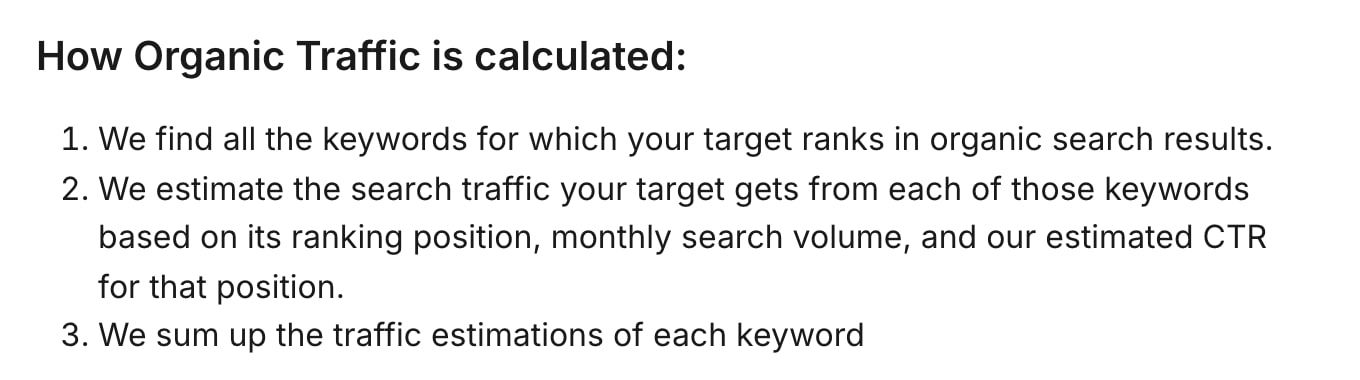
Its 2022 study names four places that goes wrong: keyword coverage, volume precision, ranking volatility and CTR prediction. Its help page is just as frank: “It’s not possible for all the variables in our traffic estimation formula to be 100% accurate.”
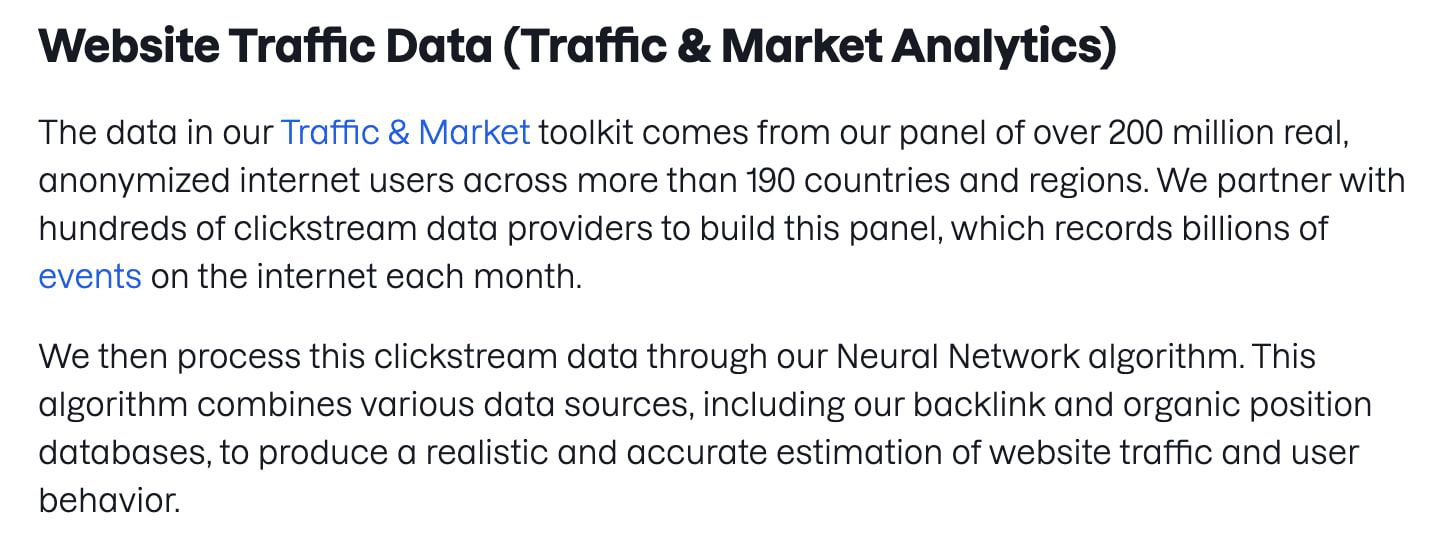
Semrush works from a different source. Its traffic data “comes from our panel of over 200 million real, anonymized internet users”, supplied by “hundreds of clickstream data providers” and processed “through our Neural Network algorithm” (Semrush KB). Its organic data comes from third-party providers that collect Google’s “top 100 positions”.
My reading: a keyword that isn’t in a tool’s database adds nothing to a site’s estimate. That’s one plausible reason small sites come out worse. It’s an inference from the formula, not something the studies tested.
Are small sites worse? #
Probably, but the evidence is mixed. Promodo calls Semrush and Similarweb unreliable below about 5,000 visits a month, while Varn’s only close matches came on two small sites.
- Promodo (2024): lists “inaccurate data for websites with low traffic” as a weakness of Semrush and Similarweb (under 5,000 visits a month for Similarweb), and says nothing about Ahrefs on small sites. Its smallest site had about 5,000 views a month, so it didn’t measure smaller ones.
- OWOX (2020): Semrush showed high deviation on 67% of small sites against 45% of large ones (CustomerThink).
- Varn (2025): Semrush came within 10% only twice, both on sites with about 1,500 organic visits a month, while sites with about 10,000 visits a month were overestimated by 107%.
Two studies point one way and one small sample points the other. I’d treat any estimate under about 5,000 visits a month as a rough guess, and Varn’s two close matches as luck rather than a pattern.
What about search volume? #
Every tool, including Google’s own Keyword Planner, gives a different number. One keyword showed 880,000, 590,000 and 100,000 searches a month in three tools.
That keyword was “reddit marketing” in the US, in Ann Smarty’s November 2024 comparison: 880,000 in Keyword Planner, 590,000 in Semrush and 100,000 in Ahrefs (Practical Ecommerce). One keyword proves nothing on its own, but it shows how wide the spread can be.
Keyword Planner isn’t a ground truth either. Google defines its figure as “The average number of times people have searched for a keyword and its close variants”, says “Your search volume statistics are rounded”, and averages them over 12 months by default (Google Ads Help).
Ahrefs’ 2021 study of 72,635 keywords used Search Console impressions as the benchmark and called a figure “roughly accurate” if it was within 50%. Keyword Planner was roughly accurate for 45.22% of keywords, and its figure was an overestimate for 91.45% of keywords (the two overlap, since a small overestimate still counts as roughly accurate); Ahrefs’ own volumes were roughly accurate for about 60% (Ahrefs, Nov 2021). That study is vendor-run and doesn’t include Semrush.
Altitude’s 2023 check of Semrush on 87 keywords from one site found a median miss of 46% and an average of 99%, with most keywords underestimated (Altitude). Its own counts (71 under, 16 over, 1 exact) add up to 88, a small slip on the page.
Isn’t Search Console the truth? #
For your own Google clicks, yes. But it hides anonymized queries in its tables, counts only Google, and impressions aren’t the same as search volume.
Google says “the actual anonymized queries are always omitted from the tables”, and the interface exports at most 1,000 rows, with the API allowing 50,000 rows per day per site per search type (Google Search Central). Its help page adds that “The chart totals can sometimes differ from the table totals” (Search Console Help).
Semrush’s own method page puts it simply: “impressions are not the same as volume”. An impression only counts when your page appeared, so it measures your visibility for a query, not every search for it.
None of this makes Search Console less useful for your own site. It means a study benchmarked on Search Console is measuring against a good number, not a perfect one. Its average position has quirks too, covered in why your rank tracker and Search Console disagree. Its row caps and 16-month window are in the documented limits of free SEO tools.
How do you check a tool against your own site? #
Compare the tool’s estimate for your site with your Search Console clicks over the same months, and use that ratio to adjust competitors in your niche. Ahrefs suggests this kind of scaling in its 2022 study.
Here’s the method, step by step. I haven’t run it on any site; it’s a way to turn a rough number into a calibrated one.
- Pick the same three months in Search Console (Web search, clicks) and in the suite’s organic traffic report for your own domain, for the same country.
- Divide your Search Console clicks by the tool’s estimate. That’s your ratio.
- Apply the ratio only to competitors in the same niche and a similar size band. Errors depend on site type and industry, so it won’t carry across niches.
- For search volume, compare the tool’s figure with your Search Console impressions for queries where your page averages a top-3 position. That’s the logic behind Semrush’s own benchmark, and Ahrefs’ 50% rule is a fair test of “close enough”.
- Re-check the ratio after the tool updates its database.
Which tool should you trust for what? #
Search Console for your own site, Ahrefs for a competitor’s organic traffic, Semrush or Similarweb for total visits, and any suite to compare keywords. Here’s how that maps to jobs.
| Job | My pick | Why |
|---|---|---|
| Your own traffic | Search Console and GA4 (free) | Both suites say their numbers are estimates, not analytics |
| A competitor's organic traffic | Ahrefs (Lite $129/mo) | Lower median miss in the only head-to-head with a stated sample, run by Ahrefs |
| A competitor's total traffic, all channels | Semrush Traffic Analytics or Similarweb | Only these estimate non-search visits; OWOX's 2020 study had Semrush closer on large sites |
| Choosing keywords | Either suite, checked against Search Console | All tools disagree widely; use them to rank keywords, not to forecast visits |
| Sites under about 5,000 visits a month | No tool | Promodo and OWOX both flag Semrush as weaker on small sites |
Source: My picks, based on the studies above. Ahrefs price verified 17 Nov 2026. Scroll sideways for more columns.
On price, the two suites start close together. Ahrefs Lite is $129 a month (Ahrefs pricing, verified 17 Nov 2026). Semrush’s SEO plan was $139.95 a month on its monthly toggle when I read it on 13 November ($139 on the page I read on 17 November), or $117.33 a month billed annually (Semrush pricing).
Accuracy alone shouldn’t decide between them, since the gap comes from one study run by one of the two. For the full plan comparison, see Semrush pricing, SE Ranking vs Semrush and Ahrefs alternatives. If you’re not sure you need a paid suite yet, I priced SEO tool stacks from $0 to $250 a month.
Before you trust an accuracy article (checked 17 Nov 2026)
- Exploding Topics calls Semrush “one of the most accurate”. Its page states “Exploding Topics is owned by Semrush”, shows no test, and lists old plan names (Exploding Topics).
- BKA Content’s accuracy guide has no numbers. It cites no studies, and the author’s company is a Semrush partner with commission links (BKA Content).
- “Keyword Planner shows ranges.” Only for some accounts. Google’s help page describes a “rounded” average over 12 months, not a range, but in 2016 Google began showing bucketed ranges such as 1K–10K to advertisers with lower spend (Search Engine Roundtable). Check which view your account shows.
- Varn’s “51%” underestimate. The same article says 52.84% in its takeaways, so “about half” is the honest version.
If you’re sizing up whether ChatGPT’s search volume compares with Google’s, that’s a different kind of estimate; see is ChatGPT really a fifth of Google. My other data posts are in the data hub, and the suites themselves are compared in the SEO tools hub.
FAQ
Is Semrush traffic data accurate?
Directional, not exact. In Ahrefs' 2022 study of 1,635 sites, Semrush's organic traffic estimates missed Search Console by a median of 68.36%. Varn, an agency that uses Semrush, found its estimate within 10% for only 2 of 32 client sites.
Is Ahrefs more accurate than Semrush for traffic?
In the only published head-to-head with a stated sample, yes: a 49.52% median miss for Ahrefs against 68.36% for Semrush. But Ahrefs ran that study, and Semrush hasn't published comparable figures, so treat it as one vendor's result.
Why is Semrush traffic different from Search Console?
It can be higher or lower. Semrush models search traffic from a clickstream panel and ranking data, while Search Console counts real Google clicks. Search Console also leaves anonymized queries out of its tables, so even the benchmark has gaps.
How accurate is search volume in SEO tools?
Rough. Ahrefs found Google Keyword Planner within 50% of real impressions for 45.22% of keywords. In one 2024 comparison, a single keyword showed 880,000, 590,000 and 100,000 monthly searches in Keyword Planner, Semrush and Ahrefs.
Where does Semrush get its traffic data?
From a panel of over 200 million anonymized internet users, supplied by hundreds of clickstream data providers and processed by a neural network, according to Semrush's knowledge base. Its organic ranking data comes from third-party providers that collect Google's top 100 results.
Can I make the estimates more accurate?
You can calibrate them. Divide your own Search Console clicks by the tool's estimate for your site over the same months, then apply that ratio to competitors of a similar size in your niche. Ahrefs suggests this kind of scaling in its 2022 study.
Sources
20 sources, accessed .
Official pricing, docs, changelogs and status pages 9
- Ahrefs Help: how accurate is organic traffic, and how it's calculated
- Ahrefs Help: how CTR is estimated for search traffic
- Semrush Knowledge Base: where Semrush data comes from
- Semrush Knowledge Base: Semrush vs Google Analytics
- Google Ads Help: Keyword Planner search volume
- Google Search Central blog: a closer look at Performance data, Oct 2022
- Search Console Help: Performance report
- Ahrefs: pricing
- Semrush: pricing
News and press 2
Other blogs 9
- Ahrefs (vendor research): traffic estimation accuracy, 1,635 sites, May 2022
- Ahrefs (vendor research): Keyword Planner vs Search Console volume, Nov 2021
- Semrush (vendor research): search volume study methodology, Mar 2022
- Varn (agency that uses Semrush): how accurate is Semrush, Jan 2025
- Promodo (agency research): Similarweb, Ahrefs and Semrush accuracy, Oct 2024
- CustomerThink (by OWOX BI's CMO): Similarweb vs Semrush, Jul 2020
- Altitude Marketing (agency): search volume estimate accuracy, Aug 2023
- Exploding Topics (owned by Semrush): is Semrush accurate, Jan 2026
- BKA Content (Semrush partner): how accurate is Semrush, Mar 2025
Last updated: 17 November 2026. Studies and help pages read 17 Nov 2026; Ahrefs price verified 17 Nov 2026, Semrush monthly price read 13 Nov 2026. Researched and drafted with AI tools; owner review is pending.


