Why keyword difficulty scores differ from tool to tool
Why does keyword difficulty differ between Ahrefs, Semrush and Mangools? I read each tool's own docs to show what KD counts and which score to trust.

Short on time?
Short on time? Here's my take.
- Comparing keywords
- Pick one tool and stay inside it
- A 40 in one tool isn't a 40 in another. Mangools itself says to compare scores within a single tool.
- Easiest to explain to a client
- Ahrefs KD
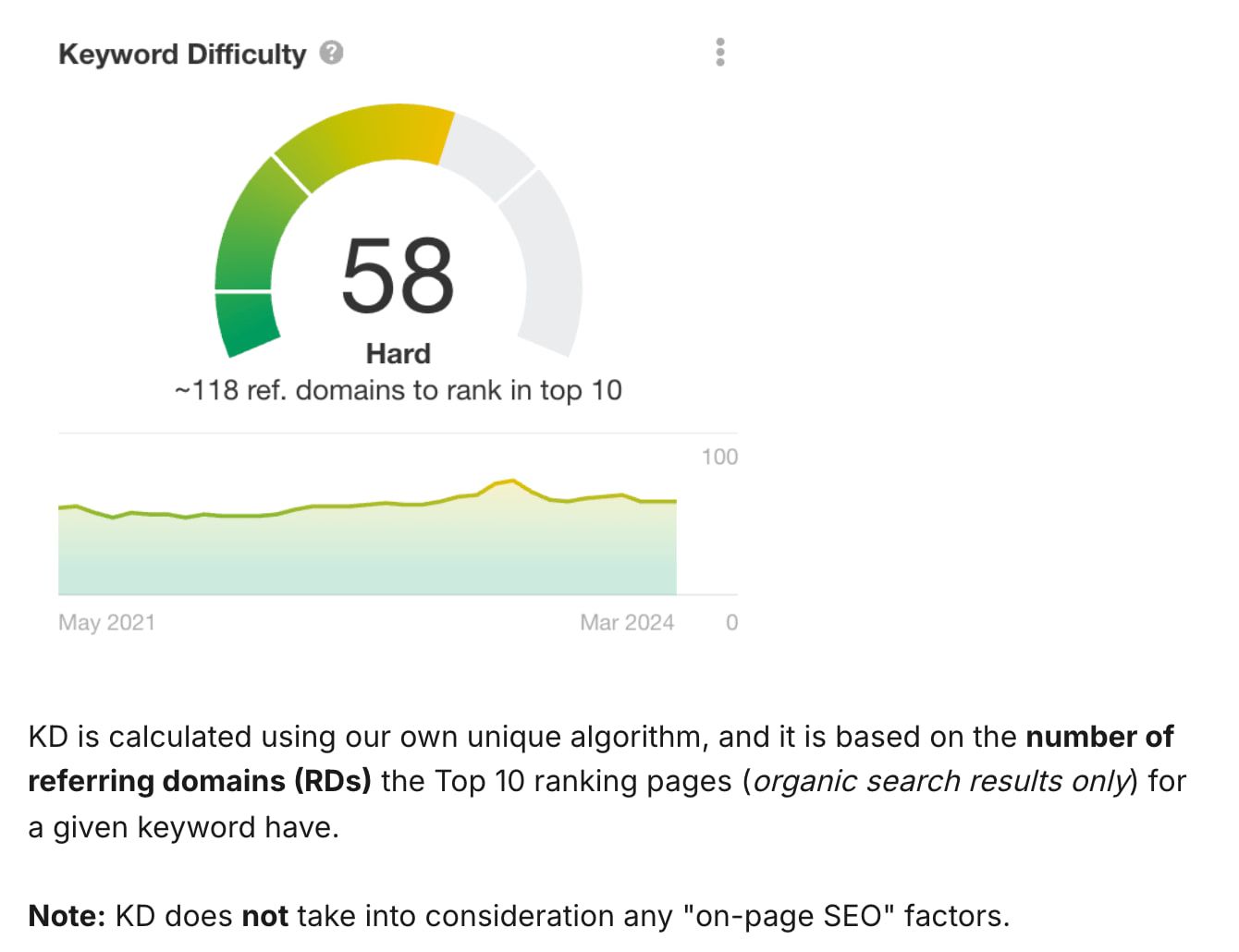
- One input: the referring domains pointing to the top 10 pages. No on-page factors, no hidden blend.
- Free, no account
- SE Ranking's keyword difficulty checker
- No sign-up, 190 countries, 0–100. Its formula isn't published, so use it for sorting.
- Difficulty for your own site
- Semrush Personal Keyword Difficulty
- Scores the keyword for your domain, using topical relevance and your metrics, on the same six bands.
- Already on Mangools
- KWFinder's KD, for sorting a list
- A weighted average of Moz and Majestic link scores. Fine for ranking your own list; don't set it against other tools.
Prices verified . From each vendor's own help pages, tools and blog posts, verified 17 Nov 2026. Moz via Search Engine Journal (2022). No vendor paid to be included.
In one example Ahrefs published, the same keyword scores 13 in Ahrefs and 56 in Semrush. I read the keyword difficulty documentation from Ahrefs, Semrush, Mangools and SE Ranking (Moz’s page wouldn’t open for my research tools) to show what each number counts and which one to trust.
Below: a formula table built from each vendor’s own pages, what the bands mean, how scores drift, and a pick for each situation. For the tools themselves, start at my SEO tools hub.
What is keyword difficulty? #
It’s a 0–100 estimate, made by each SEO tool, of how hard it would be to reach Google’s first page for a keyword. Google doesn’t publish one.
Ahrefs’ glossary puts it plainly: KD is “always only an estimation because Google does not disclose all its ranking factors”, and “That is why different SEO tools have different approaches to calculating keyword difficulty” (Ahrefs glossary).
So KD isn’t a measurement of Google. It’s a measurement of the pages that rank today, run through one vendor’s model and one vendor’s link data. That makes it useful for sorting a list of keywords, and weak as a forecast for your own page.
The scales look alike, which is part of the confusion. Ahrefs uses 0 to 100 (Ahrefs help), Semrush “a percentage from 0 to 100” (Semrush KB), and Mangools and SE Ranking 0 to 100 as well. Moz, as Search Engine Journal described it in 2022, “assigns a value from 1 to 100” (SEJ).
Why does the same keyword get different scores? #
Because each tool counts different things, from its own link index, and combines them its own way. Five differences stack up:
- Different inputs. Ahrefs counts referring domains only. Semrush adds authority, link ratios and traits of the results page. Mangools scores each result’s link profile with Moz and Majestic metrics.
- Different link data. Each vendor crawls its own index (for what Moz DA, Ahrefs DR and Semrush Authority Score each count, see DA, DR or Authority Score). Mangools borrows Moz and Majestic metrics, and says itself that they “are not used by Google in any way” (KWFinder).
- Different maths. Semrush works from medians; Mangools averages a score per result, and says sites with a weak link profile now count “more than ever”.
- Formulas change. Mangools rebuilt its KD in 2018 and Semrush overhauled its own in 2021, so old scores aren’t comparable with new ones.
- Nobody has Google’s factors. Every score is a stand-in.
Ahrefs published an image comparing four tools on three keywords (Ahrefs blog). It shows how wide the spread gets.
| Keyword | Ahrefs | Moz | Semrush | KWFinder |
|---|---|---|---|---|
| disposable face mask | 72 | 63 | 68 | 46 |
| best backpack | 42 | 47 | 79 | 50 |
| bike tire pump | 13 | 45 | 56 | 39 |
Source: Ahrefs' keyword difficulty guide, image read 17 Nov 2026. Undated, and made by a vendor that sells one of the four scores. Scroll sideways for more columns.
Treat that table as an illustration, not a test. It’s undated and comes from Ahrefs, which sells one of the four numbers. Still, no tool agrees with another on all three keywords, and “best backpack” runs from 42 to 79.
Mangools gives the same advice from the other side: scores “may differ from tool to tool”, so compare them “within a single tool” (Mangools).
How does each tool work it out? #
Ahrefs counts linking domains; Semrush blends links, authority and SERP traits; Mangools averages Moz and Majestic link scores; SE Ranking doesn’t publish its formula. Moz, by a 2022 account, keeps its own private.
| Tool | What it counts | Link data | How it combines | Scale and labels | Score for your site |
|---|---|---|---|---|---|
| Ahrefs | Referring domains to the top 10 pages; no on-page factors | Ahrefs' own index | Its own algorithm, not published | 0–100, no named bands | Not documented in its help |
| Semrush | Median referring domains and dofollow/nofollow ratio of ranking URLs, median Authority Score of ranking domains, plus traits of the results page | Semrush's own index | Weighted; last published weights are from 2021 | 0–100%, six named bands | Personal Keyword Difficulty |
| Mangools (KWFinder) | Link Profile Strength of each first-page result | Moz DA and PA, Majestic Citation Flow and Trust Flow | Weighted average; weights not disclosed | 0–100, colour-coded | None found |
| SE Ranking | Authority of top-10 domains and quality of their backlinks | Not stated | Not published | 0–100, no labels on the checker page | None found |
| Moz (via SEJ, 2022) | Page Authority, Domain Authority and projected CTR | Moz's index | Not shared by Moz | 1–100 | Not checked |
Source: Vendors' help pages, tools and blogs, read 17 Nov 2026; Moz from Search Engine Journal (23 Sep 2022) because moz.com blocked my research tools. Scroll sideways for more columns.
Ahrefs is the simplest. Its help page says KD is “calculated using our own unique algorithm, and it is based on the number of referring domains (RDs)” of the top 10 ranking pages, and it “does not take into consideration any ‘on-page SEO’ factors” (Ahrefs help, 3 Sep 2026).
One guide that ranks for this question says Ahrefs uses the referring domains of the lowest-ranking top-10 page (Lawrence Hitches). Ahrefs’ own help says the top 10 ranking pages, so I go with Ahrefs.
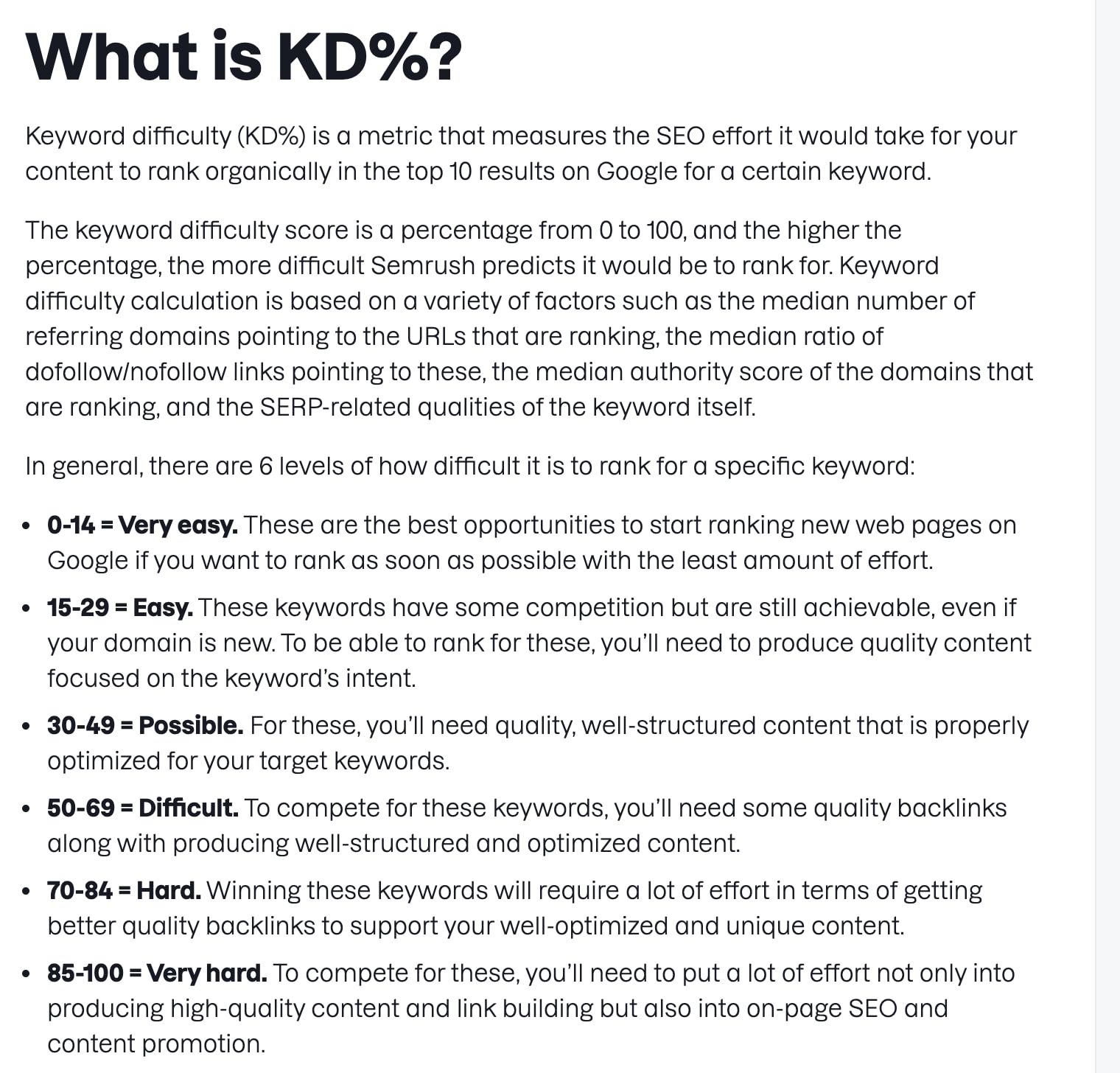
Semrush blends four factors. Its knowledge base lists “the median number of referring domains pointing to the URLs that are ranking”, “the median ratio of dofollow/nofollow links”, “the median authority score of the domains that are ranking” and “the SERP-related qualities of the keyword itself” (Semrush KB).
The KB gives no weights. The last ones Semrush published are in a May 2021 blog post: median referring domains 41.22%, median Authority Score 16.99%, search volume 9.47%, follow/nofollow ratio 9.17% and a featured snippet 4.74%, with small negative weights for word count and for having no SERP features (Semrush, 2021).
Some guides print those as today’s weights, without a link (Writesonic is one). They’re Semrush’s 2021 numbers, and the KB doesn’t say whether they’ve changed.
Mangools (KWFinder) scores each first-page result on “the quality and quantity of its backlinks”, using “selected metrics from Moz, Majestic, and our own know-how”, and then “the average score is calculated to give one final value” (Mangools). “Each metric has a different weight”, but the weights aren’t public.
Its feature page is frank that “only one aspect of website quality is taken into consideration”: backlinks (KWFinder). So a keyword whose top results have strong links but thin content will still score as hard in KWFinder; content quality isn’t in the number.
SE Ranking says less. Its free checker looks at “the top 10 search results for any given keyword”, weighing “the authority of competing domains” and “the quality of their backlink profiles”, on “a 0-100 scale” (SE Ranking checker). I found no help article with the formula, and its keyword difficulty blog post returned a 404.
Moz I could only read second-hand. Search Engine Journal wrote in 2022 that Moz “does not share its specific proprietary formula” and takes into account page authority, domain authority and projected click-through rates (SEJ). Check Moz’s own help page before you rely on that.
What’s a good keyword difficulty score? #
There’s no universal one. Only Semrush names its bands; Ahrefs and SE Ranking give a bare number, and Mangools uses colours.
| Score | Semrush's label |
|---|---|
| 0–14 | Very easy |
| 15–29 | Easy |
| 30–49 | Possible |
| 50–69 | Difficult |
| 70–84 | Hard |
| 85–100 | Very hard |
Source: Semrush Knowledge Base, read 17 Nov 2026. The same bands apply to its Personal Keyword Difficulty. Scroll sideways for more columns.
Mangools rebuilt its KD in September 2018, cut its bands from eight to six and set the green zone at 0–29, down from 0–39 (Mangools, 2018). Its pages today don’t list the bands, so I can’t confirm they’re unchanged.
Ahrefs names no bands. Its free checker shows a reference table of referring domains next to scores instead: about 56 at KD 40, rising to 756 at KD 90, so the scale isn’t linear (Ahrefs checker). SE Ranking defines only the top end: 100 means “extremely hard to rank for” (SE Ranking checker).
My take: use bands to sort a list, not to decide. “Possible” in Semrush says nothing about your site, and that’s the gap a personal score tries to fill.
What is personal keyword difficulty? #
A score made for your own domain rather than for an average site. Semrush has a documented Personal Keyword Difficulty; none of the other tools’ pages I read document one.
Semrush describes it as “how difficult it will be for the specified domain to reach the top 10 of the SERP for the specified keyword”, worked out by “our proprietary AI algorithm” (Semrush KB). The inputs are how relevant your domain is to the keyword’s topic, the competition within that topic, and metrics for your domain and the competitors in the results. It uses the same six bands.
Ahrefs takes the other side. Its KD guide calls standard KD an “absolute” metric, the same for every site, and shows how you could weight your own factors in an AI prompt as an example (Ahrefs blog). That’s a do-it-yourself idea, not a metric in its product.
When does a personal score help? My reasoning: if your site already has authority and content in a topic, a site-specific score is closer to the question you’re asking. A brand-new site has little history to score, so the gap between personal and standard KD should matter less.
What about the “most accurate” claims? #
Treat them as marketing. Semrush’s rests on its own 2021 study, and Mangools shows no test at all.
Semrush’s 2021 post calls its KD “the most accurate and consistent”, based on a study of 30,000 keywords in the US, Germany, Italy and Finland, compared with rival tools including Ahrefs, Mangools and Serpstat (Semrush, 2021). Semrush ran the study and wrote it up; I found no outside check of it.
Mangools’ feature page carries the heading “The Most Accurate Keyword Difficulty Tool” with no test behind it on the page (KWFinder).
The better lesson is that scores drift when the formula or its inputs change. In Mangools’ 2018 update, the keyword “cheap foosball table” scored 28 under the old formula, 52 after Moz changed its metrics, and 34 under the new KD (Mangools, 2018). The jump came from the inputs changing, not from Google’s results.
So don’t compare a KD from a spreadsheet you built years ago with one from today. Re-pull the whole list in one tool, on one day. I cover the same problem for traffic and volume numbers in how accurate SEO tool data is.
Can you check difficulty for free? #
Yes. SE Ranking’s checker needs no sign-up, and Ahrefs has a free checker too.
SE Ranking’s page says “You don’t have to sign up or subscribe”, and “We currently support 190 countries” (SE Ranking checker). Ahrefs’ free tool promises to “See how hard it will be to get into top 10 search results for any keyword”, on 0 to 100, with a country menu that defaults to the United States (Ahrefs checker).
Neither page states a daily limit. For a short list, that’s enough to sort keywords without paying. For hundreds of keywords plus volume, you’ll want a paid suite; I priced the options in Mangools vs SE Ranking and SE Ranking vs Semrush.
Which one should you pick? #
Pick one tool and keep all your comparisons inside it. Which one depends on what you need the number for.
| Your situation | My pick | Why |
|---|---|---|
| Explaining difficulty to a client or boss | Ahrefs KD | One input you can name: referring domains to the top 10 |
| No budget, short keyword list | SE Ranking's free checker | No sign-up, 190 countries |
| Is this keyword realistic for my site? | Semrush Personal Keyword Difficulty | The only documented site-specific score I found |
| Already paying for Mangools | KWFinder's KD | Fine for sorting; it's a backlinks-only score |
| Comparing tools before you buy | Any one of them, then stick with it | Scores across tools don't line up |
Source: My picks, from the vendors' own documentation read 17 Nov 2026. Scroll sideways for more columns.
- Explaining it to someone else: Ahrefs KD. “It counts the sites linking to what ranks” is a sentence anyone can follow, and Ahrefs says on-page factors aren’t in it.
- No budget: SE Ranking’s free checker, with Ahrefs’ free checker as a second opinion on a few keywords. Don’t mix the two scores in one list.
- Realistic targets for your own site: Semrush Personal Keyword Difficulty. It’s the only score I found that’s documented as built around your domain.
- Already on Mangools: keep KWFinder’s KD for sorting. Remember it only looks at backlinks.
- Shopping for a suite: don’t let KD decide it, since every tool’s number is internally consistent and none is checkable against Google. Pick on price and the other features you need, using my Ahrefs alternatives and Semrush alternatives guides. If “referring domain” is a new term, my glossary defines it.
FAQ
Why is keyword difficulty different in Ahrefs and Semrush?
They count different things. Ahrefs bases KD on the number of referring domains pointing to the top 10 pages and ignores on-page factors. Semrush blends median referring domains, the dofollow/nofollow ratio, the Authority Score of ranking domains and traits of the results page, each from its own link index.
What is a good keyword difficulty score?
There's no universal number. Semrush calls 0–14 very easy and 15–29 easy, but a score only means something next to other keywords in the same tool, which is what Mangools itself advises.
Is keyword difficulty accurate?
It's an estimate. Ahrefs' glossary says KD is 'always only an estimation because Google does not disclose all its ranking factors'. Semrush and Mangools both call their own score the most accurate, but Semrush's claim rests on its own 2021 study and Mangools shows no test.
Does Google have a keyword difficulty score?
No. Keyword difficulty is made by SEO tools from their own link data. Mangools even says the Moz and Majestic metrics it uses are not used by Google in any way.
Does keyword difficulty include search volume?
It depends on the tool. Ahrefs' KD uses only referring domains to the top 10. Semrush's last published weights, from 2021, gave search volume 9.47%. Mangools scores backlinks only.
What is personal keyword difficulty?
Semrush's Personal Keyword Difficulty scores how hard it would be for a specific domain to reach the top 10 for a keyword, using how relevant your site is to the topic plus your metrics and your competitors'. It uses the same six bands as standard KD.
Sources
14 sources, accessed .
Official pricing, docs, changelogs and status pages 9
- Ahrefs Help Center: what KD stands for in Keywords Explorer, 3 Sep 2026
- Ahrefs SEO glossary: keyword difficulty
- Ahrefs: free keyword difficulty checker
- Semrush Knowledge Base: what is Keyword Difficulty
- Semrush Knowledge Base: how Personal Keyword Difficulty is calculated
- Mangools: keyword difficulty checker explained (undated)
- Mangools KWFinder: keyword difficulty feature page
- Mangools: new keyword difficulty algorithm, 25 Sep 2018
- SE Ranking: free keyword difficulty checker
News and press 1
Other blogs 4
- Ahrefs (sells SEO tools): keyword difficulty guide, updated 15 Dec 2025
- Semrush (sells SEO tools): its keyword difficulty formula and study, 25 May 2021
- Writesonic (sells an AI SEO tool): what is keyword difficulty, updated 4 May 2026
- Lawrence Hitches (SEO consultant): keyword difficulty, updated 11 May 2026
Last updated: 17 November 2026. Facts verified 17 Nov 2026. Researched and drafted with AI tools; owner review is pending.


