Does ChatGPT prompt volume exist? Only as an estimate
I found no AI platform that publishes per-prompt volume, so every number is a vendor estimate. How Ahrefs, Semrush, Profound and others build theirs.

Short on time?
Short on time? Here's what I would do.
- Choosing which topics to track
- Start with Search Console, Bing's grounding queries, Google Trends and sales calls
- They give you an ordering of topics without a modelled number. Don't buy volume for this.
- Already paying for Semrush's AI toolkit
- Use Prompt Research as a relative sort
- The pricing page shows $99 a month per domain with annual billing and lists prompt research. Quote topics, never counts.
- On Ahrefs Brand Radar
- Read AI adjusted volume as Google volume, rescaled
- That's my inference from its published ratios. It isn't a count of people asking AI. Brand Radar AI starts at $199 a month.
- Pitched Profound Prompt Volumes
- Ask four questions before you talk price
- Where the prompts come from, how big and how recruited the panel is, what the unit and period are, and what changed this year. Its pricing page lists only Enterprise today.
- Never
- Forecast traffic or revenue from it
- The vendors themselves call it directional, and Ahrefs says its figure isn't derived from user query data.
Prices verified . Verified 24 Nov 2026 from the vendors' own pages. The within-platform ranking point and the ratio comparison are my inference and my arithmetic. I found no accuracy test of any vendor's volume. No vendor paid to be included, and sponsors can't buy a verdict.
Several tools now show a monthly “volume” next to each AI prompt. I read how Ahrefs, Semrush, Profound, Peec, Writesonic and four others say they make it, redid the arithmetic Ahrefs publishes, and checked what OpenAI actually shares.
Every page that defines this metric is written by someone who sells it or competes with someone who does, and I found no accuracy test of any vendor’s number. That shapes the verdict. How big ChatGPT is next to Google is a different question, and it’s in my market-size post.
Does ChatGPT prompt volume exist? #
Not as a published count. OpenAI has shared totals, 2.5 billion prompts a day in July 2025, but I found no platform that publishes how often one prompt or topic is asked; every such number is a vendor’s model.
OpenAI gave Axios 2.5 billion prompts a day from global users and 330 million from the US. TechCrunch relayed it on 21 July 2025 and doesn’t say it checked the figure (TechCrunch). I found no newer daily figure.
An NBER paper, How People Use ChatGPT, studies what people use it for. The abstract page I read gives no absolute message count.
On the per-prompt side, Ahrefs puts it plainly: “With the exception of Microsoft Copilot, no major AI platform (such as ChatGPT, Perplexity, Gemini, Claude, etc.) … shares their query data with anyone” (Ahrefs). It doesn’t say what Copilot shares. Scrunch and AirOps say the same thing in their own words: no platform hands out a prompt feed (Scrunch, AirOps).
So the “volume” in these tools is a model. That doesn’t make it useless. It changes what you can do with it.
How does each vendor make its number? #
Three ways: scale Google volume (Ahrefs, DemandSphere, DataForSEO), model licensed or clickstream panels (Profound, Semrush, Writesonic, Scrunch), or score relative demand (Peec). The table is built from each vendor’s own docs.
| Vendor | Name in the product | Method, as the vendor states it | Data source | Not stated |
|---|---|---|---|---|
| Ahrefs | AI adjusted volume | A parent keyword's Google volume times one fixed ratio per platform | Google volume; ratios from Ahrefs' own traffic data | How the ratios were derived; accuracy |
| Semrush | AI Volume, per topic | A topic-level estimate from third-party interaction data plus machine learning, because single prompts are too specific to measure | AI search clickstream (provider unnamed); Google's keyword dataset for AI Overviews | The plan on that KB page; whose clickstream; the refresh rate is given as daily in one place and monthly in another |
| Profound | Prompt Volumes | Licensed AI conversations, cleaned and modelled probabilistically | Licensed conversations, ChatGPT, Gemini and Perplexity | Unit, panel size, consent mechanics, projection method, update frequency |
| Peec | Prompt Volume, 1 to 5 | A model over search trends, AI conversations and industry signals, scored against your industry | Mixed | Plans, caps, coverage, accuracy, how industry is defined |
| Writesonic | AI search volume | A keyword-based estimate reconciled with a chat dataset | A dataset it puts at over 2 billion conversations, from its own and contracted third-party data | Price, plan, any validation |
| DataForSEO | AI search volume | AI Overviews: Google volume. ChatGPT: a separate algorithm that counts People Also Ask questions containing the keyword | Google data | Accuracy |
| Scrunch | AI search volume | Topic-level estimates, because it says reliable prompt-level data is thin | Third-party AI interaction data | Prompt-level data |
| seoClarity | AI search volume estimates | Google demand as the base, with adjustment layers calibrated on usage data from the NBER paper | Google; NBER data | Accuracy metrics |
| DemandSphere | Prompt Volume (in preview) | Resolve a prompt to a canonical keyword, take its Google volume, apply platform weightings | The weights |
Source: Each vendor's own docs, help or blog pages, read 24 Nov 2026 and paraphrased. Not stated means the page I read doesn't say, not that the vendor lacks it. Scroll sideways for more columns.
The sources are Ahrefs’ help page, Semrush’s Prompt Research and AI visibility data pages, Profound’s docs, Peec’s docs, Writesonic, DataForSEO, Scrunch’s FAQ, seoClarity and DemandSphere.
“Prompt volume” isn’t one thing. Semrush and Scrunch publish topic volume. Writesonic, Ahrefs and Profound show a figure per prompt. Semrush says its prompt database holds over 300 million prompts and refreshes it, and its Prompt Research report lets you check up to 1,000 prompts a day (Semrush).
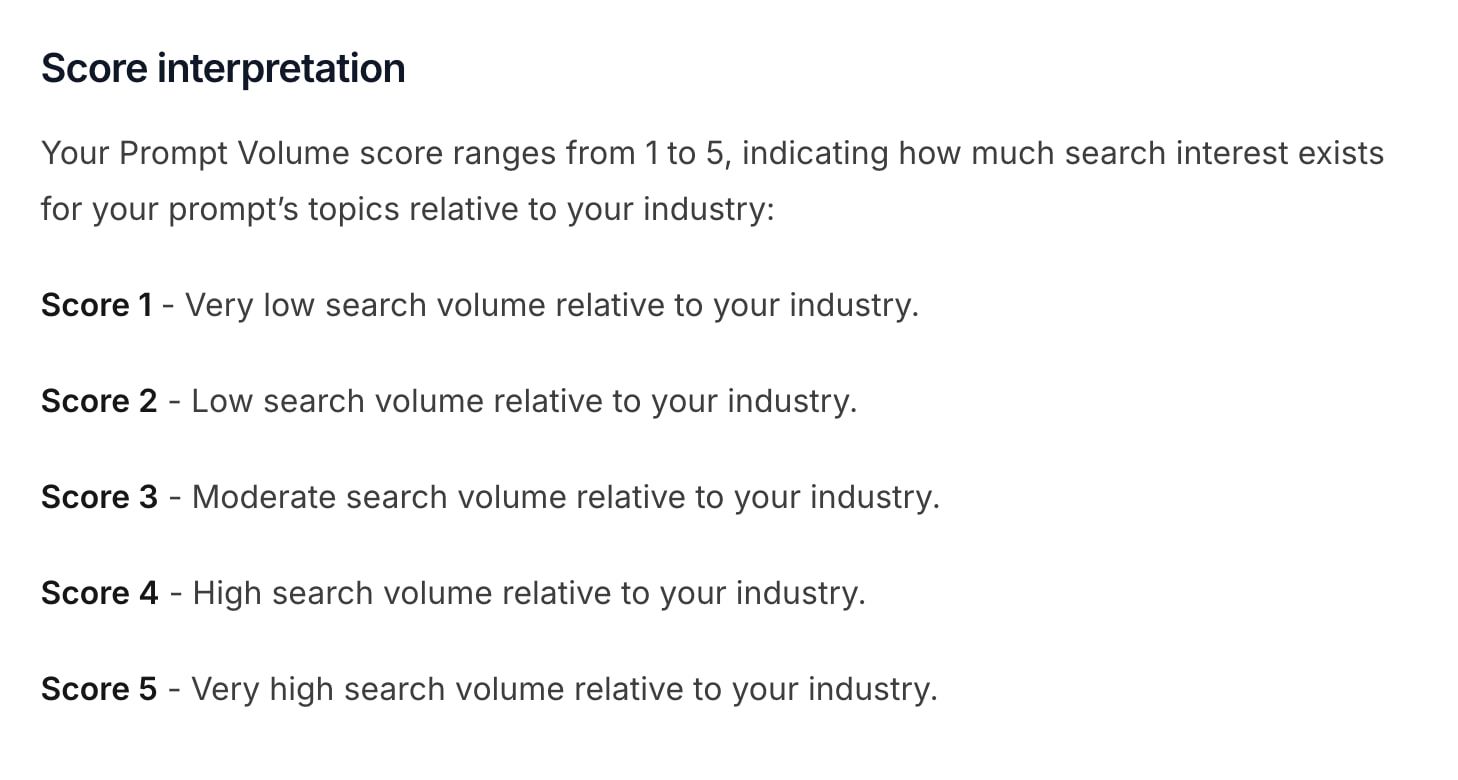
Peec’s score is the odd one out. It doesn’t give a number of searches at all, only a position on a five-point scale relative to your industry.
Is Ahrefs’ number just Google volume? #
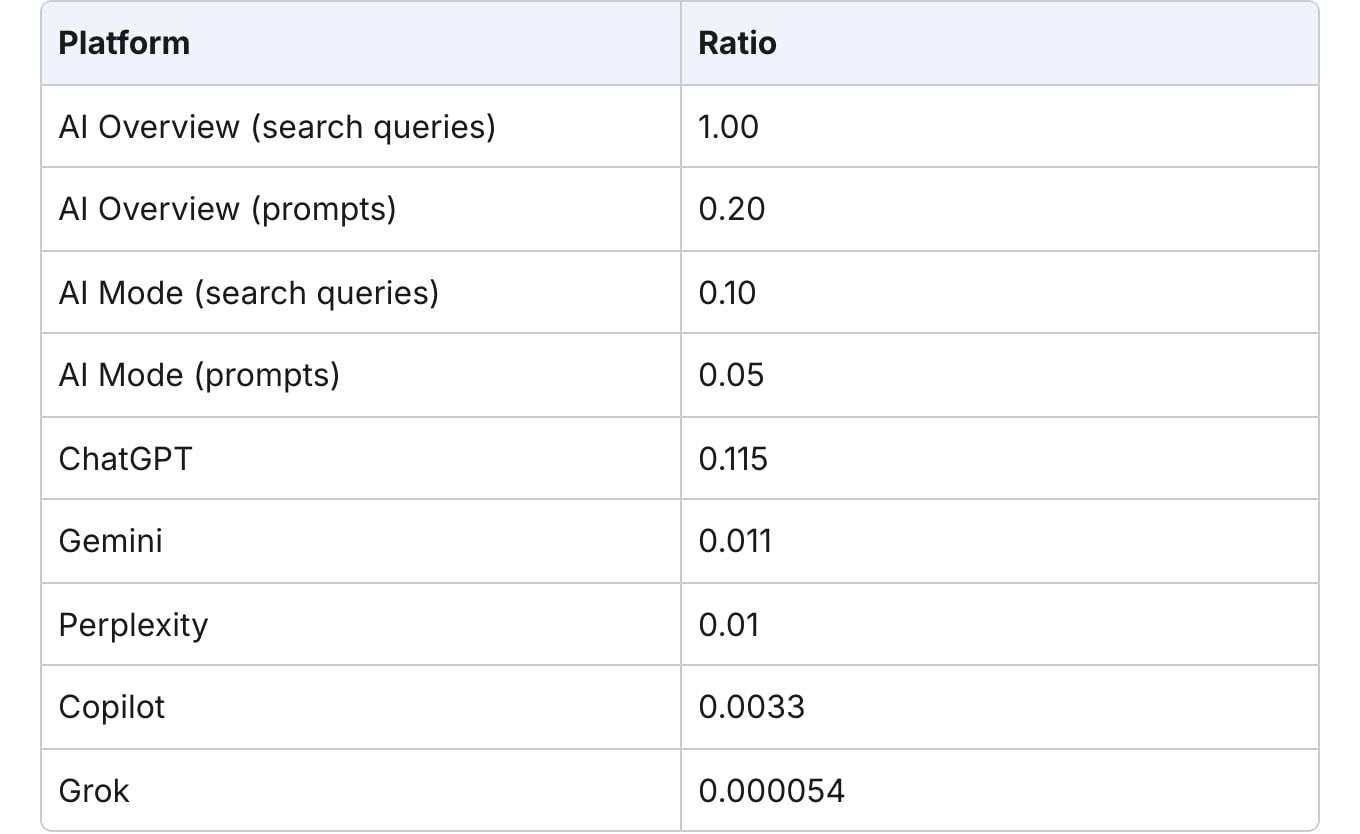
For each prompt it takes the Google volume of a parent keyword and multiplies by a platform ratio, 0.115 for ChatGPT. Ahrefs says so itself on a help page dated 3 September 2026.
| Platform | Ratio applied to the parent keyword's Google volume |
|---|---|
| AI Overviews (queries) | 1.00 |
| AI Overviews (prompts) | 0.20 |
| AI Mode (queries) | 0.10 |
| AI Mode (prompts) | 0.05 |
| ChatGPT | 0.115 |
| Gemini | 0.011 |
| Perplexity | 0.01 |
| Copilot | 0.0033 |
| Grok | 0.000054 |
Source: Ahrefs help page dated 3 Sep 2026, read 24 Nov 2026. The page doesn't say how often the ratios are updated. Scroll sideways for more columns.
The parent keyword comes from People Also Ask questions, and the highest-volume one wins (Ahrefs help). Ahrefs’ example is a prompt about a latte mug, asked in ChatGPT in the US. The parent keyword, latte cups, has 1,296 Google searches (August 2026), and 1,296 × 0.115 is about 149, which the tool shows as 150. I redid that sum and it holds.
Here’s my inference, and it’s mine, not Ahrefs’. Within one platform every prompt gets the same ratio, so ranking ChatGPT prompts by AI adjusted volume should give the same order as ranking their parent keywords by Google volume. The number adds a scale. It adds no new information about what people ask AI.
That’s why I’d read it as a relative sort. Ahrefs itself says its estimates aren’t derived from user query data, and that they can be read directionally to see what’s more (Ahrefs). It also says they’re not useful for sizing an AI-only market.
Two more points on the Ahrefs method:
- It changed on 31 August 2026. Before that, all platforms showed the same volume for the same prompt, and figures from before the switch may not match.
- The ratios aren’t explained. ChatGPT’s 0.115 is about ten times Gemini’s 0.011, my arithmetic, and the help page doesn’t say how either was derived.
DemandSphere sells the same kind of recipe with different weights. Its example takes 135,000 Google searches to 28,350 for ChatGPT, which is 21% (my arithmetic), against Ahrefs’ 11.5% (DemandSphere). The same kind of method, weights about 1.8 times apart, and neither explains its weights.
DataForSEO’s help page gives a sharper example. For one keyword in the US it shows 12,621,380 on Google AI Overviews and 63,850 on ChatGPT, roughly 200 times apart by my arithmetic, and warns that values may vary significantly by platform (DataForSEO).
Peec and Profound may carry more signal than a rescaled Google number, since both say they draw on AI conversations. But their public pages don’t give enough detail for me to check, so I can’t say.
What can’t a panel see? #
Mostly mobile, apps and anyone who isn’t in it, say the critics. The critics also sell something.
Scrunch says third-party panels are mostly browser extensions that miss mobile, apps and Safari (Scrunch). Conductor makes similar points about incentivised panels and desktop-only extension data, and says it’s building its own solution (Conductor).
DemandSphere calls this clickstream data and guesses panels cover at most 10 to 20 million people, yet it sells a Google-weighted number. A consultancy, Jaeckert & O’Daniel, argues prompt volume looks precise but carries false precision and isn’t yet a reliable control metric. It has no tests either, and it sells SEO and GEO services (Jaeckert & O’Daniel).
On the other side, Profound’s docs describe real prompts from licensed conversations, anonymized and aggregated, strongest in the US, UK and select European markets. US history starts in January 2025 and other regions in January 2026 (Profound docs). They don’t give panel size, unit or projection method.
Nick Lafferty, who says he works at Profound, writes that its panel is double opt-in and adjusted for demographic and geographic bias (Lafferty). That’s Profound’s own account, with nothing from outside it.
Conductor adds a sample-size argument. It gives a total of about 2.5 billion prompts a day, and says a sample of tens of millions a month is far under 1%. It mixes a daily total with a monthly sample, so I fixed the units.
Over 30 days, 2.5 billion a day is 75 billion, so a 50-million sample would be about 0.07%. That’s ChatGPT only, at the July 2025 rate, and my illustration, not a claim about any vendor’s panel. Conductor’s 0.15% figure has no source.
Here’s my opinion. A small sample can still be representative if it’s drawn well. The problem is that nobody publishes how it was drawn.
Ahrefs says AI prompt volumes can be significantly over-estimated, which I read as aimed at panel-based figures. It names no vendor and shows no data. Profound sells the panel, and DemandSphere calls panels weak while selling a Google-weighted number. Each side’s number is unverifiable from outside.
Why don’t two tools agree? #
They start from different data and weights, and they change method. Ahrefs replaced its approach on 31 August 2026, and seoClarity moved off clickstream in January.
seoClarity published a model of ChatGPT searches in September 2025, built from OpenAI telemetry, the NBER paper and stated assumptions. On 9 January 2026 it said its first volume model leaned heavily on clickstream and showed gaps in country coverage, industry representation and outliers. It rebuilt on Google demand as the base with adjustment layers, and gives no accuracy metrics (seoClarity, model).
Profound’s coverage shifted too. Its December 2024 launch post described a closed beta (Profound). Its August 2025 post said about 200 million precomputed keyword volumes, US ChatGPT only (Profound). Its docs now list ChatGPT, Gemini and Perplexity.
The practical rule: log the tool and the date next to every figure, and don’t compare numbers across vendors, platforms or quarters.
What do the vendors admit themselves? #
That it’s directional. Four vendors use that word or a close one, and it matches what the critics say.
| Vendor | What it says | Source |
|---|---|---|
| Ahrefs | Its estimates aren't from user query data; read them directionally | Ahrefs blog, 17 Aug 2026 |
| Semrush | No platform can give exact visibility numbers; its data is a reliable directional signal | Semrush KB, AI visibility data |
| Scrunch | Its data is directional, not exact | Scrunch FAQ |
| AirOps | Volume is relative and directional | AirOps glossary |
| Peec | A relative demand score against your industry, not a count | Peec docs |
Source: The vendors' own pages, read 24 Nov 2026. These are paraphrases, because the quotes reached me through a summarising reader. Scroll sideways for more columns.
Gracker’s glossary gives the same advice: compare topics within one tool and re-check quarterly (Gracker). It’s a promotional page that cites others’ methods and gives none of its own, so I count it as an echo and not evidence.
This is my main reason for the verdict. When the sellers and the critics agree on “relative only”, buying a number to forecast with makes no sense.
What can you use instead, for free? #
Search Console queries, Bing’s grounding queries, Google Trends or Keyword Planner, and the questions your own sales and support teams hear. None of them is a count of AI prompts either.
Bing’s AI Performance report lists grounding queries, the phrases the AI searched for, which aren’t what users typed (my Bing post). Conductor suggests Google Trends, Search Console and Keyword Planner as proxies, and says to use prompts qualitatively. It’s a competitor’s suggestion, and it’s also the cheapest one (Conductor).
How to turn those into a prompt list is in my prompt-count post, and how the tools source their prompts is in how AI visibility tools work. For a plain definition, see my glossary.
Should you pay for it? #
Not for volume alone. Free proxies give you an ordering of topics, and a ratio-based number gives the same ordering with a scale on top.
Plan facts, read 24 November 2026, from the “$” views that loaded:
- Semrush AI Visibility Toolkit: $99 a month per domain, shown with annual billing, listing AI competitor analysis and prompt research, and 25 custom prompts daily (Semrush).
- Ahrefs Brand Radar AI: from $199 a month, with a database of 588 million+ prompts. Custom prompt packs run $50, $100 and $250 (Ahrefs).
- Profound Prompt Volumes: its pricing page lists only Enterprise, with a custom number of searches, and says Starter and Growth were retired in September 2026 (Profound). Its docs say all plans. Check before you buy.
So my picks:
- Choosing topics: the free list above. Don’t buy volume for this.
- Already on Semrush’s toolkit: use Prompt Research as a relative sort, and quote topics, never counts.
- On Brand Radar: read it as Google volume rescaled per platform (my inference), not as people asking AI. My Semrush vs Ahrefs comparison covers the two suites.
- Pitched Profound Prompt Volumes: ask where the prompts come from, how big and how recruited the panel is, what the unit and period are, and what changed this year. Ask for one case where its number was checked against ground truth. My Profound pricing post has the plan detail.
- Never: forecast traffic or revenue from it.
That’s my reading of the vendors’ pages, not a check of their numbers. I’ll update this post if a vendor publishes a method or an accuracy check.
If you have to justify the spend to someone, my AI visibility ROI post covers what to show. The wider topic sits in my AI visibility hub.
FAQ
Does ChatGPT publish prompt volume?
Only totals. OpenAI gave Axios a figure of 2.5 billion prompts a day in July 2025, which TechCrunch relayed without saying it checked it. I found nothing per prompt or per topic from any AI platform.
How does Ahrefs calculate AI adjusted volume?
It takes the Google search volume of a parent keyword and multiplies it by a fixed ratio per platform. Per its help page, the ChatGPT ratio is 0.115, so a parent keyword with 1,296 Google searches comes out near 149.
Is Profound's Prompt Volumes real user data?
Profound says it licenses real AI conversations and models them. Its docs don't give the panel size, unit or projection method, and I couldn't verify the claim. Its pricing page lists the feature on Enterprise only, so check before you buy.
What does Peec's 1 to 5 prompt volume score mean?
Peec describes it as a demand score relative to your industry, from 1 for very low to 5 for very high. It isn't a count, and its docs don't say how industry is defined or what plans include it.
Can I forecast traffic from prompt volume?
No. Vendors call their estimates directional, and Ahrefs says its figure isn't derived from user query data and isn't suited to sizing an AI-only market. Use it to compare topics, not to project visits.
Why do two tools show different numbers?
They start from different data and weights, and methods change. Ahrefs applies 0.115 to ChatGPT, while DemandSphere's example implies about 0.21. Ahrefs replaced its approach on 31 August 2026, so figures from different dates or vendors aren't comparable.
What should I use instead of prompt volume?
Search Console queries, Bing's grounding queries, Google Trends or Keyword Planner, and the questions your sales and support teams hear. They are free, and none of them is a count of AI prompts either.
Sources
25 sources, accessed .
Official pricing, docs, changelogs and status pages 12
- Ahrefs help: what is AI adjusted volume and how is it calculated, dated 3 Sep 2026
- Semrush knowledge base: Prompt Research report
- Semrush knowledge base: AI visibility data
- Peec AI docs: Prompt Volume
- Profound docs: about Prompt Volumes
- Profound: pricing page
- DataForSEO help: how the AI search volume metric works
- Scrunch help: understanding prompt volume in AI search, 4 Sep 2026
- Scrunch FAQ: how Scrunch estimates AI search volume metrics
- AirOps (vendor glossary): AI search volume
- Ahrefs: pricing page, Brand Radar and prompt packs
- Semrush: AI Visibility Toolkit pricing
Independent benchmarks and published studies 1
Other blogs 11
- Ahrefs (vendor blog): how Ahrefs estimates AI search demand, 17 Aug 2026
- Profound (vendor blog): Prompt Volumes keyword volume projection, 1 Aug 2025
- Profound (vendor blog): introducing Prompt Volumes, 16 Dec 2024
- Writesonic (vendor blog): introducing Prompt Explorer, 7 Aug 2025, metadata updated 28 Jul 2026
- seoClarity (vendor research): how many searches really happen on ChatGPT, refined model, 16 Sep 2025
- seoClarity (vendor research): AI search volume estimates updated, 9 Jan 2026
- DemandSphere (vendor blog): prompt volume and prompt research, 29 Apr 2026
- Conductor (vendor blog): debunking AI prompt volume, updated 8 Jul 2026
- Gracker (vendor glossary): prompt volume, modified 7 Nov 2026
- Jaeckert & O'Daniel (consultancy blog): prompt search volume, real data or all guessed, 5 Jan 2026
- Nick Lafferty (says he works at Profound): prompt volume and AEO explained, updated 19 Nov 2026
Last updated: 24 November 2026. Facts verified 24 Nov 2026. Researched and drafted with AI tools; owner review is pending.


