Can Search Console's API now split brand queries?
Google added a branded/non-branded split to the Search Console API on 16 Nov. Who gets it, the 21 Feb cutoff, and when your regex is still needed.

Short on time?
Short on time? Here's what I would do.
- Your property is eligible and you report on branded vs non-branded
- API split from 21 Feb, your regex before that
- Run both side by side for one month before you trust the API numbers.
- Your API call returns no rows
- Treat it as 'not eligible', and stay on your regex
- An empty response isn't an error, and it doesn't mean zero brand traffic.
- You pay for a reporting tool mainly for this split
- Don't buy or switch for it
- Ask the vendor whether it uses Google's field, and from what date. I found no vendor statement.
- You send client reports
- Run the three-step check first
- Don't change a client's brand numbers until the two methods agree. The check is my reading of others' advice.
Prices verified . Verified 23 Nov 2026 against Google's pages. The picks are my reading, not Google's advice. No vendor paid to be included, and sponsors can't buy a verdict.
On 16 November Google added a branded-query split to the Search Console API. It helps only some properties, and only from 21 February 2026.
I read Google’s announcement, its API reference and help pages, and the news coverage, to see who gets it and what to do with your own brand regex. For the wider tools picture, start at my SEO tools hub.
What did Google add on 16 November? #
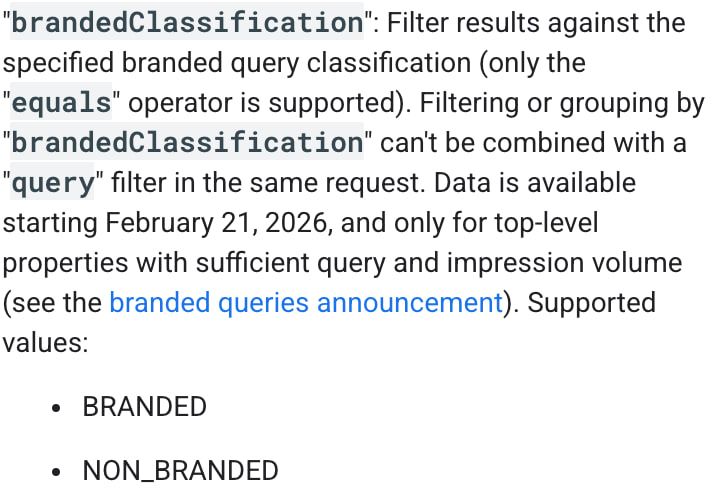
Three things to the Search Analytics API: a brandedClassification option, a webMultimodal search type, and filterLists, which filters several countries or devices in one request (Google’s post).
The branded option takes two values, BRANDED and NON_BRANDED, and you can group or filter by it. Search Engine Roundtable and PPC Land report the same three changes.
Who actually gets the branded split? #
Only eligible properties. For others, Google’s post says “the response won’t include any rows”.
Google’s API reference limits it to top-level properties with enough query and impression volume. The 2025 post about the Search Console filter excludes URL-path and subdomain properties and asks for “a sufficient volume of queries and impressions”. I found no published threshold.
An empty response isn’t an error, so it can look like zero branded clicks. Relevant Audience warns about exactly that.

How far back does it go? #
From 21 February 2026 per the API reference, which is about nine months: 275 days at 23 November, by my count. Earlier dates have no branded split in the API.
Google’s own pages disagree on history. The help page says “a 16-month history of data, starting from when it was first introduced in March 2025”. But Google’s post announcing the filter is dated 20 November 2025, so March 2025 doesn’t match that launch.
I couldn’t resolve that. I trust the API reference for API data, and John Mueller’s March remark fits it: “there’s a point when the data starts being tracked” (SEJ).
How good is Google’s idea of “branded”? #
Google says some queries get it wrong, and I found no way to edit its list. That caution isn’t in the 16 November post.
It’s in the 2025 post, which calls the classifier “an internal, AI-assisted system” where “some queries may occasionally be misidentified”, and in the help page: “Some queries might be incorrectly identified as branded or non-branded.” The help page adds that classifications are “for information only and don’t affect your site’s ranking in Search”.
No source I read says the API uses the same classifier as the filter, so I treat the caution as applying to both. SEJ’s Pulse says Google’s announcement warns about it; I found the warning in the 2025 post, not the 16 November one.
Where can you get a branded split? #
Four places, and each has a catch.
| Route | Needs | Data from | Who decides 'branded' | Catch |
|---|---|---|---|---|
| Search Console filter | Top-level property, enough impressions | Announced Nov 2025; 'all eligible sites' by 11 Mar 2026; history sentence disputed | Google, AI-assisted; no editing ('at the moment', per Mueller) | 'Some queries might be incorrectly identified' |
| API brandedClassification | Same eligibility | 21 Feb 2026, per the API reference | Google; not stated whether it's the filter's classifier; no edit route found | Empty response if ineligible; equals only; not with a query filter |
| Your own regex | Any property | Any date | You, and you can edit it | Can miss typos and product names that Google's 2025 post says its system covers |
| A reporting tool | Its docs | Unknown | Unknown | I found no vendor statement |
Source: Google's API reference, 2025 and 2026 posts and help page; SEJ and PPC Land. Read 23 Nov 2026. The API restrictions are my paraphrase of the reference. Scroll sideways for more columns.
Can my reporting tool use it? #
I found no vendor statement about this API change. One connector lists a similar dimension, and its source is unstated.
| Tool | What its page says | Read |
|---|---|---|
| Looker Studio connector (Google) | Names a Query field and a search type control; no mention of branded or multimodal. That's an absence on one page, not the live field list | 23 Nov 2026 |
| Supermetrics | Lists a 'Branded vs non-branded' dimension; doesn't say if it's Google's field or its own rule, or when it was added | 23 Nov 2026 |
| QueryWatch (phone app) | Says third-party apps get the split 'only if its developer adds it'; its own app doesn't show it. 'Not today.' | 23 Nov 2026 |
| AgencyAnalytics, Search Analytics for Sheets, Screaming Frog, Ahrefs | I found no statement either way | 23 Nov 2026 |
Source: Google's Looker Studio help page, Supermetrics and QueryWatch pages. Read 23 Nov 2026. QueryWatch's line is a vendor's self-report. Scroll sideways for more columns.
Links: Looker Studio help, Supermetrics and QueryWatch, which sells a Search Console app. For agency reporting tools, see SEO client reporting and AgencyAnalytics alternatives. If you’re weighing a paid tracker against Search Console data, why your rank tracker and Search Console disagree covers when each is the better source.
How do you check it against your regex? #
Three steps. They’re my reading of advice from SEJ, which says to run the split alongside your brand regex, and Relevant Audience, which says to keep the old regex report. Google doesn’t prescribe them.
- Pick one full month after 21 February, and confirm the property returns rows.
- Compare the API’s branded clicks with your regex total for the same month. The API can’t combine the branded option with a
queryfilter in the same request, so keep the regex report separate. - Read the 20 queries where the two disagree most, and decide which is right. The 20 is my number.
Relevant Audience also says to check totals against brand spellings before a board report. If you’re judging the November core update in Search Console, a branded split can help separate brand demand from rankings. That’s my opinion.
What about multimodal and filterLists? #
webMultimodal covers “Google Lens, Circle to Search on Android, and image uploads in Google Search”, per Google’s post. Google’s September post adds Chrome’s right-click “Search this image” and says the filter also sits in the Generative AI features report; my post on Search Console and AI Overviews covers that report.
Search Console’s help page lists “Web: multimodal” as including “search traffic when users search using images”. Google doesn’t say whether the web type includes webMultimodal, which SEJ also flags. Compare against your Performance report before adding totals. Google’s post says the type is also in BigQuery for properties with an active bulk export, with no date.
filterLists takes several countries or devices in one request. As I read the reference, it covers those two dimensions only, and you can’t use the same dimension in both filters and filterLists.
So what would I do? #
Use it where you’re eligible, and keep the regex.
- Eligible property: API split for dates from 21 February, regex before. Run the three-step check first.
- No rows back: assume you’re not eligible and stay on the regex.
- Paying for a reporting tool: don’t buy or switch for this alone. Ask the vendor whether it uses Google’s field, and from what date.
That’s my reading, not Google’s advice. I’ll update this post if Google or a reporting vendor says more.
FAQ
Can the Search Console API split branded and non-branded queries?
Yes, since 16 November 2026. Google added a brandedClassification option to the Search Analytics API that groups or filters by BRANDED and NON_BRANDED, for eligible properties.
How far back does the branded data go?
From 21 February 2026, according to Google's API reference. That's 275 days at 23 November (my count). Google's help page says March 2025, which conflicts with it, and I couldn't resolve that.
Why did my request return no rows?
Your property may not be eligible. Google's post says the response then won't include any rows, which is an empty result and not an error, so it doesn't mean you have no brand traffic.
Can I add my own brand terms?
I found no way. In March, John Mueller said adding or editing brand terms wasn't possible 'at the moment' (as Search Engine Journal reported it), and PPC Land says there's no way to review or edit the classification.
Do I still need a brand regex?
For dates before 21 February and for properties that aren't eligible, yes. For dates after it, run the API split next to your regex for a month before you trust it.
Does the API use the same classifier as the Search Console filter?
Google's 16 November post doesn't say. The 'AI-assisted' and 'may occasionally be misidentified' wording is in the November 2025 post and help page about the filter, so I treat it as a caution for both.
What is webMultimodal?
A search type for traffic from Google Lens, Circle to Search on Android and image uploads in Google Search. Google doesn't say whether the web type includes it, so check against your Performance report before adding totals.
Sources
15 sources, accessed .
Official pricing, docs, changelogs and status pages 7
- Google Search Central blog: Search Analytics API update, 16 Nov 2026
- Google Search Console API reference: searchanalytics.query
- Google Search Central blog: branded queries filter in Search Console, 20 Nov 2025
- Google Search Central blog: multimodal search type in Search Console, 24 Sept 2026
- Search Console help: Performance report dimensions and data groupings
- Search Console help: Performance report, date range and search type
- Looker Studio help: connect to Search Console
News and press 5
- Search Engine Journal: Google adds branded and multimodal data to the Search Console API, 17 Nov 2026
- PPC Land: Search Console API splits brand traffic back to February 21, 16 Nov 2026
- Search Engine Roundtable: Search Analytics API additions, 16 Nov 2026
- Search Engine Journal: SEO Pulse, 21 Nov 2026
- Search Engine Journal: Google answers questions about the branded queries filter, 12 Mar 2026
Other blogs 2
Last updated: 23 November 2026. Facts verified 23 Nov 2026. Researched and drafted with AI tools; owner review is pending.


