What is Semrush's AI-influenced traffic really estimating?
Semrush's AI-influenced traffic is a modeled estimate of visits it can't see. What it counts, what's unpublished, and the free numbers to keep.

Short on time?
Short on time? Here's what I would do.
- You already pay for Semrush
- Use it as a benchmark, nothing more
- Semrush itself recommends it for comparison. Compare your brand with rivals, and keep GA4 and Search Console as the figures you report.
- You don't pay for Semrush
- GA4's AI Assistant channel plus Search Console
- Don't buy a plan for this metric. The announcement names no plan and publishes no accuracy figures.
- Someone asks how much traffic AI drives
- Observed AI sessions, with the estimate labeled
- Report GA4's AI Assistant sessions. Attach Semrush's definition and the word estimate to anything modeled.
Prices verified . Facts verified 23 Nov 2026. Every claim about the model is Semrush's own. No vendor paid to be included, and sponsors can't buy a verdict.
On 18 November Semrush announced a metric called AI-influenced traffic, an estimate of the site visits that being mentioned in AI answers may have earned a brand. It’s the vendor’s own claim, so I read Semrush’s announcement and help pages, Google’s channel documentation and the one outside write-up I found.
Below: what the number counts, what’s unpublished, and which numbers I’d keep reporting. For the wider picture, start at my AI visibility hub.
What did Semrush announce? #
A metric that, in Semrush’s words, “estimates the website visits a brand earns from being mentioned or cited in AI answers” (Semrush blog, 18 Nov 2026, by Luke Harsel).
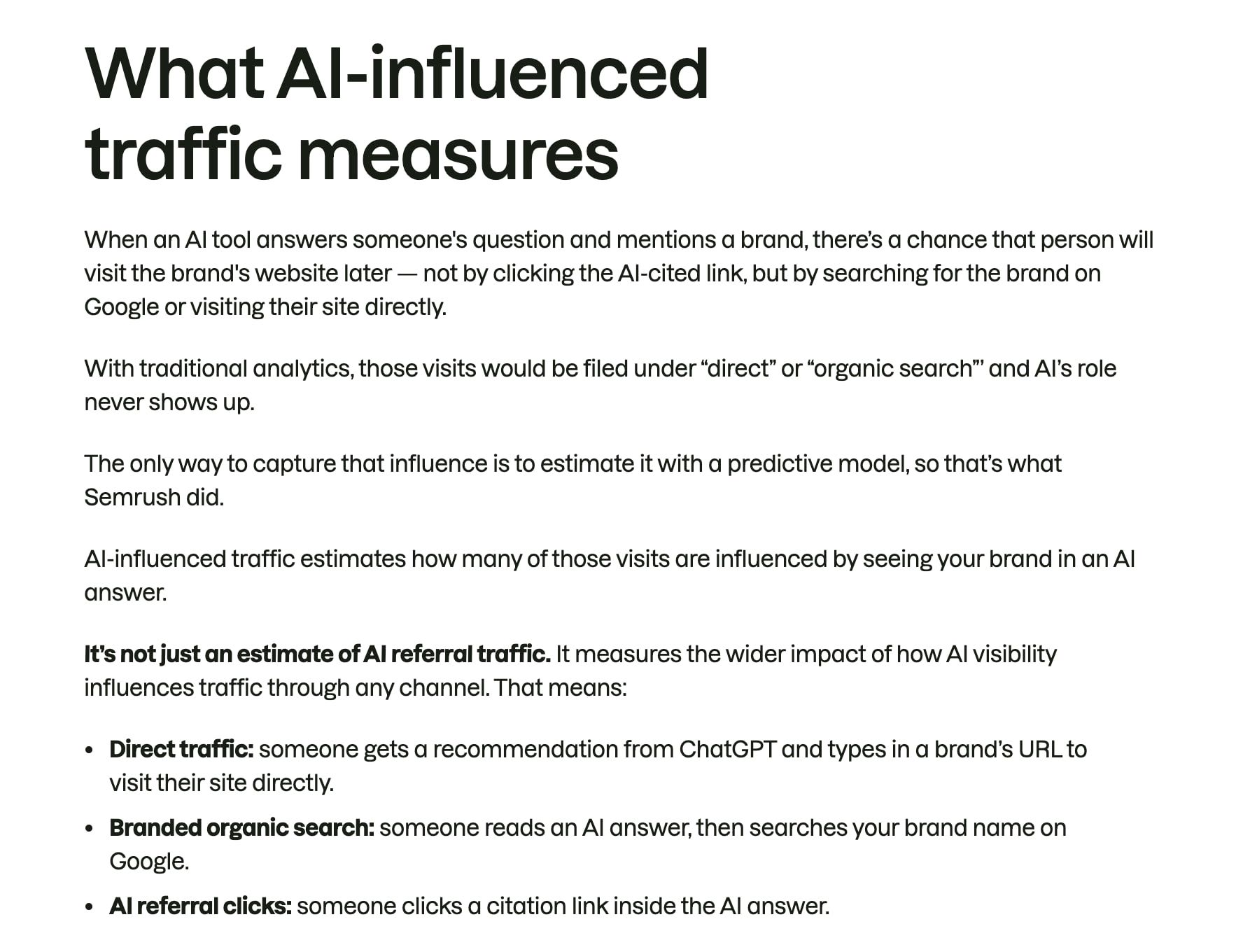
Semrush says those visits can arrive by any route. Someone types your URL after an AI recommendation, searches your brand name on Google, or clicks a link in the answer.
The number sits in Organic Rankings 2.0, beside organic traffic and mentions and citations per topic, and the rollout starts with US and UK data, per the same post.
It’s a blog post, not a press release: the newsroom list I opened, whose latest item was dated 16 November, has no entry for it. I saw no trade-press report of the metric either, so everything about the model on this page is Semrush’s account.
How does it estimate visits it can’t see? #
With a predictive model. Semrush says these visits can’t be observed directly, so it estimates them from three inputs (announcement):
- Aggregated web activity that links brand mentions in AI answers to website visits, through any channel, within a 24-hour window.
- The brand’s AI visibility in Semrush’s own AI search database: how often and how consistently it appears across its topics.
- How much demand each topic has.
Semrush says it applies the same model to every domain and topic each month, so comparing one brand with another is like for like. It recommends using the figure as a benchmark or comparison number.
That’s a sensible use for a model, but it answers “how do I stack up?” better than “how many visits did AI send me?”
Here’s what I found nowhere in the announcement:
- Any accuracy or validation result for the model.
- Which plans include the metric.
- Any comparison against GA4 or Search Console.
Semrush’s separate help page on how it turns traffic data into estimates publishes no error ranges either (Semrush KB). Its AI Traffic Checker page calls its numbers directional rather than exact (AI Traffic Checker).
Is it the same as AI referral traffic? #
No. Referral traffic is clicks that arrive from an AI platform; AI-influenced traffic also includes visits Semrush thinks an AI answer prompted that arrived another way.
Semrush’s own AI Traffic Checker page draws that line. Visits like these “may be influenced by AI, but they’re not usually counted as AI traffic because the visit did not come directly from the AI platform” (Semrush). The new metric counts them, so the two Semrush numbers measure different things.
The AI Traffic dashboard is a third thing: a tool for seeing how competitors gain traffic from AI assistants such as ChatGPT, Gemini and Copilot. Its help page doesn’t define “influenced” or explain the method.
| Number | Observed or modeled | Where it comes from | Blind spot |
|---|---|---|---|
| GA4 AI Assistant channel sessions | Observed, by referrer | Your own GA4 | Clicks with no referrer land in Direct; Google AI Overviews and AI Mode clicks aren't in this channel |
| Search Console clicks and impressions | Observed, Google only | Your own property | Says nothing about ChatGPT or other assistants |
| Direct and branded-search trend | Observed, cause unknown | GA4 and Search Console | A rise doesn't prove an AI answer caused it |
| Semrush AI-influenced traffic | Modeled; Semrush says visits aren't directly observable | Semrush's model | No accuracy figures published |
| Semrush AI Traffic dashboard and checker | Modeled competitor estimate, described as directional | Semrush | Not your own data |
Source: Semrush announcement, AI Traffic Checker and help pages; Google Analytics Help; Search Engine Journal. Read 23 Nov 2026. Scroll sideways for more columns.
Even Semrush’s own advice on AI traffic quality leans on observed numbers. It suggests comparing your own AI sessions with other channels over at least 90 days and tracking revenue per session, and it admits some AI-influenced purchases will stay unmeasured (Semrush blog, 12 Nov 2026).
What did the one outside write-up show? #
Linus Li, whose bio on that site lists him as Head of Technical Solutions at Yiguo Technology / Jindouyun SEO, looked at Organic Rankings 2.0 for one site, allbirds.com, in the US database for October 2026. His post is dated 19 November and was updated on 20 November (Linus SEO).
What he reports:
- The older organic report estimated 259K organic visits for that month, and Organic Rankings 2.0 estimated 73.2K.
- Both 2.0 tools cover only the US and UK databases, and history starts in January 2026.
- The Branded filter showed nothing for that site.
- He quotes Semrush calling the new organic model “a strong directional signal”.
Those first two numbers are two Semrush organic estimates disagreeing about one site. They’re not the AI metric, and they don’t tell us how accurate it is. It’s one domain, one month and one author leaning on Semrush’s own pages, so I treat it as a reported example, not a benchmark.
What can you measure for free? #
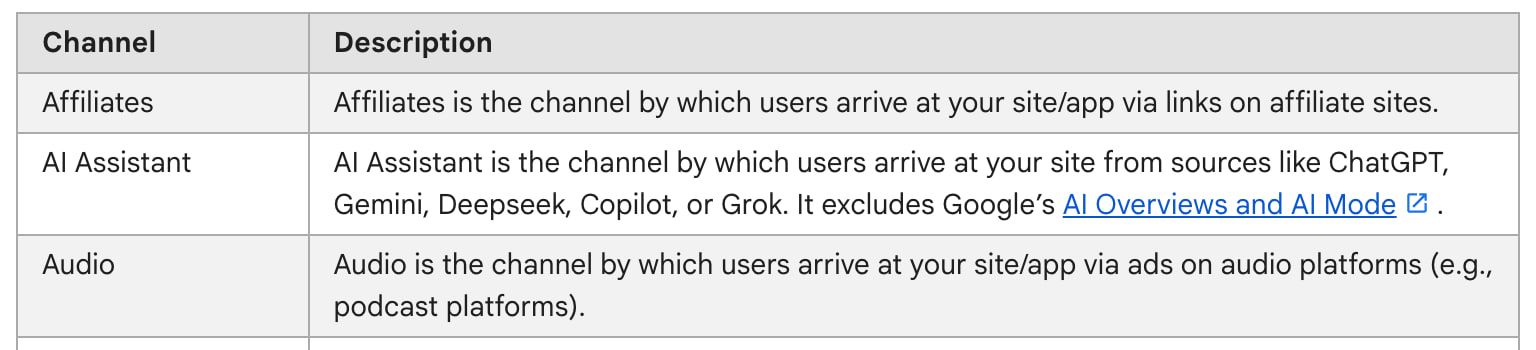
GA4 now has an observed AI channel. Google’s default channel group includes an AI Assistant channel for visits from assistants such as ChatGPT and Gemini (Google Analytics Help).
Search Engine Journal reported on 14 May 2026 that GA4 had added it automatically: a recognised AI referrer gets the medium ai-assistant, and this traffic used to sit in Referral (SEJ).
The limits are real, and they come from Google and SEJ, not from me:
- Google hasn’t published the list of referrers it recognises.
- Visits with no referrer header still land in Direct. SEJ names in-app browsers, mobile apps and pasted links.
- The definition leaves out Google AI Overviews and AI Mode; Semrush’s own post says those clicks are classed under Organic Search in GA4.
- You may still need a custom channel group, per SEJ.
Search Console adds your real Google clicks and impressions. I explain its AI report in Search Console and AI Overviews, and the GA4 setup step by step in how to track ChatGPT traffic in GA4.
For the influenced part, watch Direct sessions in GA4 and branded queries in Search Console. Semrush says that’s where such visits show up. A rise there is a hint, not proof that an AI answer caused it.
Is it worth paying for? #
Not for this metric alone. The announcement names no plan and publishes no accuracy figure, so there’s nothing to weigh a price against.
Plans change, so check Semrush’s pricing page and my Semrush pricing post, not this page. If you’re choosing between AI tracking suites, Semrush AI Toolkit vs Ahrefs Brand Radar is the closer comparison, and how to measure AI visibility, with or without a tool covers the free route.
So what would I do? #
Keep your measured numbers as the numbers you report, and treat Semrush’s figure as context.
- You already pay for Semrush: open the metric, compare your brand with rivals, and call it a benchmark in any report. That’s Semrush’s own word for it.
- You don’t pay for Semrush: skip this metric. Set up GA4’s AI Assistant channel, which is free, and watch Direct and branded search.
- You’re asked how much traffic AI drives: give the observed AI sessions from GA4, and attach Semrush’s definition and the word estimate to anything modeled.
I’ll update this post if Semrush publishes accuracy figures or says which plans include the metric.
FAQ
What is AI-influenced traffic?
It's Semrush's estimate of the website visits a brand earns from being mentioned or cited in AI answers. Semrush says the visits can arrive through any channel: direct, branded search or AI referral clicks. It's a modeled number, not a count from your analytics.
Is it the same as AI referral traffic?
No. Referral clicks are visits that arrive from an AI platform, and they're one part of what Semrush says the new metric covers. It also counts direct and branded-search visits that Semrush thinks an AI answer prompted. Semrush's own AI Traffic Checker page says such visits are not usually counted as AI traffic.
Where do I find it?
Semrush says it sits in Organic Rankings 2.0, next to organic traffic and mentions and citations per topic. The rollout starts with US and UK data.
How accurate is it?
Semrush publishes no accuracy or validation figures for it, and recommends it as a benchmark or comparison number. The one outside write-up I found looked at a single site and compared two of Semrush's organic estimates, not this metric, so I can't call it accurate or inaccurate.
Does it replace GA4 or Search Console?
No. GA4 and Search Console report visits and clicks your own property recorded. Semrush's metric is a model, and Semrush says the visits it estimates aren't directly observable.
Which Semrush plan includes it?
The announcement doesn't say. Check Semrush's pricing page before buying anything for this metric.
Sources
10 sources, accessed .
Official pricing, docs, changelogs and status pages 8
- Semrush blog (the vendor's own announcement): AI-influenced traffic, 18 Nov 2026
- Semrush blog: AI traffic quality, 12 Nov 2026
- Semrush: AI Traffic Checker
- Semrush knowledge base: the AI Traffic dashboard
- Semrush knowledge base: how Semrush turns traffic data into traffic intelligence
- Semrush newsroom: product news list
- Semrush pricing page (read for context; no prices used here)
- Google Analytics Help: default channel group
News and press 1
Last updated: 23 November 2026. Facts verified 23 Nov 2026. Researched and drafted with AI tools; owner review is pending.


