Did Google's sign-in wall break your rank tracker?
Google may be testing a sign-in wall on first searches. What's confirmed, what vendors have said, and what to check before you switch rank trackers.

Short on time?
Short on time? Here's what I would do.
- You already pay for a tracker
- Keep it, and confirm drops in Search Console
- Mark 17–18 Nov on your charts, check clicks year over year before reporting any drop, and ask for a status page.
- Choosing one now
- AccuRanker or SE Ranking, on published methods
- AccuRanker published the most detailed re-check method I read; SE Ranking published a filter and corrected history. Both are self-reported. Ask Ahrefs and Semrush in writing.
- Few keywords, one country
- Search Console alone
- It shows real clicks and costs nothing. My comparison is in rank tracker vs Search Console.
- Agencies
- A one-line data caveat in client reports
- Say tracker data had gaps in mid-November, and export history now.
Prices verified . Verified 23 Nov 2026. No vendor paid to be included, and sponsors can't buy a verdict.
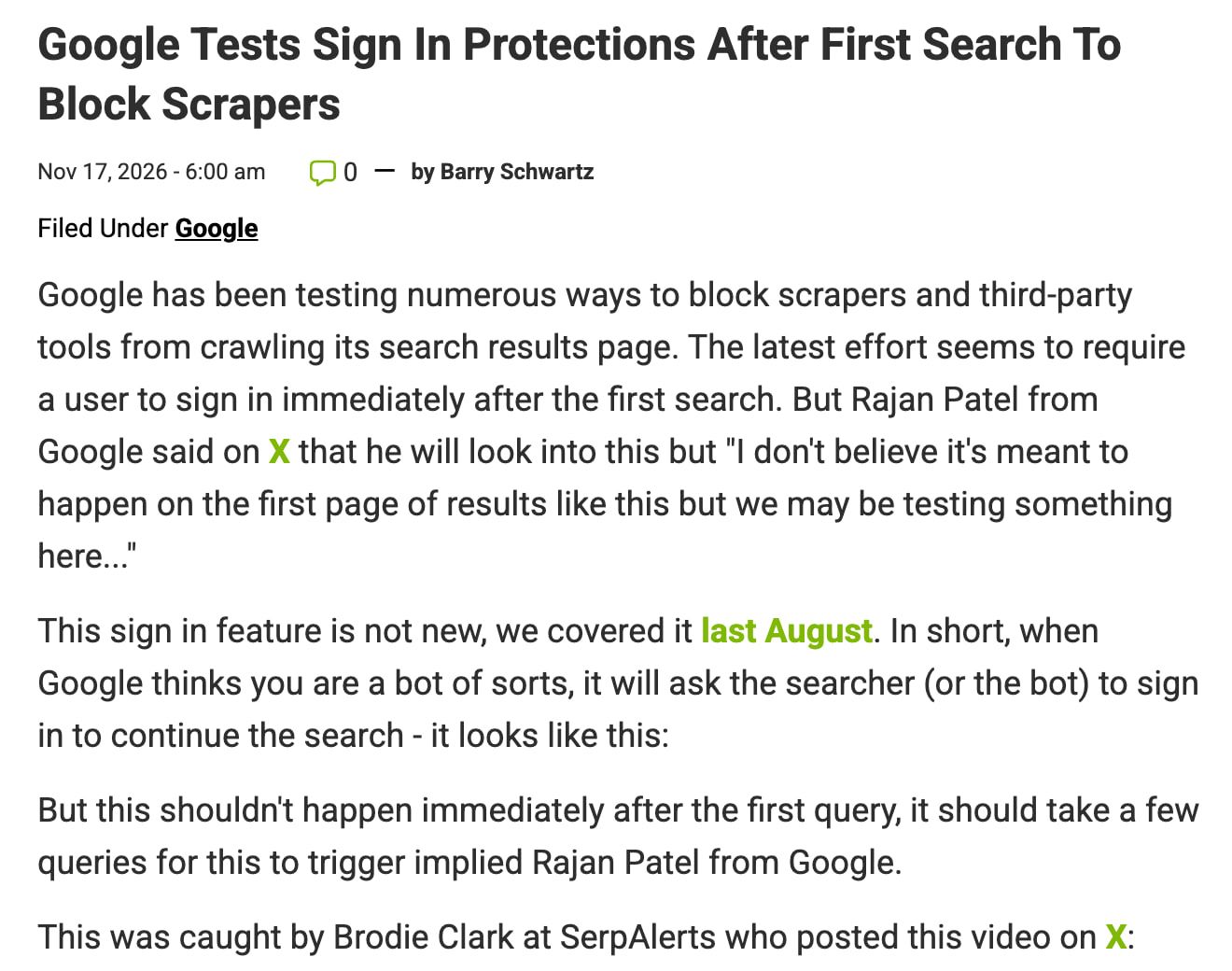
On 17 November, Search Engine Roundtable reported that Google appeared to be testing a sign-in prompt even after a first search. The next day, rank-tracking vendor Nozzle reported a sharp fall in the results Google delivered to it.
I read the reports, the vendors’ latest notes and Google’s help pages, so this post separates what’s confirmed from what isn’t, then says what a tracker buyer should do. For the wider category, start at my rank trackers hub.
What did Google actually do? #
Google appears to be testing a sign-in prompt for suspected bots, and it is a test, not a rule. Search Engine Roundtable reported on 17 November that the prompt showed up even after a first search.
Brodie Clark posted a video and said “I’ve never had this happen to me before when using incognito.” Google’s Rajan Patel replied, as quoted by SER: “I don’t believe it’s meant to happen on the first page of results like this but we may be testing something here…” I read both second-hand, because I didn’t open x.com.
There is an earlier sighting. On 3 August, SER reported a prompt reading “Sign in to verify you’re a human and see more results” after paging past the first few pages; Barry Schwartz couldn’t reproduce it, and TechWyse couldn’t either.
SER’s November report quantifies no impact and quotes no tracker vendor, and its 20 November video recap repeats the item without naming a tracker. I found no Google statement beyond Patel’s reply.
How bad was it for trackers? #
One vendor measured it. Nozzle, which sells rank tracking, says in its 18 November post that the results Google delivered to it fell to 1.6% of a normal hour at the low, and to 11.6% of normal across 13:00 to 23:00 UTC.
Its post says five data providers each hit 2% or less in their worst hour. In one provider’s sample of blocked attempts, 31% ended on the sign-in wall and the rest on a CAPTCHA, and after 23:00 UTC the wall showed on a little under 1% of that provider’s loads.
So the more accurate phrase is “bot checks, including a sign-in wall”. As I read the post, Nozzle expects rank collection to get harder and costlier and gives customers no advice. These are one company’s unaudited numbers.
| Date (2026) | What | Source |
|---|---|---|
| 3 Aug | Sign-in prompt seen after paging past the first few pages; not reproduced | SER |
| 26 Aug | Google's result-link redirect confirmed rolling out; Nozzle estimates 500–1,000 requests to resolve one five-page ranking | PPC Land |
| About 13–18 Sep | Nozzle sees about 80% less data from Google; Sistrix posts a status note on 16 Sep | SER |
| 12–27 Oct | Vendors give rates for swapped ('poisoned') results | SER, AccuRanker, Ahrefs |
| 3 Nov | SE Ranking study: filter, rechecks, about 95% of history corrected | SE Ranking |
| 17 Nov | Sign-in prompt reported after a first search; Patel: 'we may be testing something here' | SER |
| 18 Nov | Nozzle's deliveries fall to 11.6% of normal over ten hours | Nozzle |
Source: Search Engine Roundtable, PPC Land, Nozzle, AccuRanker, Ahrefs and SE Ranking pages, read 23 Nov 2026. Scroll sideways for more columns.
The mid-September row comes from SER’s 18 September report.
Is this the same as the junk results? #
No. Four different problems get blurred together, and only the last is this story.
- Swapped (“poisoned”) pages: wrong results that got into a tracker’s data.
- One-word results: results for a shortened query, mostly at position 9 or lower. My junk results post has the numbers.
- Cost of collection: PPC Land reported Google’s result-link redirect, and quoted Nozzle’s estimate of 500–1,000 requests to resolve one five-page ranking.
- Bot checks: the CAPTCHA and sign-in wall above, where a tracker can’t fetch the page at all.
All four can look like a sudden drop. Schwartz wrote on 16 November that he suspects muted core-update chatter is tied to “third-party Google tracking tools that are struggling”, so my core update guide tells you to trust Search Console.
What have vendors said so far? #
None of the vendor pages I read mentions the sign-in wall. Their latest notes are about swapped results, with different rates and different fixes, and all were written before 17 November.
| Vendor | Latest statement I opened | What it promises | Mentions sign-in or CAPTCHA? |
|---|---|---|---|
| AccuRanker | 19 Oct, data to 25 Oct | Re-fetches suspect pages, history and 'sandwich' checks, a keyword refresh in the app | No |
| SE Ranking | 3 Nov study (status page wouldn't open) | A filter since October, automatic rechecks, 'corrected about 95% of historical data within two weeks' | No |
| Ahrefs | 22 Oct, updated 6 Nov | Filters, rejects abnormal results, cleans past data, dashboard notices | No |
| Semrush | Quoted by SER in its 12 Oct article; help page | Says impact was 'limited'; no method published | Not on pages I read |
| Nozzle | 18 Nov | Measures the event; no customer steps | Yes, its own data |
| Nightwatch, Mangools, Moz, Wincher | Not searched | Ask in writing | Unverified |
Source: Vendor pages and Search Engine Roundtable, read 23 Nov 2026. Everything here is self-reported and unaudited. Scroll sideways for more columns.
The rates differ because they measure different things. Ahrefs says 5% to 20% of results were affected depending on provider; SE Ranking said on 16 October that roughly 2% of tracked results were still affected (SER); and AccuRanker had 0.6% of desktop and 1.0% of mobile keywords still showing a swapped page one on 25 October. None is a sign-in number.
How do you check a drop before you report it? #
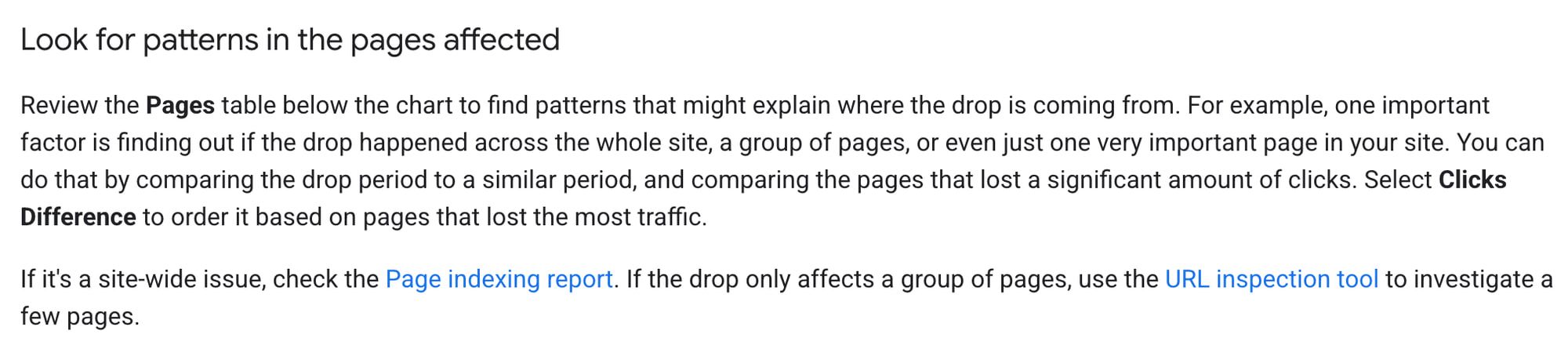
Open Search Console, compare the last three months year over year, and sort pages by the clicks difference. If clicks held while the tracker fell, suspect the tracker.
That’s the sequence in Google’s traffic-drop guide: set the last 16 months, use the Compare tab, filter by query, page, country or device, split Web, Images, Video and News, and sort Pages by the clicks difference.
The limit is on page 2. Google defines position as the topmost position of a link to your property, and a link needs an impression to get one, so low-impression keywords give thin data. My rank tracker vs Search Console post covers that gap.
Mark 17–18 November on the chart with a custom annotation: right-click, “Add annotation”, up to 120 characters, visible to everyone with property access.
Should you save your history now? #
Yes, because it’s cheap. Semrush’s help page says Position Tracking “tracks daily results for 60 days”, then keeps weekly snapshots, and you can export to Excel, CSV, Google Sheets or PDF (Semrush).
By my arithmetic, daily points for 17 November turn weekly around 16 January 2027. Export before then; how often you need daily data at all is a separate question in daily vs weekly rank tracking. If you decide to move, see how to switch rank trackers without losing your history.
Search Console keeps 16 months, and Google’s bulk export can send daily performance data to BigQuery, excluding anonymized queries. I couldn’t see its cost or start date in the help text I got.
What should you ask your vendor? #
Five questions, built from what AccuRanker, SE Ranking and Ahrefs already publish:
- Do you have a status page or dashboard notices? (Ahrefs says it uses dashboard notifications.)
- Do you re-check suspect pages? (AccuRanker and SE Ranking describe how.)
- Is stored history corrected afterwards? (SE Ranking says about 95% within two weeks; AccuRanker’s page doesn’t say it rewrites history.)
- What happens to tracking depth and price if collection costs rise? (BrightLocal moved some affected accounts to the top 20 after the 100-result change in 2025; nobody has announced a change for this event.)
- How do I trigger a re-check myself? (AccuRanker says to refresh the keyword in the app.)
If you’re comparing two vendors on this, see my Nightwatch vs AccuRanker post.
So what would I do? #
Don’t switch over one bad week, because I found no evidence that any one vendor is better placed than another for this problem. Keep your tracker, treat its mid-November data as provisional, and let Search Console decide whether anything real changed.
- Today: annotate 17–18 November in Search Console.
- Before reporting a drop: compare clicks year over year for the affected pages.
- This week: export your tracker history and Search Console data.
- At renewal: ask the five questions above and get the answers in writing.
I’ll update this post if Google or a tracker vendor comments on the test.
FAQ
Is Google requiring sign-in for all searches?
No. What I found is a test that some people saw. Search Engine Roundtable reported on 17 November that a sign-in prompt appeared after a first search, and Google's Rajan Patel replied that he doesn't believe it's meant to happen there "but we may be testing something here". I found no other Google statement.
Will my rank tracker stop working?
I can't say. No tracker's note that I read mentions the sign-in wall. Nozzle measured a ten-hour fall in results delivered to it on 18 November, but that is one company's collection.
Should I switch trackers now?
Not over one week. First ask your vendor for a status page and its re-check method, then compare its numbers with Search Console clicks. Nothing I read shows that another vendor is immune.
Is this the same as the junk results on page 2?
No. Junk results are wrong pages that reached a tracker's data; this is a tracker failing to fetch pages at all. Both can look like a sudden drop, which is why I'd check Search Console first.
How do I know if my drop is real?
Compare Search Console clicks year over year and sort pages by the clicks difference, as Google's traffic-drop guide describes. If clicks held while the tracker fell, suspect the tracker.
Could tracker prices go up?
It's possible, and I found no announcement. After Google removed 100-result pages in 2025, BrightLocal moved some affected accounts to a top-20 limit, so ask what a renewal would look like if collection costs rise.
Sources
18 sources, accessed .
Official pricing, docs, changelogs and status pages 5
News and press 7
- Search Engine Roundtable: Google tests sign-in protections even after the first search, 17 Nov 2026
- Search Engine Roundtable: video recap, 20 Nov 2026
- Search Engine Roundtable: sign-in prompt to verify you're a human, 3 Aug 2026
- Search Engine Roundtable: Google blocking tracking tools, 18 Sep 2026
- PPC Land: rank trackers and Google's result-link redirect
- Search Engine Roundtable: third-party rank tracking problems and vendor statements
- Search Engine Roundtable: core update volatility and tracking tools, 16 Nov 2026
Other blogs 6
- TechWyse (agency): Google sign-in requirement report, 5 Aug 2026
- Nozzle (sells rank tracking): Google and incognito searches, 18 Nov 2026
- Ahrefs (sells SEO tools): SERP data update, 22 Oct 2026, updated 6 Nov
- AccuRanker (sells rank tracking): poisoned SERPs, 19 Oct 2026
- SE Ranking (sells rank tracking): unrelated Google results study, 3 Nov 2026
- BrightLocal (sells local rank tracking): Google data collection update, Sep 2025
Last updated: 23 November 2026. Facts verified 23 Nov 2026. Researched and drafted with AI tools; owner review is pending.


