Daily or weekly rank tracking? What it costs to switch
Most rank trackers I priced only sell daily updates. Where weekly saves money (Ahrefs, Mangools, AWR), what switching costs, and when daily is worth it.

Short on time?
Short on time? Here's my take.
- Monthly reports, steady keywords
- Weekly: Mangools Premium, or Ahrefs' default
- Mangools Premium tracks 700 keywords weekly for $52.70 a month billed yearly (read 13 Nov). Already on Ahrefs? Keep its weekly default.
- About 500 keywords, daily
- Nightwatch Starter or ProRankTracker Starter
- Daily is included: Nightwatch €79 a month billed yearly for 500 (€99 monthly, read 13 Nov), or ProRankTracker $99 a month for 1,000.
- 2,000 keywords, daily
- SE Ranking Core
- $129 a month, or $103.20 billed annually, for 2,000 keywords tracked daily.
- Migration, launch or core update
- Daily checks on the affected keywords + Search Console
- Watch only what's changing, for as long as it's changing. Search Console's 24-hours view is free.
- Tracking AI Overview citations
- A daily tracker that records AI Overviews
- In Ahrefs' data an AI Overview changed on 70% of checks. Weekly misses most of that.
Prices verified . Prices from vendors' own pages, verified 17 Nov 2026 unless marked 13 Nov. Euro prices as shown, not converted. No vendor paid to be included, and sponsors can't buy a verdict.
You’re looking at a cheaper weekly plan and wondering if daily updates are worth the jump. I went through the pricing and help pages of ten rank trackers to see who even charges for daily, and what it costs to switch.
The surprise: most of them don’t let you choose. Daily is the only cadence they sell, so the decision only costs money on three tools. Below are those three, the switch costs at 500 and 2,000 keywords, and a pick for each situation. For the wider field, start at the rank trackers hub.
So, is daily tracking worth it? #
Only if you’ll act on a move within days: a migration, a launch, a core update or AI Overview citations. For monthly reporting on steady keywords, weekly is enough.
That’s my reading of the evidence, and two vendors who write about cadence agree, even though Nightwatch and SEOmonitor sell daily as standard. Ranktracker’s co-founder writes that “daily monitoring is not automatically better” (Ranktracker), and Wiremo, which sells map-grid tracking, calls weekly “the workhorse schedule for local businesses” (Wiremo). Both sell tracking, and neither publishes study data behind its advice.
The one place where data says weekly falls short is AI Overviews, which change faster than a weekly check can see. More on that below.
Do most trackers charge extra for daily? #
No. Most sell only daily. You choose a cadence, and save by choosing weekly, only on Ahrefs, Mangools and Advanced Web Ranking (AWR).
Here’s what the pricing pages say, all read on 17 November 2026:
- SE Ranking labels its allowances in daily keywords: Core is “2k keywords to track daily” (SE Ranking pricing). I saw no frequency option on the page.
- Semrush sells “500 keywords to track daily” on its SEO plan (Semrush pricing).
- Nightwatch says keywords are “Checked every day, in any location or language”, with “On-demand checks whenever you need them, plus daily automated updates” (Nightwatch pricing).
- AccuRanker lists “Daily updates” (AccuRanker pricing), and ProRankTracker tracks daily on Starter and Pro (ProRankTracker plans). (What each tier costs: AccuRanker plan breakdown.)
- Wincher lists “Daily ranking updates” and “On-demand ranking updates”, but its prices didn’t render for me (Wincher pricing).
The three exceptions are where your choice matters. Ahrefs’ help page is plain: “With all subscription plans, the default update frequency for the tracked keywords in Rank Tracker is weekly” (Ahrefs help, 3 Sep 2026). Its Rank Tracker page lists “Weekly” too.
Mangools offers “Rank tracking with weekly updates (daily on the Agency plan)” (Mangools plans). AWR prices cadence directly, as you’ll see in the next section.
seoClarity is a telling case. Its old blog URL on daily tracking now redirects to a product page that says “Stay a step ahead with weekly updates” and lists “24-hour rank checks” under “Additional search engine ranking” (seoClarity).
| Tracker | Cadence on its plans | Can you save with weekly? |
|---|---|---|
| SE Ranking | Daily | Not on the pricing page |
| Semrush | Daily; history thins to weekly after 60 days | No |
| Nightwatch | Daily, plus on-demand checks | No |
| AccuRanker | Daily | No |
| ProRankTracker | Daily | No |
| Wincher | Daily and on-demand (which plans unclear) | Not shown |
| Mangools | Weekly on Basic and Premium; daily on Agency | Yes: stay below Agency |
| Ahrefs | Weekly by default on all plans | Weekly is the default; daily isn't priced on its pages |
| AWR | Monthly, biweekly, weekly or daily | Yes: weekly uses 1/7 of daily's units |
| SEOmonitor | Daily for your rank, weekly for 10 pages and the second device | Hybrid by design (prices not read) |
Source: Vendors' pricing, product and help pages, read 17 Nov 2026. Scroll sideways for more columns.
What does switching to daily cost? #
At 500 keywords, nothing on AWR and $45 a month on Mangools (billed yearly). If you’re not sure your list needs 500, how many keywords to track sizes it from your pages first. At 2,000, AWR goes from $139 to $279 a month, and Mangools has no plan. Ahrefs doesn’t publish a daily price.
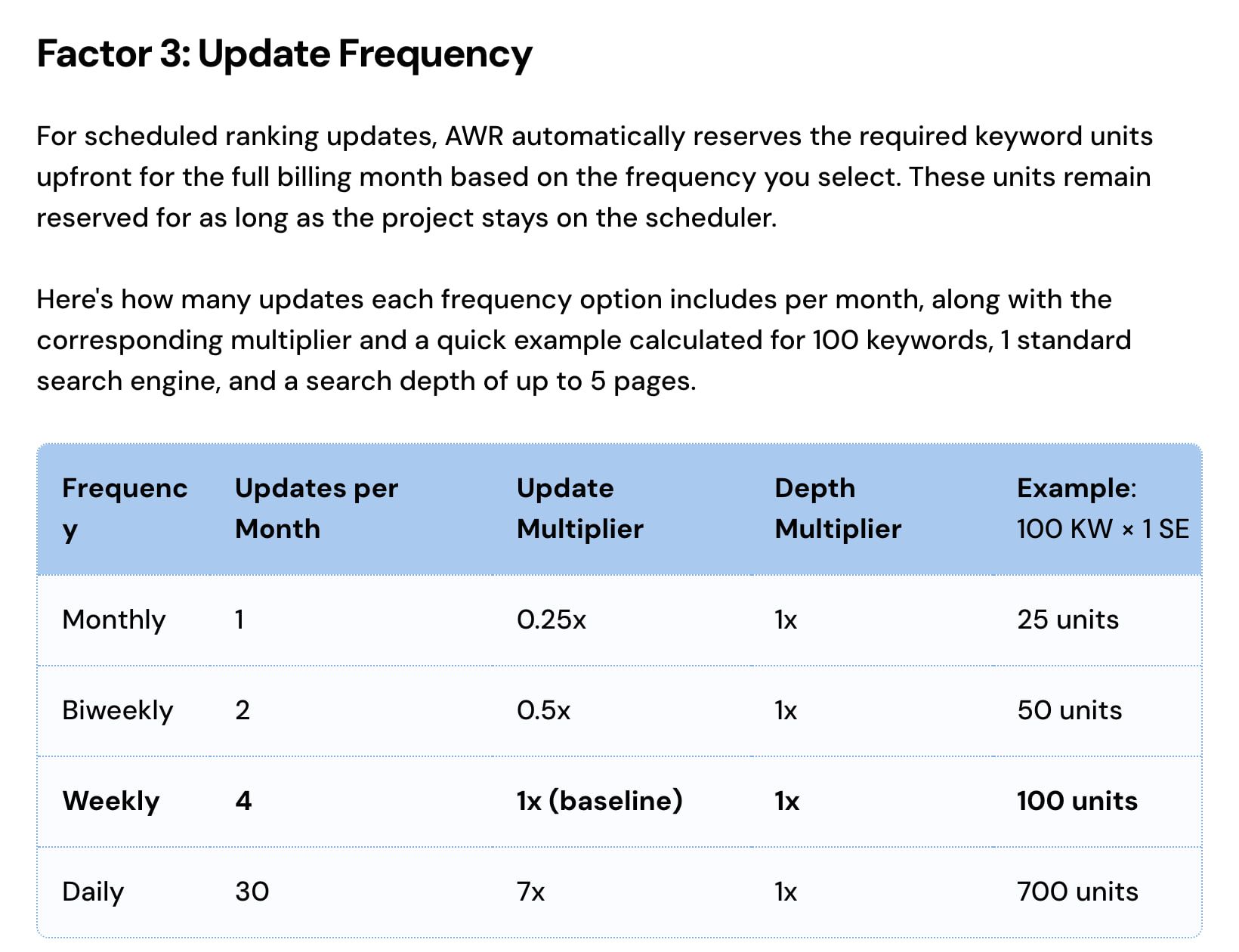
AWR’s formula is “Units = Keywords × Search Engines × Frequency Multiplier × Depth Multiplier”, where weekly is 1×, daily 7×, biweekly 0.5× and monthly 0.25× (AWR units guide, dated 16 Nov 2026). Its plans run Pro $139 for 7,000 units, Agency $279 for 14,500 and Enterprise $699 for 35,500 (AWR pricing).
So 500 keywords use 500 units weekly or 3,500 daily, and both fit Pro. At 2,000 keywords, weekly is 2,000 units on Pro, but daily is 14,000 units, which needs Agency.
Mangools’ Premium plan tracks 700 keywords weekly at $52.70 a month billed yearly; daily needs Agency, 1,500 keywords at $97.70 (both read 13 Nov 2026). That’s $45.00 a month more, or about $60 on monthly billing by my estimate.
| Keywords | Mangools | AWR | Ahrefs | Daily-only trackers (no switch) |
|---|---|---|---|---|
| 500 | Premium $52.70 → Agency $97.70 billed yearly: +$45 (read 13 Nov) | 500 → 3,500 units, both on Pro $139: +$0 | Lite $129 (750, weekly); daily not priced | Nightwatch Starter €79 yearly, €99 monthly (13 Nov) · ProRankTracker Starter $99 ($89 yearly) · SE Ranking Core $129 ($103.20 yearly) · Semrush SEO $139.95 (13 Nov; $117.33 yearly) |
| 2,000 | No plan (Agency stops at 1,500) | Pro $139 → Agency $279: +$140 | Standard $249 (2,000, weekly); daily not priced | SE Ranking Core $129 ($103.20 yearly) · ProRankTracker Pro $149 ($134 yearly) · AccuRanker Professional 2K €269 monthly (13 Nov), €229 yearly view |
Source: My arithmetic from list prices and allowances, one device and one location, no AI Overview tracking. Verified 17 Nov 2026 unless marked 13 Nov. Euro prices as shown, not converted. Scroll sideways for more columns.
Three things stood out to me in that table.
First, AWR at 500 keywords is the one place where daily is free in practice: you’re already paying for the units. Second, Ahrefs is the hardest case, because I couldn’t find a daily price on any of its own pages. Ahrefs offers to “save up to 17%” on annual billing (Ahrefs pricing), but that’s for the plan, not for daily updates. What each Ahrefs plan costs is broken down separately.
Third, if daily is the only reason you’d move from Mangools Premium to Agency, a daily-only tool can cost less. ProRankTracker Starter is $89 a month billed yearly for 1,000 daily keywords, below Agency’s $97.70.
Every count above assumes one device and one location. Add mobile or a second city and most vendors count each pair separately; I go through those rules in how rank tracker pricing counts keywords. For a head-to-head of the cheapest weekly option against a daily one, see Mangools vs SE Ranking.
When does daily earn its keep? #
When something is changing and you’d act fast: a migration, a launch, recovery work, competitive head terms, or a core update rollout. In those windows a week’s delay is a week of not knowing.
Ranktracker, which sells a tracker, puts “Competitive head terms, active campaign keywords, time-sensitive product pages” in its daily tier (Ranktracker). That’s the clearest list I found, but it’s an opinion with no data behind it.
Wiremo’s numbers are about Google Maps grids, not organic rankings, so read them as a local example. In its own case (a 9×9 grid, one keyword), daily scans use about 2,430 credits a month against about 324 weekly, and catch a change in 1 day rather than 3–4 (Wiremo). It argues daily pays off in set windows such as migrations, recovery and new campaigns. For what grid scans cost on local tools, see how BrightLocal and Whitespark price grids and Local Falcon’s price per grid scan.
Core updates are my own addition. While one rolls out, daily data shows which keywords moved and when, but I’d still judge the result in Search Console once it ends. My guide to checking the November 2026 core update has the dates.
| Situation | Cadence | Why |
|---|---|---|
| Site migration or redesign | Daily for the affected keywords, during the move | You'd fix a broken redirect within days, not weeks |
| Product or campaign launch | Daily | Ranktracker's daily tier: active campaign and time-sensitive pages |
| Core update rolling out | Daily while it rolls out, then judge in Search Console | Shows what moved; Search Console shows whether it cost clicks |
| Competitive head terms | Daily | Ranktracker's daily tier; small moves on money keywords are worth knowing early |
| AI Overview citations | Daily | AI Overview content changed on 70% of observations in Ahrefs' data |
| Evergreen, informational and brand terms | Weekly (Ranktracker suggests monthly) | Little moves, and you wouldn't act within days |
| Monthly client reports | Weekly | Semrush itself keeps only weekly points after 60 days |
| Local map grids | Weekly, daily in set windows | Wiremo's own advice for local businesses |
Source: My picks, using Ranktracker's and Wiremo's advice (vendor opinion, labelled), Ahrefs' AI Overview study and Semrush's knowledge base, read 17 Nov 2026. Scroll sideways for more columns.
When is weekly enough? #
For evergreen pages, brand terms and monthly reports. Even Semrush keeps daily points for only 60 days before switching to weekly ones, which is worth knowing before you move to another tracker.
Ranktracker’s weekly tier is “Mid-funnel content, category pages, moderately competitive terms”, and it suggests monthly for “Evergreen content, low-competition informational articles, brand terms” (Ranktracker). I’d stop at weekly for those, since a month is long enough to miss a page dropping out entirely.
The Semrush detail matters for reporting. Position Tracking “tracks daily results for 60 days”, and “After 60 days, Position Tracking displays weekly data points”; those weekly snapshots are “captured on Wednesdays by default and are tracked for 140 weeks” (Semrush KB).
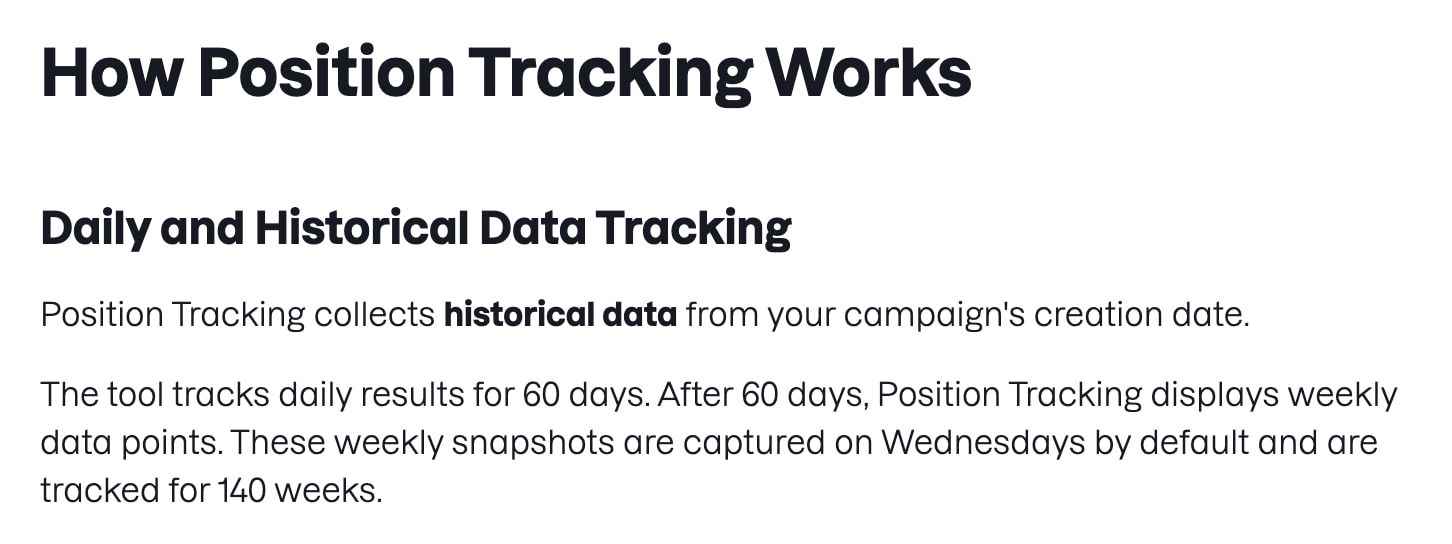
In other words, any report that looks back more than two months on Semrush is built on weekly points anyway. If your job is a monthly or quarterly view of steady keywords, paying for daily buys you little.
If you’re buying new for that job, Mangools Premium is my pick: 700 keywords tracked weekly at $52.70 a month billed yearly (read 13 Nov 2026). If you already pay for Ahrefs, its weekly default does the same job; don’t buy a second tool for cadence alone.
What about AI Overviews? #
Weekly checks miss most changes. In Ahrefs’ data an AI Overview changed on 70% of checks and lasted about 2.15 days, and those checks weren’t even daily.
Ahrefs followed more than 43,000 keywords, each with at least 16 recorded AI Overviews over about a month. It found “AI Overviews have a 70% chance of changing from one observation to the next” and a “persistence of 2.15 days on average” (Ahrefs, 11 Nov 2025).
It adds: “Since our checks weren’t daily, it’s likely that the real citation change rate is much higher.” Ahrefs sells SEO tools, so this is vendor research, but it’s the only dataset on the question I found.
My read: if a week’s check sees one version of an answer that lasts about two days, it tells you little about whether you’re usually cited. Track AI Overview citations daily, in a tracker that records them; I rank those in rank trackers for AI Overviews.
Watch the units, though. AWR counts Google Search plus AI Overview as 2 units (AWR units guide), so 500 daily keywords with AI Overview tracking come to 7,000 units, all of the Pro plan.
Does daily data add noise? #
Yes, some. Since mid-September some trackers have logged junk Google results, and daily data shows every blip, so one bad check can look like a drop.
I’ve covered what those junk results look like and how to check them in why your rank tracker shows junk results. Wiremo puts the trade-off bluntly: daily tracking for most keywords “punishes everyone else with credit burn and noise” (Wiremo). That’s its view about map grids, but the logic carries over.
A feature to ask your vendor about: what happens to a sudden large drop. SEOmonitor’s help says “earlier data may remain visible while a suspicious change is checked” (SEOmonitor help). If your tracker publishes every drop the moment it sees it, confirm big ones before you report them.
Can Search Console fill the gap for free? #
For your own site, partly: its 24-hours view shows hourly clicks, impressions and average position within a few hours. It can’t show competitors or fixed positions.
Google added the view in December 2024. It “includes data from the last available 24 hours”, hour by hour, “with a delay of only a few hours”, in the Search results, Discover and Google News reports (Google Search Central). Search Engine Journal lists the metrics as clicks, impressions, CTR and average position, broken down by query, page and country (SEJ).
That makes it a good free alarm during a migration or launch. If clicks fall overnight, you’ll see it the same day, whatever cadence your tracker runs on.
What it isn’t is a rank tracker. Average position is an average across real searches, not one check from a set place and device, and it shows nothing for keywords where you don’t appear. I line up what a tracker and Search Console each measure in my guide to rank tracking vs AI visibility.
What would I do? #
Track weekly by default and go daily only where you’d act within days. Here’s my pick for each case, on the prices I read.
- Monthly reports on steady keywords: weekly. Buying new, Mangools Premium (700 keywords, $52.70 a month billed yearly, read 13 Nov). On Ahrefs, keep the weekly default.
- About 500 keywords, and you want daily: Nightwatch Starter (€79 a month billed yearly, €99 monthly read 13 Nov, 500 keywords) or ProRankTracker Starter ($99 a month, $89 billed yearly, 1,000 keywords). Daily costs nothing extra on either. (Limits per plan: what each Nightwatch plan includes.)
- 2,000 keywords daily: SE Ranking Core, $129 a month or $103.20 billed annually.
- Already on AWR with 500 keywords or fewer: switch them to daily. It still fits Pro.
- AI Overview citations: daily, in a tracker that records them.
For a migration, launch or core update, you don’t need to move everything to daily. Watch the affected keywords daily for that window and keep the rest weekly.
Some tools are built for that mix. SEOmonitor collects daily on your primary device, then runs a weekly collection that “runs on Saturday and targets the first ten results pages”, with the second device weekly (SEOmonitor help). Nightwatch adds on-demand checks to its daily updates (Nightwatch pricing).
AWR sells on-demand updates by the unit: a 1-hour update costs the same as a weekly update, “up to 2,000 units/day”, a 12-hour one 0.5× and a 48-hour one 0.25× (AWR units guide). That’s a way to check a migration’s keywords without switching the whole account. Pair any of these with Search Console’s 24-hours view, which costs nothing.
If you’re choosing between two daily trackers on price, Nightwatch vs AccuRanker compares two of them line by line.
FAQ
Is daily rank tracking worth it?
Only when you'll act on a move within days: a migration, a launch, a core update rollout or AI Overview citations. Most trackers include daily on every plan anyway (SE Ranking, Semrush, Nightwatch, AccuRanker, ProRankTracker), so the question costs money only on Ahrefs, Mangools and AWR.
Does Ahrefs track rankings daily?
Weekly by default. Ahrefs' help says the default update frequency 'is weekly' on all subscription plans, and its Rank Tracker page lists 'Weekly'. The Ahrefs pricing, help and Rank Tracker pages I read don't price a daily option.
Which rank trackers update weekly?
Ahrefs by default on every plan, Mangools on Basic and Premium (daily only on Agency), and Advanced Web Ranking if you choose weekly units. SEOmonitor runs a weekly deep collection next to its daily one.
How much more does daily rank tracking cost?
At AWR, daily uses 7 times the units of weekly: 500 keywords still fit the $139 Pro plan, while 2,000 move from Pro to the $279 Agency plan. At Mangools, daily means the Agency plan, $45 a month more than Premium billed yearly (read 13 Nov 2026). Elsewhere daily is included.
How often do AI Overviews change?
Often. In Ahrefs' study of more than 43,000 keywords, an AI Overview had a 70% chance of changing from one observation to the next and lasted 2.15 days on average. Ahrefs says its checks weren't daily, so the real citation change rate is likely higher. Weekly tracking misses most of that.
Can Search Console replace a daily tracker?
Partly, for your own site. Its free 24-hours view shows hourly clicks, impressions, CTR and average position with a delay of only a few hours. It shows an average position across real searches, not a tracker's fixed check, and nothing for competitors.
Sources
20 sources, accessed .
Official pricing, docs, changelogs and status pages 16
- SE Ranking: pricing (keywords tracked daily)
- Semrush: pricing (keywords to track daily)
- Semrush knowledge base: Position Tracking (60-day daily history)
- Nightwatch: pricing, daily and on-demand checks
- AccuRanker: pricing
- ProRankTracker: plans and pricing
- Wincher: pricing (prices not rendered)
- Ahrefs help: how often tracked keywords update (3 Sep 2026)
- Ahrefs: pricing and tracked-keyword allowances
- Ahrefs: Rank Tracker product page
- Mangools: plans and pricing (prices read 13 Nov 2026)
- Advanced Web Ranking help: keyword units explained (16 Nov 2026)
- Advanced Web Ranking: pricing and unit allowances
- SEOmonitor help (sells rank tracking): daily and weekly collection, 27 Sep 2026
- seoClarity (sells rank tracking): daily and hourly rank tracking product page
- Google Search Central blog: the 24-hours view in Search Console (12 Dec 2024)
Last updated: 17 November 2026. Facts verified 17 Nov 2026; prices marked 13 Nov were read that day. Researched and drafted with AI tools; owner review is pending.


