Are AI Overviews replacing the local map pack?
Semrush says AI Overviews took over the local map pack in its last 80 searches, all from one day. How that squares with four older studies.

Short on time?
Short on time? Here's what I would do.
- You track local with a map-grid tool (Local Falcon, BrightLocal)
- Keep it
- Synup and Whitespark still show a pack on most plain local searches. Semrush's 99% came from one day.
- You want to see AI answers for your area
- A monthly hand check of your 10 best local queries
- Do each in a bare and a conversational phrasing before you pay for anything.
- You run a local business
- Keep your Google Business Profile accurate
- Google's guide says profiles can help in AI responses. Don't rebuild a strategy on one study.
- Thinking of buying a tool because of this study
- Don't buy one for this
- My reading of five vendor-run studies. None is neutral, and none measured clicks.
Prices verified . Verified 23 Nov 2026. The picks are my reading of the studies, not Google's advice. No vendor paid to be included, and sponsors can't buy a verdict.
On 17 November Semrush published a study saying AI Overviews had taken over the local map pack. I read it next to four other studies from the past 18 months.
The short answer depends on how people word the search, and none of these studies is neutral. For the wider topic, start at my AI visibility hub.
What did Semrush actually find? #
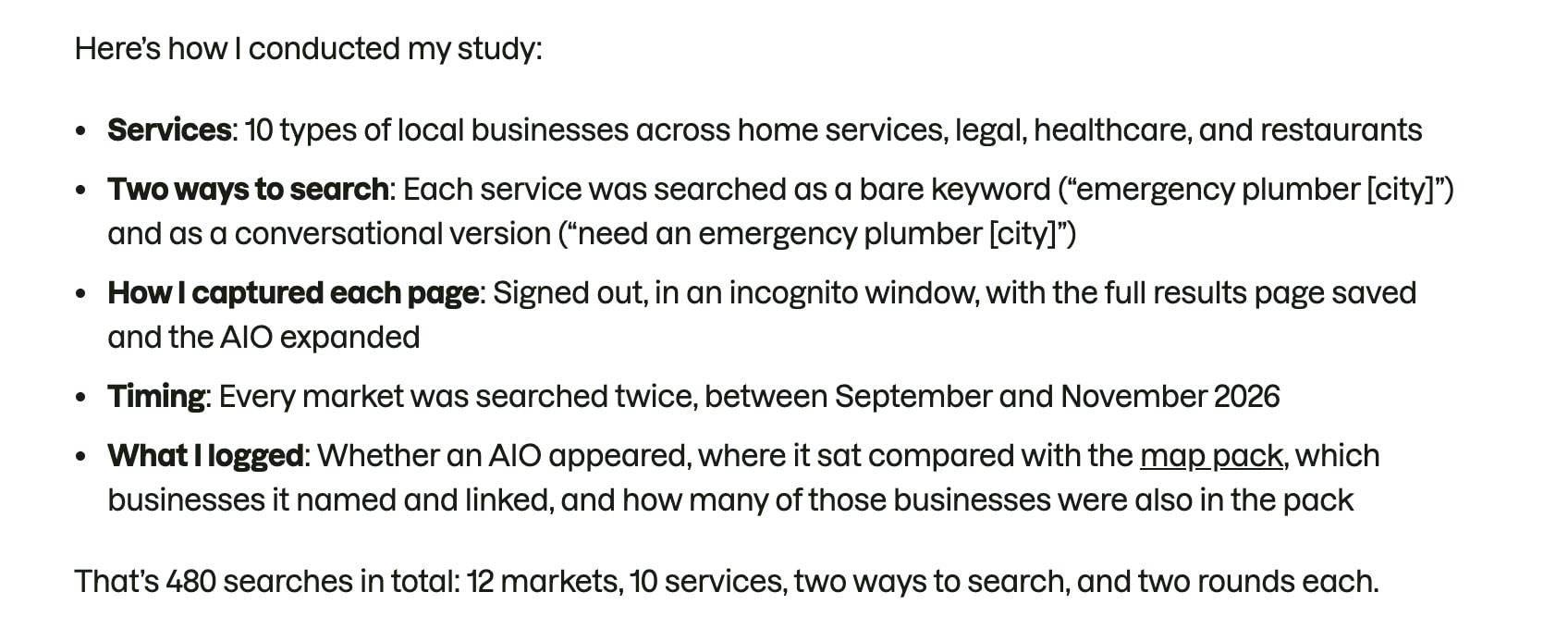
In 480 hand-run searches across 12 US cities, AI Overviews showed on 79 of 80 last-round searches in four markets. In 76 of those 80, business cards sat inside the AI Overview with no separate pack, and 3 were text-only (Semrush).
It reports “480 searches in total: 12 markets, 10 services, two ways to search, and two rounds each”, run by hand, signed out and incognito, between September and November 2026. The device isn’t stated.
Semrush sells Position Tracking and AI tools, the page carries free-trial banners, and no raw data is linked. The author’s own caveat is that the last round was “captured … on a single day, so it could be a test or a rollout that hasn’t reached everyone yet.”
Can you compare 38% with 99%? #
No. The two figures come from different market sets. The 38% is the first pass in eight markets, and the 99% is the second pass in a four-market subset.
The like-for-like pairs are 38% to 66% across the eight markets, and 60% to 99% across the four, all stated on the page. The 48 of 80 behind the 60% is from a table on the page, not a sentence. The page’s pooled 61% (292 of 480) mixes both rounds.
Do older studies say the same? #
Mostly not. Here are five studies side by side, with who sells what.
| Study (who sells what) | When, and how big | Local pack | AI Overview | Comparable? |
|---|---|---|---|---|
| Semrush (SEO and AI tools) | Sept-Nov 2026; 480 hand searches, 12 US cities | No separate pack in 76 of 80 last-round searches (AI Overview on 79) | 38% to 66% (8 markets); 60% to 99% (4 markets) | The event |
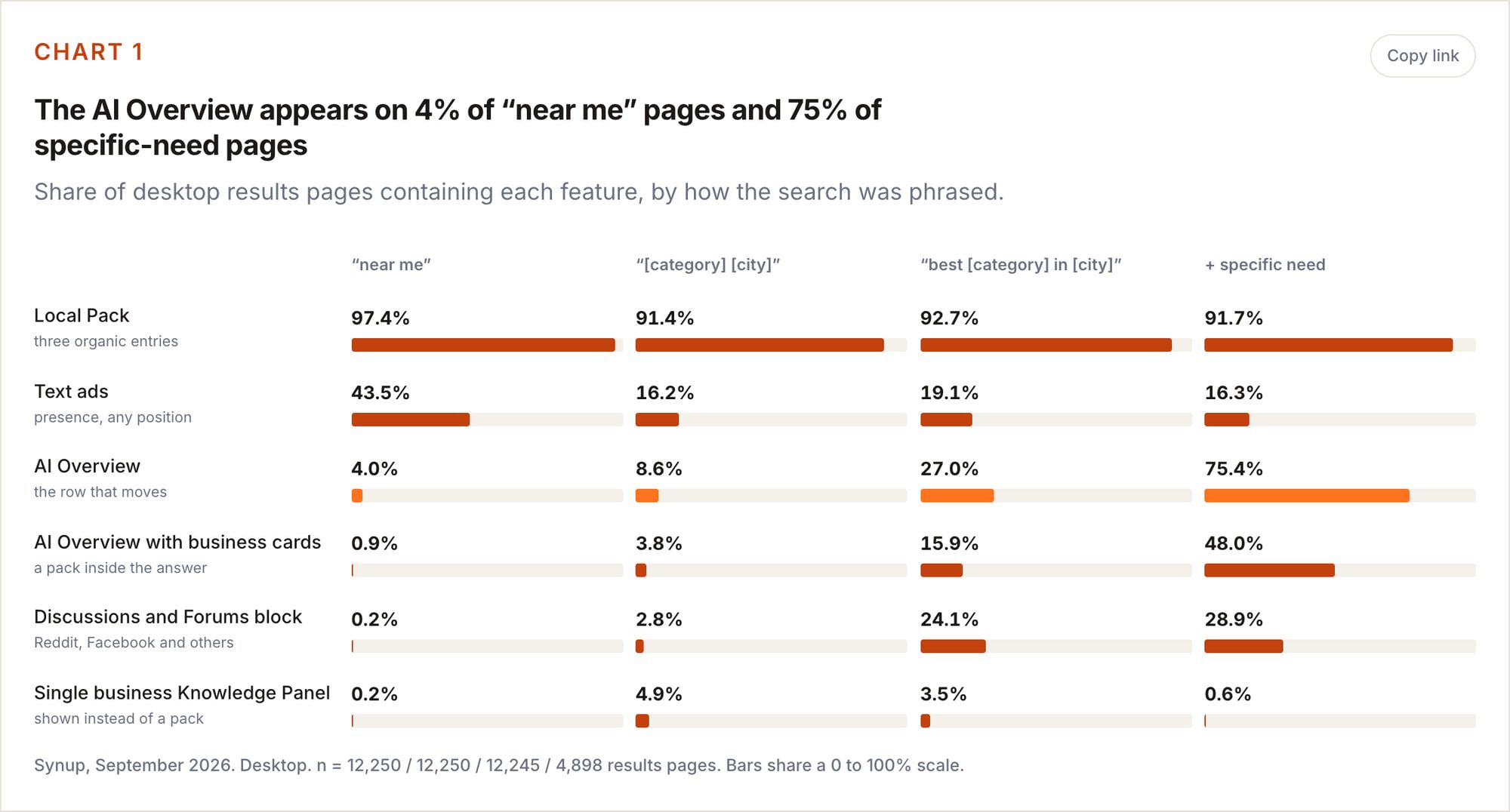
| Synup (listings and review tools) | Sept 2026; 53,900 pages, 250 US cities, desktop | On 91-97% of pages | 4.0%, 8.6%, 27.0% or 75.4%, by wording | On presence, yes; queries differ |
| Shotland / Local SEO Guide (consultancy, vendor-linked deck) | Jun-Jul 2026; 15.2M US SERPs, 8 verticals | Desktop 37.3%, mobile 57.6% | Desktop 38.5%, mobile 34.1% | Partly; broader queries |
| Whitespark (local software and services) | May 2025; 540 manual queries, 3 cities | 93% of local-intent queries | 15% of local-intent queries; 68% on average | Yes, but about 18 months old |
| BrightLocal (local tools) | Sept 2026; about 200,000 prompts, 1,300+ locations | Not measured | Mention rate 38%, against 66% for Google Maps | No: mention rates, not presence |
Source: Study pages, read 23 Nov 2026. Whitespark calls its data a 'limited data set'; Synup says its AI Overview rates 'should be read as floors'. Scroll sideways for more columns.
Links: Synup, Shotland’s deck, Whitespark and BrightLocal. Local Falcon’s May 2025 whitepaper found AI Overviews on 40.2% of 60,000 synthetic queries and doesn’t measure packs.
Two of the top results I read repeat Whitespark’s figures (the same numbers as its May 2025 study) under newer headlines: a contributed Entrepreneur opinion piece, and an SEJ column citing its 68% against 39%.
Why do the numbers disagree? #
Mostly query wording and device. Synup’s desktop AI Overview rate climbs from 4.0% for “[category] near me” to 8.6% for “[category] [city]”, 27.0% for “best [category] in [city]” and 75.4% for qualified searches across 50 cities.
Semrush saw the same direction: conversational searches got AI Overviews more often, 66% against 24% in round one and 88% against 66% in round two. Whitespark’s May 2025 data was starker: 15% AI Overviews and a pack on 93% of local-intent queries, against 92% and 6% for informational ones.
Device matters too. In Shotland’s deck, AI Overviews and packs are level on desktop, but on mobile the pack leads, 57.6% to 34.1%. Semrush doesn’t say which device it used.
BrightLocal measures mention rates and says success in Maps doesn’t necessarily lead to success in an LLM. It compares aggregate rates, not the same businesses, so I read that as a hint.
Is Google testing a new local pack? #
Search Engine Roundtable reports a test. Its main witness saw it on mobile, and on 18 November she wrote that the old version was back. On 10 November SER described an AI Overview version of the local pack without action buttons, reviews or photos.
Joy Hawkins, who sells local SEO consulting, wrote: “On mobile, every time I get this version, the traditional local pack is gone.” Her 18 November update: “Did Google fix this? I’m seeing the old version again.” I read both through SER, since x.com wouldn’t load.
A Local Search Forum thread from March opens with “I also haven’t been able to replicate the SERP result again.” Hawkins said it had been live on mobile since the previous autumn, on 7% of tracked queries and 13% in February, with no sample size. An earlier thread had her saying “Only on mobile and only in the USA”.
Her agency’s Sterling Sky page puts “AI Local Packs” at roughly 8% of keywords per Places Scout, with “32% fewer unique businesses”, and cites call data from 179 Google Business Profiles. It states no method for any of these figures. Its date is unclear: it shows 21 September 2026, but SER cited a near-identical title in January.
I found no link between this test and Semrush’s business cards, and no Google statement. Google’s AI features guide says Business Profiles can help “be visible in both AI responses and other Google Search results”, but doesn’t explain how local results appear in AI answers.
Should I change how I track local? #
Keep the map-grid tracker and add a free hand check, not a new tool. If you’re sizing that tracker’s credits, what a geo-grid scan really costs has the arithmetic.
| Option | What it answers | What it can't tell you | My pick |
|---|---|---|---|
| Map-grid tracker (Local Falcon, BrightLocal Local Search Grid) | Where you rank on a map around a location | Whether either tool reports AI Overviews: their pages don't make that clear | Keep |
| AI prompt tracker | Whether AI assistants mention you | What Google's results page shows, unless the tool tracks AI Overviews | Skip for now |
| Monthly hand check, two phrasings | What a searcher sees: pack, AI Overview, business cards | Scale, other cities, personalised results | Do it; it's free |
| Google Business Profile upkeep | Google's guide says it can help visibility in AI responses | How local results get into AI answers | Keep |
Source: Google's AI features guide; BrightLocal and Local Falcon pricing pages. Read 23 Nov 2026. Scroll sideways for more columns.
BrightLocal’s pricing page lists a Local AI Visibility Tracker under Track (Manage and Grow are described as including everything in the plan below) and names ChatGPT and “Google’s AIs”. Local Falcon’s lists “AI Visibility Tracking” without naming engines. Prices are in my Local Falcon pricing and BrightLocal vs Whitespark posts, and the best local rank tracker for your grid size lists which of eight tools track AI answers.
Sterling Sky’s page also says most tracking software can’t see AI local packs yet. That’s an agency’s claim with no source I could find. For general AI Overview rates, see how many searches show AI Overviews and rank trackers for AI Overviews. For what Google reports about AI features on your own site, see Search Console and AI Overviews.
So what would I do? #
Don’t change tools on one 80-search sample. Keep the map-grid tracker and check by hand.
- Once a month: list your 10 best local queries. Write each as a bare search (“plumber [your city]”) and a conversational one (“I need a plumber tonight in [your city]”). Those examples are mine.
- Signed out, on phone and desktop: note whether a pack shows, an AI Overview shows, business cards sit inside it, and if you appear in either, with the date. Semrush went signed out, and Shotland’s data splits by device.
- If AI Overviews with business cards keep showing for your queries over two or three months, look at an AI tracker then.
None of these studies measured clicks, so none says what any format does to calls or visits. Google’s Ask Maps can also now find appointments and call local businesses, US first; the profile checks are in what to set before Ask Maps calls a client. I’ll update this post if Google comments or Semrush shares its data.
FAQ
Did AI Overviews replace the map pack?
Not as a general fact. One Semrush sample says so for its last round, in four markets on one day, and the author says it could be a test. Synup (September 2026) and Whitespark (May 2025) still show a pack on most plain local searches, while Shotland's 2026 deck has the pack ahead only on mobile.
Where did '79 of 80' come from?
From the second pass of Semrush's four-market subset, captured on a single day. In 76 of those 80 searches the AI Overview held business cards and there was no separate pack, and 3 more were text-only.
Is Google testing a new local pack?
Search Engine Roundtable reported on 10 November 2026 an AI Overview version of the local pack without action buttons, reviews or photos. Joy Hawkins saw it on mobile, and on 18 November she wrote that she was seeing the old version again. I found no Google statement.
Should I stop tracking my map-grid rankings?
No. Synup and Whitespark still show a pack on most plain local searches, and Semrush's own sample is 80 searches on one day. Keep the tracker and add a monthly hand check.
Does a strong Maps ranking mean AI answers mention me?
BrightLocal's September 2026 study suggests not necessarily: Google Maps mentioned a tracked business in about 66% of searches against 32-38% for AI surfaces. It compares aggregate mention rates, not the same businesses, so it suggests rather than shows.
Do bare and conversational searches differ?
Yes, in Semrush's rounds: conversational searches got AI Overviews more often, 66% against 24% in round one and 88% against 66% in round two. Synup's desktop data points the same way, from 4.0% for 'near me' searches to 75.4% for qualified ones.
Sources
16 sources, accessed .
Official pricing, docs, changelogs and status pages 3
Community discussions 2
News and press 4
- Search Engine Roundtable: Google tests AI Overview local pack without action buttons, 10 Nov 2026
- Search Engine Roundtable: AI Overviews in place of local packs, 16 Jan 2026
- Entrepreneur (contributed opinion): AI hasn't cracked local search yet, 23 Oct 2026
- Search Engine Journal (contributed column): AI Overviews now answer most local searches, 22 Jul 2026
Other blogs 7
- Semrush (sells SEO and AI tools): AI Overviews are taking over the map pack, 17 Nov 2026
- Synup (sells listings and review tools): local SERP study, Sept 2026
- Andrew Shotland (LocalSEOGuide): the state of local AEO, deck for a Duda webinar, 30 Jul 2026
- Whitespark (sells local software): prevalence of AI Overviews in local search, 12 May 2025
- BrightLocal (sells local tools): local AI visibility study, 16 Sept 2026
- Local Falcon (sells geo-grid tracking): AI Overviews and local business visibility whitepaper, 21 May 2025
- Sterling Sky (local SEO agency): AI is quietly taking over local SEO, date unclear
Last updated: 23 November 2026. Facts verified 23 Nov 2026. Researched and drafted with AI tools; owner review is pending.


