Tracking Muse Spark? What each tool actually checks
Six AI visibility tools now track Muse Spark, Meta AI or Muse, but each checks something different. Which plan includes it, and who should pay.

Short on time?
Short on time? Here's who should pay for it.
- Small B2B teams
- Skip it for now
- If you want a Meta signal anyway, Trakkr Growth ($100 a month) includes Meta AI with no per-model fee.
- US consumer and retail brands
- LLM Pulse's Meta AI add-on
- EUR 12 a month for weekly checks on the EUR 49 Starter. The only vendor page I read that says it queries meta.ai with Meta's own web search.
- Already on Profound or Peec Enterprise
- Ask your account team to switch on Muse Spark
- Both list it under Enterprise; neither page shows a separate price.
- Everyone
- Read any Muse number as a model or assistant check
- No vendor page shows what Muse tells a real shopper with memory.
Prices verified . Prices verified 16 Nov 2026. LLM Pulse prices only in euros, excluding VAT. No vendor paid to be included, and sponsors can't buy a verdict.
Six AI visibility tools I found now cover Meta’s Muse, the model behind it or the Meta AI assistant. They don’t all check the same thing, and two of them offer it only on Enterprise plans.
I read Meta’s two announcements and every vendor page I could find to see what each tool actually queries, what it costs and whether it’s worth paying for. For the wider tool category, start at my AI visibility hub.
What is Muse, exactly? #
Three things share the name. Muse Spark is Meta’s model, launched in April 2026. Meta AI is the assistant it powers. Muse is a personal agent that launched in the US on 8 September 2026.
| Name | What it is | Where people use it | When (2026) |
|---|---|---|---|
| Muse Spark | Meta's large language model | Inside Meta AI and Muse; an API was promised in private preview for select partners | 8 Apr 2026 |
| Meta AI | Meta's assistant, powered by Muse Spark | The Meta AI app, meta.ai, and WhatsApp, Instagram, Facebook, Messenger and Threads | Muse Spark reached it in April; Meta's other apps from May |
| Muse | A personal AI agent, powered by Muse Spark | The Muse app, WhatsApp and muse.ai; rolling out in the US | 8 Sep 2026 |
Source: Meta Newsroom posts of 8 Apr 2026 (updated 12 May) and 8 Sep 2026 (updated 10 Nov), read 16 Nov 2026. Scroll sideways for more columns.
Meta’s April post calls Muse Spark “the first in a new series of large language models built by Meta Superintelligence Labs” and says it “currently powers the Meta AI app and website” (Meta). A May update says it’s starting to reach Meta AI in WhatsApp, Instagram, Facebook, Messenger and Threads.
The agent came five months later. “Muse is a personal AI agent. It doesn’t just answer questions, it actually does the work,” says Meta’s September post, which describes it as “powered by Muse Spark” (Meta). It runs on a “Muse Secure VM” with its own browser, and Meta says it’s “free for most of what people need, with subscription plans”.
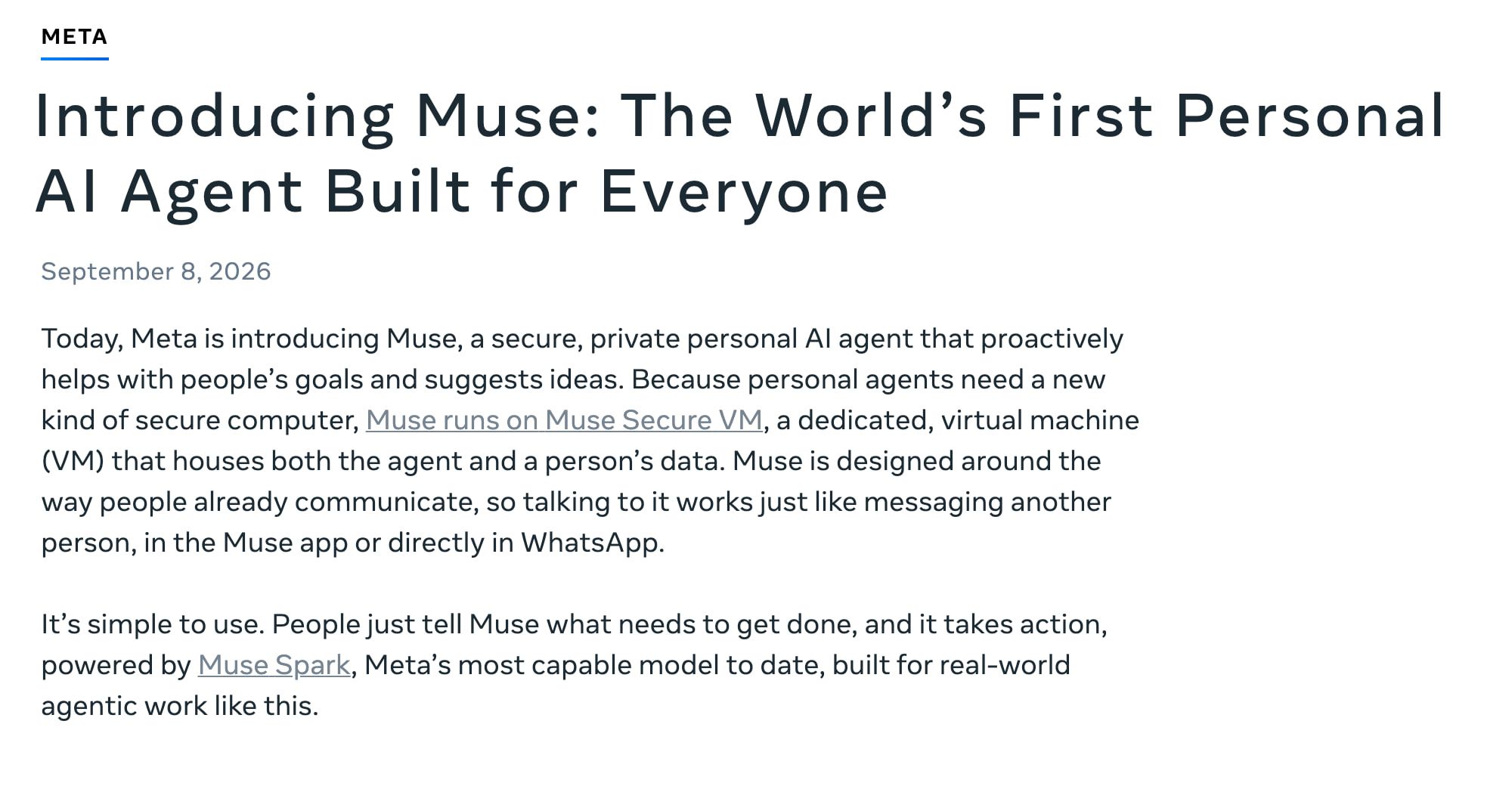
One correction worth making: Peec’s September press release, as copied by TechIntelPro, dates Muse Spark to September. Meta’s own posts put the model in April and the agent in September.
Which tools track it, and on which plan? #
Profound and Peec track the Muse Spark model on Enterprise only. LLM Pulse sells a Meta AI add-on from EUR 12 a month, and Trakkr includes Meta AI on its $100 plan. Rankscale and Goodie don’t say which plan covers it.
| Tool | What it says it checks | Plan that includes it | Price seen |
|---|---|---|---|
| Profound | The Muse Spark model, via Meta's API | Enterprise only | Custom |
| Peec AI | Muse Spark, labelled as an API model (also Meta Wonder) | Enterprise only | Custom |
| LLM Pulse | Meta AI on meta.ai, with Meta's web search | Add-on to any plan | EUR 12 a month weekly, EUR 20 daily, on the EUR 49 Starter |
| Trakkr | 'Meta AI' (method not stated) | Every paid plan | $100 a month (Growth) |
| Rankscale | Muse Spark (pricing-page banner) | Not stated | Not stated for Muse |
| Goodie | Muse and Meta AI, separately (method not stated) | Not stated | Not stated |
Source: Vendor pricing, changelog and product pages, verified 16 Nov 2026. LLM Pulse prices in euros, excluding VAT. Scroll sideways for more columns.
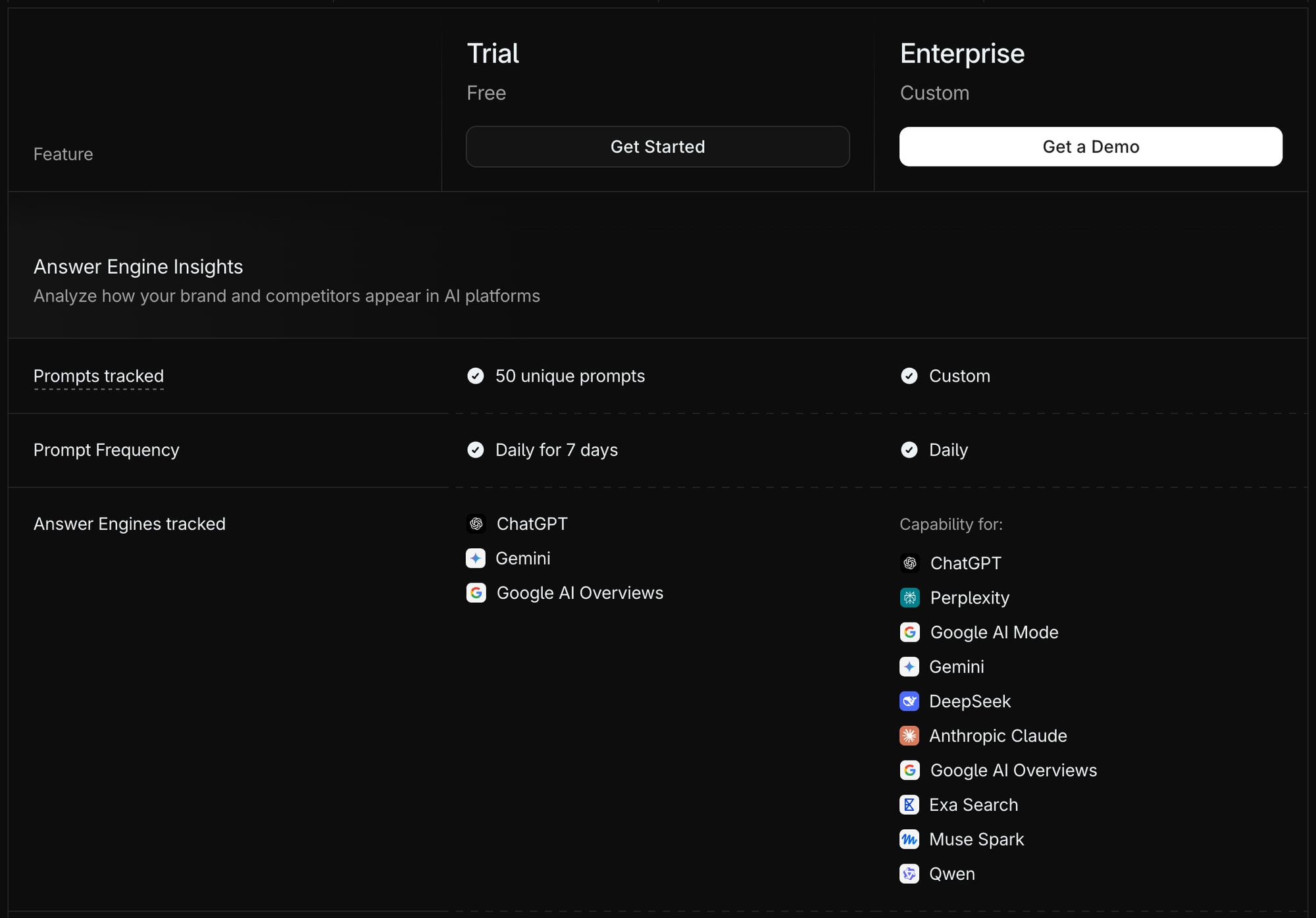
Profound describes Muse Spark as “a large language model that developers can call through Meta’s API” (Profound). Its pricing page lists Muse Spark among 10 engines on Enterprise, while the Trial covers ChatGPT, Gemini and AI Overviews. My Profound pricing post covers what Enterprise involves.
Peec lists “Muse Spark” and “Meta Wonder” as API models on custom Enterprise (Peec). Its self-serve plans, $95, $245 and $495 a month, let you choose 3 models from 8, and none of the 8 is from Meta. The changelog shows Muse Spark “available for daily tracking” from 11 September. More in Peec AI pricing.
LLM Pulse is the only vendor I read that names the consumer surface: it “tracks Meta AI in the Meta AI assistant itself, on meta.ai, with the web search Meta runs there” (LLM Pulse). Its model price list puts Meta AI at EUR 12 a month weekly or EUR 20 daily on Starter, rising to EUR 25/40 on Growth and EUR 70/120 on Scale.
Starter itself is EUR 49 a month for 50 prompts checked weekly, and already includes ChatGPT, Perplexity, Google AI Mode, AI Overviews and Gemini (LLM Pulse). So weekly Meta AI tracking starts at EUR 61 a month all in (my arithmetic, excluding VAT).
Trakkr includes Meta AI among 8 models and says “All eight are included in every paid plan”, from $100 a month on Growth (Trakkr). It doesn’t mention Muse or say how it reaches Meta AI.
Rankscale shows a banner, “We now support Meta Muse Spark”, on its pricing page without naming a plan. Goodie says it tracks Muse and Meta AI “separately”, daily, in English for the US and Canada (Goodie), with no plan or price.
Can a tracker see what Muse tells a shopper? #
Not on any vendor page I read. The agent knows its user and the model doesn’t. Muse answers for a person it remembers; a tracker checking the model or the assistant has no such person behind the prompt.
Profound puts it plainly: “Muse knows who it’s shopping for, and Muse Spark doesn’t.” In its own study of 2,240 answers from ChatGPT Instant and Muse Spark, run with and without a memory file, Muse Spark cited “0.7 distinct websites per answer instead of 1.4” when given a relevant memory (Profound). That’s a vendor’s own study, and it doesn’t split every result by model.
Peec’s release quotes its CPO and CMO, Malte Landwehr, calling Spark tracking “the closest approximation brands have” to their performance in Muse. Two vendors selling the feature agree on the limit, which I take seriously.
Is Muse already visiting your site? #
Possibly. HUMAN’s October data, as reported by Search Engine Journal, credits Meta’s Muse with 59% of AI agent requests on sites HUMAN protects, which isn’t the whole web.
SEJ quotes the report: “Meta’s Muse accounted for 59% on its own”, with OpenAI at about 30%, where a request is “a page load or a search”. HUMAN sells bot and agent identification services, and its report wouldn’t open for me.
SEJ also cites Meta’s engineering post saying Muse’s browsing “will appear as your activity” to websites. That’s a log-file question, not a tracker one: check your server logs before you pay anyone to estimate it. For what Clarity and log tools can and can’t see, read how to see AI agent traffic on your site.
So who should pay for it? #
Pay only if Meta’s audience is your audience.
- Small B2B teams: skip dedicated Muse tracking for now. If you want a Meta signal anyway, Trakkr Growth at $100 a month includes Meta AI with no per-model fee. It also covers ChatGPT, Claude and AI Overviews, and it’s my pick for Claude at about $100 in Profound alternatives.
- US consumer and retail brands: add it. My pick is LLM Pulse’s Meta AI add-on, EUR 12 a month weekly on top of EUR 49 for Starter, because it’s the only vendor page that says it queries the consumer assistant with Meta’s web search.
- Already on Profound or Peec Enterprise: ask your account team to switch Muse Spark on. Neither pricing page lists a separate fee. The two are compared in Peec AI vs Profound.
- Agencies: add Meta only for consumer clients, and say in the report which surface you’re tracking. Per-client pricing is in AI visibility tools for agencies.
- Everyone: label any Muse number as a model or assistant check. None of these tools shows what Muse tells a shopper it remembers.
I’ll update this post if a vendor documents how it checks the Muse agent itself.
FAQ
What is Muse Spark?
Meta's model. Meta introduced it on 8 April 2026 as the first in a new series of large language models from Meta Superintelligence Labs, and says it powers the Meta AI app and website.
Is Muse the same as Meta AI?
No. Meta AI is the assistant in the Meta AI app, on meta.ai and in Meta's apps. Muse is a personal AI agent that Meta launched in the US on 8 September 2026, in the Muse app, in WhatsApp and at muse.ai. Both run on Muse Spark.
Which AI visibility tools track Muse Spark?
Profound and Peec track the Muse Spark model on Enterprise plans only. Rankscale says it supports Muse Spark without naming a plan. LLM Pulse and Trakkr track Meta AI, the assistant, and Goodie says it tracks Muse and Meta AI separately.
How much does Muse tracking cost?
The cheapest published option is LLM Pulse's Meta AI add-on at EUR 12 a month for weekly checks on its EUR 49 Starter plan. Trakkr includes Meta AI on its $100 Growth plan. Profound and Peec price it as part of a custom Enterprise deal (verified 16 Nov 2026).
Can a tracker see what Muse tells a specific shopper?
No vendor page I read shows that. Muse uses what it knows about its user, and Profound's own study found that with a relevant memory, Muse Spark cited 0.7 websites per answer instead of 1.4.
Is Muse visiting my website?
Possibly. HUMAN's October data, as reported by Search Engine Journal, credits Meta's Muse with 59% of AI agent requests on the sites and apps HUMAN protects. Check your own server logs; SEJ reports that Meta's engineering post says Muse's browsing will appear as the user's activity.
Sources
15 sources, accessed .
Official pricing, docs, changelogs and status pages 13
- Meta Newsroom: Introducing Muse Spark, 8 Apr 2026 (updated 12 May)
- Meta Newsroom: Introducing Muse, a personal AI agent, 8 Sep 2026 (updated 10 Nov)
- Profound blog: Muse Spark is now available in Profound, 4 Nov 2026 (includes Profound's memory study)
- Profound pricing (engines by plan)
- Profound: Answer Engine Insights (engine list)
- Peec AI pricing (models by plan)
- Peec AI changelog (Muse Spark entries, Sep to Nov 2026)
- LLM Pulse blog: Meta AI and Muse tracking, 27 Sep 2026 (updated 16 Nov)
- LLM Pulse pricing (EUR)
- LLM Pulse: extra AI model prices by plan (EUR)
- Rankscale pricing (Muse Spark banner)
- Trakkr pricing (USD, models included)
- Goodie: Muse model page
Last updated: 16 November 2026. Prices and plans verified 16 Nov 2026. Researched and drafted with AI tools; owner review is pending.


